




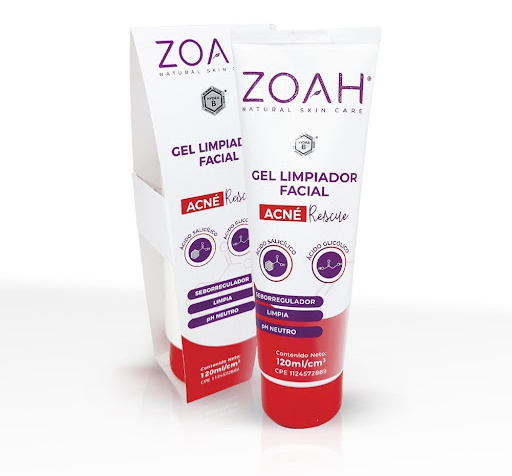
Ingredients overview
 INCI photo pending approval
Highlights
Key Ingredients
Skim through
ZOAH Limpiador Facial AcneIngredients explained
Good old water, aka H2O. The most common skincare ingredient of all. You can usually find it right in the very first spot of the ingredient list, meaning it’s the biggest thing out of all the stuff that makes up the product.
It’s mainly a solvent for ingredients that do not like to dissolve in oils but rather in water.
Once inside the skin, it hydrates, but not from the outside - putting pure water on the skin (hello long baths!) is drying.
One more thing: the water used in cosmetics is purified and deionized (it means that almost all of the mineral ions inside it is removed). Like this, the products can stay more stable over time.
Super common ingredient in all kinds of cleansing products: face and body washes, shampoos and foam baths.
Number one reason for its popularity has to do with bubbles. Everyone loves bubbles. And cocamidopropyl betaine is great at stabilizing them.
The other reason is that it’s mild and works very well combined with other cleansing agents and surfactants. The art of cleansing is usually to balance between properly cleansing but not over-cleansing and cocamidopropyl betaine is helpful in pulling off this balance right.
Oh, and one more nice thing: even though it’s synthetic it’s highly biodegradable.
More info on CAPB on Collins Beaty Pages.
- It's a helper ingredient that improves the freeze-thaw stability of products
- It's also a solvent, humectant and to some extent a penetration enhancer
- It has a bad reputation among natural cosmetics advocates but cosmetic scientists and toxicology experts do not agree (read more in the geeky details section)
- It's a super common and super debated skincare ingredient
- It has several benefits: great solvent, penetration enhancer, creates cosmetically elegant, light formulas, great astringent and antimicrobial
- It can be very drying if it's in the first few ingredients on an ingredient list
- Some experts even think that regular exposure to alcohol damages skin barrier and causes inflammation though it's a debated opinion (read more in geeky details tab)
It’s probably the most common cleansing ingredient of all. It’s usually the Chief Bubble Officer responsible for big bubbles in cleansing products through the foam it creates is a bit airy and loose and not as dense and luxurious as the foam created by infamous SLS.
As for mildness, it goes somewhere in the middle. It’s often confused with sodium lauryl sulfate (SLS), but they are absolutely not the same. The SLES molecule has a bigger water-soluble head part that makes it milder and much less irritating. It is considered absolutely ok in the amount used in cosmetic products, though if you are looking for a mild facial cleanser, you have better chances with a formula without SLES. For an average shower gel? SLES works just fine.
- It's one of the gold standard ingredients for treating problem skin
- It can exfoliate skin both on the surface and in the pores
- It's a potent anti-inflammatory agent
- It's more effective for treating blackheads than acne
- For acne combine it with antibacterial agents like benzoyl peroxide or azelaic acid
 We don't have description for this ingredient yet.
A controversial preservative that has formaldehyde-releasing properties. It works great against bacteria and also has mild fungicide abilities.
Cosmetic chemist, Colin wrote a great article about formaldehyde and DMDM Hydantoin. He writes that formaldehyde is the perfect example of "the dose makes the poison" principle. It's a natural stuff that can also be found in fresh fruits and vegetables, and eating it in tiny amounts is totally ok. However, in larger amounts (according to Wikipedia 30 mL of a solution containing 37% formaldehyde) it's deadly.
The amount of formaldehyde used in cosmetics either neat or through formaldehyde-releasing preservatives is tiny. Probably that is why the Cosmetic Ingredient Review Broad concluded both in 1988 and in 2008 that DMDM Hydantoin is "safe as used in cosmetics".
However, Colins argues that in the case of formaldehyde-releasing preservatives, formaldehyde is released slowly and the skin has probably not evolved to deal with that. The lingering formaldehyde might be toxic to the Langerhans Cells that are important for the skin's defense system. Another potential issue is that formaldehyde-releasers might also release other things while reacting with amino acids in the skin that is probably the explanation why some people are not allergic to formaldehyde but are allergic to formaldehyde-releasing preservatives. These are all theories, far from proven facts, but we feel that there are some justified reasons why formaldehyde-releasing preservatives and Dmdm Hydantoin count as controversial.
All in all, it's up to you to decide if you wanna avoid this preservative group or not. If so, there are other, less risky and more skin-friendly options out there.
The extract coming from the juice containing leaves of the Aloe vera plant. It's usually a hydroglycolic extract (though oil extract for the lipid parts also exists) that has similar moisturizing, emollient and anti-inflammatory properties as the juice itself. We have written some more about aloe here.
A little helper ingredient that is used to adjust the pH of the product. It also helps to keep products stay nice longer by neutralizing the metal ions in the formula (they usually come from water).
A handy helper ingredient (a polymer, i.e. big molecule from repeated subunits) that is used to stabilize emulsions as well as to thicken up products. It can also stabilize foam in cleansing products.
It’s pretty much the current IT-preservative. It’s safe and gentle, but even more importantly, it’s not a feared-by-everyone-mostly-without-scientific-reason paraben.
It’s not something new: it was introduced around 1950 and today it can be used up to 1% worldwide. It can be found in nature - in green tea - but the version used in cosmetics is synthetic.
Other than having a good safety profile and being quite gentle to the skin it has some other advantages too. It can be used in many types of formulations as it has great thermal stability (can be heated up to 85°C) and works on a wide range of pH levels (ph 3-10).
It’s often used together with ethylhexylglycerin as it nicely improves the preservative activity of phenoxyethanol.
The extract coming from the juice containing leaves of the Aloe vera plant. It's usually a hydroglycolic extract (though oil extract for the lipid parts also exists) that has similar moisturizing, emollient and anti-inflammatory properties as the juice itself. We have written some more about aloe here.
We don't have description for this ingredient yet.
Exactly what it sounds: nice smelling stuff put into cosmetic products so that the end product also smells nice. Fragrance in the US and parfum in the EU is a generic term on the ingredient list that is made up of 30 to 50 chemicals on average (but it can have as much as 200 components!).
If you are someone who likes to know what you put on your face then fragrance is not your best friend - there's no way to know what’s really in it.
Also, if your skin is sensitive, fragrance is again not your best friend. It’s the number one cause of contact allergy to cosmetics. It’s definitely a smart thing to avoid with sensitive skin (and fragrance of any type - natural is just as allergic as synthetic, if not worse!).
A fluid silicone that reduces surface tension. It can improve oil (or silicone) in water emulsions with faster absorption, better spreading, and a lighter feel.
An easy-to-formulate, commonly used, nice to have ingredient that’s also called pro-vitamin B5. As you might guess from the “pro” part, it’s a precursor to vitamin B5 (whose fancy name is pantothenic acid).
Its main job in skincare products is to moisturise the skin. It’s a humectant meaning that it can help the skin to attract water and then hold onto it. There is also research showing that panthenol can help our skin to produce more lovely lipids that are important for a strong and healthy skin barrier.
Another great thing about panthenol is that it has anti-inflammatory and skin protecting abilities. A study shows that it can reduce the irritation caused by less-nice other ingredients (e.g. fragrance, preservatives or chemical sunscreens) in the product.
Research also shows that it might be useful for wound healing as it promotes fibroblast (nice type of cells in our skin that produce skin-firming collagen) proliferation.
If that wasn’t enough panthenol is also useful in nail and hair care products. A study shows that a nail treatment liquide with 2% panthenol could effectively get into the nail and significantly increase the hydration of it.
As for the hair the hydration effect is also true there. Panthenol might make your hair softer, more elastic and helps to comb your hair more easily.
- It’s the most researched AHA with the most proven skin benefits
- It gently lifts off dead skin cells to reveal newer, fresher, smoother skin
- It can help skin’s own collagen production that results in firmer, younger skin
- It can fade brown spots caused by sun damage or PIH
- Choose a product where you know the concentration and pH value because these two greatly influence effectiveness
- Don’t forget to use your sunscreen (in any case but especially so next to an AHA product)
- Slight stinging or burning with a stronger AHA product is normal
- If your skin is very sensitive, rosacea prone choose rather a BHA or PHA product
An abbreviation that pops up on a lot of ingredient lists. It stands for EthyleneDiamineTetraacetic Acid and it's a famous molecule for being an excellent chelating agent, i.e. a molecule that can bind to metal ions (coming usually from water) and make them harmless in a cosmetic formula. With a chelating agent, cosmetic formulas stay nice longer.
EDTA is an acid molecule and its salt versions are even more often used, such as the super common Disodium EDTA.
You may also want to take a look at...
| what‑it‑does | solvent |
| what‑it‑does | surfactant/cleansing |
| what‑it‑does | moisturizer/humectant | solvent |
| irritancy, com. | 0, 0 |
| what‑it‑does | antimicrobial/antibacterial | solvent | viscosity controlling |
| what‑it‑does | surfactant/cleansing | emulsifying |
| what‑it‑does | exfoliant | anti-acne | soothing | preservative |
| what‑it‑does | emulsifying | surfactant/cleansing | viscosity controlling |
| irritancy, com. | 0, 2 |
| what‑it‑does | preservative |
| what‑it‑does | soothing | emollient | moisturizer/humectant |
| what‑it‑does | chelating | buffering |
| what‑it‑does | surfactant/cleansing | viscosity controlling |
| irritancy, com. | 0, 1 |
| what‑it‑does | preservative |
| what‑it‑does | soothing | emollient | moisturizer/humectant |
| what‑it‑does | antimicrobial/antibacterial |
| what‑it‑does | perfuming |
| what‑it‑does | soothing | moisturizer/humectant |
| irritancy, com. | 0, 0 |
| what‑it‑does | exfoliant | buffering |
| what‑it‑does | chelating |