




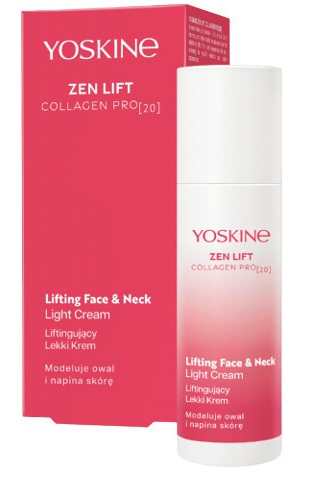
Zen Lift Lifting Face & Neck Light Cream
Ingredients overview
Highlights
Key Ingredients
Skim through
YOSKINE Zen Lift Lifting Face & Neck Light CreamIngredients explained
Good old water, aka H2O. The most common skincare ingredient of all. You can usually find it right in the very first spot of the ingredient list, meaning it’s the biggest thing out of all the stuff that makes up the product.
It’s mainly a solvent for ingredients that do not like to dissolve in oils but rather in water.
Once inside the skin, it hydrates, but not from the outside - putting pure water on the skin (hello long baths!) is drying.
One more thing: the water used in cosmetics is purified and deionized (it means that almost all of the mineral ions inside it is removed). Like this, the products can stay more stable over time.
- A natural moisturizer that’s also in our skin
- A super common, safe, effective and cheap molecule used for more than 50 years
- Not only a simple moisturizer but knows much more: keeps the skin lipids between our skin cells in a healthy (liquid crystal) state, protects against irritation, helps to restore barrier
- Effective from as low as 3% with even more benefits for dry skin at higher concentrations up to 20-40%
- High-glycerin moisturizers are awesome for treating severely dry skin
A super common, waxy, white, solid stuff that helps water and oil to mix together, gives body to creams and leaves the skin feeling soft and smooth.
Chemically speaking, it is the attachment of a glycerin molecule to the fatty acid called stearic acid. It can be produced from most vegetable oils (in oils three fatty acid molecules are attached to glycerin instead of just one like here) in a pretty simple, "green" process that is similar to soap making. It's readily biodegradable.
It also occurs naturally in our body and is used as a food additive. As cosmetic chemist Colins writes it, "its safety really is beyond any doubt".
An emollient ester (oily liquid from Isostearyl Alcohol + Isostearic Acid) that gives excellent slip, lubricity and luxurious softness on skin. It's also popular in makeup products to disperse pigments nicely and evenly.
Unless you live under a rock you must have heard about shea butter. It's probably the most hyped up natural butter in skincare today. It comes from the seeds of African Shea or Karite Trees and used as a magic moisturizer and emollient.
But it's not only a simple emollient, it regenerates and soothes the skin, protects it from external factors (such as UV rays or wind) and is also rich in antioxidants (among others vitamin A, E, F, quercetin and epigallocatechin gallate). If you are looking for rich emollient benefits + more, shea is hard to beat.
 We don't have description for this ingredient yet.
A small, three amino acid (glycine-histidine-lysine or GHK) peptide that is famous for being a type I collagen fragment. The theory behind collagen-fragment peptides is that when collagen naturally breaks down in the skin, the resulting peptide fragments signal to the skin that it should get to work and create some nice, new collagen.
Adding in collagen fragment peptides, like GHK, might trick the skin into thinking that collagen has broken down and it's time to create some more. So Tripeptide-1 is believed to be able to stimulate collagen production in the skin, and more collagen means fewer wrinkles and younger looking skin. FYI; Tripeptide-1 is the same peptide that can be found in the famous Matrixyl 3000, but in Matrixyl a palmitic acid is attached to it to increase its oil solubility and thus skin penetration.
Another reason why Tripeptide-1 is especially famous is that it is not only a signal peptide but also a so-called carrier peptide that helps to stabilize and deliver copper in the skin. It has a high affinity for copper ions and likes to form a complex with them called Copper-Tripeptide-1 or GHK-Cu. GHK-Cu is a famous and well-researched peptide that does a bunch of things in the skin and we have a shiny explanation about it here.
As for Tripeptide-1 in and of itself, without a palmitic acid or copper attached to it, it goes by the trade name Kollaren and according to the manufacturer, it not only stimulates collagen but also other essential skin proteins such as fibronectin, elastin, and laminin. Kollaren is also claimed to be beneficial for acne-prone skin as it can boost tissue repair and thus help acne scars to heal faster.
An anti-aging peptide that can visibly reduce the length and depth of wrinkles, at least according to its manufacturer. In vitro (meaning it was done in the lab, not on real people) studies show that it enhances epidermal regeneration, collagen type I and III synthesis as well as the synthesis of other important skin proteins.
We don't have description for this ingredient yet.
It's a super small, chemically chopped up version of sodium hyaluronate. Its trade name is miniHA, and its molecular weight is 10 kDa. This counts as really tiny given that "normal" HA has a molecular weight of 0.5-2 million Da.
To be honest, low molecular weight (LMW), and especially this ultra-low molecular weight HA is a controversial ingredient. On the upside, it can penetrate the skin better (though 10kDa still counts as big!) and might be able to moisturize the deeper layers of the skin where normal HA cannot get. Also, according to the manufacturer of miniHA, it has better antioxidant activity than a 1.6MDa version HA and it also has better sun protection and after-sun repair abilities than the higher MW versions. It also works in synergy with higher molecular weight versions, and the combination of 0.1% 1.45MDa-HA + 0.1% 380 kDa-HA + 0.1% miniHA hydrated the skin significantly better than 0.3% 1.45MDa-HA alone.
On the downside, the biological role of LMW-HA in the skin is being a pro-inflammatory signaling agent and there is a study by another manufacturer called Evonik showing that HA versions with smaller than 50kDa molecular weight might be pro-inflammatory when put on the skin. Granted, the study was only done on reconstituted human epidermis, so it might or might not be like this on real human skin.
If you wanna get confused and read much more about hyaluronic acid and what the different molecular weight versions might or might not do, click here and read our excruciatingly long description.
We don't have description for this ingredient yet.
We don't have description for this ingredient yet.
An extract coming from red algae that's rich in milk sugar polysaccharide called galactan. According to the manufacturer, it can stimulate the telosomic protein expression thus limiting the shortening of telomeres.
Telomeres are like the plastic tips at the end of shoelaces: they give a protective ending to the DNA strands. The problem is that they get shorter and shorter with chromosome replication and after a while, they cannot protect the DNA strands anymore so DNA gets damaged and our cells cannot do their job. Based on this theory, it's believed that limiting the shortening of telomeres can maintain skin cell longevity and delay the skin aging process.
The in-vitro (in the lab) tests by the manufacturer showed that 0.5% Telesomyl on pre-senescence human fibroblasts reduced stress-induced telomeres shortening by 65%. The in-vivo (on people) tests showed that after 42 days, Telesomyl improved the appearance of the dermal matrix by 30.2%, smoothed the skin’s surface around the crow’s feet area, and improved the perceived age of the panellists by 3 years.
We don't have description for this ingredient yet.
A cellulose (the big molecule found in the cell wall of green plants) derivative that is used as an emulsion stabilizer and thickener.
A white powdery thing that's the major component of glass and sand. In cosmetics, it’s often in products that are supposed to keep your skin matte as it has great oil-absorbing abilities. It’s also used as a helper ingredient to thicken up products or suspend insoluble particles.
A common functional ingredient that helps to keep the oil-loving and water-loving ingredients together (emulsifier), stabilizes and thickens the products.
Chemically speaking, it is ethoxylated Cetearyl alcohol, meaning that some ethylene oxide is added to the fatty alcohol to increase the water-soluble part in the molecule. The result is that the mainly oil soluble, emollient fatty alcohol is converted to an emulsifier molecule that keeps oil and water mixed in creams. The number in the name of Ceteareth emulsifiers refers to the average number of ethylene oxide molecules added and 20 makes a good emulsifier.
A handy multi-tasker, white to light yellowish oil-loving wax that works very well in oil-in-water emulsions. It makes your skin feel nice and smooth (emollient), stabilizes oil-water mixes and gives body to them.
Oh, and one more thing: it's a so-called fatty alcohol - the good, emollient type of alcohol that is non-drying and non-irritating. It is often mixed with fellow fatty alcohol, Cetyl Alcohol, and the mixture is called Cetearyl Alcohol in the ingredient list.
We don't have description for this ingredient yet.
A multi-functional, silky feeling helper ingredient that can do quite many things. It's used as an emulsion stabilizer, solvent and a broad spectrum antimicrobial. According to manufacturer info, it's also a moisturizer and helps to make the product feel great on the skin. It works synergistically with preservatives and helps to improve water-resistance of sunscreens.
We don't have description for this ingredient yet.
Super common little helper ingredient that helps products to remain nice and stable for a longer time. It does so by neutralizing the metal ions in the formula (that usually get into there from water) that would otherwise cause some not so nice changes.
It is typically used in tiny amounts, around 0.1% or less.
It’s pretty much the current IT-preservative. It’s safe and gentle, but even more importantly, it’s not a feared-by-everyone-mostly-without-scientific-reason paraben.
It’s not something new: it was introduced around 1950 and today it can be used up to 1% worldwide. It can be found in nature - in green tea - but the version used in cosmetics is synthetic.
Other than having a good safety profile and being quite gentle to the skin it has some other advantages too. It can be used in many types of formulations as it has great thermal stability (can be heated up to 85°C) and works on a wide range of pH levels (ph 3-10).
It’s often used together with ethylhexylglycerin as it nicely improves the preservative activity of phenoxyethanol.
A handy multifunctional ingredient that works as a preservative booster, as well as an antioxidant and soothing agent.
If you have spotted ethylhexylglycerin on the ingredient list, most probably you will see there also the current IT-preservative, phenoxyethanol. They are good friends because ethylhexylglycerin can boost the effectiveness of phenoxyethanol (and other preservatives) and as an added bonus it feels nice on the skin too.
Also, it's an effective deodorant and a medium spreading emollient.
We don't have description for this ingredient yet.
Exactly what it sounds: nice smelling stuff put into cosmetic products so that the end product also smells nice. Fragrance in the US and parfum in the EU is a generic term on the ingredient list that is made up of 30 to 50 chemicals on average (but it can have as much as 200 components!).
If you are someone who likes to know what you put on your face then fragrance is not your best friend - there's no way to know what’s really in it.
Also, if your skin is sensitive, fragrance is again not your best friend. It’s the number one cause of contact allergy to cosmetics. It’s definitely a smart thing to avoid with sensitive skin (and fragrance of any type - natural is just as allergic as synthetic, if not worse!).
You may also want to take a look at...
| what‑it‑does | solvent |
| what‑it‑does | skin-identical ingredient | moisturizer/humectant |
| irritancy, com. | 0, 0 |
| what‑it‑does | emollient | emulsifying |
| irritancy, com. | 0, 1 |
| what‑it‑does | emollient |
| irritancy, com. | 1, 4 |
| what‑it‑does | emollient |
| what‑it‑does | emollient |
| what‑it‑does | emollient |
| what‑it‑does | viscosity controlling |
| what‑it‑does | cell-communicating ingredient |
| what‑it‑does | cell-communicating ingredient |
| what‑it‑does | moisturizer/humectant |
| what‑it‑does | cell-communicating ingredient |
| what‑it‑does | viscosity controlling |
| irritancy, com. | 0, 0 |
| what‑it‑does | viscosity controlling |
| what‑it‑does | emulsifying | surfactant/cleansing |
| irritancy, com. | 3, 2 |
| what‑it‑does | emollient | viscosity controlling | emulsifying | surfactant/cleansing |
| irritancy, com. | 2, 2 |
| what‑it‑does | surfactant/cleansing | emulsifying |
| what‑it‑does | solvent | moisturizer/humectant |
| what‑it‑does | antioxidant |
| what‑it‑does | chelating |
| what‑it‑does | preservative |
| what‑it‑does | antioxidant | preservative |
| what‑it‑does | perfuming |
| what‑it‑does | preservative |
| what‑it‑does | perfuming |
| what‑it‑does | perfuming |