




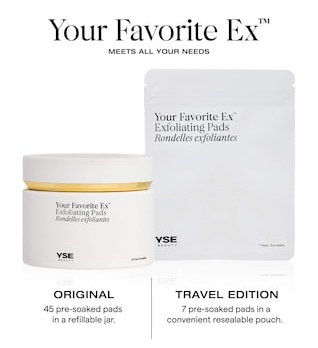
Your Favorite Ex Smoothing Exfoliating Pads
Ingredients overview
Highlights
Key Ingredients
Other Ingredients
Skim through
YISE Beauty Your Favorite Ex Smoothing Exfoliating PadsIngredients explained
Good old water, aka H2O. The most common skincare ingredient of all. You can usually find it right in the very first spot of the ingredient list, meaning it’s the biggest thing out of all the stuff that makes up the product.
It’s mainly a solvent for ingredients that do not like to dissolve in oils but rather in water.
Once inside the skin, it hydrates, but not from the outside - putting pure water on the skin (hello long baths!) is drying.
One more thing: the water used in cosmetics is purified and deionized (it means that almost all of the mineral ions inside it is removed). Like this, the products can stay more stable over time.
- It’s the most researched AHA with the most proven skin benefits
- It gently lifts off dead skin cells to reveal newer, fresher, smoother skin
- It can help skin’s own collagen production that results in firmer, younger skin
- It can fade brown spots caused by sun damage or PIH
- Choose a product where you know the concentration and pH value because these two greatly influence effectiveness
- Don’t forget to use your sunscreen (in any case but especially so next to an AHA product)
- Slight stinging or burning with a stronger AHA product is normal
- If your skin is very sensitive, rosacea prone choose rather a BHA or PHA product
- It’s a polyhydroxy acid (PHA), that is often referred to as next generation AHA
- It gently lifts off dead skin cells form the skin surface making skin smooth and even
- In the long term it provides anti-aging benefits, like increased skin thickness and decreased wrinkles (though a tad less than even more proven superstar AHAs)
- It’s a great moisturizer and even helps to repair impaired skin barrier
- It’s antioxidant, and does not make your skin more sensitive to the sun
- It can be used even if your skin is very sensitive, rosacea prone or if you are post cosmetic procedure
Propanediol is a natural alternative for the often used and often bad-mouthed propylene glycol. It's produced sustainably from corn sugar and it's Ecocert approved.
It's quite a multi-tasker: can be used to improve skin moisturization, as a solvent, to boost preservative efficacy or to influence the sensory properties of the end formula.
A multi-functional, silky feeling helper ingredient that can do quite many things. It's used as an emulsion stabilizer, solvent and a broad spectrum antimicrobial. According to manufacturer info, it's also a moisturizer and helps to make the product feel great on the skin. It works synergistically with preservatives and helps to improve water-resistance of sunscreens.
A nice odorless liquid used mainly as a superior solubilizer and efficacy booster for cosmetic active ingredients such as skincare bigshot vitamin C, self-tanning active DHA or the anti-acne gold standard, benzoyl peroxide.
Other than that it can also be used in hair care products where it gives a longer-lasting and more uniform coloring. According to a manufacturer, it might even prevent the formation of split ends.
The unfancy name for it is lye. It’s a solid white stuff that’s very alkaline and used in small amounts to adjust the pH of the product and make it just right.
For example, in case of AHA or BHA exfoliants, the right pH is super-duper important, and pH adjusters like sodium hydroxide are needed.
BTW, lye is not something new. It was already used by ancient Egyptians to help oil and fat magically turn into something else. Can you guess what? Yes, it’s soap. It still often shows up in the ingredient list of soaps and other cleansers.
Sodium hydroxide in itself is a potent skin irritant, but once it's reacted (as it is usually in skin care products, like exfoliants) it is totally harmless.
Ectoin is a surprisingly well-researched, multi-functional active that can do from pollution & light protection to skin hydration, soothing, and barrier repair, several things to your skin.
It is an extremolyte, a small stress-protection molecule that protects microorganisms living under extreme conditions such as salt lakes, hot springs, arctic ice, the deep sea, or deserts. It was discovered in 1985 in a microorganism living in a salt lake in the Egyptian desert.
The key skill of Ectoin is protection that applies also to the skin. Its main mode of action is binding water molecules (aka kosmotropic) and creating hydro complexes. These complexes then surround important biomolecules (e.g. cells, proteins, enzymes) and form a stabilizing hydration shell around them.
This protection mechanism means good things when it comes to our skin: Ectoin has antioxidant, anti-inflammatory, pollution& light protecting, skin hydrating, barrier repairing as well as anti-aging properties.
A placebo-controlled 10-person study examined a four-week treatment with 0.5% Ectoin in the crow's feet area and found a significant anti-wrinkle effect (-19% mean wrinkle depth) in 100% of the participants. Another double-blind, placebo-controlled clinical study with 24 participants used a 2% Ectoin cream twice a day for 4 weeks and found an improvement in all of the measured parameters, such as wrinkle volume, skin scaling, roughness, and elasticity.
Another remarkable property of Ectoin is protecting the epidermal immune cells called Langerhans cells from UV damage. 0.3% and 0.5% Ectoin cream was used twice a day for 14 days on the forearm and then irradiated with 1.5 MED UV (one and a half times the UV dose that causes detectable redness). While the untreated, UV-stressed area showed a 40% decrease in viable Langerhans cells, 0.5% Ectoin showed 100% protection (and 0.3% showed ~95% protection).
The soothing efficacy is also backed up by multiple in-vivo studies. A 20-person study compared 1% Ectoin cream to 0.25% hydrocortisone treatment on surfactant irritated skin and found similar effectiveness in reducing skin redness. Another study with 23 females with sensitive skin found that a 1% Ectoin cream helped to tolerate a 0.5% or 1% retinol treatment much better.
A tiny, 5-person study examined the long-term (7 days) skin hydration effect of 1% Ectoin. During the study, hydration levels increased up to 200% compared to placebo, and even 7 days after stopping the treatment hydration status was largely preserved. Higher concentration (5-7%) Ectoin treatments are also used as OTC medical products for the treatment of eczema or atopic skin.
The anti-pollution magic properties are also well-established and Ectoin is currently the only anti-pollution active ingredient approved for use in medical products (e.g. inhalation solutions) in Europe. Clinical studies showed a reduction of inflammations in human lungs of patients with COPD (a pulmonary disease) and pollution-induced asthma. But coming back to the skin, Ectoin protects both from PMs (Particulate Matters, including ultrafine) as well as PAHs (Polycyclic Aromatic Hydrocarbons) and heavy metals.
If that weren't enough, Ectoin is also shown to protect the skin from blue and visible light, and pigmentation resulting from environmental stress (think UV, pollution, oxidative stress).
All in all, we think Ectoin is one of those under-the-radar actives that deserves more hype than it is currently getting. As an amazing all-around skin protectant, it is a useful addition to any skincare routine.
It's a liquid extract coming from grape. According to manufacturer info, it's a skin peeling agent, aka exfoliant, that contains a nice mix of AHA acids (if those magic three letters do not tell you anything, you must click here now.)
About 40% of the extract is a mix of tartaric, malic, lactic, citric and gluconic acid and they work to gently lift off dead skin cells to reveal nicer fresher skin underneath. The manufacturer also claims that the exfoliation with grape juice extract is very well tolerated and depending on the concentration the result can be soft or even strong exfoliation.
 We don't have description for this ingredient yet.
We don't have description for this ingredient yet.
We don't have description for this ingredient yet.
Cucumber is a nice, non-irritating plant extract that’s known for it’s soothing and emollient properties. It’s not something new to put it on our face: even Cleopatra used it to “preserve her skin”.
It’s commonly believed that cucumber is the answer to puffy eyes, but there is no research confirming this. What research does confirm is that it contains amino acids and organic acids that’s helpful for the skin’s acid mantle. There is also an enzyme (called shikimate dehydrigenase) in the pulp that’s shown to have anti-inflammatory properties.
We don't have description for this ingredient yet.
We don't have description for this ingredient yet.
We don't have description for this ingredient yet.
Apple needs no introduction as one of the most common fruits on planet Earth. It's not only a healthy fruit snack, it's also a goodie if you put in all over your face.
It's loaded with proteins, starch, sugars, acids, vitamins and salts. The sugars (mainly fructose, glucose, sucrose) give apple fruit extract nice moisturizing and smoothing properties, while the acids (mainly malic and gallic acid) give it mild exfoliant, skin brightening and antibacterial properties.
We don't have description for this ingredient yet.
We don't have description for this ingredient yet.
We don't have description for this ingredient yet.
We don't have description for this ingredient yet.
You may also want to take a look at...
| what‑it‑does | solvent |
| what‑it‑does | exfoliant | buffering |
| what‑it‑does | exfoliant | chelating |
| what‑it‑does | solvent | moisturizer/humectant |
| what‑it‑does | solvent | moisturizer/humectant |
| what‑it‑does | solvent | moisturizer/humectant | perfuming |
| irritancy, com. | 0, 0 |
| what‑it‑does | buffering |
| what‑it‑does | antioxidant | soothing | moisturizer/humectant |
| what‑it‑does | exfoliant | antioxidant |
| what‑it‑does | moisturizer/humectant |
| what‑it‑does | moisturizer/humectant |
| what‑it‑does | soothing | emollient |
| what‑it‑does | perfuming |
| what‑it‑does | emollient |
| what‑it‑does | moisturizer/humectant |
| what‑it‑does | perfuming | viscosity controlling |
| what‑it‑does | chelating |
| what‑it‑does | emulsifying | surfactant/cleansing |