




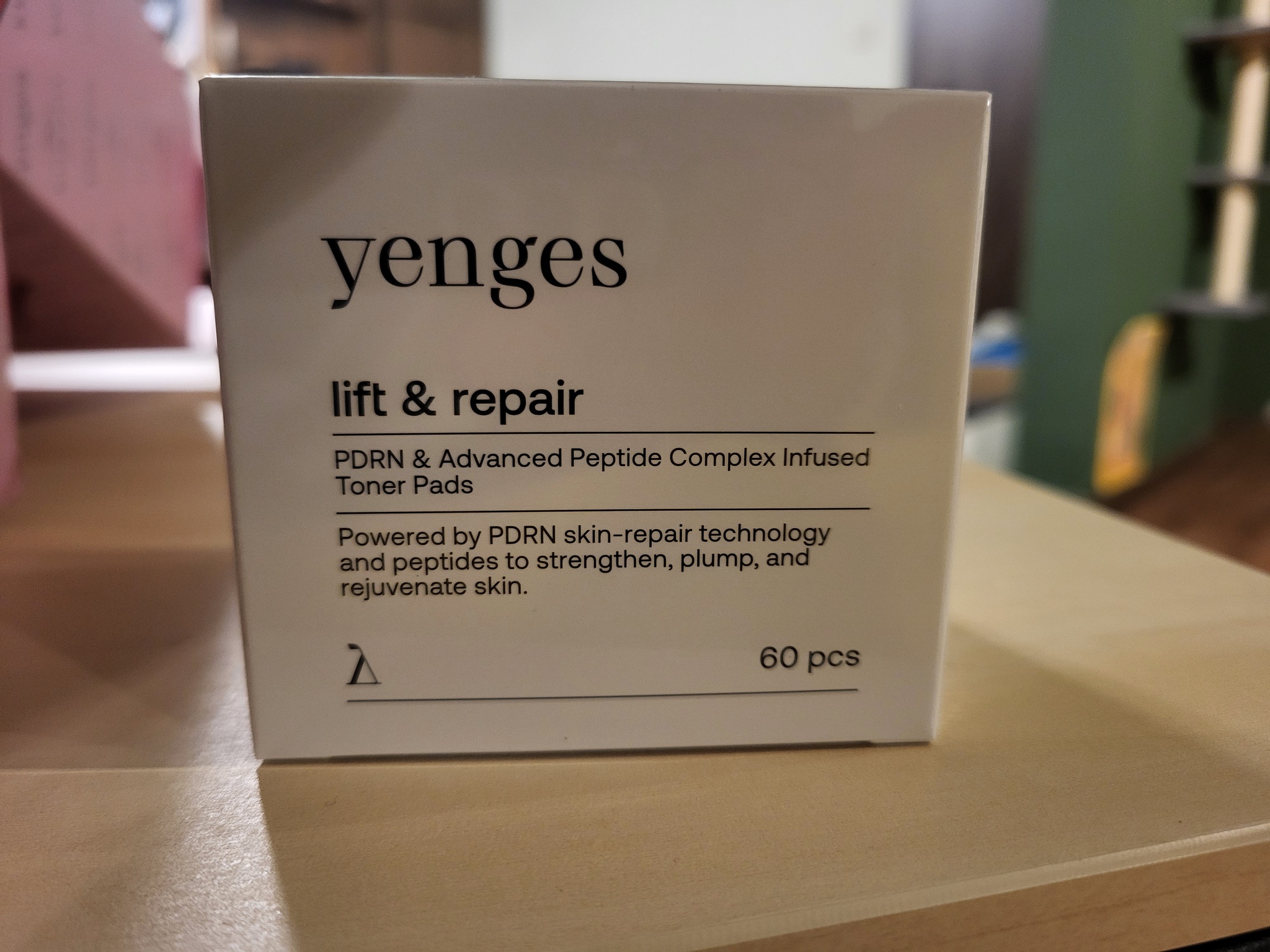
Ingredients overview
 INCI photo pending approval
Highlights
Key Ingredients
Skim through
Yenges Lift & RepairIngredients explained
Good old water, aka H2O. The most common skincare ingredient of all. You can usually find it right in the very first spot of the ingredient list, meaning it’s the biggest thing out of all the stuff that makes up the product.
It’s mainly a solvent for ingredients that do not like to dissolve in oils but rather in water.
Once inside the skin, it hydrates, but not from the outside - putting pure water on the skin (hello long baths!) is drying.
One more thing: the water used in cosmetics is purified and deionized (it means that almost all of the mineral ions inside it is removed). Like this, the products can stay more stable over time.
- A natural moisturizer that’s also in our skin
- A super common, safe, effective and cheap molecule used for more than 50 years
- Not only a simple moisturizer but knows much more: keeps the skin lipids between our skin cells in a healthy (liquid crystal) state, protects against irritation, helps to restore barrier
- Effective from as low as 3% with even more benefits for dry skin at higher concentrations up to 20-40%
- High-glycerin moisturizers are awesome for treating severely dry skin
- A multi-functional skincare superstar with several proven benefits for the skin
- Great anti-aging, wrinkle smoothing ingredient used at 4-5% concentration
- Fades brown spots alone or in combination with amino sugar, acetyl glucosamine
- Increases ceramide synthesis that results in a stronger, healthier skin barrier and better skin hydration
- Can help to improve several skin conditions including acne, rosacea, and atopic dermatitis
A derivative of Urea, that works as a strong moisturizer and humectant meaning that it helps the skin to cling onto water and thus to make it hydrated and elastic.
According to manufacturer's data, Hydroxyethyl Urea has a similar moisturizing ability to glycerin (measured at 5%), but it feels nicer on the skin as it is non-sticky and non-tacky and gives a lubricous and moist feeling to the skin.
An easy-to-formulate, commonly used, nice to have ingredient that’s also called pro-vitamin B5. As you might guess from the “pro” part, it’s a precursor to vitamin B5 (whose fancy name is pantothenic acid).
Its main job in skincare products is to moisturise the skin. It’s a humectant meaning that it can help the skin to attract water and then hold onto it. There is also research showing that panthenol can help our skin to produce more lovely lipids that are important for a strong and healthy skin barrier.
Another great thing about panthenol is that it has anti-inflammatory and skin protecting abilities. A study shows that it can reduce the irritation caused by less-nice other ingredients (e.g. fragrance, preservatives or chemical sunscreens) in the product.
Research also shows that it might be useful for wound healing as it promotes fibroblast (nice type of cells in our skin that produce skin-firming collagen) proliferation.
If that wasn’t enough panthenol is also useful in nail and hair care products. A study shows that a nail treatment liquide with 2% panthenol could effectively get into the nail and significantly increase the hydration of it.
As for the hair the hydration effect is also true there. Panthenol might make your hair softer, more elastic and helps to comb your hair more easily.
This awfully long named ingredient is, in fact, a pretty small molecule. It's a tripeptide (a three amino acid peptide) with molecular weight less than 500 Da, meaning that it's small enough to penetrate nicely and easily into the skin.
It belongs to the "Botox in a jar" type of peptides (similar to Argireline or Leuphasyl) targeting wrinkles caused by facial movements, like laughter lines or crow’s feet. According to the manufacturer's in-vivo (made on real people) studies, 4% Syn-Ake used for 28 days resulted in 21% smoother and 15-20% less wrinkled skin with max values up to 52%. The smoothing effect was measurable on 80% of the volunteers, while the wrinkle reduction effect was evident on 73%.
A four amino acid peptide with the amino sequence of glycine-glutamine-proline-arginine. It is attached to palmitic acid (a fatty acid) to increase oil solubility and skin penetration.
It works by reducing the production of the signal molecule, interleukin-6 (IL-6) which promotes inflammation in the skin and less inflammation means slower degradation of important things (like collagen) that results in younger looking skin for a longer time.
It works in synergy with its pal, Palmitoyl Tripeptide-1 in the famous Matrixyl 3000 complex. You can read some more about the famous duo here.
Centella Asiatica - or sometimes also called Gotu Kola or Cica - has been used in folk medicine for hundreds of years. It’s traditionally used to improve small wounds, burns and scratches and it’s also a well known anti-inflammatory agent for eczema.
Recently science has taken an interest in Gotu Kola as well and it turns out it really has many active compounds with several benefits. Just for hard-core geeks, the main biologically active compounds are pentacyclic triterpenoid saponins called asiaticoside, madecassoside, asiatic and madecassic acid (also called centellosides).
One of the biological activities of the centellosides is to be able to stimulate GAGs (glycosaminoglycans - polysaccharides that are part of the liquidy stuff between our skin cells), and especially hyaluronic acid synthesis in our skin. This is probably one of the reasons why Centella Asiatica Extract has nice skin moisturizing properties that was confirmed by a 25 people, four weeks study along with Centella's anti-inflammatory effects.
Madecassoside can also help in burn wound healing through increasing antioxidant activity and enhancing collagen synthesis. Asiaticoside was shown to increase antioxidant levels on rats skin when applied at 0.2%.
Centella Asiatica also often shows up in products that try to treat cellulite or striae. Of course, it cannot make a miracle but it might have some effect via regulating microcirculation and normalizing the metabolism in the cells of connective tissues.
Bottom line: Gotu Kola is a great plant ingredient with proven wound healing, anti-inflammatory, and antioxidant properties. Nice to spot on any ingredient list.
 We don't have description for this ingredient yet.
A really multi-functional helper ingredient that can do several things in a skincare product: it can bring a soft and pleasant feel to the formula, it can act as a humectant and emollient, it can be a solvent for some other ingredients (for example it can help to stabilize perfumes in watery products) and it can also help to disperse pigments more evenly in makeup products. And that is still not all: it can also boost the antimicrobial activity of preservatives.
It’s pretty much the current IT-preservative. It’s safe and gentle, but even more importantly, it’s not a feared-by-everyone-mostly-without-scientific-reason paraben.
It’s not something new: it was introduced around 1950 and today it can be used up to 1% worldwide. It can be found in nature - in green tea - but the version used in cosmetics is synthetic.
Other than having a good safety profile and being quite gentle to the skin it has some other advantages too. It can be used in many types of formulations as it has great thermal stability (can be heated up to 85°C) and works on a wide range of pH levels (ph 3-10).
It’s often used together with ethylhexylglycerin as it nicely improves the preservative activity of phenoxyethanol.
A really famous peptide that is part of Matrixyl 3000, the most sold peptide complex in the word. Before we go and find out what the big deal with Matrixyl 3000 is, let's just focus on Palmitoyl Tripeptide-1 itself for a bit.
It's a small three amino acid (they are the building blocks of all proteins) peptide with the amino sequence of glycine-histidine-lysine, or GHK. GHK is attached to palmitic acid (a fatty acid) to increase oil solubility and skin penetration.
The GHK part is the important one as it's a type I collagen fragment. When collagen naturally breaks down in the skin, the resulting peptide fragments signal to the skin that it should get to work and create some nice, new collagen. Adding in collagen fragment peptides, like GHK, might trick the skin into thinking that collagen has broken down and it's time to create some more.
Therefore, Palmitoyl Tripeptide-1 is believed to be able to stimulate collagen production in the skin, and more collagen means fewer wrinkles and younger looking skin.
In Matrixyl 3000, Palmitoyl Tripeptide-1 is coupled with Palmitoyl Tetrapeptide-7 and the duo works in synergy to reduce wrinkles and give younger looking skin. According to the manufacturer's in-vivo (made on real people) test, applying 3% Matrixyl 3000 twice a day for 2 months resulted in all of the following things:
- 39.4% reduction in surface occupied by deep wrinkles
- 32.9% reduction in main wrinkle density
- 19.9% reduction in main wrinkle average depth
- 16% improvement in roughness
- 16.2% in lifting effect
- 5.5% improvement in elasticity
- 15.5% improvement in skin tone
Manufacturer results, of course, always have to be taken with a pinch of salt, but if you like peptides, the Matryxil 3000 duo is one of the best-proven and most well-known ones and it's something that is worth trying.
Super common soothing ingredient. It can be found naturally in the roots & leaves of the comfrey plant, but more often than not what's in the cosmetic products is produced synthetically.
It's not only soothing but it' also skin-softening and protecting and can promote wound healing.
The big and important protein molecule that usually comes from animal skin such as fish or bovine. The gist of the "collagen in topical skincare" subject is to know that collagen in a jar has nothing to do with wrinkles but everything to do with skin hydration. We have a shiny explanation about this at soluble collagen, so click here to read more >>
- Green tea is one of the most researched natural ingredients
- The active parts are called polyphenols, or more precisely catechins (EGCG being the most abundant and most active catechin)
- There can be huge quality differences between green tea extracts. The good ones contain 50-90% catechins (and often make the product brown and give it a distinctive smell)
- Green tea is proven to be a great antioxidant, UV protectant, anti-inflammatory, anticarcinogenic and antimicrobial
- Because of these awesome properties green tea is a great choice for anti-aging and also for skin diseases including rosacea, acne and atopic dermatitis
We don't have description for this ingredient yet.
A tripeptide (three amino acids attached to each other: Lys-Val-Lys) that's claimed to protect and boost collagen and improve skin texture.
The manufacturer did an in-vivo (made on real people) study with 45 volunteers and found that used twice daily for 84 days 1% and 2.5% Syn-Coll reduces the appearance of wrinkles by 7 and 12% respectively. In another study (also by the manufacturer) with 33 female Chinese volunteers, 77% of the participants felt that Syn-Coll visibly improved the firmness and elasticity of the skin after 4 weeks. What's more, 60% of the participants also noticed a reduction in the look of the pore size also after 4 weeks of treatment.
A nice little helper ingredient that can thicken up cosmetic products and create beautiful gel formulas. It's derived from cellulose, the major component of the cell wall of green plants. It is compatible with most co-ingredients and gives a very good slip to the formulas.
Sodium chloride is the fancy name of salt. Normal, everyday table salt.
If (similar to us) you are in the weird habit of reading the label on your shower gel while taking a shower, you might have noticed that sodium chloride is almost always on the ingredient list. The reason for this is that salt acts as a fantastic thickener in cleansing formulas created with ionic cleansing agents (aka surfactants) such as Sodium Laureth Sulfate. A couple of percents (typically 1-3%) turns a runny surfactant solution into a nice gel texture.
If you are into chemistry (if not, we understand, just skip this paragraph), the reason is that electrolytes (you know, the Na+ and Cl- ions) screen the electrostatic repulsion between the head groups of ionic surfactants and thus support the formation of long shaped micelles (instead of spherical ones) that entangle like spaghetti, and viola, a gel is formed. However, too much of it causes the phenomenon called "salting out", and the surfactant solution goes runny again.
Other than that, salt also works as an emulsion stabilizer in water-in-oil emulsions, that is when water droplets are dispersed in the outer oil (or silicone) phase. And last but not least, when salt is right at the first spot of the ingredient list (and is not dissolved), the product is usually a body scrub where salt is the physical exfoliating agent.
It’s the - sodium form - cousin of the famous NMF, hyaluronic acid (HA). If HA does not tell you anything we have a super detailed, geeky explanation about it here. The TL; DR version of HA is that it's a huge polymer (big molecule from repeated subunits) found in the skin that acts as a sponge helping the skin to hold onto water, being plump and elastic. HA is famous for its crazy water holding capacity as it can bind up to 1000 times its own weight in water.
As far as skincare goes, sodium hyaluronate and hyaluronic acid are pretty much the same and the two names are used interchangeably. As cosmetic chemist kindofstephen writes on reddit "sodium hyaluronate disassociates into hyaluronic acid molecule and a sodium atom in solution".
In spite of this, if you search for "hyaluronic acid vs sodium hyaluronate" you will find on multiple places that sodium hyaluronate is smaller and can penetrate the skin better. Chemically, this is definitely not true, as the two forms are almost the same, both are polymers and the subunits can be repeated in both forms as much as you like. (We also checked Prospector for sodium hyaluronate versions actually used in cosmetic products and found that the most common molecular weight was 1.5-1.8 million Da that absolutely counts as high molecular weight).
What seems to be a true difference, though, is that the salt form is more stable, easier to formulate and cheaper so it pops up more often on the ingredient lists.
If you wanna become a real HA-and-the-skin expert you can read way more about the topic at hyaluronic acid (including penetration-questions, differences between high and low molecular weight versions and a bunch of references to scientific literature).
If you see a cosmetic product that claims that it has "Botox-like effect" then two things are almost certain: one, the product overpromises and two, it contains Argireline.
So this one is the famous peptide that's marketed by its manufacturer as the "Botox in a jar". The basis for this claim is that it targets the same wrinkle forming mechanism (wrinkles caused by facial muscle movement) as Botox, but the way it works is very different. In addition, the extent to which it can prevent muscles from contracting (and to smooth wrinkles) is very different (otherwise why would anyone use still Botox?).
The manufacturer did several studies to prove that Argireline really works and it does (just not as well as Botox). In-vivo (made on real people) tests showed that using 10% Argireline solution around the eyes for 15 days decreased wrinkles depth by 17%, while a 5% Argireline formula applied for 28 days did almost the same with a decrease in wrinkle depth by 16.26%. A Spanish University also did some research and found that Argireline increased the level of skin moisturization and decreased both the depth and width of wrinkles "significantly".
This means, Acetyl Hexapeptide-8 does have some ability to smooth wrinkles (but not as well as Botox - sorry, if we sound like a broken record). Also, we have to agree with TruthInAging, that it's not a collagen builder and not a preventer of structural aging (think vitamin C, AHAs or retinol); it's just a quick fix. If you are looking for one, this could be your thing. If you are more of a "let's treat this aging thing properly" type, then it's probably not your thing.
Exactly what it sounds: nice smelling stuff put into cosmetic products so that the end product also smells nice. Fragrance in the US and parfum in the EU is a generic term on the ingredient list that is made up of 30 to 50 chemicals on average (but it can have as much as 200 components!).
If you are someone who likes to know what you put on your face then fragrance is not your best friend - there's no way to know what’s really in it.
Also, if your skin is sensitive, fragrance is again not your best friend. It’s the number one cause of contact allergy to cosmetics. It’s definitely a smart thing to avoid with sensitive skin (and fragrance of any type - natural is just as allergic as synthetic, if not worse!).
We don't have description for this ingredient yet.
You may also want to take a look at...
| what‑it‑does | solvent |
| what‑it‑does | skin-identical ingredient | moisturizer/humectant |
| irritancy, com. | 0, 0 |
| what‑it‑does | cell-communicating ingredient | skin brightening | anti-acne | moisturizer/humectant |
| what‑it‑does | moisturizer/humectant |
| what‑it‑does | soothing | moisturizer/humectant |
| irritancy, com. | 0, 0 |
| what‑it‑does | cell-communicating ingredient |
| what‑it‑does | cell-communicating ingredient |
| what‑it‑does | soothing | antioxidant | moisturizer/humectant |
| what‑it‑does | solvent |
| what‑it‑does | preservative |
| what‑it‑does | cell-communicating ingredient |
| what‑it‑does | soothing |
| irritancy, com. | 0, 0 |
| what‑it‑does | moisturizer/humectant |
| what‑it‑does | antioxidant | soothing |
| what‑it‑does | cell-communicating ingredient |
| what‑it‑does | viscosity controlling |
| what‑it‑does | viscosity controlling |
| what‑it‑does | skin-identical ingredient | moisturizer/humectant |
| irritancy, com. | 0, 0 |
| what‑it‑does | cell-communicating ingredient | moisturizer/humectant |
| what‑it‑does | perfuming |