




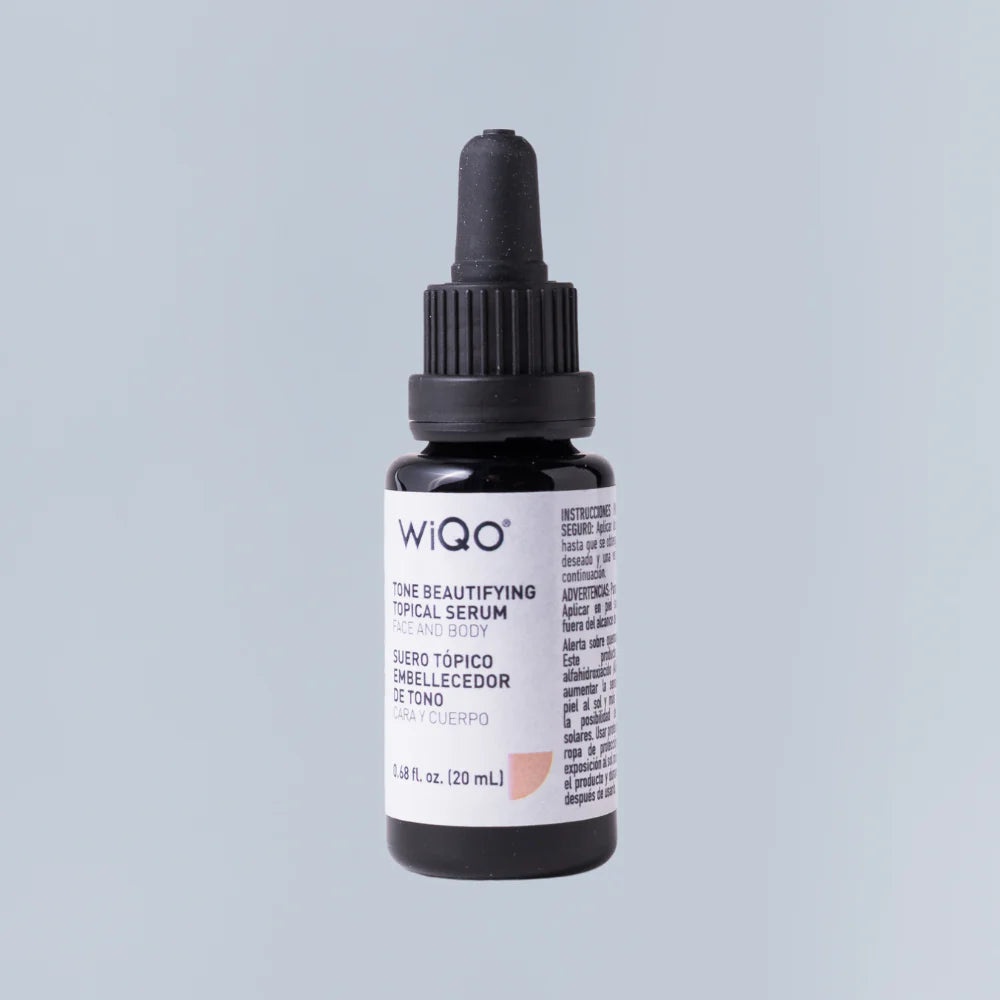
Tone Beautifying Topical Serum
Ingredients overview
Highlights
Key Ingredients
Skim through
Wiqo Tone Beautifying Topical SerumIngredients explained
Good old water, aka H2O. The most common skincare ingredient of all. You can usually find it right in the very first spot of the ingredient list, meaning it’s the biggest thing out of all the stuff that makes up the product.
It’s mainly a solvent for ingredients that do not like to dissolve in oils but rather in water.
Once inside the skin, it hydrates, but not from the outside - putting pure water on the skin (hello long baths!) is drying.
One more thing: the water used in cosmetics is purified and deionized (it means that almost all of the mineral ions inside it is removed). Like this, the products can stay more stable over time.
- A natural moisturizer that’s also in our skin
- A super common, safe, effective and cheap molecule used for more than 50 years
- Not only a simple moisturizer but knows much more: keeps the skin lipids between our skin cells in a healthy (liquid crystal) state, protects against irritation, helps to restore barrier
- Effective from as low as 3% with even more benefits for dry skin at higher concentrations up to 20-40%
- High-glycerin moisturizers are awesome for treating severely dry skin
- A multi-functional skincare superstar with several proven benefits for the skin
- Great anti-aging, wrinkle smoothing ingredient used at 4-5% concentration
- Fades brown spots alone or in combination with amino sugar, acetyl glucosamine
- Increases ceramide synthesis that results in a stronger, healthier skin barrier and better skin hydration
- Can help to improve several skin conditions including acne, rosacea, and atopic dermatitis
A nice odorless liquid used mainly as a superior solubilizer and efficacy booster for cosmetic active ingredients such as skincare bigshot vitamin C, self-tanning active DHA or the anti-acne gold standard, benzoyl peroxide.
Other than that it can also be used in hair care products where it gives a longer-lasting and more uniform coloring. According to a manufacturer, it might even prevent the formation of split ends.
 We don't have description for this ingredient yet.
Propanediol is a natural alternative for the often used and often bad-mouthed propylene glycol. It's produced sustainably from corn sugar and it's Ecocert approved.
It's quite a multi-tasker: can be used to improve skin moisturization, as a solvent, to boost preservative efficacy or to influence the sensory properties of the end formula.
The golden yellow oil coming from the Macadamia nut, a native Australian nut. Similar to other plant oils, it's loaded with emollient and nourishing fatty acids. It's a high oleic acid oil (50-67% oleic acid and only 0-5% linoleic acid) that makes it very emollient and ideal for dry skin types (and less ideal for acne-prone skin).
Its unique property is that it contains high amounts of a rare fatty acid called palmitoleic acid (12-25%) that give Macadamia oil a "cushiony" feel. It's also easily absorbed and makes the skin soft and supple.
We don't have description for this ingredient yet.
It's one of those things that help your cosmetics not to go wrong too soon, aka a preservative. It can be naturally found in fruits and teas but can also be made synthetically.
No matter the origin, in small amounts (up to 1%) it’s a nice, gentle preservative. Has to be combined with some other nice preservatives, like potassium sorbate to be broad spectrum enough.
In high amounts, it can be a skin irritant, but don’t worry, it’s never used in high amounts.
Ferulic Acid (FA) is a goodie that can be found naturally in plant cell walls. There is a lot of it especially in the bran of grasses such as rice, wheat and oats.
FA - whose main job is to be an antioxidant - owes its fame to a 2005 research that discovered that adding in 0.5% FA to a 15% Vitamin C + 1% Vitamin E solution not only stabilizes the highly unstable, divaish Vit C, but it also doubles the photoprotection abilities of the formula.
Couple of other studies show that FA just by itself is also a nice addition to cosmetic formulations: it can penetrate the skin (which is kind of important to do the job) and it has protecting properties against UV caused skin damage.
So if you spot it on the ingredient list be happy about it. :)
Alpha-Lipoic Acid (ALA) is a great antioxidant that's also part of the body's natural antioxidant system. It's soluble both in water-rich and lipid-rich environments so it's versatile and can interact with many types of evil oxidants as well as other nice antioxidants.
ALA seems to be a great choice for topical use as studies show it can penetrate the skin rapidly where it's converted to DHLA (dihydrolipoic acid), an even more potent antioxidant molecule. A nicely designed (we mean double-blind, placebo-controlled) 12-week study from 2003 confirmed that 5% ALA cream can decrease skin roughness and improve general signs of photoaging statistically significantly. A slight catch, though, is that burning and warmth in the skin was quite a common side effect, especially in the first 4 weeks.
All in all, ALA is definitely a research-proven, great antioxidant but if your skin is sensitive higher concentrations might not be for you.
The unfancy name for it is lye. It’s a solid white stuff that’s very alkaline and used in small amounts to adjust the pH of the product and make it just right.
For example, in case of AHA or BHA exfoliants, the right pH is super-duper important, and pH adjusters like sodium hydroxide are needed.
BTW, lye is not something new. It was already used by ancient Egyptians to help oil and fat magically turn into something else. Can you guess what? Yes, it’s soap. It still often shows up in the ingredient list of soaps and other cleansers.
Sodium hydroxide in itself is a potent skin irritant, but once it's reacted (as it is usually in skin care products, like exfoliants) it is totally harmless.
We don't have description for this ingredient yet.
A helper ingredient that helps to make the products stay nice longer, aka preservative. It works mainly against fungi and has only milder effect against bacteria.
It is Ecocert and Cosmos approved, works quite well at low concentrations (0.1-0.6%) and is popular in natural products.
Tamarind seed gum is a polysaccharide that moisturizes and smoothes the skin. According to manufacturer info, it also improves the skin's elasticity and leaves an extremely pleasant velvety feeling on the skin.
We don't have description for this ingredient yet.
Though its name says acid, it's not really an exfoliant. It's a plant extract with some antioxidant properties. Its main thing in cosmetic products is to neutralize the metal ions in the formula (that usually get into there from water) that would otherwise cause some not so nice changes. It's a natural alternative to sometimes bad-mouthed chelating agents, EDTAs.
A large sugar molecule (aka polysaccharide) that's used as a gelling agent and comes from brown seaweed.
Combined with calcium salts, it forms a rigid gel used in "rubber masks".
- Primary fat-soluble antioxidant in our skin
- Significant photoprotection against UVB rays
- Vit C + Vit E work in synergy and provide great photoprotection
- Has emollient properties
- Easy to formulate, stable and relatively inexpensive
Butylene glycol, or let’s just call it BG, is a multi-tasking colorless, syrupy liquid. It’s a great pick for creating a nice feeling product.
BG’s main job is usually to be a solvent for the other ingredients. Other tasks include helping the product to absorb faster and deeper into the skin (penetration enhancer), making the product spread nicely over the skin (slip agent), and attracting water (humectant) into the skin.
It’s an ingredient whose safety hasn’t been questioned so far by anyone (at least not that we know about). BG is approved by Ecocert and is also used enthusiastically in natural products. BTW, it’s also a food additive.
Sunflower does not need a big intro as you probably use it in the kitchen as cooking oil, or you munch on the seeds as a healthy snack or you adore its big, beautiful yellow flower during the summer - or you do all of these and probably even more. And by even more we mean putting it all over your face as sunflower oil is one of the most commonly used plant oils in skincare.
It’s a real oldie: expressed directly from the seeds, the oil is used not for hundreds but thousands of years. According to The National Sunflower Association, there is evidence that both the plant and its oil were used by American Indians in the area of Arizona and New Mexico about 3000 BC. Do the math: it's more than 5000 years – definitely an oldie.
Our intro did get pretty big after all (sorry for that), so let's get to the point finally: sunflower oil - similar to other plant oils - is a great emollient that makes the skin smooth and nice and helps to keep it hydrated. It also protects the surface of the skin and enhances the damaged or irritated skin barrier. Leslie Bauman notes in Cosmetic Dermatology that one application of sunflower oil significantly speeds up the recovery of the skin barrier within an hour and sustains the results 5 hours after using it.
It's also loaded with fatty acids (mostly linoleic (50-74%) and oleic (14-35%)). The unrefined version (be sure to use that on your skin!) is especially high in linoleic acid that is great even for acne-prone skin. Its comedogen index is 0, meaning that it's pretty much an all skin-type oil.
Truth be told, there are many great plant oils and sunflower oil is definitely one of them.
You might know licorice as a sweet treat from your childhood, but it's actually a legume that grows around the Mediterranean Sea, the Middle East, central and southern Russia. It's sweet and yellow and not only used for licorice all sorts but it's also a skincare superstar thanks to two magic properties:
Nr. 1 magic property is that it has skin-lightening or to say it another way depigmenting properties. The most active part is called glabridin. The topical application (meaning when you put it on your face) of 0.5% glabridin was shown to inhibit UVB caused pigmentation of guinea pigs. Another study even suggested that licorice is more effective than the gold standard skin-lightening agent hydroquinone. All in all, licorice is considered to be one of the safest skin lightening agents with the fewest side effects.
There is just one catch regarding glabridin and licorice: the amount of glabridin in commercial licorice extracts can vary a lot. We have seen extracts with only 4% glabridin as well as 40% glabridin. The latter one is a very-very expensive ingredient, so if you are after the depigmenting properties try to choose a product that boasts its high-quality licorice extract.
Nr. 2 magic property is that licorice is a potent anti-inflammatory. Glabridin has also some soothing properties but the main active anti-inflammatory component is glycyrrhizin. It’s used to treat several skin diseases that are connected to inflammation including atopic dermatitis, rosacea or eczema.
Oh, and one more thing: glabridin seems to be also an antioxidant, which is just one more reason to be happy about licorice root extract on an ingredient list.
Bottom line: Licorice is a great skincare ingredient with significant depigmenting, anti-inflammatory and even some antioxidant properties. Be happy if it's on the ingredient list. :)
Citric acid comes from citrus fruits and is an AHA. If these magic three letters don’t tell you anything, click here and read our detailed description on glycolic acid, the most famous AHA.
So citric acid is an exfoliant, that can - just like other AHAs - gently lift off the dead skin cells of your skin and make it more smooth and fresh.
There is also some research showing that citric acid with regular use (think three months and 20% concentration) can help sun-damaged skin, increase skin thickness and some nice hydrating things called glycosaminoglycans in the skin.
But according to a comparative study done in 1995, citric acid has less skin improving magic properties than glycolic or lactic acid. Probably that’s why citric acid is usually not used as an exfoliant but more as a helper ingredient in small amounts to adjust the pH of a formulation.
You may also want to take a look at...
| what‑it‑does | solvent |
| what‑it‑does | skin-identical ingredient | moisturizer/humectant |
| irritancy, com. | 0, 0 |
| what‑it‑does | cell-communicating ingredient | skin brightening | anti-acne | moisturizer/humectant |
| what‑it‑does | solvent | moisturizer/humectant | perfuming |
| irritancy, com. | 0, 0 |
| what‑it‑does | skin brightening | soothing |
| what‑it‑does | solvent | moisturizer/humectant |
| what‑it‑does | emollient |
| what‑it‑does | preservative | perfuming | solvent | viscosity controlling |
| what‑it‑does | antioxidant | antimicrobial/antibacterial |
| what‑it‑does | antioxidant |
| what‑it‑does | buffering |
| what‑it‑does | preservative |
| what‑it‑does | moisturizer/humectant | viscosity controlling |
| what‑it‑does | chelating |
| what‑it‑does | viscosity controlling |
| irritancy, com. | 4, 4 |
| what‑it‑does | antioxidant |
| irritancy, com. | 0-3, 0-3 |
| what‑it‑does | moisturizer/humectant | solvent |
| irritancy, com. | 0, 1 |
| what‑it‑does | emollient |
| irritancy, com. | 0, 0 |
| what‑it‑does | soothing | skin brightening |
| what‑it‑does | buffering |