




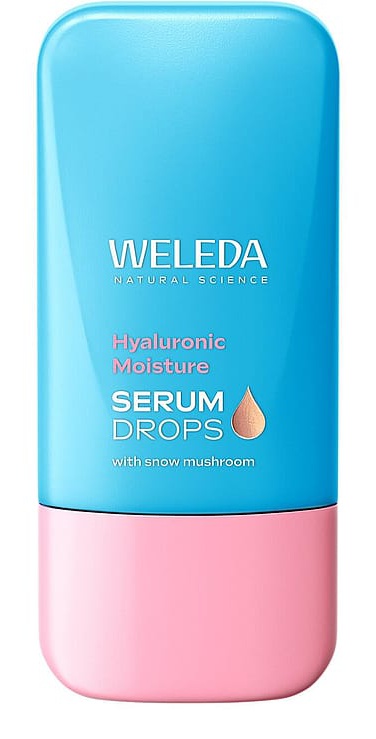
Hyaluronic Moisture Booster Serum Drops

Highlights
Key Ingredients
Skim through
| Ingredient name | what-it-does | irr., com. | ID-Rating |
|---|---|---|---|
| Water (Aqua) | solvent | ||
| Glycerin | skin-identical ingredient, moisturizer/humectant | 0, 0 | superstar |
| Pyrus Malus (Apple) Fruit Water | |||
| Pentylene Glycol | solvent, moisturizer/humectant | ||
| Betaine | moisturizer/humectant | goodie | |
| Galactoarabinan | antioxidant | goodie | |
| Tremella Fuciformis Sporocarp Extract | antioxidant, moisturizer/humectant | goodie | |
| Aloe Barbadensis Leaf Juice Powder+ | soothing, moisturizer/humectant | goodie | |
| Sodium Hyaluronate | skin-identical ingredient, moisturizer/humectant | 0, 0 | goodie |
| Citric Acid | buffering | ||
| Caprylyl Glycol | moisturizer/humectant, emollient | ||
| Potassium Sorbate | preservative |
Weleda Hyaluronic Moisture Booster Serum DropsIngredients explained
Good old water, aka H2O. The most common skincare ingredient of all. You can usually find it right in the very first spot of the ingredient list, meaning it’s the biggest thing out of all the stuff that makes up the product.
It’s mainly a solvent for ingredients that do not like to dissolve in oils but rather in water.
Once inside the skin, it hydrates, but not from the outside - putting pure water on the skin (hello long baths!) is drying.
One more thing: the water used in cosmetics is purified and deionized (it means that almost all of the mineral ions inside it is removed). Like this, the products can stay more stable over time.
- A natural moisturizer that’s also in our skin
- A super common, safe, effective and cheap molecule used for more than 50 years
- Not only a simple moisturizer but knows much more: keeps the skin lipids between our skin cells in a healthy (liquid crystal) state, protects against irritation, helps to restore barrier
- Effective from as low as 3% with even more benefits for dry skin at higher concentrations up to 20-40%
- High-glycerin moisturizers are awesome for treating severely dry skin
 We don't have description for this ingredient yet.
A multi-functional, silky feeling helper ingredient that can do quite many things. It's used as an emulsion stabilizer, solvent and a broad spectrum antimicrobial. According to manufacturer info, it's also a moisturizer and helps to make the product feel great on the skin. It works synergistically with preservatives and helps to improve water-resistance of sunscreens.
A sugar beet-derived amino acid derivative with nice skin protection and moisturization properties. Betaine's special thing is being an osmolyte, a molecule that helps to control cell-water balance. It is also a natural osmoprotectant, meaning that it attracts water away from the protein surface and thus protects them from denaturation and increases their thermodynamic stability.
It also gives sensorial benefits to the formula and when used in cleansers, it helps to make them milder and gentler.
Galactoarabinan is a natural polysaccharide (a big carbohydrate molecule) that comes from the Larch trees.
According to the manufacturer it can do all kinds of good in a formula: it can reduce trans-epidermal-water-loss (a fancy way of saying that it's moisturizing), improve the appearance of skin’s superficial fine lines, improve the uniformity and spreadability of a formulation and provides SPF enhancement. What's more it can also help to boost the efficacy of AHA exfoliants (while not boosting the irritation side effect).
A polysaccharide (a big sugar molecule) coming from the edible fruit bodies of the Silver Ear mushroom in China. Legend has it, imperial Concubine Yang Kuei-fei - the most beautiful woman in Chinese history - used it for her facial care.
So Tremella Extract is a big molecule (more than 1M Da molecular weight) with sugar constituents of Mannose, Xylose, and Glucuronic acid (20%). The last one is the most important one, as Glucuronic acid is also a major component in hyaluronic acid (HA). Thanks to this, Tremella is claimed to be an awesome moisturizer with slightly greater water-holding capacities than HA itself. This is quite a big deal as HA is known for its crazy water-holding capacity (up to 1000 times its own weight).
Not only that but Tremella also seems to have some antioxidant effect, it's not sticky (humectants do tend to be sticky) and it leaves skin moist and smooth. No wonder, Concubine Yang Kuei-fei liked this mushroom.
A spray-dried or freeze-dried version of Aloe Leaf Juice. The point of both drying methods is to make water evaporate from the juice and leave just the "useful" components behind.
So the aloe powder has similar soothing, emollient and moisturizing properties as the juice. You can read a bit more about the juice here.
It’s the - sodium form - cousin of the famous NMF, hyaluronic acid (HA). If HA does not tell you anything we have a super detailed, geeky explanation about it here. The TL; DR version of HA is that it's a huge polymer (big molecule from repeated subunits) found in the skin that acts as a sponge helping the skin to hold onto water, being plump and elastic. HA is famous for its crazy water holding capacity as it can bind up to 1000 times its own weight in water.
As far as skincare goes, sodium hyaluronate and hyaluronic acid are pretty much the same and the two names are used interchangeably. As cosmetic chemist kindofstephen writes on reddit "sodium hyaluronate disassociates into hyaluronic acid molecule and a sodium atom in solution".
In spite of this, if you search for "hyaluronic acid vs sodium hyaluronate" you will find on multiple places that sodium hyaluronate is smaller and can penetrate the skin better. Chemically, this is definitely not true, as the two forms are almost the same, both are polymers and the subunits can be repeated in both forms as much as you like. (We also checked Prospector for sodium hyaluronate versions actually used in cosmetic products and found that the most common molecular weight was 1.5-1.8 million Da that absolutely counts as high molecular weight).
What seems to be a true difference, though, is that the salt form is more stable, easier to formulate and cheaper so it pops up more often on the ingredient lists.
If you wanna become a real HA-and-the-skin expert you can read way more about the topic at hyaluronic acid (including penetration-questions, differences between high and low molecular weight versions and a bunch of references to scientific literature).
Citric acid comes from citrus fruits and is an AHA. If these magic three letters don’t tell you anything, click here and read our detailed description on glycolic acid, the most famous AHA.
So citric acid is an exfoliant, that can - just like other AHAs - gently lift off the dead skin cells of your skin and make it more smooth and fresh.
There is also some research showing that citric acid with regular use (think three months and 20% concentration) can help sun-damaged skin, increase skin thickness and some nice hydrating things called glycosaminoglycans in the skin.
But according to a comparative study done in 1995, citric acid has less skin improving magic properties than glycolic or lactic acid. Probably that’s why citric acid is usually not used as an exfoliant but more as a helper ingredient in small amounts to adjust the pH of a formulation.
It’s a handy multi-tasking ingredient that gives the skin a nice, soft feel. At the same time, it also boosts the effectiveness of other preservatives, such as the nowadays super commonly used phenoxyethanol.
The blend of these two (caprylyl glycol + phenoxyethanol) is called Optiphen, which not only helps to keep your cosmetics free from nasty things for a long time but also gives a good feel to the finished product. It's a popular duo.
It's one of those things that help your cosmetics not to go wrong too soon, aka a preservative. It’s not a strong one and doesn’t really work against bacteria, but more against mold and yeast. To do that it has to break down to its active form, sorbic acid. For that to happen, there has to be water in the product and the right pH value (pH 3-4).
But even if everything is right, it’s not enough on its own. If you see potassium sorbate you should see some other preservative next to it too.
BTW, it’s also a food preservative and even has an E number, E202.
You may also want to take a look at...
| what‑it‑does | solvent |
| what‑it‑does | skin-identical ingredient | moisturizer/humectant |
| irritancy, com. | 0, 0 |
| what‑it‑does | solvent | moisturizer/humectant |
| what‑it‑does | moisturizer/humectant |
| what‑it‑does | antioxidant |
| what‑it‑does | antioxidant | moisturizer/humectant |
| what‑it‑does | soothing | moisturizer/humectant |
| what‑it‑does | skin-identical ingredient | moisturizer/humectant |
| irritancy, com. | 0, 0 |
| what‑it‑does | buffering |
| what‑it‑does | moisturizer/humectant | emollient |
| what‑it‑does | preservative |