




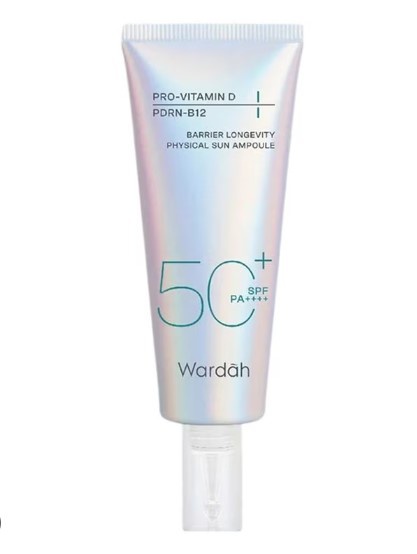
PDRN Sunscreen Barrier Longevity Physical Sun Ampoule SPF 50+ Pa++++
Ingredients overview
Highlights
Key Ingredients
Other Ingredients
Skim through
Wardah PDRN Sunscreen Barrier Longevity Physical Sun Ampoule SPF 50+ Pa++++Ingredients explained
Good old water, aka H2O. The most common skincare ingredient of all. You can usually find it right in the very first spot of the ingredient list, meaning it’s the biggest thing out of all the stuff that makes up the product.
It’s mainly a solvent for ingredients that do not like to dissolve in oils but rather in water.
Once inside the skin, it hydrates, but not from the outside - putting pure water on the skin (hello long baths!) is drying.
One more thing: the water used in cosmetics is purified and deionized (it means that almost all of the mineral ions inside it is removed). Like this, the products can stay more stable over time.
When it comes to sunscreen agents, Zinc Oxide is pretty much in a league of its own. It's a physical (or inorganic) sunscreen that has a lot in common with fellow inorganic sunscreen Titanium Dioxide (TiO2) but a couple of things make it superior even to TiO2.
If physical sunscreens don't tell you anything, go ahead and read about the basics here. Most of what we wrote about Titanium Dioxide is also true for Zinc Oxide so we will focus here on the differences.
The first main difference is that while TiO2 gives a nice broad spectrum protection, Zinc Oxide has an even nicer and even broader spectrum protection. It protects against UVB, UVA II, and UVA I almost uniformly, and is considered to be the broadest range sunscreen available today.
It's also highly stable and non-irritating. So much so that Zinc Oxide also counts as a skin protectant and anti-irritant. It's also often used to treat skin irritations such as diaper rash.
As for the disadvantages, Zinc Oxide is also not cosmetically elegant. It leaves a disturbing whitish tint on the skin, although, according to a 2000 research paper by Dr. Pinnell, it's slightly less white than TiO2. Still, it's white and disturbing enough to use Zinc Oxide nanoparticles more and more often.
We wrote more about nanoparticles and the concerns around them here, but the gist is that if nanoparticles were absorbed into the skin that would be a reason for legitimate health concerns. But luckily, so far research shows that sunscreen nanoparticles are not absorbed but remain on the surface of the skin or in the uppermost (dead) layer of the skin. This seems to be true even if the skin is damaged, for example, sunburnt.
All in all, if you've found a Zinc Oxide sunscreen that you are happy to use every single day, that's fantastic and we suggest you stick with it. It's definitely one of the best, or probably even the best option out there for sun protection available worldwide.
A light emollient ester (C8-10 fatty acids connected to C12-18 fatty alcohols) that absorbs quickly and leaves a dry but silky finish on the skin. In terms of skin feel, it is similar to Dicaprylyl Carbonate, another commonly used light emollient.
A clear, colorless, odorless oily liquid that makes the formula easily spreadable and also makes the skin nice and smooth (emollient). It's especially helpful in sunscreens as it can help to solubilize UV filters.
A clear, colorless, very easily spreadable and very volatile (evaporates from the skin easily) silicone fluid. It leaves a non-greasy, dry-smooth feel on the skin.
A so-called dispersant or dispersing agent that's used in inorganic (titanium dioxide/zinc oxide based) sunscreens or in make-up products to help to distribute the pigments nicely and evenly on the skin. It's also claimed to increase the UV absorption of the sunscreen formula as well as to reduce the annoying white cast left behind by inorganic sunscreens.
Titanium Dioxide is one of the two members of the elite sunscreen group called physical sunscreens (or inorganic sunscreens if you’re a science geek and want to be precise).
Traditionally, UV-filters are categorized as either chemical or physical. The big difference is supposed to be that chemical agents absorb UV-light while physical agents reflect it like a bunch of mini umbrellas on top of the skin. While this categorization is easy and logical it turns out it's not true. A recent, 2016 study shows that inorganic sunscreens work mostly by absorption, just like chemical filters, and only a little bit by reflection (they do reflect the light in the visible spectrum, but mostly absorb in the UV spectrum).
Anyway, it doesn't matter if it reflects or absorbs, Titanium Dioxide is a pretty awesome sunscreen agent for two main reasons: it gives a nice broad spectrum coverage and it's highly stable. Its protection is very good between 290 - 350 nm (UVB and UVA II range), and less good at 350-400 nm (UVA I) range. Regular sized Titanium Dioxide also has a great safety profile, it's non-irritating and is pretty much free from any health concerns (like estrogenic effect worries with some chemical filters).
The disadvantage of Titanium Dioxide is that it's not cosmetically elegant, meaning it's a white, "unspreadable" mess. Sunscreens containing Titanium Dioxide are often hard to spread on the skin and they leave a disturbing whitish tint. The cosmetic industry is, of course, really trying to solve this problem and the best solution so far is using nanoparticles. The itsy-bitsy Nano-sized particles improve both spreadability and reduce the whitish tint a lot, but unfortunately, it also introduces new health concerns.
The main concern with nanoparticles is that they are so tiny that they are absorbed into the skin more than we want them (ideally sunscreen should remain on the surface of the skin). Once absorbed they might form unwanted complexes with proteins and they might promote the formation of evil free radicals. But do not panic, these are concerns under investigation. A 2009 review article about the safety of nanoparticles summarizes this, "to date, in-vivo and in-vitro studies have not demonstrated percutaneous penetration of nanosized particles in titanium dioxide and zinc oxide sunscreens". The English translation is, so far it looks like sunscreens with nanoparticles do stay on the surface of the skin where they should be.
All in all, Titanium Dioxide is a famous sunscreen agent and for good reason, it gives broad spectrum UV protection (best at UVB and UVA II), it's highly stable, and it has a good safety profile. It's definitely one of the best UV-filter agents we have today, especially in the US where new-generation Tinosorb filters are not (yet) approved.
A fatty alcohol (the non-drying type with a long oil loving chain of 20 carbon atoms) that is used to increase the viscosity of the formula and it also helps the oily and the watery parts to stay nicely mixed together (called emulsion stabilizing).
A fatty alcohol (the non-drying type with a long oil loving chain of 22 carbon atoms) that is used to increase the viscosity of the formula and it also helps the oily and the watery parts to stay nicely mixed together (called emulsion stabilizing).
It's a helper ingredient that helps to thicken up formulas and form a nice gel texture. It leaves a rich, elegant feel with a velvety finish on the skin and works over a wide pH range.
An ingredient that is created from the attachment of the water-loving sugar molecule, glucose, and an oil-loving 20 carbon long fatty chain. This makes it a partly water- and partly oil-soluble material, meaning it functions as an emulsifier helping oil and water to mix.
Most often, it comes to the formula coupled with two fatty alcohol friends, Arachidyl and Behenyl alcohol, to make up an emulsifier trio trade named Montanov 202. As described by its manufacturer, the main thing of Montanonv 202 is that it gives creams a unique evanescent and light feel with a matt finish. It also leaves the skin soft, but not oily, is hypoallergenic and non-comedogenic making it perfect for both oily and sensitive skin formulas.
This long-named, polymer molecule (big molecule from repeated subunits) is a helper ingredient that's good at emulsifying and stabilizing oils into water-based formulas. It also acts as a thickening and gelling agent that creates nice, non-sticky and supple textures. It works over a very wide pH range (3-12) and can be used to thicken up low-ph formulas, such as exfoliants. Its recommended used range is 0.3-3%.
 We don't have description for this ingredient yet.
We don't have description for this ingredient yet.
We don't have description for this ingredient yet.
One of the main biologically active components of the famous medicinal plant, Centella Asiatica, aka Gotu Kola. It has well established wound healing, skin-soothing and antioxidant activities.
There is also a study by La Roche Posay (belongs to L'Oreal) that examined the anti-aging effects of 5% Vitamin C combined with 0.1% Madecassoside. They mention that " Madecassoside is known to induce collagen expression and ⁄ or to modulate inflammatory mediators thus might prevent and correct some signs of aging." The surprisingly long, 6-month study observed "significant improvement of the clinical score for deep and superficial wrinkles, suppleness, firmness, roughness, and skin hydration", but Vitamin C in itself is already an anti-aging superstar, so it is hard to know how much Madecassoside did.
Another promising property of Madecassoside is that it seems to inhibit UV-induced melanin synthesis (test formula with 0.05% MA, used twice a day on 23 volunteers for 8 weeks), making it a great active for hyperpigmentation-prone skin.
If that would not be enough, the French manufacturer (Seppic) also has encouraging in-vivo studies on the molecule. Used at 0.2%, Madecassoside reduces redness and peeling in skin with light atopic dermatitis as well as itching in psoriasis-prone skin.
Super common soothing ingredient. It can be found naturally in the roots & leaves of the comfrey plant, but more often than not what's in the cosmetic products is produced synthetically.
It's not only soothing but it' also skin-softening and protecting and can promote wound healing.
Though its name does not reveal it, Carnosine is a peptide, a small, two amino acid (β-Ala-His) one. It is naturally present in high concentrations in muscle and brain tissues, but the one used in cosmetic products is biomimetic, meaning that it is synthetically produced in a lab to copy the natural thing.
A 2017 review paper on topical peptides writes about Carnosine that it is a "well-documented aqueous antioxidant with wound healing activity".
Other than that we can write about manufacturer-done in-vitro (in the lab, not on real people) studies that show Carnosine to have anti-glycation properties. Glycation is the not-so-nice process that happens when we bombard our body with too much sugar that results in damaged body proteins and eventually in more wrinkles.
Also, a manufacturer done in vitro study shows that carnosine might have collagen-boosing magic power. However, the 2017 research paper also mentions that even though Carnosine is a small molecule, it is water soluble and does not penetrate the skin past the top layers so we have some doubt if the collagen-boosting works in real life. We could find one anti-aging study made on real people that mentions Carnosine, but it was combined with a bunch of other anti-aging actives so it is pretty much impossible to know what Carnosine did or did not.
One last thing to mention is that there is also a manufacturer done clinical study (done on real people) that shows carnosine being effective against the damages caused by infrared (IR) radiation. (source)
We don't have description for this ingredient yet.
We don't have description for this ingredient yet.
It seems to us that squalane is in fashion and there is a reason for it. Chemically speaking, it is a saturated (no double bonds) hydrocarbon (a molecule consisting only of carbon and hydrogen), meaning that it's a nice and stable oily liquid with a long shelf life.
It occurs naturally in certain fish and plant oils (e.g. olive), and in the sebum (the oily stuff our skin produces) of the human skin. As f.c. puts it in his awesome blog post, squalane's main things are "emolliency, surface occlusion, and TEWL prevention all with extreme cosmetic elegance". In other words, it's a superb moisturizer that makes your skin nice and smooth, without being heavy or greasy.
Another advantage of squalane is that it is pretty much compatible with all skin types and skin conditions. It is excellent for acne-prone skin and safe to use even if you have fungi-related skin issues, like seborrhea or fungal acne.
The unsaturated (with double bonds) and hence less stable version of Squalane is Squalene, you can read about it here >>
A white powdery thing that's the major component of glass and sand. In cosmetics, it’s often in products that are supposed to keep your skin matte as it has great oil-absorbing abilities. It’s also used as a helper ingredient to thicken up products or suspend insoluble particles.
A handy helper ingredient that helps water and oil to mix nicely together, aka emulsifier. It is especially recommended for protective, baby care and general purpose emollient creams.
It also helps to disperse insoluble particles (think color pigments or zinc/titanium dioxide sunscreen) nice and even in cosmetic formulas.
A spherical texturizing powder that's used as a texture enhancer and soft focus agent. It's claimed to give silicone type softness to the formula and also works as a (temporary) wrinkle filler.
Propanediol is a natural alternative for the often used and often bad-mouthed propylene glycol. It's produced sustainably from corn sugar and it's Ecocert approved.
It's quite a multi-tasker: can be used to improve skin moisturization, as a solvent, to boost preservative efficacy or to influence the sensory properties of the end formula.
A clear, light yellow liquid that is used to coat pigments (such as inorganic sunscreen agents or colorants) in cosmetic products. The coating helps to stabilize pigments in the formulas and also helps them to spread easily and evenly on the skin.
A common little helper ingredient that helps water and oil to mix together, aka emulsifier.
Citric acid comes from citrus fruits and is an AHA. If these magic three letters don’t tell you anything, click here and read our detailed description on glycolic acid, the most famous AHA.
So citric acid is an exfoliant, that can - just like other AHAs - gently lift off the dead skin cells of your skin and make it more smooth and fresh.
There is also some research showing that citric acid with regular use (think three months and 20% concentration) can help sun-damaged skin, increase skin thickness and some nice hydrating things called glycosaminoglycans in the skin.
But according to a comparative study done in 1995, citric acid has less skin improving magic properties than glycolic or lactic acid. Probably that’s why citric acid is usually not used as an exfoliant but more as a helper ingredient in small amounts to adjust the pH of a formulation.
A multi-functional, silky feeling helper ingredient that can do quite many things. It's used as an emulsion stabilizer, solvent and a broad spectrum antimicrobial. According to manufacturer info, it's also a moisturizer and helps to make the product feel great on the skin. It works synergistically with preservatives and helps to improve water-resistance of sunscreens.
A chelating agent that helps to preserve cosmetic products by neutralizing the metal ions (especially iron) in the formula (that usually get into there from water). Its special thing is that it also acts as a biostatic and fungistatic agent and remains active even at high pH.
It is often coupled with antimicrobial glycols (such as propanediol) to create a "preservative free preservative system" for cosmetic products.
A really multi-functional helper ingredient that can do several things in a skincare product: it can bring a soft and pleasant feel to the formula, it can act as a humectant and emollient, it can be a solvent for some other ingredients (for example it can help to stabilize perfumes in watery products) and it can also help to disperse pigments more evenly in makeup products. And that is still not all: it can also boost the antimicrobial activity of preservatives.
An alkaline (high pH, aka basic) material that is used to set the pH of the cosmetic formula to the right value.
A little helper ingredient that works as a preservative. It works against bacteria and some species of fungi and yeast. It's often combined with IT-preservative, phenoxyethanol.
You may also want to take a look at...
| what‑it‑does | solvent |
| what‑it‑does | sunscreen |
| irritancy, com. | 0, 1 |
| what‑it‑does | emollient |
| what‑it‑does | emollient | solvent |
| what‑it‑does | emulsifying |
| what‑it‑does | sunscreen | colorant |
| what‑it‑does | emollient | viscosity controlling |
| what‑it‑does | emollient | viscosity controlling |
| what‑it‑does | viscosity controlling |
| what‑it‑does | emulsifying | surfactant/cleansing |
| what‑it‑does | viscosity controlling |
| what‑it‑does | viscosity controlling |
| what‑it‑does | antioxidant | soothing |
| what‑it‑does | soothing |
| irritancy, com. | 0, 0 |
| what‑it‑does | antioxidant | cell-communicating ingredient |
| what‑it‑does | skin-identical ingredient | emollient |
| irritancy, com. | 0, 1 |
| what‑it‑does | viscosity controlling |
| what‑it‑does | emulsifying |
| irritancy, com. | 0, 1-2 |
| what‑it‑does | solvent | moisturizer/humectant |
| what‑it‑does | emulsifying | surfactant/cleansing |
| what‑it‑does | buffering |
| what‑it‑does | solvent | moisturizer/humectant |
| what‑it‑does | chelating |
| what‑it‑does | solvent |
| what‑it‑does | buffering |
| what‑it‑does | preservative | antimicrobial/antibacterial |