




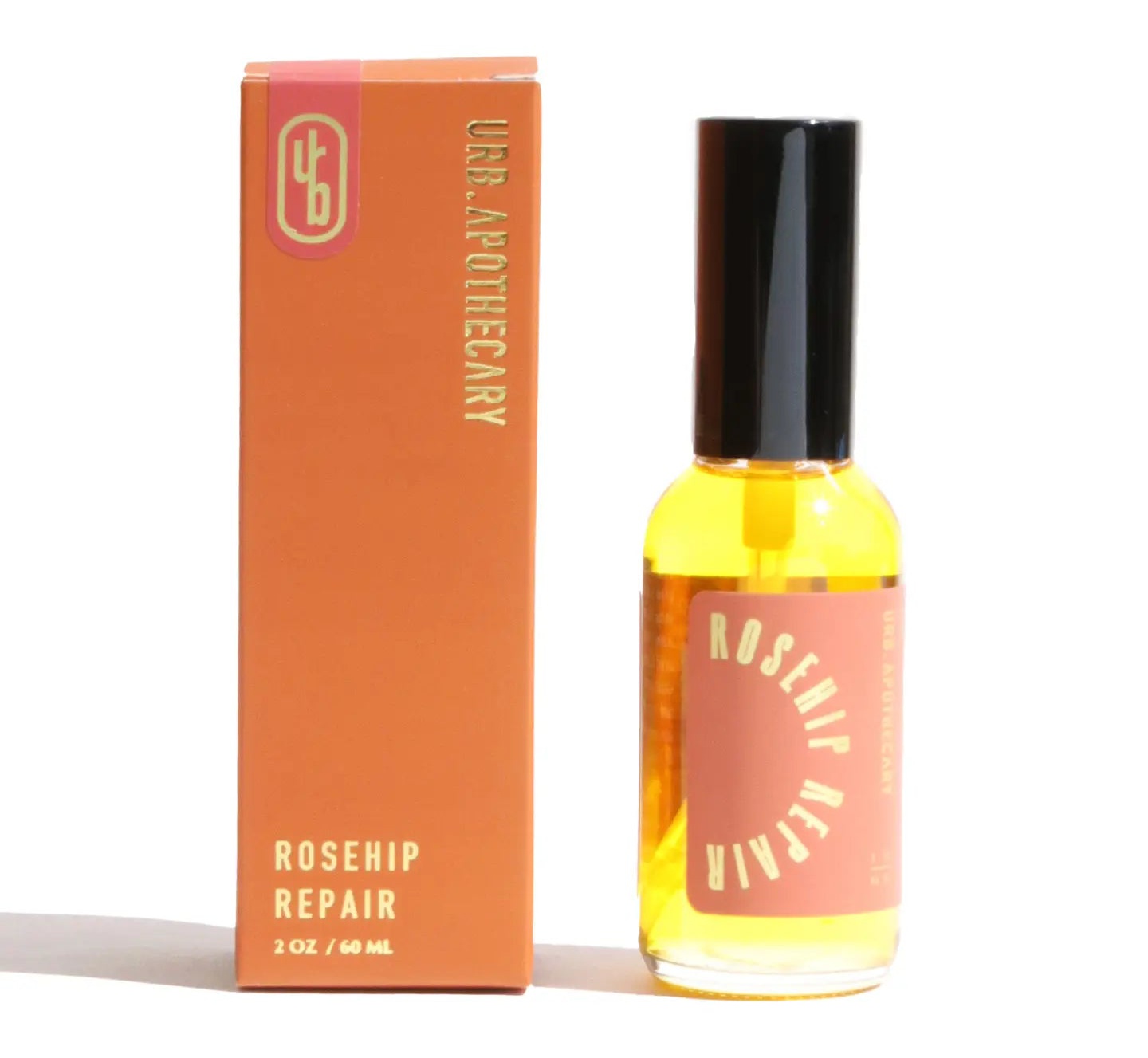
Ingredients overview
 INCI photo pending approval
Highlights
Key Ingredients
Other Ingredients
Skim through
| Ingredient name | what-it-does | irr., com. | ID-Rating |
|---|---|---|---|
| Helianthus Annuus (Sunflower) | emollient | 0, 0 | goodie |
| Infused With | |||
| Calendula Officinalis* (Calendula) Flowers | |||
| Carthamus Tinctorius (High Linoleic Safflower) Oil | antioxidant, emollient | 0, 0-2 | goodie |
| Camellia Oleifera* (Green Tea) Seed Oil | emollient | goodie | |
| Adansonia Digitata Oil (Baobab) | emollient | ||
| Rosehip Seed Oil | emollient | goodie | |
| Rosa Canina | emollient | ||
| Rosa Damascena^* (Bulgarian Rose) | antioxidant, perfuming, antimicrobial/antibacterial | icky | |
| Cotton Essential Oil | 2, 3 | ||
| Rosa Damascena (Bulgarian Rose) Absolute | antioxidant, perfuming, antimicrobial/antibacterial | icky | |
| Tocopherols (Vitamin E Non-Gmo) | antioxidant | 0-3, 0-3 | goodie |
Urb.apothecary Rosehip RepairIngredients explained
Sunflower does not need a big intro as you probably use it in the kitchen as cooking oil, or you munch on the seeds as a healthy snack or you adore its big, beautiful yellow flower during the summer - or you do all of these and probably even more. And by even more we mean putting it all over your face as sunflower oil is one of the most commonly used plant oils in skincare.
It’s a real oldie: expressed directly from the seeds, the oil is used not for hundreds but thousands of years. According to The National Sunflower Association, there is evidence that both the plant and its oil were used by American Indians in the area of Arizona and New Mexico about 3000 BC. Do the math: it's more than 5000 years – definitely an oldie.
Our intro did get pretty big after all (sorry for that), so let's get to the point finally: sunflower oil - similar to other plant oils - is a great emollient that makes the skin smooth and nice and helps to keep it hydrated. It also protects the surface of the skin and enhances the damaged or irritated skin barrier. Leslie Bauman notes in Cosmetic Dermatology that one application of sunflower oil significantly speeds up the recovery of the skin barrier within an hour and sustains the results 5 hours after using it.
It's also loaded with fatty acids (mostly linoleic (50-74%) and oleic (14-35%)). The unrefined version (be sure to use that on your skin!) is especially high in linoleic acid that is great even for acne-prone skin. Its comedogen index is 0, meaning that it's pretty much an all skin-type oil.
Truth be told, there are many great plant oils and sunflower oil is definitely one of them.
This ingredient name is not according to the INCI-standard. :( What, why?!
This ingredient name is not according to the INCI-standard. :( What, why?!
The oil coming from the seeds of the yellow flowered safflower plant. Similar to other plant oils, it's loaded with nourishing and moisturizing fatty acids: it's a high linoleic acid oil (70%) and has only smaller amounts of oleic acid (11%) (this might be great for acne-prone skin). It also contains antioxidant vitamin E (44mg/100g alpha-tocopherol).
A beautiful golden-yellow oil coming from the Camellia tree. It's a 5 -10 meters high tree with spectacular white flowers native to Asia. It's pretty common there and also used as cooking oil or salad dressing. Sometimes Camellia oil is referred to as "the olive oil of Asia".
So what can it do for the skin? Similar to many other great non-fragrant plant oils, it's a great emollient and moisturising oil for dry skin. It's light in texture, absorbs fast into the skin and leaves it soft and supple.
It contains a bunch of good-for-the-skin stuff: it's very rich (70-85%) in nourishing and moisturising fatty acid, oleic acid (though if you are acne-prone be careful with oleic acid), contains significant amount of antioxidant vitamin E (0.15%) as well as great emollient and antioxidant squalene (2-3%).
All in all, a skin goodie especially for dry skin.
 We don't have description for this ingredient yet.
The oil coming from the seeds of dog-rose, a wild rose species native to Europe, northwest Africa and western Asia. It's a nice emollient, moisturizing plant oil loaded with skin-nourishing fatty acids (linoleic acid - 51%, linolenic acid - 19% and oleic acid - 20%).
If you start to dig a bit deeper into the rosehip oil topic, you will soon see that there are lots of species of rose, and it's all a bit confusing to know what the differences and similarities between the oils of the different roses are. As far as our research can tell, here is the gist.
In skincare two major types of rosehip oil are used:
1. Rosa Rubiginosa that is a synonym for Rosa Eglanteria and for Rosa Mosqueta. We will call it RR from now on.
2. Rosa Canina, or RC
The oil content and composition of RR and RC is similar, but there are some differences: RR contains 8% of oil, while RC contains a bit more, 10%. However, the quality of RR oil seems to be a bit better: it contains 78% essential unsaturated fatty acids while RC contains only 71%. Also, the linoleic-oleic ratio of RR is better (3.3 vs 2.5) that might be important if your skin is acne-prone (as linoleic acid is good for acne and oleic is not).
There is one more important thing to mention: RR oil is famous for containing the miracle active, tretinoin. Though Wikipedia puts RR and RC oil under the same article called as Rose hip seed oil, the referenced research about tretinoin content examines only Rosa Rubiginosa. We looked for a research paper explicitly stating that Rosa Canina also contains tretinoin, but could not find one, so we can neither deny nor confirm it. What we could find is a paper mentioning the tocopherols (vitamin E) and carotenoids (pro-vitamin A) content of Rosa Canina oil that gives it some nice antioxidant properties.
All in all, it is a great emollient plant oil with great fatty acids beneficial for any skin type.
Though it says fruit oil in its name, the rosehip fruit contains the seeds that contain the oil. So this one is the same as Rosa Canina Seed Oil, or Rosehip Oil, known for its high omega fatty acid content (linoleic acid - 51%, linolenic acid - 19% and oleic acid - 20%) and skin-regenerative properties.
There is a common misconception that rosehip oil contains vitamin C as the fruit itself does, but vitamin C is a water-soluble vitamin hence it is not contained in the oil. The antioxidant and regenerative properties of the oil probably come from the oil-soluble tocopherols (vitamin E) and carotenoids (pro-vitamin A). Read more here.
We are big fans of all kinds of roses as ornamental plants but when it comes to skincare, it is a mixed bag. Before we list out the good and the not so good, here is an interesting thing.
The oil content in rose is very, very low so distilling rose essential oil requires huge amounts of rose flowers. It has such a wonderful scent that there are no comparable synthetic alternatives. You can probably guess that this means rose essential oil is expensive.... very very expensive.
So the good things: thanks to its wonderful scent the high-end perfume industry loves rose oil. Also, we (humans :)) love rose oil. We love its scent so much that it can heal headaches, depression, stress, and even grief.
Rose oil contains more than 95 compounds, among them flavonoids, anthocyanins, vitamin C, and quercetin that are all known for their medicinal properties and great antioxidant effects. Similar to many other essential oils, it has antimicrobial properties too.
Now, the not-so-good thing? Out of the 95 compounds, the major ones are citronellol and geraniol, fragrant components that might irritate sensitive skin.
We don't have description for this ingredient yet.
The super concentrated version of Rose Essential Oil (you can read here a bit more about what an absolute is and how it's prepared).
So what we wrote there is pretty much true here as well: it's very expensive, smells heavenly, but it's a mixed bag when it comes to skincare. On the upside, it has antioxidant and antimicrobial compounds and on the downside, most if it is fragrant compounds that might hurt sensitive skin types.
- Primary fat-soluble antioxidant in our skin
- Significant photoprotection against UVB rays
- Vit C + Vit E work in synergy and provide great photoprotection
- Has emollient properties
- Easy to formulate, stable and relatively inexpensive
You may also want to take a look at...
| what‑it‑does | emollient |
| irritancy, com. | 0, 0 |
| what‑it‑does | antioxidant | emollient |
| irritancy, com. | 0, 0-2 |
| what‑it‑does | emollient |
| what‑it‑does | emollient |
| what‑it‑does | emollient |
| what‑it‑does | emollient |
| what‑it‑does | antioxidant | perfuming | antimicrobial/antibacterial |
| irritancy, com. | 2, 3 |
| what‑it‑does | antioxidant | perfuming | antimicrobial/antibacterial |
| what‑it‑does | antioxidant |
| irritancy, com. | 0-3, 0-3 |