




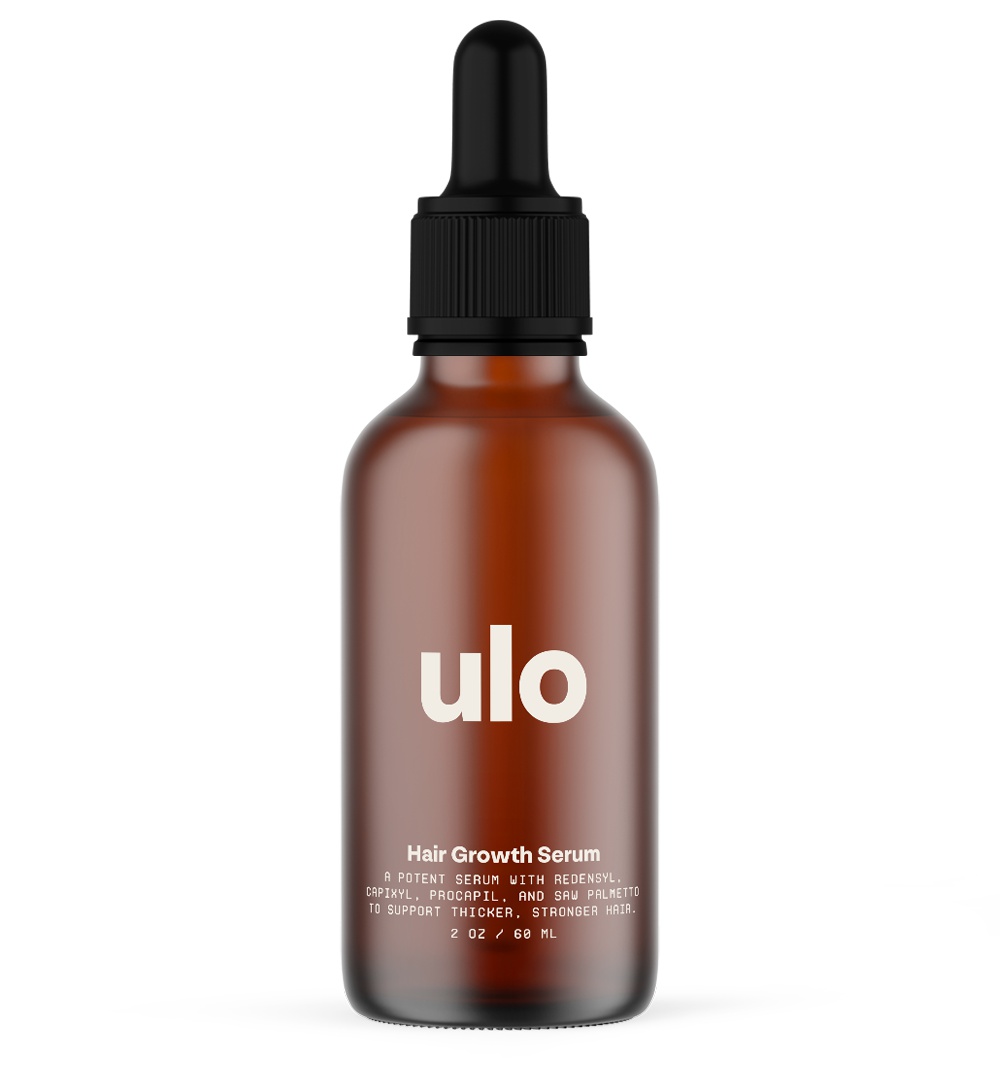
Hair Growth Serum
Ingredients overview
Highlights
Key Ingredients
Other Ingredients
Skim through
Ulo Hair Growth SerumIngredients explained
Good old water, aka H2O. The most common skincare ingredient of all. You can usually find it right in the very first spot of the ingredient list, meaning it’s the biggest thing out of all the stuff that makes up the product.
It’s mainly a solvent for ingredients that do not like to dissolve in oils but rather in water.
Once inside the skin, it hydrates, but not from the outside - putting pure water on the skin (hello long baths!) is drying.
One more thing: the water used in cosmetics is purified and deionized (it means that almost all of the mineral ions inside it is removed). Like this, the products can stay more stable over time.
This ingredient name is not according to the INCI-standard. :( What, why?!
Butylene glycol, or let’s just call it BG, is a multi-tasking colorless, syrupy liquid. It’s a great pick for creating a nice feeling product.
BG’s main job is usually to be a solvent for the other ingredients. Other tasks include helping the product to absorb faster and deeper into the skin (penetration enhancer), making the product spread nicely over the skin (slip agent), and attracting water (humectant) into the skin.
It’s an ingredient whose safety hasn’t been questioned so far by anyone (at least not that we know about). BG is approved by Ecocert and is also used enthusiastically in natural products. BTW, it’s also a food additive.
Good old water, aka H2O. The most common skincare ingredient of all. You can usually find it right in the very first spot of the ingredient list, meaning it’s the biggest thing out of all the stuff that makes up the product.
It’s mainly a solvent for ingredients that do not like to dissolve in oils but rather in water.
Once inside the skin, it hydrates, but not from the outside - putting pure water on the skin (hello long baths!) is drying.
One more thing: the water used in cosmetics is purified and deionized (it means that almost all of the mineral ions inside it is removed). Like this, the products can stay more stable over time.
A relatively new, four amino acid peptide that promises to help combat hair loss alongside red clover extract as part of the trademarked technology Capixyl.
The main thing of Acetyl Tetrapeptide-3 is to stimulate the synthesis of key Extra Cellular Matrix (aka ECM, the gooey stuff between cells that make up the framework of our skin) components in the scalp. According to the manufacturer’s lab studies, the expression of type III collagen increased by 65% and the expression of laminins (anchoring proteins found in the ECM) was up a massive 285%, resulting in a stronger ECM bed for hair anchoring.
Together with red clover extract, the duo has a synergistic action and works to combat hair loss thanks to a neat multi-faceted approach: it not only stimulates important ECM components but also inhibits the DHT-causing 5-a-reductase enzyme (DHT is the annoying hormone largely responsible for male pattern baldness) and reduces micro-inflammation around hair follicles. The manufacturer’s study over 4 months showed the total impact of Capixyl was an increased anagen (growth phase)/telogen (resting phase) ratio of +46%, resulting in significantly denser hair.
All in all, Acetyl Tetrapeptide-3 is a promising ingredient in the fight against hair loss, but as the only results we could find were from the manufacturer, take these claims with a pinch of salt until more research is done.
 We don't have description for this ingredient yet.
This ingredient name is not according to the INCI-standard. :( What, why?!
- A natural moisturizer that’s also in our skin
- A super common, safe, effective and cheap molecule used for more than 50 years
- Not only a simple moisturizer but knows much more: keeps the skin lipids between our skin cells in a healthy (liquid crystal) state, protects against irritation, helps to restore barrier
- Effective from as low as 3% with even more benefits for dry skin at higher concentrations up to 20-40%
- High-glycerin moisturizers are awesome for treating severely dry skin
Good old water, aka H2O. The most common skincare ingredient of all. You can usually find it right in the very first spot of the ingredient list, meaning it’s the biggest thing out of all the stuff that makes up the product.
It’s mainly a solvent for ingredients that do not like to dissolve in oils but rather in water.
Once inside the skin, it hydrates, but not from the outside - putting pure water on the skin (hello long baths!) is drying.
One more thing: the water used in cosmetics is purified and deionized (it means that almost all of the mineral ions inside it is removed). Like this, the products can stay more stable over time.
We don't have description for this ingredient yet.
We don't have description for this ingredient yet.
A non-essential amino acid (the building blocks of skin proteins, like collagen or elastin), that the body can produce itself, but its production decreases with age. When you put it all over your face, it works as a moisturizer and maybe more.
According to great skincare blog Futurederm, glycine might help with wound healing and tissue repair and when used together with other amino acids, leucine and proline it might improve wrinkles.
BTW, it's also a building block of a bunch of important and famous peptides, including copper-tripeptide-1, palmitoyl tripeptide-1 or palmitoyl hexapeptide-12.
- Green tea is one of the most researched natural ingredients
- The active parts are called polyphenols, or more precisely catechins (EGCG being the most abundant and most active catechin)
- There can be huge quality differences between green tea extracts. The good ones contain 50-90% catechins (and often make the product brown and give it a distinctive smell)
- Green tea is proven to be a great antioxidant, UV protectant, anti-inflammatory, anticarcinogenic and antimicrobial
- Because of these awesome properties green tea is a great choice for anti-aging and also for skin diseases including rosacea, acne and atopic dermatitis
Butylene glycol, or let’s just call it BG, is a multi-tasking colorless, syrupy liquid. It’s a great pick for creating a nice feeling product.
BG’s main job is usually to be a solvent for the other ingredients. Other tasks include helping the product to absorb faster and deeper into the skin (penetration enhancer), making the product spread nicely over the skin (slip agent), and attracting water (humectant) into the skin.
It’s an ingredient whose safety hasn’t been questioned so far by anyone (at least not that we know about). BG is approved by Ecocert and is also used enthusiastically in natural products. BTW, it’s also a food additive.
Good old water, aka H2O. The most common skincare ingredient of all. You can usually find it right in the very first spot of the ingredient list, meaning it’s the biggest thing out of all the stuff that makes up the product.
It’s mainly a solvent for ingredients that do not like to dissolve in oils but rather in water.
Once inside the skin, it hydrates, but not from the outside - putting pure water on the skin (hello long baths!) is drying.
One more thing: the water used in cosmetics is purified and deionized (it means that almost all of the mineral ions inside it is removed). Like this, the products can stay more stable over time.
A helper ingredient that usually comes to the formula coupled with PEG-40 Hydrogenated Castor Oil. The two together work as surfactants and oil solubilizers. It's a non-sticky duo that works at low concentration and is often used to solubilize fragrance components into water-based formulas.
A mildly viscous, amber-colored liquid with fatty odor, made from Castor Oil and polyethylene glycol (PEG).
If it were a person, we’d say, it’s agile, diligent & multifunctional. It’s mostly used as an emulsifier and surfactant but most often it is used to solubilize fragrances into water-based formulas.
We don't have description for this ingredient yet.
A three amino acid peptide where the famous collagen fragment, Tripeptide-1, aka GHK is combined with Biotin, the well-known supplement for stronger nails and hairs. The result of the combination is Biotinoyl Tripeptide-1, a peptide claimed to be helpful for reducing hair loss and for making the eyelashes appear longer, fuller, and stronger.
As for proof, the manufacturer did some in-vitro (made in test tubes) studies that show that our molecule can promote hair bulb keratinocyte proliferation and also helps optimal hair anchorage by stimulating the synthesis and organization of the adhesion molecules laminin 5 and collagen IV. This means that our peptide might help the hair to be stronger and to stay longer in its place, though these are only in vitro results that might or might not translate to real-world use.
As for a clinical, made on real people study, the manufacturer did one for eyelash growth with 30 volunteers. Using a mascara with 2% of SpecPed LashLD (trade name for the diluted, buyable version of Biotinoyl Tripeptide-1), the lashes got longer by 17% and thicker by 19% after 30 days.
We don't have description for this ingredient yet.
The extract coming from the lovely herb, rosemary. It contains lots of chemicals, including flavonoids, phenolic acids, and diterpenes. Its main active is rosmarinic acid, a potent antioxidant, and anti-inflammatory. It has also anti-bacterial, astringent and toning properties.
The leaves contain a small amount of essential oil (1-2%) with fragrant components, so if you are allergic to fragrance, it might be better to avoid it.
We don't have description for this ingredient yet.
We don't have description for this ingredient yet.
We don't have description for this ingredient yet.
It's one of those things that help your cosmetics not to go wrong too soon, aka a preservative. It can be naturally found in fruits and teas but can also be made synthetically.
No matter the origin, in small amounts (up to 1%) it’s a nice, gentle preservative. Has to be combined with some other nice preservatives, like potassium sorbate to be broad spectrum enough.
In high amounts, it can be a skin irritant, but don’t worry, it’s never used in high amounts.
Adenosine is an important little compound in our body that has a vital cell-signalling role. Research on smearing it on our face is also promising and shows so far a couple of things:
- It can help with wound healing
- It’s a good anti-inflammatory agent
- It might even help with skin’s own collagen production and improve skin firmness and elasticity
- It helps with barrier repair and protection
- It might be even useful for the hair helping with hair thickness and hair growth
It's a common little helper ingredient that helps water and oil to mix together. Also, it can help to increase the solubility of some other ingredients in the formula.
It’s one of those little helper ingredients that makes sure the product stays the same over time. No color change or anything like that. It does so by neutralizing the metal ions in the formula (that usually get into there from water) that would otherwise cause some not so nice changes.
Hello, our favorite molecule that helps us wake up in the morning and then keeps us going through the day. As a super well-known stimulant from coffee, tea and plenty of other soft drinks, Caffeine needs no introduction. So we will skip right to the part where we talk about what the hell it does in so-so many cosmetic products.
Looking at the research, we were surprised to find how versatile Caffeine is. It is a small, water-loving molecule with pretty good skin penetration abilties. Once in the skin, it has nice antioxidant properties, meaning that it reduces the formation of evil free radicals and it might even be useful in preventing UV-induced skin cancers.
A well-known thing about Caffeine is that it improves the microcirculation of the blood vessels. Though conventional wisdom and anecdotal evidence says that this property is helpful for dark under-eye circles and puffy eyes, we have to mention that the double-blind research we have found about a 3% caffeine gel concluded that "the overall efficacy of the selected caffeine gel in reducing puffy eyes was not significantly different from that of its gel base." But you know, the proof is in the pudding.
Another thing Caffeine is used for in body care products is its anti-cellulite effects. In theory, it can speed up the lipolysis process (the "fat burning" by our cells) and stimulate the draining lymph system that might lead to the improvement of cellulite. But here again, the evidence that it actually makes a measurable, let alone visible, improvement on actual human beings is limited (we could find only some animal skin studies or caffeine being combined with other actives).
Last, but not least, we have to write about caffeine and hair growth. The theory is that it can inhibit the activity of the 5-α-reductase enzyme that plays an important role in hair loss and allows a renewed growth phase of the hair. We have found some recent and promising research to back this up. A 2017 study compared a 0.2% caffeine liquid with a 5% Minoxidil (an FDA approved active to treat baldness) solution and found that "a caffeine-based topical liquid should be considered as not inferior to minoxidil 5% solution in men with androgenetic alopecia", or English translation means that the caffeine liquid was pretty much as good as the FDA-approved Minoxidil stuff. Not bad!
Overall, we think that caffeine is a very versatile and biologically active ingredient. Even though some of its effects are more hyped up than backed up, it is still a nice to have on many ingredient lists.
The essential oil coming from steam distillation of freshly harvested, flowering peppermint sprigs. Its major component is menthol that gives the oil its well-known refreshing and cooling properties. Peppermint oil is traditionally used as an inhalant for cold and coughs and there is also some clinical data validating its use against headaches by rubbing a peppermint oil cream on the forehead.
As for skincare, other than the nice grassy-minty smell and the refreshing sensations, we cannot write good things. It can be a skin irritant, so much so that it is a well-known counterirritant for muscle pains creating mild surface irritation to make things better in the deeper layers. But for everyday skincare, counterirritation is not something you wanna do, so we think that peppermint oil is better to avoid, especially if your skin is sensitive.
An Ecocert-approved, natural preservative that counts as gentle and non-irritating to the skin. Usually, it comes to the formula as part of a preservative blend as it's not enough on its own.
We don't have description for this ingredient yet.
We don't have description for this ingredient yet.
We don't have description for this ingredient yet.
The sodium salt of lactic acid. It's a great skin moisturizer and also used to regulate the pH value of the cosmetic formula. It's a natural ingredient approved by both ECOCERT and COSMOS.
We don't have description for this ingredient yet.
A mild, natural preservative that usually comes to the formula together with its other mild preservative friends, such as Benzoic Acid and/or Dehydroacetic Acid. Btw, it's also used as a food preservative.
PCA stands for Pyrrolidone Carboxylic Acid and though it might not sound like it, it is a thing that can be found naturally in our skin. The sodium salt form of PCA is an important skin-identical ingredient and great natural moisturizer that helps the skin to hold onto water and stay nicely hydrated.
PCA stands for Pyrrolidone Carboxylic Acid and though it might not sound like it, it is a thing that can be found naturally in our skin. In fact, after amino acids, it is the second biggest NMF component of the skin with 12% being PCA of the NMF composition of normal skin. So similar to other NMFs, it's a skin goodie that helps the skin to hold onto water and stay nicely hydrated.
A semi-essential (infants cannot synthesize it, but adults can) amino acid that is one of the primary building blocks of hair keratin and skin collagen. It's a natural moisturizing factor, a skin hydrator and might also help to speed up wound healing.
Arginine usually has a positive charge (cationic) that makes it substantive to skin and hair (those are more negatively charged surfaces) and an excellent film former. Thanks to the positive charge, it also creates a complex with AHAs (AHAs like to lose a hydrogen ion and be negatively charged, so the positive and the negative ions attract each other) that causes a "time-release AHA effect" and reduces the irritation associated with AHAs.
A non-essential amino acid (important building block of collagen and elastin) that hydrates the skin. It is also used to set the pH of the cosmetic product (buffering).
SD-Alcohol and some numer+letter refers to alcohol (or ethanol) being denaturated with different kind of additives. These additives make sure that the alcohol is poisonous and bad tasting so that nobody drinks their alcohol-loaded toner. 40-B specifically means the additives are denatonium benzoate and t-butyl alcohol.
As for Alcohol Denat in skincare, it's a controversial ingredient. It's a great solvent and makes cosmetically elegant, light formulas but at best it's skin-drying, at worst it's skin-barrier damaging. We have written about alcohol way more here.
An essential amino acid (a building block of skin proteins like collagen) that our body cannot produce itself but has to take from external sources, like diet.
It's a branched chain amino acid that is claimed to enhance energy, increase endurance and aid in muscle tissue recovery and repair when taken as a supplement. It's not clear what valine does when you put it on the skin, but as all amino acids, it must be at least a great skin hydrator.
A non-essential amino acid (meaning that our body can produce it) that's also one of the major building blocks of collagen. According to the Futurederm blog, it might be able to improve wrinkles when combined with other amino acids, glycine and leucine
An essential amino acid that's also a key building block of collagen and elastin. When taken orally, it helps the digestive and intestinal tracts function more smoothly and also helps the absorption of nutrients. As for skincare, it is not clear what it does other than being a skin hydrator.
A branch-chained, essential amino acid that can be found in things like almond, cashew or soy protein. When taken orally it may promote protein synthesis. As for skincare - like all the amino acids - it's a skin-identical ingredient and moisturizer. It also seems to be useful as a barrier repair ingredient.
A semi-essential amino acid meaning that enough has to be eaten from it so that the body does not use up essential amino acids (that our body cannot produce itself) to synthesize it. It has an important role in regulating the immune defense, allergic reactions, and inflammatory processes in the body.
As for skincare, it's a skin moisturizer that might also protect from some skin infections.
An essential amino acid that the body cannot produce itself but has to take from the diet. Combined with UVA exposure, phenylalanine is used in the treatment of vitiligo (a pigmentation disorder where patches of the skin lose the pigment).
A non-essential amino acid (a building block of skin proteins like collagen or elastin) that hydrates the skin.
Serine is an amino acid that most often comes to the formula as part of a moisturizing complex. It's a non-essential amino acid (meaning that our body can synthesize it) and serves as a water-binding ingredient.
In general, amino acids are great skincare ingredients that play an important role in proper skin hydration but there is not much info out there about what specifically serine can do for the skin.
We don't have description for this ingredient yet.
You may also want to take a look at...
| what‑it‑does | solvent |
| what‑it‑does | moisturizer/humectant | solvent |
| irritancy, com. | 0, 1 |
| what‑it‑does | solvent |
| what‑it‑does | viscosity controlling |
| what‑it‑does | cell-communicating ingredient |
| what‑it‑does | skin-identical ingredient | moisturizer/humectant |
| irritancy, com. | 0, 0 |
| what‑it‑does | solvent |
| what‑it‑does | antioxidant | preservative |
| what‑it‑does | moisturizer/humectant |
| what‑it‑does | skin-identical ingredient |
| what‑it‑does | soothing |
| what‑it‑does | antioxidant | soothing |
| what‑it‑does | moisturizer/humectant | solvent |
| irritancy, com. | 0, 1 |
| what‑it‑does | solvent |
| what‑it‑does | emulsifying | surfactant/cleansing |
| what‑it‑does | antioxidant |
| what‑it‑does | cell-communicating ingredient |
| what‑it‑does | antioxidant | soothing | antimicrobial/antibacterial |
| what‑it‑does | buffering |
| what‑it‑does | antioxidant |
| what‑it‑does | preservative | perfuming | solvent | viscosity controlling |
| what‑it‑does | cell-communicating ingredient |
| what‑it‑does | emulsifying | surfactant/cleansing |
| irritancy, com. | 0, 0 |
| what‑it‑does | chelating |
| what‑it‑does | antioxidant | perfuming |
| what‑it‑does | perfuming |
| what‑it‑does | preservative |
| what‑it‑does | emollient |
| what‑it‑does | soothing | surfactant/cleansing |
| what‑it‑does | buffering | moisturizer/humectant |
| what‑it‑does | viscosity controlling |
| what‑it‑does | preservative |
| what‑it‑does | skin-identical ingredient | moisturizer/humectant |
| irritancy, com. | 0, 0 |
| what‑it‑does | skin-identical ingredient | moisturizer/humectant |
| what‑it‑does | skin-identical ingredient |
| what‑it‑does | skin-identical ingredient |
| what‑it‑does | antioxidant |
| what‑it‑does | solvent | viscosity controlling |
| what‑it‑does | soothing |
| what‑it‑does | skin-identical ingredient |
| what‑it‑does | skin-identical ingredient |
| what‑it‑does | skin-identical ingredient |
| what‑it‑does | skin-identical ingredient |
| what‑it‑does | skin-identical ingredient | moisturizer/humectant |
| what‑it‑does | skin-identical ingredient |
| what‑it‑does | skin-identical ingredient |
| what‑it‑does | skin-identical ingredient |