




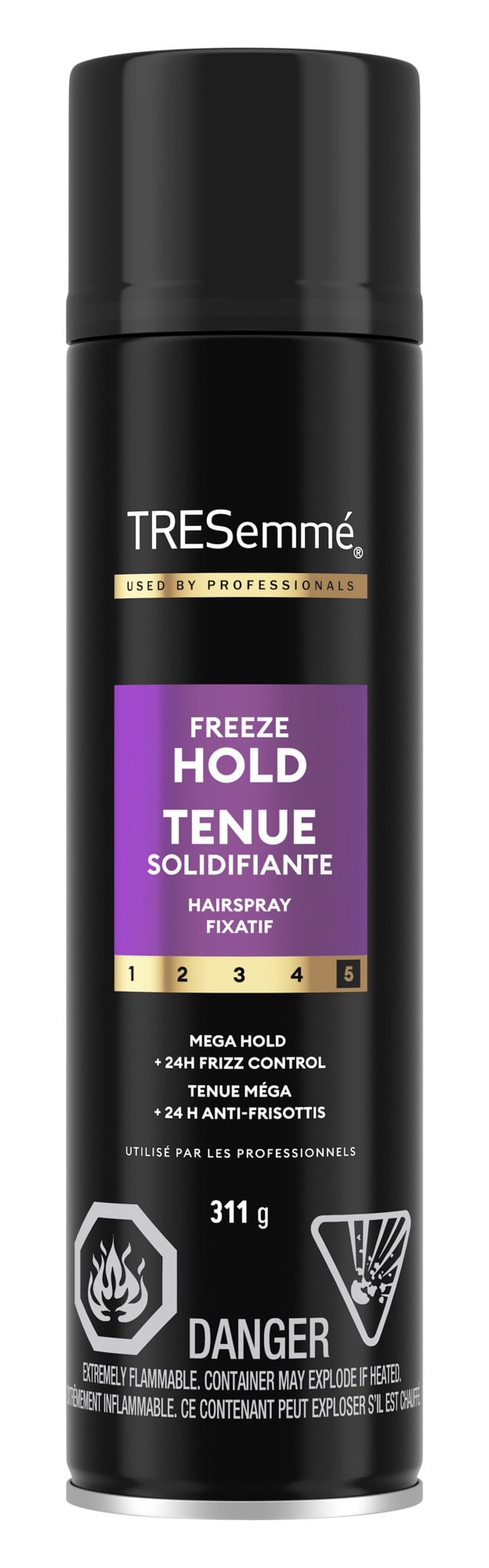
Freeze Hold Hairspray
Highlights
Skim through
| Ingredient name | what-it-does | irr., com. | ID-Rating |
|---|---|---|---|
| Alcohol Denat | antimicrobial/antibacterial, solvent, viscosity controlling | icky | |
| Hydrofluorocarbon 152A | |||
| Octylacrylamide/Acrylates/Butylaminoethyl Methacrylate Copolymer | |||
| Aminomethyl Propanol | buffering | ||
| Cyclotetrasiloxane | emollient, solvent | ||
| Cyclopentasiloxane | emollient, solvent | ||
| Fragrance (Parfum) | perfuming | icky |
TRESemmé Freeze Hold HairsprayIngredients explained
- It's a super common and super debated skincare ingredient
- It has several benefits: great solvent, penetration enhancer, creates cosmetically elegant, light formulas, great astringent and antimicrobial
- It can be very drying if it's in the first few ingredients on an ingredient list
- Some experts even think that regular exposure to alcohol damages skin barrier and causes inflammation though it's a debated opinion (read more in geeky details tab)
 We don't have description for this ingredient yet.
We don't have description for this ingredient yet.
An alkaline (high pH, aka basic) material that is used to set the pH of the cosmetic formula to the right value.
A four-unit long, cyclic structured, super light silicone that is the small sister of the more commonly used 5-unit long cyclic structured Cyclopentasiloxane. It is a so-called volatile silicone that evaporates off the skin and hair rather than staying on it.
Similar to other silicones, it has excellent spreading properties and amazing silkiness. It is often blended with other silicones to achieve unique sensorial properties in the formula.
A super commonly used 5 unit long, cyclic structured silicone that is water-thin and does not stay on the skin but evaporates from it (called volatile silicone). Similar to other silicones, it gives skin and hair a silky, smooth feel.
It's often combined with the non-volatile (i.e. stays on the skin) dimethicone as the two together form a water-resistant, breathable protective barrier on the skin without a negative tacky feel.
Exactly what it sounds: nice smelling stuff put into cosmetic products so that the end product also smells nice. Fragrance in the US and parfum in the EU is a generic term on the ingredient list that is made up of 30 to 50 chemicals on average (but it can have as much as 200 components!).
If you are someone who likes to know what you put on your face then fragrance is not your best friend - there's no way to know what’s really in it.
Also, if your skin is sensitive, fragrance is again not your best friend. It’s the number one cause of contact allergy to cosmetics. It’s definitely a smart thing to avoid with sensitive skin (and fragrance of any type - natural is just as allergic as synthetic, if not worse!).
You may also want to take a look at...
| what‑it‑does | antimicrobial/antibacterial | solvent | viscosity controlling |
| what‑it‑does | buffering |
| what‑it‑does | emollient | solvent |
| what‑it‑does | emollient | solvent |
| what‑it‑does | perfuming |