




Ingredients overview
Highlights
Key Ingredients
Skim through
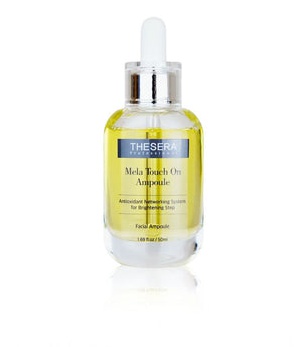
Theresa Mela Touch On AmpouleIngredients explained
 We don't have description for this ingredient yet.
- A natural moisturizer that’s also in our skin
- A super common, safe, effective and cheap molecule used for more than 50 years
- Not only a simple moisturizer but knows much more: keeps the skin lipids between our skin cells in a healthy (liquid crystal) state, protects against irritation, helps to restore barrier
- Effective from as low as 3% with even more benefits for dry skin at higher concentrations up to 20-40%
- High-glycerin moisturizers are awesome for treating severely dry skin
Butylene glycol, or let’s just call it BG, is a multi-tasking colorless, syrupy liquid. It’s a great pick for creating a nice feeling product.
BG’s main job is usually to be a solvent for the other ingredients. Other tasks include helping the product to absorb faster and deeper into the skin (penetration enhancer), making the product spread nicely over the skin (slip agent), and attracting water (humectant) into the skin.
It’s an ingredient whose safety hasn’t been questioned so far by anyone (at least not that we know about). BG is approved by Ecocert and is also used enthusiastically in natural products. BTW, it’s also a food additive.
Lactobionic acid is the brother or maybe the sister of gluconolactone. Usually, it’s called a PHA, though some studies call it bionic acid or aldobionic acid. Not that this matters too much. What matters is that it’s similarly awesome to gluconolactone. So go read about gluconolactone to get the idea.
In a nutshell, it’s a next generation AHA, with almost all the benefits and more and without the irritation. It gently lifts off dead skin cells and makes your skin smooth and even. It moisturizes and helps the skin barrier. Can be used on sensitive skin too or post cosmetic procedure. In the long run, it has anti-aging benefits (though a tad less than AHAs), and it’s even an antioxidant.
Must try, just like the other AHAs.
- It’s a polyhydroxy acid (PHA), that is often referred to as next generation AHA
- It gently lifts off dead skin cells form the skin surface making skin smooth and even
- In the long term it provides anti-aging benefits, like increased skin thickness and decreased wrinkles (though a tad less than even more proven superstar AHAs)
- It’s a great moisturizer and even helps to repair impaired skin barrier
- It’s antioxidant, and does not make your skin more sensitive to the sun
- It can be used even if your skin is very sensitive, rosacea prone or if you are post cosmetic procedure
A really multi-functional helper ingredient that can do several things in a skincare product: it can bring a soft and pleasant feel to the formula, it can act as a humectant and emollient, it can be a solvent for some other ingredients (for example it can help to stabilize perfumes in watery products) and it can also help to disperse pigments more evenly in makeup products. And that is still not all: it can also boost the antimicrobial activity of preservatives.
A semi-essential (infants cannot synthesize it, but adults can) amino acid that is one of the primary building blocks of hair keratin and skin collagen. It's a natural moisturizing factor, a skin hydrator and might also help to speed up wound healing.
Arginine usually has a positive charge (cationic) that makes it substantive to skin and hair (those are more negatively charged surfaces) and an excellent film former. Thanks to the positive charge, it also creates a complex with AHAs (AHAs like to lose a hydrogen ion and be negatively charged, so the positive and the negative ions attract each other) that causes a "time-release AHA effect" and reduces the irritation associated with AHAs.
- A multi-functional skincare superstar with several proven benefits for the skin
- Great anti-aging, wrinkle smoothing ingredient used at 4-5% concentration
- Fades brown spots alone or in combination with amino sugar, acetyl glucosamine
- Increases ceramide synthesis that results in a stronger, healthier skin barrier and better skin hydration
- Can help to improve several skin conditions including acne, rosacea, and atopic dermatitis
Good old water, aka H2O. The most common skincare ingredient of all. You can usually find it right in the very first spot of the ingredient list, meaning it’s the biggest thing out of all the stuff that makes up the product.
It’s mainly a solvent for ingredients that do not like to dissolve in oils but rather in water.
Once inside the skin, it hydrates, but not from the outside - putting pure water on the skin (hello long baths!) is drying.
One more thing: the water used in cosmetics is purified and deionized (it means that almost all of the mineral ions inside it is removed). Like this, the products can stay more stable over time.
We don't have description for this ingredient yet.
Thanks to Nivea, Q10 is a pretty well-known ingredient and the fame and Beiersdorf's (the parent company of Nivea) obsession with it are not for no reason. It's an antioxidant found naturally in human cells where it plays a big role in energy production.
In fact, it's so important for energy production that if taken as an oral supplement it has a caffeine-like effect and if taken at night you will probably not sleep very well (so you should take it in the morning). Q10 supplementation is not a bad idea: it not only gives you energy but research also shows that oral Q10 increases the Q10 level of the skin (of course, it decreases with age like pretty much every good thing in the skin) and may help to reduce wrinkles. If you are not for supplements, dietary sources include fish, spinach, and nuts.
As for skincare, Q10 comes in the form of a yellow, oil-soluble powder that's shown to absorb into the upper layer of the skin and act there like an awesome antioxidant. It not only has preventative effects but might also be able to reduce the depth of wrinkles, though 0.3% Q10 was used in the study that counts as really high (products containing that much should be very yellow!).
- Works best between a concentration of 5-20%
- Boosts the skin’s own collagen production
- Fades pigmentation and brown spots
- If used under sunscreen it boosts its UV protection
- Extremely unstable and oxidizes very easily in presence of light or air
- Stable in solutions with water only if pH is less than 3.5 or in waterless formulations
- Vit E + C work in synergy and provide superb photoprotection
- Ferulic acid doubles the photoprotection effect of Vit C+E and helps to stabilize Vit C
- Potent Vit. C serums might cause a slight tingling on sensitive skin
We don't have description for this ingredient yet.
A water-loving emollient that is used as a solubilizer in water-based, toner-like formulas. Solubilizers are handy helper ingredients to dissolve small amounts of oil-loving materials (such as essential oils or fragrances) into watery liquids. Polyglyceryl-4 Caprate also has some emollient properties, making the skin feel nice and smooth.
- Primary fat-soluble antioxidant in our skin
- Significant photoprotection against UVB rays
- Vit C + Vit E work in synergy and provide great photoprotection
- Has emollient properties
- Easy to formulate, stable and relatively inexpensive
A nice little helper ingredient that can thicken up cosmetic products and create beautiful gel formulas. It's derived from cellulose, the major component of the cell wall of green plants. It is compatible with most co-ingredients and gives a very good slip to the formulas.
Sunflower does not need a big intro as you probably use it in the kitchen as cooking oil, or you munch on the seeds as a healthy snack or you adore its big, beautiful yellow flower during the summer - or you do all of these and probably even more. And by even more we mean putting it all over your face as sunflower oil is one of the most commonly used plant oils in skincare.
It’s a real oldie: expressed directly from the seeds, the oil is used not for hundreds but thousands of years. According to The National Sunflower Association, there is evidence that both the plant and its oil were used by American Indians in the area of Arizona and New Mexico about 3000 BC. Do the math: it's more than 5000 years – definitely an oldie.
Our intro did get pretty big after all (sorry for that), so let's get to the point finally: sunflower oil - similar to other plant oils - is a great emollient that makes the skin smooth and nice and helps to keep it hydrated. It also protects the surface of the skin and enhances the damaged or irritated skin barrier. Leslie Bauman notes in Cosmetic Dermatology that one application of sunflower oil significantly speeds up the recovery of the skin barrier within an hour and sustains the results 5 hours after using it.
It's also loaded with fatty acids (mostly linoleic (50-74%) and oleic (14-35%)). The unrefined version (be sure to use that on your skin!) is especially high in linoleic acid that is great even for acne-prone skin. Its comedogen index is 0, meaning that it's pretty much an all skin-type oil.
Truth be told, there are many great plant oils and sunflower oil is definitely one of them.
If you have spotted ethylhexylglycerin on the ingredient list, most probably you will see there also the current IT-preservative, phenoxyethanol. They are good friends because ethylhexylglycerin can boost the effectiveness of phenoxyethanol (and other preservatives) and as an added bonus it feels nice on the skin too.
Also, it's an effective deodorant and a medium spreading emollient.
A chelating agent that helps to preserve cosmetic products by neutralizing the metal ions (especially iron) in the formula (that usually get into there from water). Its special thing is that it also acts as a biostatic and fungistatic agent and remains active even at high pH.
It is often coupled with antimicrobial glycols (such as propanediol) to create a "preservative free preservative system" for cosmetic products.
It’s a handy multi-tasking ingredient that gives the skin a nice, soft feel. At the same time, it also boosts the effectiveness of other preservatives, such as the nowadays super commonly used phenoxyethanol.
The blend of these two (caprylyl glycol + phenoxyethanol) is called Optiphen, which not only helps to keep your cosmetics free from nasty things for a long time but also gives a good feel to the finished product. It's a popular duo.
We don't have description for this ingredient yet.
Alpha-Lipoic Acid (ALA) is a great antioxidant that's also part of the body's natural antioxidant system. It's soluble both in water-rich and lipid-rich environments so it's versatile and can interact with many types of evil oxidants as well as other nice antioxidants.
ALA seems to be a great choice for topical use as studies show it can penetrate the skin rapidly where it's converted to DHLA (dihydrolipoic acid), an even more potent antioxidant molecule. A nicely designed (we mean double-blind, placebo-controlled) 12-week study from 2003 confirmed that 5% ALA cream can decrease skin roughness and improve general signs of photoaging statistically significantly. A slight catch, though, is that burning and warmth in the skin was quite a common side effect, especially in the first 4 weeks.
All in all, ALA is definitely a research-proven, great antioxidant but if your skin is sensitive higher concentrations might not be for you.
We don't have description for this ingredient yet.
Super common little helper ingredient that helps products to remain nice and stable for a longer time. It does so by neutralizing the metal ions in the formula (that usually get into there from water) that would otherwise cause some not so nice changes.
It is typically used in tiny amounts, around 0.1% or less.
We don't have description for this ingredient yet.
It’s the - sodium form - cousin of the famous NMF, hyaluronic acid (HA). If HA does not tell you anything we have a super detailed, geeky explanation about it here. The TL; DR version of HA is that it's a huge polymer (big molecule from repeated subunits) found in the skin that acts as a sponge helping the skin to hold onto water, being plump and elastic. HA is famous for its crazy water holding capacity as it can bind up to 1000 times its own weight in water.
As far as skincare goes, sodium hyaluronate and hyaluronic acid are pretty much the same and the two names are used interchangeably. As cosmetic chemist kindofstephen writes on reddit "sodium hyaluronate disassociates into hyaluronic acid molecule and a sodium atom in solution".
In spite of this, if you search for "hyaluronic acid vs sodium hyaluronate" you will find on multiple places that sodium hyaluronate is smaller and can penetrate the skin better. Chemically, this is definitely not true, as the two forms are almost the same, both are polymers and the subunits can be repeated in both forms as much as you like. (We also checked Prospector for sodium hyaluronate versions actually used in cosmetic products and found that the most common molecular weight was 1.5-1.8 million Da that absolutely counts as high molecular weight).
What seems to be a true difference, though, is that the salt form is more stable, easier to formulate and cheaper so it pops up more often on the ingredient lists.
If you wanna become a real HA-and-the-skin expert you can read way more about the topic at hyaluronic acid (including penetration-questions, differences between high and low molecular weight versions and a bunch of references to scientific literature).
Turmeric is the yellow spice you probably know from curry and Indian food. It's also a traditional herbal medicine used in Ayurveda for its bunch of anti-something magic abilities including being anti-inflammatory, antimicrobial, antioxidant and anticarcinogenic.
As for turmeric and skincare, we have good news: studies show that the root extract and its main biologically active component, curcumin can do multiple good things for the skin. Thanks to its anti-inflammatory and antimicrobial activity, it shows some promise for acne-prone skin and a small study from 2013 showed that it might be able to regulate sebum production.
It's also a potent antioxidant and skin-brightening agent so it often shows up in anti-aging and/or radiance-boosting products.
We don't have description for this ingredient yet.
An easy-to-formulate, commonly used, nice to have ingredient that’s also called pro-vitamin B5. As you might guess from the “pro” part, it’s a precursor to vitamin B5 (whose fancy name is pantothenic acid).
Its main job in skincare products is to moisturise the skin. It’s a humectant meaning that it can help the skin to attract water and then hold onto it. There is also research showing that panthenol can help our skin to produce more lovely lipids that are important for a strong and healthy skin barrier.
Another great thing about panthenol is that it has anti-inflammatory and skin protecting abilities. A study shows that it can reduce the irritation caused by less-nice other ingredients (e.g. fragrance, preservatives or chemical sunscreens) in the product.
Research also shows that it might be useful for wound healing as it promotes fibroblast (nice type of cells in our skin that produce skin-firming collagen) proliferation.
If that wasn’t enough panthenol is also useful in nail and hair care products. A study shows that a nail treatment liquide with 2% panthenol could effectively get into the nail and significantly increase the hydration of it.
As for the hair the hydration effect is also true there. Panthenol might make your hair softer, more elastic and helps to comb your hair more easily.
Exactly what it sounds: nice smelling stuff put into cosmetic products so that the end product also smells nice. Fragrance in the US and parfum in the EU is a generic term on the ingredient list that is made up of 30 to 50 chemicals on average (but it can have as much as 200 components!).
If you are someone who likes to know what you put on your face then fragrance is not your best friend - there's no way to know what’s really in it.
Also, if your skin is sensitive, fragrance is again not your best friend. It’s the number one cause of contact allergy to cosmetics. It’s definitely a smart thing to avoid with sensitive skin (and fragrance of any type - natural is just as allergic as synthetic, if not worse!).
A super common and cheap fragrance ingredient. It's in many plants, e.g. rosemary, eucalyptus, lavender, lemongrass, peppermint and it's the main component (about 50-90%) of the peel oil of citrus fruits.
It does smell nice but the problem is that it oxidizes on air exposure and the resulting stuff is not good for the skin. Oxidized limonene can cause allergic contact dermatitis and counts as a frequent skin sensitizer.
Limonene's nr1 function is definitely being a fragrance component, but there are several studies showing that it's also a penetration enhancer, mainly for oil-loving components.
All in all, limonene has some pros and cons, but - especially if your skin is sensitive - the cons probably outweigh the pros.
A common fragrance ingredient that smells like jasmine. It is one of the “EU 26 fragrances” that has to be labelled separately because of allergen potential. Best to avoid if your skin is sensitive.
It’s a common fragrance ingredient that has a light floral smell. It’s one of the “EU 26 fragrances” that has to be labelled separately (and cannot be simply included in the term “fragrance/perfume” on the label) because of allergen potential. Best to avoid if your skin is sensitive.
You may also want to take a look at...
| what‑it‑does | perfuming |
| what‑it‑does | skin-identical ingredient | moisturizer/humectant |
| irritancy, com. | 0, 0 |
| what‑it‑does | moisturizer/humectant | solvent |
| irritancy, com. | 0, 1 |
| what‑it‑does | exfoliant | buffering |
| what‑it‑does | exfoliant | chelating |
| what‑it‑does | solvent |
| what‑it‑does | skin-identical ingredient |
| what‑it‑does | cell-communicating ingredient | skin brightening | anti-acne | moisturizer/humectant |
| what‑it‑does | solvent |
| what‑it‑does | antioxidant |
| what‑it‑does | antioxidant | skin brightening | buffering |
| what‑it‑does | skin brightening | soothing |
| what‑it‑does | emulsifying |
| what‑it‑does | antioxidant |
| irritancy, com. | 0-3, 0-3 |
| what‑it‑does | viscosity controlling |
| what‑it‑does | emollient |
| irritancy, com. | 0, 0 |
| what‑it‑does | preservative |
| what‑it‑does | chelating |
| what‑it‑does | moisturizer/humectant | emollient |
| what‑it‑does | antioxidant |
| what‑it‑does | chelating |
| what‑it‑does | skin-identical ingredient | moisturizer/humectant |
| irritancy, com. | 0, 0 |
| what‑it‑does | antioxidant | soothing | skin brightening | perfuming |
| what‑it‑does | soothing | moisturizer/humectant |
| irritancy, com. | 0, 0 |
| what‑it‑does | perfuming |
| what‑it‑does | perfuming | solvent |
| what‑it‑does | perfuming |
| what‑it‑does | perfuming |