




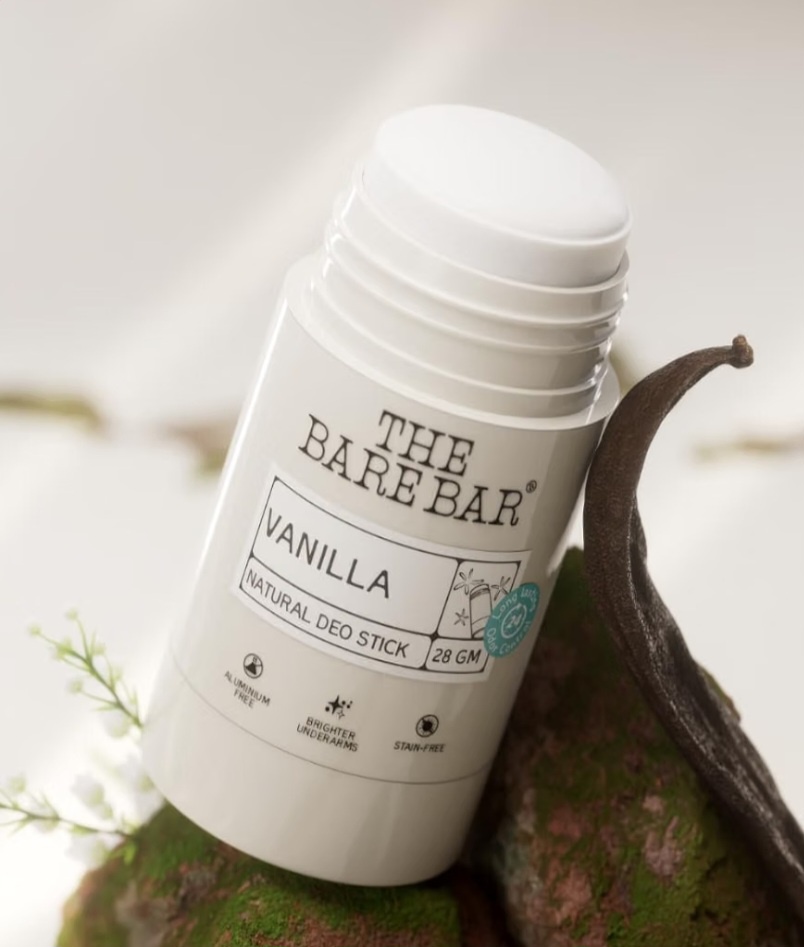
Ingredients overview
 INCI photo pending approval
Highlights
Key Ingredients
Skim through
The Bare Bar Natural Deo StickIngredients explained
A super common emollient that makes your skin feel nice and smooth. It comes from coconut oil and glycerin, it’s light-textured, clear, odorless and non-greasy. It’s a nice ingredient that just feels good on the skin, is super well tolerated by every skin type and easy to formulate with. No wonder it’s popular.
A super common emollient that makes your skin feel nice and smooth. It comes from coconut oil and glycerin, it’s light-textured, clear, odorless and non-greasy. It’s a nice ingredient that just feels good on the skin, is super well tolerated by every skin type and easy to formulate with. No wonder it’s popular.
A soft, white powder that can be used as a talc replacement in body powders or in pressed powders. It also has some oil absorbing properties and gives increased cushion and richness to emulsion-type formulas.
Unless you live under a rock you must have heard about shea butter. It's probably the most hyped up natural butter in skincare today. It comes from the seeds of African Shea or Karite Trees and used as a magic moisturizer and emollient.
But it's not only a simple emollient, it regenerates and soothes the skin, protects it from external factors (such as UV rays or wind) and is also rich in antioxidants (among others vitamin A, E, F, quercetin and epigallocatechin gallate). If you are looking for rich emollient benefits + more, shea is hard to beat.
A hydrocarbon wax consisting mainly of saturated straight chain hydrocarbons with C18-90+ carbon chain length. It has a high melting point (58-100 C) and it is used mainly in stick type products, such as lip balms to keep the product nice and solid.
A vegetable wax coming from the leaves of the Brazilian tropical palm tree, Copernicia cerifera. Similar to other waxes, it is used to stabilize and give body to products, or to keep stick type formulas solid. It is the hardest natural wax with a high melting point (around 85C) and high gloss making it a great wax choice for lip products.
 We don't have description for this ingredient yet.
Sunflower does not need a big intro as you probably use it in the kitchen as cooking oil, or you munch on the seeds as a healthy snack or you adore its big, beautiful yellow flower during the summer - or you do all of these and probably even more. And by even more we mean putting it all over your face as sunflower oil is one of the most commonly used plant oils in skincare.
It’s a real oldie: expressed directly from the seeds, the oil is used not for hundreds but thousands of years. According to The National Sunflower Association, there is evidence that both the plant and its oil were used by American Indians in the area of Arizona and New Mexico about 3000 BC. Do the math: it's more than 5000 years – definitely an oldie.
Our intro did get pretty big after all (sorry for that), so let's get to the point finally: sunflower oil - similar to other plant oils - is a great emollient that makes the skin smooth and nice and helps to keep it hydrated. It also protects the surface of the skin and enhances the damaged or irritated skin barrier. Leslie Bauman notes in Cosmetic Dermatology that one application of sunflower oil significantly speeds up the recovery of the skin barrier within an hour and sustains the results 5 hours after using it.
It's also loaded with fatty acids (mostly linoleic (50-74%) and oleic (14-35%)). The unrefined version (be sure to use that on your skin!) is especially high in linoleic acid that is great even for acne-prone skin. Its comedogen index is 0, meaning that it's pretty much an all skin-type oil.
Truth be told, there are many great plant oils and sunflower oil is definitely one of them.
We don't have description for this ingredient yet.
We don't have description for this ingredient yet.
It’s the most commonly used version of pure vitamin E in cosmetics. You can read all about the pure form here. This one is the so-called esterified version.
According to famous dermatologist, Leslie Baumann while tocopheryl acetate is more stable and has a longer shelf life, it’s also more poorly absorbed by the skin and may not have the same awesome photoprotective effects as pure Vit E.
We don't have description for this ingredient yet.
We don't have description for this ingredient yet.
Exactly what it sounds: nice smelling stuff put into cosmetic products so that the end product also smells nice. Fragrance in the US and parfum in the EU is a generic term on the ingredient list that is made up of 30 to 50 chemicals on average (but it can have as much as 200 components!).
If you are someone who likes to know what you put on your face then fragrance is not your best friend - there's no way to know what’s really in it.
Also, if your skin is sensitive, fragrance is again not your best friend. It’s the number one cause of contact allergy to cosmetics. It’s definitely a smart thing to avoid with sensitive skin (and fragrance of any type - natural is just as allergic as synthetic, if not worse!).
We don't have description for this ingredient yet.
We don't have description for this ingredient yet.
You may also want to take a look at...
| what‑it‑does | emollient |
| what‑it‑does | emollient |
| what‑it‑does | viscosity controlling |
| what‑it‑does | emollient |
| what‑it‑does | viscosity controlling |
| what‑it‑does | emollient |
| irritancy, com. | 0, 1 |
| what‑it‑does | viscosity controlling |
| what‑it‑does | emollient |
| irritancy, com. | 0, 0 |
| what‑it‑does | buffering |
| what‑it‑does | perfuming |
| what‑it‑does | antioxidant |
| irritancy, com. | 0, 0 |
| what‑it‑does | emollient |
| what‑it‑does | antioxidant | moisturizer/humectant |
| what‑it‑does | perfuming |
| what‑it‑does | perfuming |