




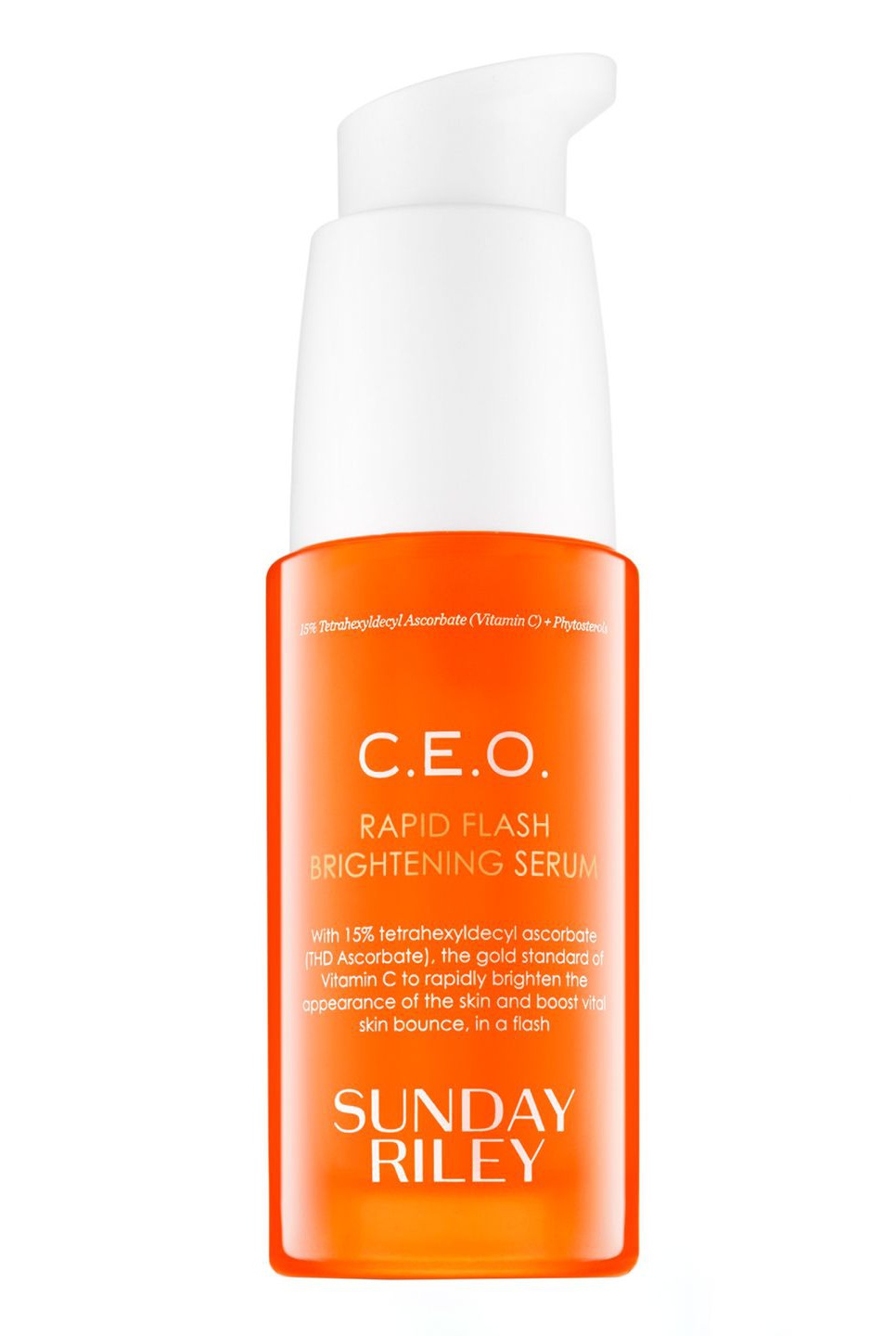
C.E.O. Rapid Flash Brightening Serum
Ingredients overview
Highlights
Key Ingredients
Skim through
Sunday Riley C.E.O. Rapid Flash Brightening SerumIngredients explained
Good old water, aka H2O. The most common skincare ingredient of all. You can usually find it right in the very first spot of the ingredient list, meaning it’s the biggest thing out of all the stuff that makes up the product.
It’s mainly a solvent for ingredients that do not like to dissolve in oils but rather in water.
Once inside the skin, it hydrates, but not from the outside - putting pure water on the skin (hello long baths!) is drying.
One more thing: the water used in cosmetics is purified and deionized (it means that almost all of the mineral ions inside it is removed). Like this, the products can stay more stable over time.
Tetrahexyldecyl Ascorbate is a stable, oil-soluble form of skincare big shot Vitamin C. If you do not know, why Vitamin C is such a big deal in skincare, click here and read all about it. We are massive vitamin C fans and have written about it in excruciating detail.
So now, you know that Vitamin C is great and all, but it's really unstable and gives cosmetics companies many headaches. To solve this problem they came up with vitamin C derivatives, and one of them is Tetrahexyldecyl Ascorbate (let's call it THDA in short).
It's a really promising candidate (see below), but while reading all the goodness about it in a minute, do not forget that derivatives not only have to be absorbed into the skin but also have to be converted to pure vitamin C (ascorbic acid or AA) and the efficacy of the conversion is often unknown. In addition, vitamin C's three magic properties (antioxidant, collagen booster, skin brightener) are all properly proven in-vivo (on real people), but for the derivatives, it's mostly in-vitro studies or in the case of THDA, it's in-vitro and done by an ingredient supplier.
With this context in mind let's see what THDA might be able to do. First, it is stable (if pH < 5), easy to formulate, and a joy to work with for a cosmetic chemist.
Second, because it's oil-soluble, its skin penetration abilities seem to be great. So great in fact, that it surpasses the penetration of pure vitamin C threefold at the same concentration and it penetrates successfully into the deeper layers of the skin (that is usually important to do some anti-aging work). There is also in-vitro data showing that it converts to AA in the skin.
Third, THDA seems to have all three magic abilities of pure vitamin C: it gives antioxidant protection from both UVB and UVA rays, it increases collagen synthesis (even more than AA) and it has a skin brightening effect by reducing melanogenesis by more than 80% in human melanoma cell cultures.
So this all sounds really great, but these are only in-vitro results at this point. We could find Tetrahexyldecyl Ascorbate mentioned only in one published in-vivo study that examined the anti-aging properties of a silicone formula containing 10% AA and 7% THDA. The authors theorized that the 10% AA is released slowly from the silicon delivery system and probably stays in the upper layer of the skin to give antioxidant benefits, while THDA penetrates more rapidly and deeply and gives some wrinkle-reducing benefits. The study was a small (10 patients), double-blind experiment, and the formula did show some measurable anti-aging results. However, it is hard to know how much pure vitamin C or THDA can be thanked.
Bottom line: a really promising, but not well-proven vitamin C derivative that can be worth a try especially if you like experimenting (but if you like the tried and true, pure vitamin C will be your best bet).
It seems to us that squalane is in fashion and there is a reason for it. Chemically speaking, it is a saturated (no double bonds) hydrocarbon (a molecule consisting only of carbon and hydrogen), meaning that it's a nice and stable oily liquid with a long shelf life.
It occurs naturally in certain fish and plant oils (e.g. olive), and in the sebum (the oily stuff our skin produces) of the human skin. As f.c. puts it in his awesome blog post, squalane's main things are "emolliency, surface occlusion, and TEWL prevention all with extreme cosmetic elegance". In other words, it's a superb moisturizer that makes your skin nice and smooth, without being heavy or greasy.
Another advantage of squalane is that it is pretty much compatible with all skin types and skin conditions. It is excellent for acne-prone skin and safe to use even if you have fungi-related skin issues, like seborrhea or fungal acne.
The unsaturated (with double bonds) and hence less stable version of Squalane is Squalene, you can read about it here >>
A hydrocarbon-based emollient that can come in different viscosities from silky-light through satiny-smooth to luxurious, rich. It forms a non-occlusive film on the surface of the skin and brings gloss without greasiness to the formula. It's a very pure and hypoallergenic emollient that's also ideal for baby care products.
 We don't have description for this ingredient yet.
It’s pretty much the current IT-preservative. It’s safe and gentle, but even more importantly, it’s not a feared-by-everyone-mostly-without-scientific-reason paraben.
It’s not something new: it was introduced around 1950 and today it can be used up to 1% worldwide. It can be found in nature - in green tea - but the version used in cosmetics is synthetic.
Other than having a good safety profile and being quite gentle to the skin it has some other advantages too. It can be used in many types of formulations as it has great thermal stability (can be heated up to 85°C) and works on a wide range of pH levels (ph 3-10).
It’s often used together with ethylhexylglycerin as it nicely improves the preservative activity of phenoxyethanol.
Acetamidoethoxyethanol is a high-performance moisturizer that's claimed to give both amazing instant and longer term (up to 30 hours) hydration to the skin. It works through interacting with water and keratin (skin protein) to keep the water molecules tightly bound in the upper layer of the skin. This binding mechanism supposedly ensures that Acetamidoethoxyethanol gives great hydration initially as well as over 30 hours.
It's also non-sticky, spreads nicely and easily on the skin and plays well with other common ingredients in the formula.
Jojoba-derived emollient wax esters (fatty acid + fatty alcohol) that make your skin feel nice and smooth. Chemically speaking, pure jojoba oil is also a wax ester (read our shiny explanation here), however, the ingredients called jojoba esters on the ingredient lists are made from jojoba oil and/or hydrogenated jojoba oil via interesterification.
They have multiple versions with variable fatty acid chain length and the ingredient can have a liquid, a creamy, a soft or firm paste, or even a hard wax consistency. The common thing between all versions is, that unlike most normal triglyceride oils, jojoba esters have superior stability, provide non-greasy emolliency and are readily absorbed into the skin.
A copolymer is a big molecule that consists not of one but of two repeating subunits. This particular copolymer is a handy helper ingredient to form nice gel textures.
It usually comes to the formula combined with emollients (such as C13-14 Isoparaffin, Isohexadecane, Isononyl Isononanoate or Squalane) and can be used as an emulsifier and/or thickener to produce milky gel emulsions with a soft and non-tacky skin feel.
We don't have description for this ingredient yet.
- Primary fat-soluble antioxidant in our skin
- Significant photoprotection against UVB rays
- Vit C + Vit E work in synergy and provide great photoprotection
- Has emollient properties
- Easy to formulate, stable and relatively inexpensive
- It’s the most researched AHA with the most proven skin benefits
- It gently lifts off dead skin cells to reveal newer, fresher, smoother skin
- It can help skin’s own collagen production that results in firmer, younger skin
- It can fade brown spots caused by sun damage or PIH
- Choose a product where you know the concentration and pH value because these two greatly influence effectiveness
- Don’t forget to use your sunscreen (in any case but especially so next to an AHA product)
- Slight stinging or burning with a stronger AHA product is normal
- If your skin is very sensitive, rosacea prone choose rather a BHA or PHA product
It’s a handy multi-tasking ingredient that gives the skin a nice, soft feel. At the same time, it also boosts the effectiveness of other preservatives, such as the nowadays super commonly used phenoxyethanol.
The blend of these two (caprylyl glycol + phenoxyethanol) is called Optiphen, which not only helps to keep your cosmetics free from nasty things for a long time but also gives a good feel to the finished product. It's a popular duo.
It’s one of those little helper ingredients that makes sure the product stays the same over time. No color change or anything like that. It does so by neutralizing the metal ions in the formula (that usually get into there from water) that would otherwise cause some not so nice changes.
The essential oil coming from the sweet orange. In the case of orange (and citruses in general), the essential oil is mainly in the peel of the fruit, so it's pretty much the same as the orange peel oil (also has the same CAS number - a unique ID assigned to chemicals).
Its main component is limonene (up to 97%), a super common fragrant ingredient that makes everything smell nice (but counts as a frequent skin sensitizer).
A little helper ingredient that works as a preservative. It works against bacteria and some species of fungi and yeast. It's often combined with IT-preservative, phenoxyethanol.
It's the yellow, solid stuff that you probably know from beeswax candles. It's a natural material produced by honey bees to build their honeycomb.
As for skincare, it's used as an emollient and thickening agent. It's super common in lip balms and lipsticks.
- A natural moisturizer that’s also in our skin
- A super common, safe, effective and cheap molecule used for more than 50 years
- Not only a simple moisturizer but knows much more: keeps the skin lipids between our skin cells in a healthy (liquid crystal) state, protects against irritation, helps to restore barrier
- Effective from as low as 3% with even more benefits for dry skin at higher concentrations up to 20-40%
- High-glycerin moisturizers are awesome for treating severely dry skin
It seems to us that squalane is in fashion and there is a reason for it. Chemically speaking, it is a saturated (no double bonds) hydrocarbon (a molecule consisting only of carbon and hydrogen), meaning that it's a nice and stable oily liquid with a long shelf life.
It occurs naturally in certain fish and plant oils (e.g. olive), and in the sebum (the oily stuff our skin produces) of the human skin. As f.c. puts it in his awesome blog post, squalane's main things are "emolliency, surface occlusion, and TEWL prevention all with extreme cosmetic elegance". In other words, it's a superb moisturizer that makes your skin nice and smooth, without being heavy or greasy.
Another advantage of squalane is that it is pretty much compatible with all skin types and skin conditions. It is excellent for acne-prone skin and safe to use even if you have fungi-related skin issues, like seborrhea or fungal acne.
The unsaturated (with double bonds) and hence less stable version of Squalane is Squalene, you can read about it here >>
This ingredient name is not according to the INCI-standard. :( What, why?!
A 100% natural and plant-derived moisturizer that mimics the natural carbohydrate fraction found in the upper layer of the skin. Its special magic power is to bind to the skin stronger and longer than other moisturizer ingredients do so it can keep the skin hydrated longer than usual.
You may also want to take a look at...
| what‑it‑does | solvent |
| what‑it‑does | antioxidant | skin brightening |
| what‑it‑does | skin-identical ingredient | emollient |
| irritancy, com. | 0, 1 |
| what‑it‑does | emulsifying |
| what‑it‑does | emollient | perfuming | solvent |
| what‑it‑does | emulsifying |
| what‑it‑does | preservative |
| what‑it‑does | moisturizer/humectant |
| what‑it‑does | soothing | emollient | moisturizer/humectant |
| what‑it‑does | viscosity controlling |
| what‑it‑does | emollient |
| what‑it‑does | antioxidant |
| irritancy, com. | 0-3, 0-3 |
| what‑it‑does | exfoliant | buffering |
| what‑it‑does | moisturizer/humectant | emollient |
| what‑it‑does | chelating |
| what‑it‑does | perfuming |
| what‑it‑does | preservative | antimicrobial/antibacterial |
| what‑it‑does | emollient | viscosity controlling | emulsifying | perfuming |
| irritancy, com. | 0, 0-2 |
| what‑it‑does | skin-identical ingredient | moisturizer/humectant |
| irritancy, com. | 0, 0 |
| what‑it‑does | skin-identical ingredient | emollient |
| irritancy, com. | 0, 1 |
| what‑it‑does | moisturizer/humectant |