




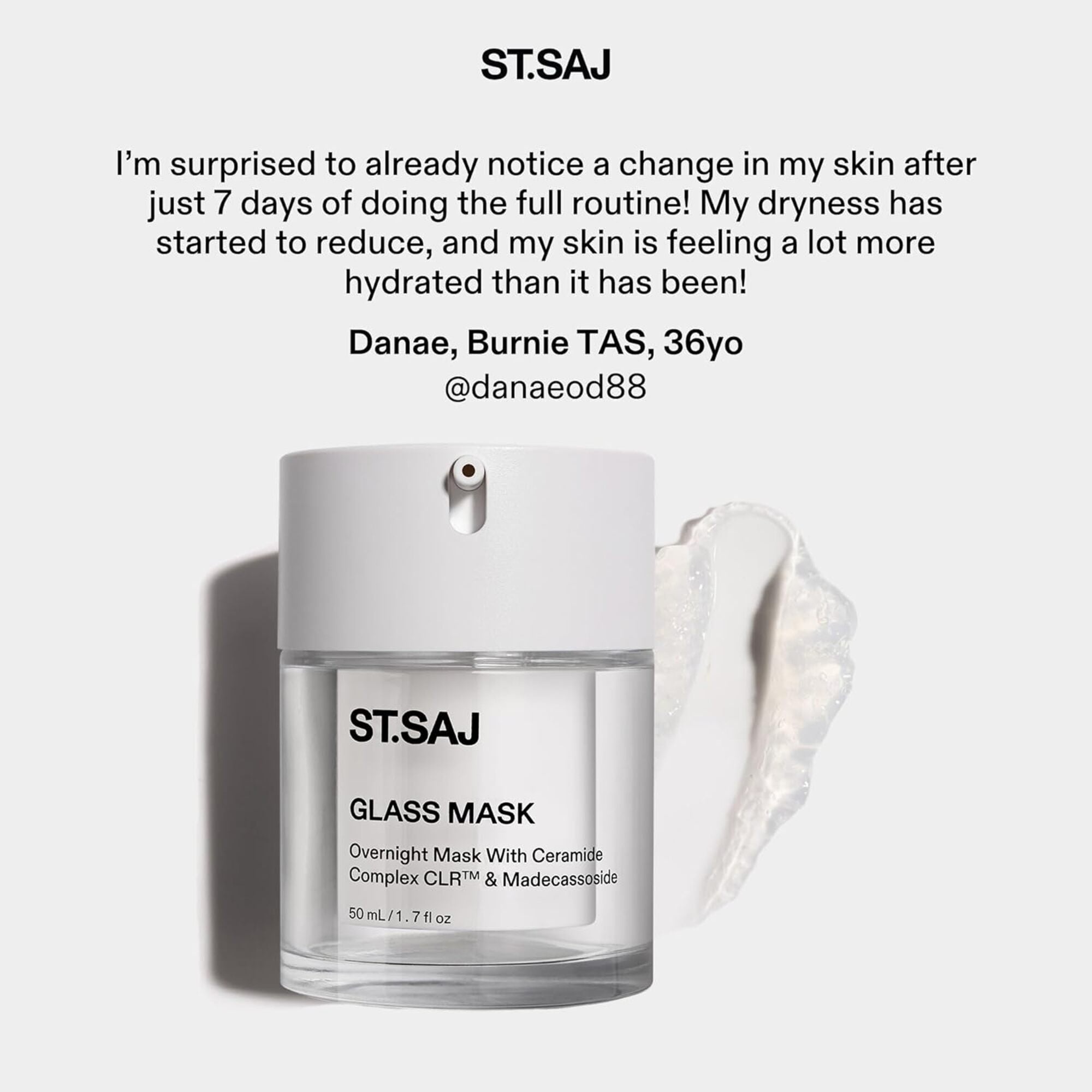
Ingredients overview
Highlights
Key Ingredients
Other Ingredients
Skim through
ST. SAJ Glass MaskIngredients explained
Good old water, aka H2O. The most common skincare ingredient of all. You can usually find it right in the very first spot of the ingredient list, meaning it’s the biggest thing out of all the stuff that makes up the product.
It’s mainly a solvent for ingredients that do not like to dissolve in oils but rather in water.
Once inside the skin, it hydrates, but not from the outside - putting pure water on the skin (hello long baths!) is drying.
One more thing: the water used in cosmetics is purified and deionized (it means that almost all of the mineral ions inside it is removed). Like this, the products can stay more stable over time.
- A natural moisturizer that’s also in our skin
- A super common, safe, effective and cheap molecule used for more than 50 years
- Not only a simple moisturizer but knows much more: keeps the skin lipids between our skin cells in a healthy (liquid crystal) state, protects against irritation, helps to restore barrier
- Effective from as low as 3% with even more benefits for dry skin at higher concentrations up to 20-40%
- High-glycerin moisturizers are awesome for treating severely dry skin
A multi-functional, silky feeling helper ingredient that can do quite many things. It's used as an emulsion stabilizer, solvent and a broad spectrum antimicrobial. According to manufacturer info, it's also a moisturizer and helps to make the product feel great on the skin. It works synergistically with preservatives and helps to improve water-resistance of sunscreens.
Propanediol is a natural alternative for the often used and often bad-mouthed propylene glycol. It's produced sustainably from corn sugar and it's Ecocert approved.
It's quite a multi-tasker: can be used to improve skin moisturization, as a solvent, to boost preservative efficacy or to influence the sensory properties of the end formula.
It's a helper ingredient that helps to thicken up formulas and form a nice gel texture. It leaves a rich, elegant feel with a velvety finish on the skin and works over a wide pH range.
 We don't have description for this ingredient yet.
Beetroot is a beautifully colored vegetable that you probably know from the kitchen. As for skincare - according to manufacturer info - it works as a natural moisturizer that might be able to increase the concentration of NMFs (natural moisturizing factors) in the upper layer of the skin giving skin both immediate and longer term hydration.
According to Paula's Choice, it's also a colorant and a source of antioxidants.
A type of lipid that's the major (about 75%) component of all cell membranes. As for skincare, it works as an emollient and skin-identical ingredient.
It has a water-loving head with two water-hating tails and this structure gives the molecule emulsifying properties. It is also often used to create liposomes, small spheres surrounded by phospholipid bi-layer designed to carry some active ingredient and help its absorption.
A big sugar molecule (polysaccharide) that is used as a natural thickening and gelling agent. It is similar to more commonly used Xanthan Gum, and the two are also often combined to create gel formulas or to stabilize emulsions.
We don't have description for this ingredient yet.
- It's one of the gold standard ingredients for treating problem skin
- It can exfoliate skin both on the surface and in the pores
- It's a potent anti-inflammatory agent
- It's more effective for treating blackheads than acne
- For acne combine it with antibacterial agents like benzoyl peroxide or azelaic acid
One of the main biologically active components of the famous medicinal plant, Centella Asiatica, aka Gotu Kola. It has well established wound healing, skin-soothing and antioxidant activities.
There is also a study by La Roche Posay (belongs to L'Oreal) that examined the anti-aging effects of 5% Vitamin C combined with 0.1% Madecassoside. They mention that " Madecassoside is known to induce collagen expression and ⁄ or to modulate inflammatory mediators thus might prevent and correct some signs of aging." The surprisingly long, 6-month study observed "significant improvement of the clinical score for deep and superficial wrinkles, suppleness, firmness, roughness, and skin hydration", but Vitamin C in itself is already an anti-aging superstar, so it is hard to know how much Madecassoside did.
Another promising property of Madecassoside is that it seems to inhibit UV-induced melanin synthesis (test formula with 0.05% MA, used twice a day on 23 volunteers for 8 weeks), making it a great active for hyperpigmentation-prone skin.
If that would not be enough, the French manufacturer (Seppic) also has encouraging in-vivo studies on the molecule. Used at 0.2%, Madecassoside reduces redness and peeling in skin with light atopic dermatitis as well as itching in psoriasis-prone skin.
Exactly what it sounds: nice smelling stuff put into cosmetic products so that the end product also smells nice. Fragrance in the US and parfum in the EU is a generic term on the ingredient list that is made up of 30 to 50 chemicals on average (but it can have as much as 200 components!).
If you are someone who likes to know what you put on your face then fragrance is not your best friend - there's no way to know what’s really in it.
Also, if your skin is sensitive, fragrance is again not your best friend. It’s the number one cause of contact allergy to cosmetics. It’s definitely a smart thing to avoid with sensitive skin (and fragrance of any type - natural is just as allergic as synthetic, if not worse!).
Hydrolyzed Hyaluronic Acid is a low molecular weight, chemically chopped up version of the naturally big molecule and current IT-moisturizer, Hyaluronic Acid (HA). The TL; DR version of HA is that it's a huge polymer (big molecule from repeated subunits) found in the skin that acts as a sponge helping the skin to retain water, making it plump and elastic. As HA is a polymer, the subunits can be repeated many times (as a high-molecular-weight version), or just a few times (as a low-molecular-weight version).
We wrote in detail at HA about how different molecular weight versions do different things both as a component of the skin and as a skincare ingredient, so click here and read about all the details. Hydrolyzed Hyaluronic Acid can also come in different molecular-weight versions with different properties:
- 100-300 kDa version: apart from moisturizing, this size might also help the skin to repair itself by increasing its self-defense. It is also claimed to boost the wound healing process and is especially helpful for sensitive skin types (acne, rosacea, inflammation-related skin diseases).
- 50k Da version: this is the size that is claimed to be able to absorb into the skin and plump up wrinkles, so it is used mainly as an "anti-aging ingredient"
- below 50k, around 10k Da version: there is a Japanese version trade named Hyalo-Oligo that has only a 10k molecular weight and is claimed to penetrate the skin very well, have a unique touch and give deep and long-lasting moisturization. Based on the Evonik-research and the natural role of LMW-HA in the body working as a pro-inflammatory signal molecule, this ultra-low molecular weight version is a controversial ingredient.
If you wanna become a real HA-and-the-skin expert, you can read much more about the topic at hyaluronic acid (including penetration-questions, differences between high and low molecular weight versions and a bunch of references to scientific literature).
The essential oil coming from the rind of the orange (the sweet one). In general, the main component of citrus peel oils is limonene (83-97% for sweet orange peel), a super common fragrant ingredient that makes everything smell nice (but counts as a frequent skin sensitizer).
Other than that, citrus peel also contains the problematic compound called furanocoumarin that makes them mildly phototoxic. Orange peel contains less of it than some other citruses (like bergamot or lime), but still, be careful with it especially if it is in a product for daytime use.
The fragrant essential oil coming from the flowers of Rose Geranium. Like most essential oils, it contains antioxidant and antimicrobial components, but the main ones are fragrant constituents (like citronellol and geraniol). Be careful with it, if your skin is sensitive.
The essential oil coming from the peel of the bergamot orange. It's a common top note in perfumes and contains (among others) fragrant compounds limonene (37%), linalyl acetate (30%) and linalool (8.8%).
Fragrant compounds smell nice but are common allergens and can be a problem for sensitive skin types. The bigger problem with bergamot oil though, is that it also contains furanocoumarins (more specifically, bergapten and bergamottin) that have well-documented phototoxic effects. A phototoxic reaction is a not nice one causing red, edematous lesions on the affected area. We think it is a good idea to avoid bergamot oil but if you have a product that you love, make sure to use it at night only.
Nowadays, furanocoumarin-free versions of bergamot oil are also available and more and more common, and they usually go by the INCI name Bergamot Fruit Oil.
It's one of those things that help your cosmetics not to go wrong too soon, aka a preservative. It can be naturally found in fruits and teas but can also be made synthetically.
No matter the origin, in small amounts (up to 1%) it’s a nice, gentle preservative. Has to be combined with some other nice preservatives, like potassium sorbate to be broad spectrum enough.
In high amounts, it can be a skin irritant, but don’t worry, it’s never used in high amounts.
A mild, natural preservative that usually comes to the formula together with its other mild preservative friends, such as Benzoic Acid and/or Dehydroacetic Acid. Btw, it's also used as a food preservative.
Though the official function of P-Anisic Acid is masking (meaning that it helps to mask not so nice smells in the product), according to manufacturer info it is rather used as a preservative. It is a skin friendly organic acid that works against fungi.
A little helper ingredient that is used to adjust the pH of the product. It also helps to keep products stay nice longer by neutralizing the metal ions in the formula (they usually come from water).
- It’s the second most researched AHA after glycolic acid
- It gently lifts off dead skin cells to reveal newer, fresher, smoother skin
- It also has amazing skin hydrating properties
- In higher concentration (10% and up) it improves skin firmness, thickness and wrinkles
- Choose a product where you know the concentration and pH value because these two greatly influence effectiveness
- Don’t forget to use your sunscreen (in any case but especially so next to an AHA product)
Linalool is a super common fragrance ingredient. It’s kind of everywhere - both in plants and in cosmetic products. It’s part of 200 natural oils including lavender, ylang-ylang, bergamot, jasmine, geranium and it can be found in 90-95% of prestige perfumes on the market.
The problem with linalool is, that just like limonene it oxidises on air exposure and becomes allergenic. That’s why a product containing linalool that has been opened for several months is more likely to be allergenic than a fresh one.
A study made in the UK with 483 people tested the allergic reaction to 3% oxidised linalool and 2.3% had positive test results.
Geraniol is a common fragrance ingredient. It smells like rose and can be found in rose oil or in small quantities in geranium, lemon and many other essential oils.
Just like other similar fragrance ingredients (like linalool and limonene) geraniol also oxidises on air exposure and becomes allergenic. Best to avoid if you have sensitive skin.
Citronellol is a very common fragrance ingredient with a nice rose-like odor. In the UK, it’s actually the third most often listed perfume on the ingredient lists.
It can be naturally found in geranium oil (about 30%) or rose oil (about 25%).
As with all fragrance ingredients, citronellol can also cause allergic contact dermatitis and should be avoided if you have perfume allergy. In a 2001 worldwide study with 178 people with known sensitization to fragrances citronellol tested positive in 5.6% of the cases.
There is no known anti-aging or positive skin benefits of the ingredient. It’s in our products to make it smell nice.
It’s a common fragrance ingredient that smells like lemon and has a bittersweet taste. It can be found in many plant oils, e.g. lemon, orange, lime or lemongrass.
It’s one of the “EU 26 fragrances” that has to be labelled separately (and cannot be simply included in the term “fragrance/perfume” on the label) because of allergen potential. Best to avoid if your skin is sensitive.
It’s pretty much the current IT-preservative. It’s safe and gentle, but even more importantly, it’s not a feared-by-everyone-mostly-without-scientific-reason paraben.
It’s not something new: it was introduced around 1950 and today it can be used up to 1% worldwide. It can be found in nature - in green tea - but the version used in cosmetics is synthetic.
Other than having a good safety profile and being quite gentle to the skin it has some other advantages too. It can be used in many types of formulations as it has great thermal stability (can be heated up to 85°C) and works on a wide range of pH levels (ph 3-10).
It’s often used together with ethylhexylglycerin as it nicely improves the preservative activity of phenoxyethanol.
A little helper ingredient that is used to adjust the pH of the product. It also helps to keep products stay nice longer by neutralizing the metal ions in the formula (they usually come from water).
You may also want to take a look at...
| what‑it‑does | solvent |
| what‑it‑does | skin-identical ingredient | moisturizer/humectant |
| irritancy, com. | 0, 0 |
| what‑it‑does | solvent | moisturizer/humectant |
| what‑it‑does | solvent | moisturizer/humectant |
| what‑it‑does | viscosity controlling |
| what‑it‑does | moisturizer/humectant |
| what‑it‑does | antioxidant | moisturizer/humectant |
| what‑it‑does | skin-identical ingredient | emollient |
| what‑it‑does | emollient |
| what‑it‑does | viscosity controlling |
| what‑it‑does | buffering | moisturizer/humectant |
| what‑it‑does | exfoliant | anti-acne | soothing | preservative |
| what‑it‑does | antioxidant | soothing |
| what‑it‑does | perfuming |
| what‑it‑does | moisturizer/humectant |
| what‑it‑does | perfuming |
| what‑it‑does | perfuming |
| what‑it‑does | perfuming |
| what‑it‑does | preservative | perfuming | solvent | viscosity controlling |
| what‑it‑does | preservative |
| what‑it‑does | preservative |
| what‑it‑does | chelating | buffering |
| what‑it‑does | exfoliant | moisturizer/humectant | buffering |
| what‑it‑does | perfuming |
| what‑it‑does | perfuming |
| what‑it‑does | perfuming |
| what‑it‑does | perfuming |
| what‑it‑does | perfuming |
| what‑it‑does | preservative |
| what‑it‑does | chelating | buffering |