




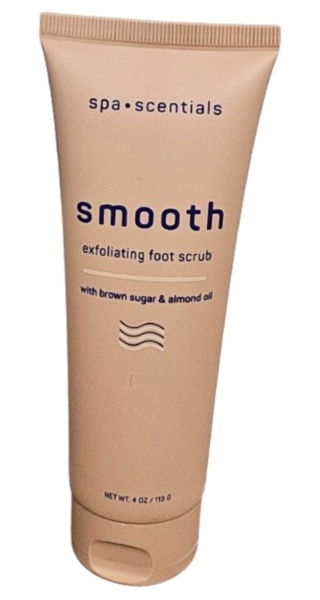
Smooth

Highlights
Other Ingredients
Skim through
| Ingredient name | what-it-does | irr., com. | ID-Rating |
|---|---|---|---|
| Water (Aqua) | solvent | ||
| Carbomer | viscosity controlling | 0, 1 | |
| Glycerin | skin-identical ingredient, moisturizer/humectant | 0, 0 | superstar |
| Lactose | moisturizer/humectant | ||
| Microcrystalline Cellulose | viscosity controlling | ||
| Sucrose | moisturizer/humectant, soothing | goodie | |
| Hydroxypropyl Methylcellulose | surfactant/cleansing, viscosity controlling | 0, 1 | |
| Sodium Hydroxide | buffering | ||
| Isopropyl Palmitate | emollient | 1, 3-4 | |
| Phenoxyethanol | preservative | ||
| Fragrance (Parfum) | perfuming | icky | |
| Chlorphenesin | preservative, antimicrobial/antibacterial | ||
| Menthol | soothing | icky | |
| Butyrospermum Parkii Butter | emollient | goodie | |
| Polyethylene | viscosity controlling | ||
| Almond Oil | emollient | 0, 1-3 | goodie |
Spa Scentials SmoothIngredients explained
Good old water, aka H2O. The most common skincare ingredient of all. You can usually find it right in the very first spot of the ingredient list, meaning it’s the biggest thing out of all the stuff that makes up the product.
It’s mainly a solvent for ingredients that do not like to dissolve in oils but rather in water.
Once inside the skin, it hydrates, but not from the outside - putting pure water on the skin (hello long baths!) is drying.
One more thing: the water used in cosmetics is purified and deionized (it means that almost all of the mineral ions inside it is removed). Like this, the products can stay more stable over time.
A big molecule created from repeated subunits (a polymer of acrylic acid) that magically converts a liquid into a nice gel formula. It usually has to be neutralized with a base (such as sodium hydroxide) for the thickening to occur and it creates viscous, clear gels that also feel nice and non-tacky on the skin. No wonder, it is a very popular and common ingredient. Typically used at 1% or less in most formulations.
- A natural moisturizer that’s also in our skin
- A super common, safe, effective and cheap molecule used for more than 50 years
- Not only a simple moisturizer but knows much more: keeps the skin lipids between our skin cells in a healthy (liquid crystal) state, protects against irritation, helps to restore barrier
- Effective from as low as 3% with even more benefits for dry skin at higher concentrations up to 20-40%
- High-glycerin moisturizers are awesome for treating severely dry skin
 We don't have description for this ingredient yet.
Cellulose is an important component of the cell walls of green plants and it's the most abundant natural polymer (big molecule from repeated subunits) on Earth. If the polymer structure is not too big (less than 200 repeated units), cellulose becomes microcrystalline cellulose.
In skin care, it comes as a fine or less fine white powder. The less fine (bigger particle size) version is used as a gentle scrubbing agent (a nice natural, biodegradable alternative to now banned plastic polyethylene) and the ultra fine version is used as a helper ingredient that gives a super-silky, soft touch, reduces tackiness or greasiness and can also be used as a mattifying agent.
Combined with Cellulose Gum, it also works as a nice gelling agent.
A type fo sugar, usually refined from cane or beet sugar. On the skin, it has water-binding properties and helps to keep your skin hydrated.
A handy helper ingredient (a polymer, i.e. big molecule from repeated subunits) that is used to stabilize emulsions as well as to thicken up products. It can also stabilize foam in cleansing products.
The unfancy name for it is lye. It’s a solid white stuff that’s very alkaline and used in small amounts to adjust the pH of the product and make it just right.
For example, in case of AHA or BHA exfoliants, the right pH is super-duper important, and pH adjusters like sodium hydroxide are needed.
BTW, lye is not something new. It was already used by ancient Egyptians to help oil and fat magically turn into something else. Can you guess what? Yes, it’s soap. It still often shows up in the ingredient list of soaps and other cleansers.
Sodium hydroxide in itself is a potent skin irritant, but once it's reacted (as it is usually in skin care products, like exfoliants) it is totally harmless.
A clear, colorless emollient ester (oily liquid from isopropyl alcohol + palmitic acid) that makes the skin nice and smooth. It has very good spreading properties and gives a silky touch to the products.
It’s pretty much the current IT-preservative. It’s safe and gentle, but even more importantly, it’s not a feared-by-everyone-mostly-without-scientific-reason paraben.
It’s not something new: it was introduced around 1950 and today it can be used up to 1% worldwide. It can be found in nature - in green tea - but the version used in cosmetics is synthetic.
Other than having a good safety profile and being quite gentle to the skin it has some other advantages too. It can be used in many types of formulations as it has great thermal stability (can be heated up to 85°C) and works on a wide range of pH levels (ph 3-10).
It’s often used together with ethylhexylglycerin as it nicely improves the preservative activity of phenoxyethanol.
Exactly what it sounds: nice smelling stuff put into cosmetic products so that the end product also smells nice. Fragrance in the US and parfum in the EU is a generic term on the ingredient list that is made up of 30 to 50 chemicals on average (but it can have as much as 200 components!).
If you are someone who likes to know what you put on your face then fragrance is not your best friend - there's no way to know what’s really in it.
Also, if your skin is sensitive, fragrance is again not your best friend. It’s the number one cause of contact allergy to cosmetics. It’s definitely a smart thing to avoid with sensitive skin (and fragrance of any type - natural is just as allergic as synthetic, if not worse!).
A little helper ingredient that works as a preservative. It works against bacteria and some species of fungi and yeast. It's often combined with IT-preservative, phenoxyethanol.
Menthol needs no introduction: it's the thing that causes the cooling sensation so well-known both from cosmetic products as well as a bunch of other things like chocolate, chewing gum, toothpaste or cigarette. It's a natural compound that comes from the essential oil of Mentha species (peppermint oil contains 40-50% menthol) and it gives them their typical minty smell and flavor.
As for skincare, menthol seems to be a mixed bag. Apart from the cool cooling sensation (that might last up to 70 mins!), it also has painkilling, itch reducing, antibacterial, antifungal and even penetration enhancing properties. On the other hand, it also seems to act as a skin irritant that increases trans-epidermal water loss (the water that evaporates from the outer layer of the skin) and thus contributes to drying out the skin.
Unless you live under a rock you must have heard about shea butter. It's probably the most hyped up natural butter in skincare today. It comes from the seeds of African Shea or Karite Trees and used as a magic moisturizer and emollient.
But it's not only a simple emollient, it regenerates and soothes the skin, protects it from external factors (such as UV rays or wind) and is also rich in antioxidants (among others vitamin A, E, F, quercetin and epigallocatechin gallate). If you are looking for rich emollient benefits + more, shea is hard to beat.
Polyethylene is the most common plastic in the world. It is a super versatile polymer (molecule from repeated subunits) and when it comes to cosmetics, it is often referred to as microbeads. Well, it used to be referred to as microbeads, as it was banned in 2015 in the " Microbead-Free Waters Act" due to the small plastic spheres accumulating in the waters and looking like food to fish. Well done by Obama.
But being versatile means that polyethylene does not only come as scrub particles but also as a white wax. In its wax-form, it is still well, alive and pretty popular. It thickens up water-free formulas, increases hardness and raises the melting point of emulsions and water-less balms. It is particularly common in cleansing balms and stick-type makeup products due to its ability to add body, hardness and slip to these formulas.
The emollient plant oil that comes from almonds. Similar to other plant oils, it is loaded with skin-nourishing fatty acids (oleic acid - 55-86% and linoleic acid 7-35%) and contains several other skin goodies such as antioxidant vitamin E and vitamin B versions.
It's a nice, basic oil that is often used due to its great smoothing, softening and moisturizing properties. It's also particularly good at treating dry brittle nails (source).
You may also want to take a look at...
| what‑it‑does | solvent |
| what‑it‑does | viscosity controlling |
| irritancy, com. | 0, 1 |
| what‑it‑does | skin-identical ingredient | moisturizer/humectant |
| irritancy, com. | 0, 0 |
| what‑it‑does | moisturizer/humectant |
| what‑it‑does | viscosity controlling |
| what‑it‑does | moisturizer/humectant | soothing |
| what‑it‑does | surfactant/cleansing | viscosity controlling |
| irritancy, com. | 0, 1 |
| what‑it‑does | buffering |
| what‑it‑does | emollient |
| irritancy, com. | 1, 3-4 |
| what‑it‑does | preservative |
| what‑it‑does | perfuming |
| what‑it‑does | preservative | antimicrobial/antibacterial |
| what‑it‑does | soothing |
| what‑it‑does | emollient |
| what‑it‑does | viscosity controlling |
| what‑it‑does | emollient |
| irritancy, com. | 0, 1-3 |