




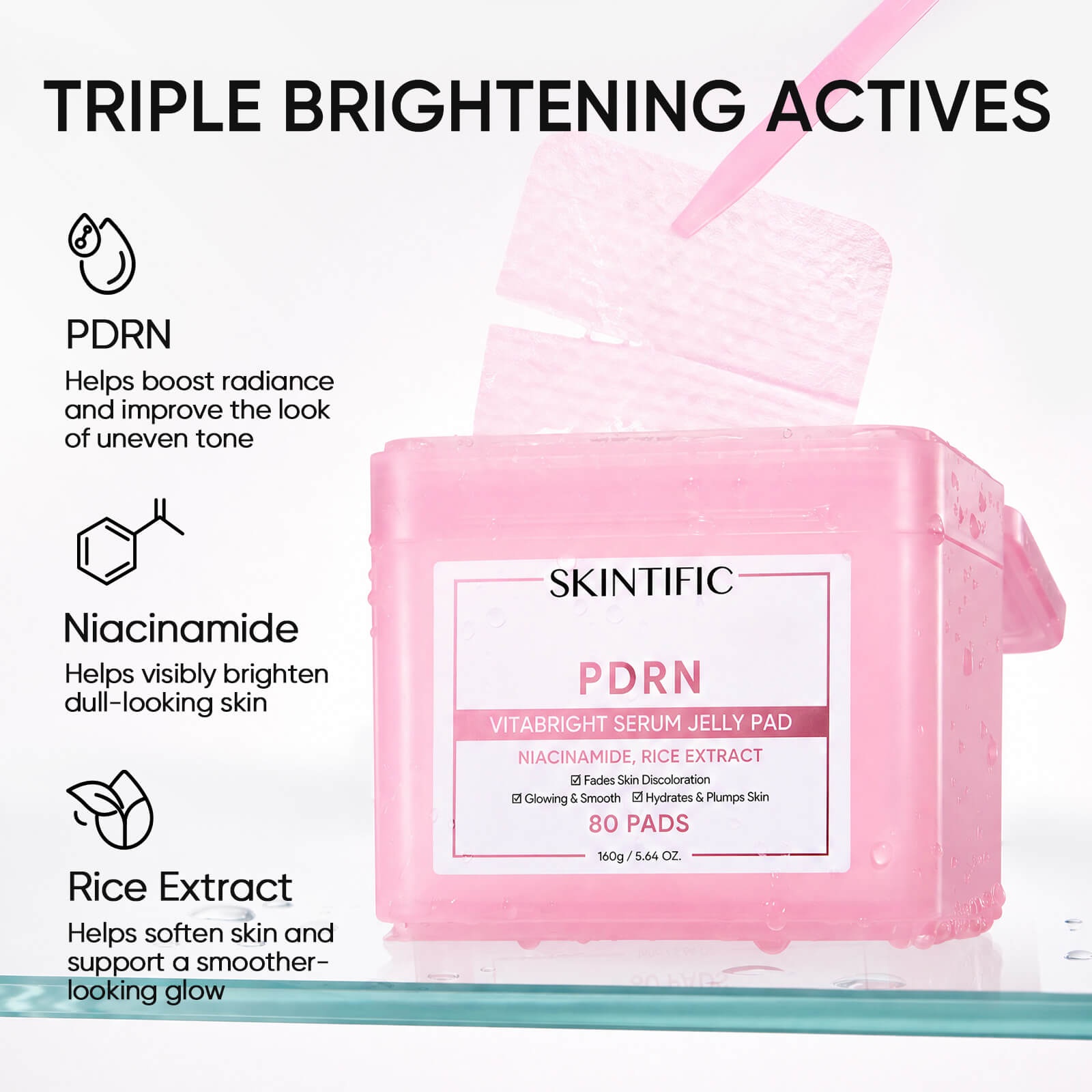
Pdrn Vitabright Serum Jelly Pad
Ingredients overview
Highlights
Key Ingredients
Other Ingredients
Skim through
Skintific Pdrn Vitabright Serum Jelly PadIngredients explained
Good old water, aka H2O. The most common skincare ingredient of all. You can usually find it right in the very first spot of the ingredient list, meaning it’s the biggest thing out of all the stuff that makes up the product.
It’s mainly a solvent for ingredients that do not like to dissolve in oils but rather in water.
Once inside the skin, it hydrates, but not from the outside - putting pure water on the skin (hello long baths!) is drying.
One more thing: the water used in cosmetics is purified and deionized (it means that almost all of the mineral ions inside it is removed). Like this, the products can stay more stable over time.
Butylene glycol, or let’s just call it BG, is a multi-tasking colorless, syrupy liquid. It’s a great pick for creating a nice feeling product.
BG’s main job is usually to be a solvent for the other ingredients. Other tasks include helping the product to absorb faster and deeper into the skin (penetration enhancer), making the product spread nicely over the skin (slip agent), and attracting water (humectant) into the skin.
It’s an ingredient whose safety hasn’t been questioned so far by anyone (at least not that we know about). BG is approved by Ecocert and is also used enthusiastically in natural products. BTW, it’s also a food additive.
- It's a helper ingredient that improves the freeze-thaw stability of products
- It's also a solvent, humectant and to some extent a penetration enhancer
- It has a bad reputation among natural cosmetics advocates but cosmetic scientists and toxicology experts do not agree (read more in the geeky details section)
- A natural moisturizer that’s also in our skin
- A super common, safe, effective and cheap molecule used for more than 50 years
- Not only a simple moisturizer but knows much more: keeps the skin lipids between our skin cells in a healthy (liquid crystal) state, protects against irritation, helps to restore barrier
- Effective from as low as 3% with even more benefits for dry skin at higher concentrations up to 20-40%
- High-glycerin moisturizers are awesome for treating severely dry skin
- A multi-functional skincare superstar with several proven benefits for the skin
- Great anti-aging, wrinkle smoothing ingredient used at 4-5% concentration
- Fades brown spots alone or in combination with amino sugar, acetyl glucosamine
- Increases ceramide synthesis that results in a stronger, healthier skin barrier and better skin hydration
- Can help to improve several skin conditions including acne, rosacea, and atopic dermatitis
A really multi-functional helper ingredient that can do several things in a skincare product: it can bring a soft and pleasant feel to the formula, it can act as a humectant and emollient, it can be a solvent for some other ingredients (for example it can help to stabilize perfumes in watery products) and it can also help to disperse pigments more evenly in makeup products. And that is still not all: it can also boost the antimicrobial activity of preservatives.
A handy multifunctional ingredient that works as a preservative booster, as well as an antioxidant and soothing agent.
 We don't have description for this ingredient yet.
Though its name does not reveal it, Carnosine is a peptide, a small, two amino acid (β-Ala-His) one. It is naturally present in high concentrations in muscle and brain tissues, but the one used in cosmetic products is biomimetic, meaning that it is synthetically produced in a lab to copy the natural thing.
A 2017 review paper on topical peptides writes about Carnosine that it is a "well-documented aqueous antioxidant with wound healing activity".
Other than that we can write about manufacturer-done in-vitro (in the lab, not on real people) studies that show Carnosine to have anti-glycation properties. Glycation is the not-so-nice process that happens when we bombard our body with too much sugar that results in damaged body proteins and eventually in more wrinkles.
Also, a manufacturer done in vitro study shows that carnosine might have collagen-boosing magic power. However, the 2017 research paper also mentions that even though Carnosine is a small molecule, it is water soluble and does not penetrate the skin past the top layers so we have some doubt if the collagen-boosting works in real life. We could find one anti-aging study made on real people that mentions Carnosine, but it was combined with a bunch of other anti-aging actives so it is pretty much impossible to know what Carnosine did or did not.
One last thing to mention is that there is also a manufacturer done clinical study (done on real people) that shows carnosine being effective against the damages caused by infrared (IR) radiation. (source)
It’s the - sodium form - cousin of the famous NMF, hyaluronic acid (HA). If HA does not tell you anything we have a super detailed, geeky explanation about it here. The TL; DR version of HA is that it's a huge polymer (big molecule from repeated subunits) found in the skin that acts as a sponge helping the skin to hold onto water, being plump and elastic. HA is famous for its crazy water holding capacity as it can bind up to 1000 times its own weight in water.
As far as skincare goes, sodium hyaluronate and hyaluronic acid are pretty much the same and the two names are used interchangeably. As cosmetic chemist kindofstephen writes on reddit "sodium hyaluronate disassociates into hyaluronic acid molecule and a sodium atom in solution".
In spite of this, if you search for "hyaluronic acid vs sodium hyaluronate" you will find on multiple places that sodium hyaluronate is smaller and can penetrate the skin better. Chemically, this is definitely not true, as the two forms are almost the same, both are polymers and the subunits can be repeated in both forms as much as you like. (We also checked Prospector for sodium hyaluronate versions actually used in cosmetic products and found that the most common molecular weight was 1.5-1.8 million Da that absolutely counts as high molecular weight).
What seems to be a true difference, though, is that the salt form is more stable, easier to formulate and cheaper so it pops up more often on the ingredient lists.
If you wanna become a real HA-and-the-skin expert you can read way more about the topic at hyaluronic acid (including penetration-questions, differences between high and low molecular weight versions and a bunch of references to scientific literature).
A nice little helper ingredient that can thicken up cosmetic products and create beautiful gel formulas. It's derived from cellulose, the major component of the cell wall of green plants. It is compatible with most co-ingredients and gives a very good slip to the formulas.
We don't have description for this ingredient yet.
We don't have description for this ingredient yet.
We don't have description for this ingredient yet.
The extract coming from the juice containing leaves of the Aloe vera plant. It's usually a hydroglycolic extract (though oil extract for the lipid parts also exists) that has similar moisturizing, emollient and anti-inflammatory properties as the juice itself. We have written some more about aloe here.
Glyceryl acrylate/acrylic acid copolymer is the fancy word for a common polymer (big molecule from repeated subunits), namely polyacrylic acid (aka carbomer when it comes to cosmetics) with glycerin attached to it in some places.
The main thing of this polymer is that it forms a hydrogel (trade named Lubrajel) that can sit on top of the skin and provide moisturizing, water-soluble ingredients such as glycerin to the skin. Think of it as a very thin, wet sponge that a cosmetic manufacturer can fill with good ingredients for your skin. It also works as a thickening agent (remember, it is a carbomer type of molecule), and can provide the skin with a nice slippery feel. It can also draw water to the skin (thank you, pendant glycerol groups!), providing skin hydration.
Also, don’t let people scare you into thinking polyacrylic acid is dangerous because of the toxicity of acrylic acid. Since acrylic acid is dangerous due to its ability to absorb into the skin (since it’s small), when you chain them together into a polymer (which is big), this danger is no longer significant.
- Mandelic acid is an AHA that comes from bitter almond
- It can gently lift off dead surface skin cells and make the skin more smooth and even
- It has antibacterial properties
- It’s promising against acne and post inflammatory hyperpigmentation
- It’s light sensitive, so choose a product with opaque packaging
We don't have description for this ingredient yet.
We don't have description for this ingredient yet.
We don't have description for this ingredient yet.
We don't have description for this ingredient yet.
One of the many types of ceramides that can be found naturally in the upper layer of the skin. Ceramides make up about 50% of the goopy stuff that's between our skin cells and play a super important role in having a healthy skin barrier and keeping the skin hydrated. It works even better when combined with its pal, Ceramide 1.
We wrote way more about ceramides at ceramide 1, so click here to know more.
We don't have description for this ingredient yet.
We don't have description for this ingredient yet.
We don't have description for this ingredient yet.
Though its name says acid, it's not really an exfoliant. It's a plant extract with some antioxidant properties. Its main thing in cosmetic products is to neutralize the metal ions in the formula (that usually get into there from water) that would otherwise cause some not so nice changes. It's a natural alternative to sometimes bad-mouthed chelating agents, EDTAs.
We don't have description for this ingredient yet.
A super common emollient that makes your skin feel nice and smooth. It comes from coconut oil and glycerin, it’s light-textured, clear, odorless and non-greasy. It’s a nice ingredient that just feels good on the skin, is super well tolerated by every skin type and easy to formulate with. No wonder it’s popular.
We don't have description for this ingredient yet.
We don't have description for this ingredient yet.
A type of sugar molecule, that has water-binding properties and helps to keep your skin hydrated.
We don't have description for this ingredient yet.
We don't have description for this ingredient yet.
It's the chemically chopped up version of normal lecithin. Most often it's used to create liposomes and to coat and stabilize other ingredients.
An amino-acid (glutamic acid) derived molecule that is claimed to form lamellar liquid crystals similar to the ones formed in the skin between skin cells (called lipid bilayer). The lipid bilayer is like the "mortar" between our skin cells ("the bricks") and is super important for a healthy skin barrier and keeping water in the upper layers of the skin.
So Phytosteryl/Octyldodecyl Lauroyl Glutamate is a skin-lipid-like material that makes your skin nice and smooth (emollient) and keeps your skin hydrated. According to the manufacturer's tests, it is more effective than petrolatum in promoting the recovery of damaged skin and improving rough skin conditions.
A chelating agent that helps to preserve cosmetic products by neutralizing the metal ions (especially iron) in the formula (that usually get into there from water). Its special thing is that it also acts as a biostatic and fungistatic agent and remains active even at high pH.
It is often coupled with antimicrobial glycols (such as propanediol) to create a "preservative free preservative system" for cosmetic products.
A slightly basic (7.0-7.6 pH) molecule used to adjust the pH is cosmetic formulas.
A little helper ingredient that works as a preservative. It works against bacteria and some species of fungi and yeast. It's often combined with IT-preservative, phenoxyethanol.
A superabsorbent polymer (big molecule from repeated subunits) that has crazy water binding abilities. Sometimes its referred to as "waterlock" and can absorb 100 to 1000 times its mass in water.
As for its use in cosmetic products, it is a handy multi-tasker that thickens up water-based formulas and also has some emulsifying and emulsion stabilizing properties.
It’s a little helper ingredient that helps to set the pH of a cosmetic formulation to be just right. It’s very alkaline (you know the opposite of being very acidic): a 1% solution has a pH of around 10.
It does not have the very best safety reputation but in general, you do not have to worry about it.
What is true is that if a product contains so-called N-nitrogenating agents (e.g.: preservatives like 2-Bromo-2-Nitropropane-1,3-Diol, 5-Bromo-5-Nitro- 1,3-Dioxane or sodium nitrate - so look out for things with nitro, nitra in the name) that together with TEA can form some not nice carcinogenic stuff (that is called nitrosamines). But with proper formulation that does not happen, TEA in itself is not a bad guy.
But let’s assume a bad combination of ingredients were used and the nitrosamines formed. :( Even in that case you are probably fine because as far as we know it cannot penetrate the skin.
But to be on the safe side, if you see Triethanolamine in an INCI and also something with nitra, nitro in the name of it just skip the product, that cannot hurt.
A big molecule created from repeated subunits (a polymer of acrylic acid) that magically converts a liquid into a nice gel formula. It usually has to be neutralized with a base (such as sodium hydroxide) for the thickening to occur and it creates viscous, clear gels that also feel nice and non-tacky on the skin. No wonder, it is a very popular and common ingredient. Typically used at 1% or less in most formulations.
You may also want to take a look at...
| what‑it‑does | solvent |
| what‑it‑does | moisturizer/humectant | solvent |
| irritancy, com. | 0, 1 |
| what‑it‑does | moisturizer/humectant | solvent |
| irritancy, com. | 0, 0 |
| what‑it‑does | skin-identical ingredient | moisturizer/humectant |
| irritancy, com. | 0, 0 |
| what‑it‑does | cell-communicating ingredient | skin brightening | anti-acne | moisturizer/humectant |
| what‑it‑does | solvent |
| what‑it‑does | antioxidant | preservative |
| what‑it‑does | moisturizer/humectant |
| what‑it‑does | antioxidant | cell-communicating ingredient |
| what‑it‑does | skin-identical ingredient | moisturizer/humectant |
| irritancy, com. | 0, 0 |
| what‑it‑does | viscosity controlling |
| what‑it‑does | abrasive/scrub |
| what‑it‑does | soothing | emollient | moisturizer/humectant |
| what‑it‑does | moisturizer/humectant | viscosity controlling |
| what‑it‑does | exfoliant | antimicrobial/antibacterial |
| what‑it‑does | exfoliant |
| what‑it‑does | skin-identical ingredient |
| what‑it‑does | viscosity controlling |
| what‑it‑does | chelating |
| what‑it‑does | emollient |
| what‑it‑does | antioxidant |
| what‑it‑does | moisturizer/humectant |
| what‑it‑does | moisturizer/humectant |
| what‑it‑does | emollient | emulsifying |
| what‑it‑does | perfuming | solvent |
| what‑it‑does | colorant |
| what‑it‑does | solvent |
| what‑it‑does | emollient |
| what‑it‑does | chelating |
| what‑it‑does | buffering |
| what‑it‑does | preservative | antimicrobial/antibacterial |
| what‑it‑does | viscosity controlling |
| what‑it‑does | buffering |
| irritancy, com. | 0, 2 |
| what‑it‑does | viscosity controlling |
| irritancy, com. | 0, 1 |