




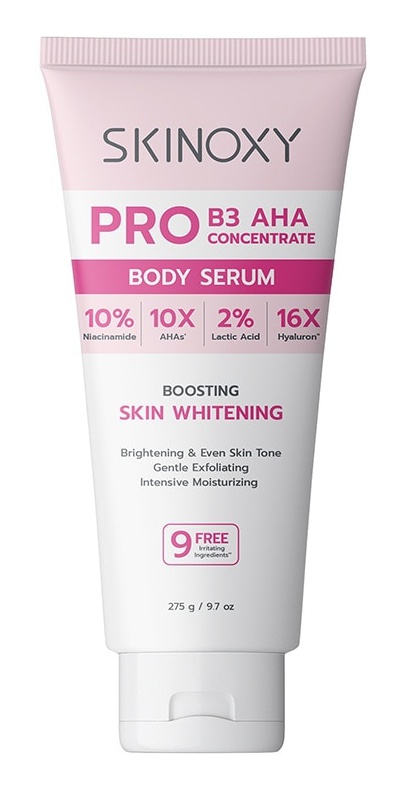
Body Serum Pro B3 AHA Concentrate
Ingredients overview
Highlights
Key Ingredients
Other Ingredients
Skim through
Skinoxy Body Serum Pro B3 AHA ConcentrateIngredients explained
Good old water, aka H2O. The most common skincare ingredient of all. You can usually find it right in the very first spot of the ingredient list, meaning it’s the biggest thing out of all the stuff that makes up the product.
It’s mainly a solvent for ingredients that do not like to dissolve in oils but rather in water.
Once inside the skin, it hydrates, but not from the outside - putting pure water on the skin (hello long baths!) is drying.
One more thing: the water used in cosmetics is purified and deionized (it means that almost all of the mineral ions inside it is removed). Like this, the products can stay more stable over time.
- A multi-functional skincare superstar with several proven benefits for the skin
- Great anti-aging, wrinkle smoothing ingredient used at 4-5% concentration
- Fades brown spots alone or in combination with amino sugar, acetyl glucosamine
- Increases ceramide synthesis that results in a stronger, healthier skin barrier and better skin hydration
- Can help to improve several skin conditions including acne, rosacea, and atopic dermatitis
A super commonly used 5 unit long, cyclic structured silicone that is water-thin and does not stay on the skin but evaporates from it (called volatile silicone). Similar to other silicones, it gives skin and hair a silky, smooth feel.
It's often combined with the non-volatile (i.e. stays on the skin) dimethicone as the two together form a water-resistant, breathable protective barrier on the skin without a negative tacky feel.
A clear, colorless oil-like liquid that makes the skin feel smooth and nice (aka emollient) and it does so without it being greasy.
What's more, it can even reduce the heavy, greasy feel in products with high oil content. It's also fast-spreading meaning that it gives the formula a good, nice slip. It absorbs quickly into the skin and helps other ingredients to penetrate quicker and deeper.
Thanks to all this, it's one of the most commonly used emollients out there. There is just one little drawback: it has a high comedogenic index (5 out of 5...), so it might clog pores if you're prone to it.
- It's a helper ingredient that improves the freeze-thaw stability of products
- It's also a solvent, humectant and to some extent a penetration enhancer
- It has a bad reputation among natural cosmetics advocates but cosmetic scientists and toxicology experts do not agree (read more in the geeky details section)
Probably the most common silicone of all. It is a polymer (created from repeating subunits) molecule and has different molecular weight and thus different viscosity versions from water-light to thick liquid.
As for skincare, it makes the skin silky smooth, creates a subtle gloss and forms a protective barrier (aka occlusive). Also, works well to fill in fine lines and wrinkles and give skin a plump look (of course that is only temporary, but still, it's nice). There are also scar treatment gels out there using dimethicone as their base ingredient. It helps to soften scars and increase their elasticity.
As for hair care, it is a non-volatile silicone meaning that it stays on the hair rather than evaporates from it and smoothes the hair like no other thing. Depending on your hair type, it can be a bit difficult to wash out and might cause some build-up (btw, this is not true to all silicones, only the non-volatile types).
- It’s the second most researched AHA after glycolic acid
- It gently lifts off dead skin cells to reveal newer, fresher, smoother skin
- It also has amazing skin hydrating properties
- In higher concentration (10% and up) it improves skin firmness, thickness and wrinkles
- Choose a product where you know the concentration and pH value because these two greatly influence effectiveness
- Don’t forget to use your sunscreen (in any case but especially so next to an AHA product)
A super common, waxy, white, solid stuff that helps water and oil to mix together, gives body to creams and leaves the skin feeling soft and smooth.
Chemically speaking, it is the attachment of a glycerin molecule to the fatty acid called stearic acid. It can be produced from most vegetable oils (in oils three fatty acid molecules are attached to glycerin instead of just one like here) in a pretty simple, "green" process that is similar to soap making. It's readily biodegradable.
It also occurs naturally in our body and is used as a food additive. As cosmetic chemist Colins writes it, "its safety really is beyond any doubt".
A very common water-loving surfactant and emulsifier that helps to keep water and oil mixed nicely together.
It's often paired with glyceryl stearate - the two together form a super effective emulsifier duo that's salt and acid tolerant and works over a wide pH range. It also gives a "pleasing product aesthetics", so no wonder it's popular.
A so-called fatty (the good, non-drying kind of) alcohol that does all kinds of things in a skincare product: it makes your skin feel smooth and nice (emollient), helps to thicken up products and also helps water and oil to blend (emulsifier). Can be derived from coconut or palm kernel oil.
It’s pretty much the current IT-preservative. It’s safe and gentle, but even more importantly, it’s not a feared-by-everyone-mostly-without-scientific-reason paraben.
It’s not something new: it was introduced around 1950 and today it can be used up to 1% worldwide. It can be found in nature - in green tea - but the version used in cosmetics is synthetic.
Other than having a good safety profile and being quite gentle to the skin it has some other advantages too. It can be used in many types of formulations as it has great thermal stability (can be heated up to 85°C) and works on a wide range of pH levels (ph 3-10).
It’s often used together with ethylhexylglycerin as it nicely improves the preservative activity of phenoxyethanol.
It's a very alkaline stuff that helps to set the pH of the cosmetic formula to be just right. It's similar to the more often used sodium hydroxide and pretty much the same of what we wrote there applies here too.
A type of clay mineral that works as a nice helper ingredient to thicken and stabilize formulas. As a clay, it consists of platelets that have a negative charge on the surface (face) and a positive on the edge. So the face of one platelet attracts the edge of the other and this builds a so-called "house of card" structure meaning that Magnesium Aluminum Silicate (MAS) thickens up products and helps to suspend non-soluble particles such as color pigments or inorganic sunscreens (zinc oxide and titanium dioxide).
As the "house of card" structure takes some time to form but collapses quickly if the formula is stirred, products thickened with MAS can be thick in the jar but become easily spreadable upon application (called thixotropy). MAS also gives nice sensory properties, it is not tacky or sticky and gives a rich, creamy skin feel. Also a good team player and works in synergy with other thickeners such as Cellulose Gum or Xanthan Gum.
An amino acid-based emulsifier that helps water and oil to mix and stay that way. It is considered as natural, environmentally friendly, and hypoallergenic.
Super common soothing ingredient. It can be found naturally in the roots & leaves of the comfrey plant, but more often than not what's in the cosmetic products is produced synthetically.
It's not only soothing but it' also skin-softening and protecting and can promote wound healing.
It's one of the most commonly used thickeners and emulsion stabilizers. If the product is too runny, a little xanthan gum will make it more gel-like. Used alone, it can make the formula sticky and it is a good team player so it is usually combined with other thickeners and so-called rheology modifiers (helper ingredients that adjust the flow and thus the feel of the formula). The typical use level of Xantha Gum is below 1%, it is usually in the 0.1-0.5% range.
Btw, Xanthan gum is all natural, a chain of sugar molecules (polysaccharide) produced from individual sugar molecules (glucose and sucrose) via fermentation. It’s approved by Ecocert and also used in the food industry (E415).
A versatile polymer that helps to thicken up products and can also act as an emulsifier, enabling gel-cream-like textures. It works over a wide pH range and is electrolyte tolerant.
Exactly what it sounds: nice smelling stuff put into cosmetic products so that the end product also smells nice. Fragrance in the US and parfum in the EU is a generic term on the ingredient list that is made up of 30 to 50 chemicals on average (but it can have as much as 200 components!).
If you are someone who likes to know what you put on your face then fragrance is not your best friend - there's no way to know what’s really in it.
Also, if your skin is sensitive, fragrance is again not your best friend. It’s the number one cause of contact allergy to cosmetics. It’s definitely a smart thing to avoid with sensitive skin (and fragrance of any type - natural is just as allergic as synthetic, if not worse!).
A hydrocarbon-based emollient that can come in different viscosities from silky-light through satiny-smooth to luxurious, rich. It forms a non-occlusive film on the surface of the skin and brings gloss without greasiness to the formula. It's a very pure and hypoallergenic emollient that's also ideal for baby care products.
A thick, high molecular weight silicone that is usually diluted in another, lighter silicone fluid (like dimethicone or cyclopentasiloxane). The dimethiconol containing silicone blends leave a silky smooth, non-greasy film on the skin.
If you have spotted ethylhexylglycerin on the ingredient list, most probably you will see there also the current IT-preservative, phenoxyethanol. They are good friends because ethylhexylglycerin can boost the effectiveness of phenoxyethanol (and other preservatives) and as an added bonus it feels nice on the skin too.
Also, it's an effective deodorant and a medium spreading emollient.
Super common little helper ingredient that helps products to remain nice and stable for a longer time. It does so by neutralizing the metal ions in the formula (that usually get into there from water) that would otherwise cause some not so nice changes.
It is typically used in tiny amounts, around 0.1% or less.
It’s the most commonly used version of pure vitamin E in cosmetics. You can read all about the pure form here. This one is the so-called esterified version.
According to famous dermatologist, Leslie Baumann while tocopheryl acetate is more stable and has a longer shelf life, it’s also more poorly absorbed by the skin and may not have the same awesome photoprotective effects as pure Vit E.
 We don't have description for this ingredient yet.
- A natural moisturizer that’s also in our skin
- A super common, safe, effective and cheap molecule used for more than 50 years
- Not only a simple moisturizer but knows much more: keeps the skin lipids between our skin cells in a healthy (liquid crystal) state, protects against irritation, helps to restore barrier
- Effective from as low as 3% with even more benefits for dry skin at higher concentrations up to 20-40%
- High-glycerin moisturizers are awesome for treating severely dry skin
Citric acid comes from citrus fruits and is an AHA. If these magic three letters don’t tell you anything, click here and read our detailed description on glycolic acid, the most famous AHA.
So citric acid is an exfoliant, that can - just like other AHAs - gently lift off the dead skin cells of your skin and make it more smooth and fresh.
There is also some research showing that citric acid with regular use (think three months and 20% concentration) can help sun-damaged skin, increase skin thickness and some nice hydrating things called glycosaminoglycans in the skin.
But according to a comparative study done in 1995, citric acid has less skin improving magic properties than glycolic or lactic acid. Probably that’s why citric acid is usually not used as an exfoliant but more as a helper ingredient in small amounts to adjust the pH of a formulation.
- It’s the most researched AHA with the most proven skin benefits
- It gently lifts off dead skin cells to reveal newer, fresher, smoother skin
- It can help skin’s own collagen production that results in firmer, younger skin
- It can fade brown spots caused by sun damage or PIH
- Choose a product where you know the concentration and pH value because these two greatly influence effectiveness
- Don’t forget to use your sunscreen (in any case but especially so next to an AHA product)
- Slight stinging or burning with a stronger AHA product is normal
- If your skin is very sensitive, rosacea prone choose rather a BHA or PHA product
A really multi-functional helper ingredient that can do several things in a skincare product: it can bring a soft and pleasant feel to the formula, it can act as a humectant and emollient, it can be a solvent for some other ingredients (for example it can help to stabilize perfumes in watery products) and it can also help to disperse pigments more evenly in makeup products. And that is still not all: it can also boost the antimicrobial activity of preservatives.
Malic acid comes from apple and is an AHA. If these magic three letters don’t tell you anything, click here and read our detailed description on glycolic acid, the most famous AHA.
So malic acid is an exfoliant, that can - just like other AHAs - gently lift off the dead skin cells of your skin and make it more smooth and fresh.
There is not much research out there about malic acid itself. We could find one comparative study, that compared the effectiveness of glycolic acid, lactic acid, citric acid and malic acid. The first two ones were the winners while malic and citric acid were less effective.
It’s the - sodium form - cousin of the famous NMF, hyaluronic acid (HA). If HA does not tell you anything we have a super detailed, geeky explanation about it here. The TL; DR version of HA is that it's a huge polymer (big molecule from repeated subunits) found in the skin that acts as a sponge helping the skin to hold onto water, being plump and elastic. HA is famous for its crazy water holding capacity as it can bind up to 1000 times its own weight in water.
As far as skincare goes, sodium hyaluronate and hyaluronic acid are pretty much the same and the two names are used interchangeably. As cosmetic chemist kindofstephen writes on reddit "sodium hyaluronate disassociates into hyaluronic acid molecule and a sodium atom in solution".
In spite of this, if you search for "hyaluronic acid vs sodium hyaluronate" you will find on multiple places that sodium hyaluronate is smaller and can penetrate the skin better. Chemically, this is definitely not true, as the two forms are almost the same, both are polymers and the subunits can be repeated in both forms as much as you like. (We also checked Prospector for sodium hyaluronate versions actually used in cosmetic products and found that the most common molecular weight was 1.5-1.8 million Da that absolutely counts as high molecular weight).
What seems to be a true difference, though, is that the salt form is more stable, easier to formulate and cheaper so it pops up more often on the ingredient lists.
If you wanna become a real HA-and-the-skin expert you can read way more about the topic at hyaluronic acid (including penetration-questions, differences between high and low molecular weight versions and a bunch of references to scientific literature).
We don't have description for this ingredient yet.
We don't have description for this ingredient yet.
Butylene glycol, or let’s just call it BG, is a multi-tasking colorless, syrupy liquid. It’s a great pick for creating a nice feeling product.
BG’s main job is usually to be a solvent for the other ingredients. Other tasks include helping the product to absorb faster and deeper into the skin (penetration enhancer), making the product spread nicely over the skin (slip agent), and attracting water (humectant) into the skin.
It’s an ingredient whose safety hasn’t been questioned so far by anyone (at least not that we know about). BG is approved by Ecocert and is also used enthusiastically in natural products. BTW, it’s also a food additive.
We don't have description for this ingredient yet.
We don't have description for this ingredient yet.
- It’s naturally in our skin and behaves there like a sponge
- It can bind up to 1000 times its own weight in water
- It is a big molecule from repeated subunits (polymer) so different molecular weight versions exist (unfortunately there is no way to determine MW from INCI list only)
- High-molecular-weight-HA (>500 kDa) is an excellent surface hydrator, skin protectant and can act as an osmotic pump helping water-soluble actives to penetrate deeper into the skin
- Low-molecular-weight-HA (< 500 kDa) can hydrate the skin somewhat deeper though it is still a big molecule and works mainly in the epidermis (outer layer of the skin)
- Low-molecular-weight-HA might also help the skin to repair itself by increasing its self-defense (~ 200kDa used in the study)
- Ultra-low-molecular-weight-HA (<50kDa) is a controversial ingredient and might work as a pro-inflammatory signal molecule
Hydrolyzed Hyaluronic Acid is a low molecular weight, chemically chopped up version of the naturally big molecule and current IT-moisturizer, Hyaluronic Acid (HA). The TL; DR version of HA is that it's a huge polymer (big molecule from repeated subunits) found in the skin that acts as a sponge helping the skin to retain water, making it plump and elastic. As HA is a polymer, the subunits can be repeated many times (as a high-molecular-weight version), or just a few times (as a low-molecular-weight version).
We wrote in detail at HA about how different molecular weight versions do different things both as a component of the skin and as a skincare ingredient, so click here and read about all the details. Hydrolyzed Hyaluronic Acid can also come in different molecular-weight versions with different properties:
- 100-300 kDa version: apart from moisturizing, this size might also help the skin to repair itself by increasing its self-defense. It is also claimed to boost the wound healing process and is especially helpful for sensitive skin types (acne, rosacea, inflammation-related skin diseases).
- 50k Da version: this is the size that is claimed to be able to absorb into the skin and plump up wrinkles, so it is used mainly as an "anti-aging ingredient"
- below 50k, around 10k Da version: there is a Japanese version trade named Hyalo-Oligo that has only a 10k molecular weight and is claimed to penetrate the skin very well, have a unique touch and give deep and long-lasting moisturization. Based on the Evonik-research and the natural role of LMW-HA in the body working as a pro-inflammatory signal molecule, this ultra-low molecular weight version is a controversial ingredient.
If you wanna become a real HA-and-the-skin expert, you can read much more about the topic at hyaluronic acid (including penetration-questions, differences between high and low molecular weight versions and a bunch of references to scientific literature).
It's a super small, chemically chopped up version of sodium hyaluronate. Its trade name is miniHA, and its molecular weight is 10 kDa. This counts as really tiny given that "normal" HA has a molecular weight of 0.5-2 million Da.
To be honest, low molecular weight (LMW), and especially this ultra-low molecular weight HA is a controversial ingredient. On the upside, it can penetrate the skin better (though 10kDa still counts as big!) and might be able to moisturize the deeper layers of the skin where normal HA cannot get. Also, according to the manufacturer of miniHA, it has better antioxidant activity than a 1.6MDa version HA and it also has better sun protection and after-sun repair abilities than the higher MW versions. It also works in synergy with higher molecular weight versions, and the combination of 0.1% 1.45MDa-HA + 0.1% 380 kDa-HA + 0.1% miniHA hydrated the skin significantly better than 0.3% 1.45MDa-HA alone.
On the downside, the biological role of LMW-HA in the skin is being a pro-inflammatory signaling agent and there is a study by another manufacturer called Evonik showing that HA versions with smaller than 50kDa molecular weight might be pro-inflammatory when put on the skin. Granted, the study was only done on reconstituted human epidermis, so it might or might not be like this on real human skin.
If you wanna get confused and read much more about hyaluronic acid and what the different molecular weight versions might or might not do, click here and read our excruciatingly long description.
We don't have description for this ingredient yet.
A multi-functional, silky feeling helper ingredient that can do quite many things. It's used as an emulsion stabilizer, solvent and a broad spectrum antimicrobial. According to manufacturer info, it's also a moisturizer and helps to make the product feel great on the skin. It works synergistically with preservatives and helps to improve water-resistance of sunscreens.
We don't have description for this ingredient yet.
Propanediol is a natural alternative for the often used and often bad-mouthed propylene glycol. It's produced sustainably from corn sugar and it's Ecocert approved.
It's quite a multi-tasker: can be used to improve skin moisturization, as a solvent, to boost preservative efficacy or to influence the sensory properties of the end formula.
Apple needs no introduction as one of the most common fruits on planet Earth. It's not only a healthy fruit snack, it's also a goodie if you put in all over your face.
It's loaded with proteins, starch, sugars, acids, vitamins and salts. The sugars (mainly fructose, glucose, sucrose) give apple fruit extract nice moisturizing and smoothing properties, while the acids (mainly malic and gallic acid) give it mild exfoliant, skin brightening and antibacterial properties.
Also known as Sugarcane, Saccharum Officinarum is a handy moisturizing ingredient mostly used as a humectant. This means that it can help the skin to attract water and then to hold onto it.
It bears a close relationship to AHA superstar, Glycolic Acid that can be derived from it, so it's often claimed that Sugarcane Extract itself also exfoliates and brightens the skin. We could not find any research studies to back this up, but Saccharum Officinarum very often comes to the formula combined with other acid containing plant extracts trade named ACB Fruit Mix. According to manufacturer data, 5% of the fruit mix increases cellular renewal by 24%, while 4% pure Glycolic did the same by 33%. So maybe, a tiny bit of exfoliation, but if you want proven efficacy, stick to pure acids.
Sodium Acetylated Hyaluronate is a variation of current IT moisturizer, Hyaluronic acid, where some water-loving -OH groups are replaced by amphipathic (partly water-loving and partly water-hating) acetyl groups. The modified molecule is claimed to have even better moisture retention ability than normal HA and better affinity to the skin surface.
The better affinity comes from the acetyl groups that act as tiny "anchors" to attach the HA molecule to the skin. Staying on top of the skin better and longer means longer-lasting surface hydration and improved elasticity. It is also less sticky and more cosmetically elegant than normal HA, so no wonder the nickname of this molecule is super hyaluronic acid.
A helper ingredient that helps to make the products stay nice longer, aka preservative. It works mainly against fungi.
It’s pH dependent and works best at acidic pH levels (3-5). It’s not strong enough to be used in itself so it’s always combined with something else, often with potassium sorbate.
It's a special "cross-linked" from of IT-moisturizer, hyaluronic acid (HA). Cross-linked means that "normal" HA pieces (1-2 million Da molecular weight) are chemically bound togeather to create a big, "infinite" mesh.
The special HA mesh has a remarkable water-binding capacity, 5 times more than the already crazy water-binding capacity of "normal" HA. This water filled crosslinked HA gel forms a smooth film on the skin and continuously delivers the bound water, so it gives long-term moisturizing benefits.
Btw, crosslinking HA was developed for dermal fillers (as crosslinking helps their longevity), and this guy is the topical version of FDA approved dermal filler called Hylan B gel. Smearing crosslinked version all over ourselves is a newish thing, and incoming evidence so far suggests that it's a great idea, even better than normal HA.
A very recent, 2016 research article compared the topical moisturizing effect of crosslinked HA (not Hylan B gel specifically, but something called Resilient HA or RHA), HMW-HA and LMW-HA and found that "TEWL (that is trans-epidermal water loss, the water that evaporates from the skin) was reduced by 27.8% with RHA, and by 15.6% with HMW HA, but increased by 55.5% with LMW HA." (You can read much more about HMW and LMW HA here in the geeky details section.)
All in all, we think Sodium Hyaluronate Crosspolymer is an awesome version of HA, probably superior to traditional versions, so be happy to spot it on the ingredient list.
We don't have description for this ingredient yet.
We don't have description for this ingredient yet.
When it comes to grape and skincare, the seed extract and the seed oil steals most of the show. The reason for that is that the seed contains the majority of the skin goodies, the antioxidant superstar polyphenols.
The fruit also contains some, but it's less potent. However - according to manufacturer info - the fruit extract is not only an antioxidant, but it's also a soothing, moisturizing and nourishing agent.
We don't have description for this ingredient yet.
You may also want to take a look at...
| what‑it‑does | solvent |
| what‑it‑does | cell-communicating ingredient | skin brightening | anti-acne | moisturizer/humectant |
| what‑it‑does | emollient | solvent |
| what‑it‑does | emollient | perfuming |
| irritancy, com. | 3, 3-5 |
| what‑it‑does | moisturizer/humectant | solvent |
| irritancy, com. | 0, 0 |
| what‑it‑does | emollient |
| irritancy, com. | 0, 1 |
| what‑it‑does | exfoliant | moisturizer/humectant | buffering |
| what‑it‑does | emollient | emulsifying |
| irritancy, com. | 0, 1 |
| what‑it‑does | surfactant/cleansing | emulsifying |
| irritancy, com. | 0, 0 |
| what‑it‑does | emollient | viscosity controlling |
| irritancy, com. | 2, 2 |
| what‑it‑does | preservative |
| what‑it‑does | buffering |
| what‑it‑does | viscosity controlling |
| irritancy, com. | 0, 0 |
| what‑it‑does | emulsifying | surfactant/cleansing |
| what‑it‑does | soothing |
| irritancy, com. | 0, 0 |
| what‑it‑does | viscosity controlling |
| what‑it‑does | viscosity controlling |
| what‑it‑does | perfuming |
| what‑it‑does | emollient | perfuming | solvent |
| what‑it‑does | emollient | moisturizer/humectant |
| what‑it‑does | preservative |
| what‑it‑does | chelating |
| what‑it‑does | surfactant/cleansing |
| what‑it‑does | antioxidant |
| irritancy, com. | 0, 0 |
| what‑it‑does | skin-identical ingredient | moisturizer/humectant |
| irritancy, com. | 0, 0 |
| what‑it‑does | buffering |
| what‑it‑does | exfoliant | buffering |
| what‑it‑does | solvent |
| what‑it‑does | exfoliant | buffering |
| what‑it‑does | buffering | exfoliant |
| what‑it‑does | skin-identical ingredient | moisturizer/humectant |
| irritancy, com. | 0, 0 |
| what‑it‑does | moisturizer/humectant | solvent |
| irritancy, com. | 0, 1 |
| what‑it‑does | moisturizer/humectant |
| what‑it‑does | skin-identical ingredient | moisturizer/humectant |
| what‑it‑does | moisturizer/humectant |
| what‑it‑does | moisturizer/humectant |
| what‑it‑does | solvent | moisturizer/humectant |
| what‑it‑does | solvent | moisturizer/humectant |
| what‑it‑does | moisturizer/humectant |
| what‑it‑does | moisturizer/humectant |
| what‑it‑does | moisturizer/humectant |
| what‑it‑does | preservative |
| what‑it‑does | skin-identical ingredient | antioxidant | moisturizer/humectant |
| what‑it‑does | soothing | antioxidant | moisturizer/humectant |
| what‑it‑does | moisturizer/humectant |