




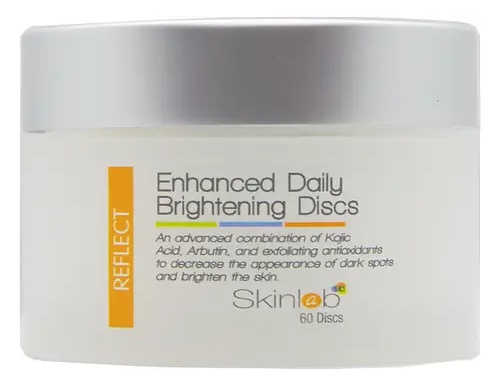
Enhanced Daily Brightening Discs
Ingredients overview
Highlights
Key Ingredients
Other Ingredients
Skim through
| Ingredient name | what-it-does | irr., com. | ID-Rating |
|---|---|---|---|
| Water | solvent | ||
| Ethoxydiglycol | solvent, moisturizer/humectant, perfuming | 0, 0 | |
| Sd Alcohol 40-B | solvent, viscosity controlling | icky | |
| Ascorbic Acid | antioxidant, skin brightening, buffering | superstar | |
| Pentylene Glycol | solvent, moisturizer/humectant | ||
| Arbutin | antioxidant, skin brightening | goodie | |
| Kojic Acid | antioxidant, skin brightening | goodie | |
| Salicylic Acid | exfoliant, anti-acne, soothing, preservative | superstar | |
| Butylene Glycol | moisturizer/humectant, solvent | 0, 1 | |
| Camellia Oleifera Extract | antioxidant, soothing | goodie | |
| L-Ergothioneine | antioxidant | ||
| Evodia Rutaecarpa Fruit Extract | goodie | ||
| Glycerin | skin-identical ingredient, moisturizer/humectant | 0, 0 | superstar |
| Rumex Crispus Extract | soothing | ||
| PEG-8 Dimethicone | emollient | ||
| Laureth-4 | emulsifying, surfactant/cleansing | 4, 5 | |
| Trolamine | buffering | 0, 2 | |
| Sodium Metabisulfite | antioxidant, preservative | ||
| Edetate Disodium | chelating |
Skinlab Enhanced Daily Brightening DiscsIngredients explained
Good old water, aka H2O. The most common skincare ingredient of all. You can usually find it right in the very first spot of the ingredient list, meaning it’s the biggest thing out of all the stuff that makes up the product.
It’s mainly a solvent for ingredients that do not like to dissolve in oils but rather in water.
Once inside the skin, it hydrates, but not from the outside - putting pure water on the skin (hello long baths!) is drying.
One more thing: the water used in cosmetics is purified and deionized (it means that almost all of the mineral ions inside it is removed). Like this, the products can stay more stable over time.
A nice odorless liquid used mainly as a superior solubilizer and efficacy booster for cosmetic active ingredients such as skincare bigshot vitamin C, self-tanning active DHA or the anti-acne gold standard, benzoyl peroxide.
Other than that it can also be used in hair care products where it gives a longer-lasting and more uniform coloring. According to a manufacturer, it might even prevent the formation of split ends.
SD-Alcohol and some numer+letter refers to alcohol (or ethanol) being denaturated with different kind of additives. These additives make sure that the alcohol is poisonous and bad tasting so that nobody drinks their alcohol-loaded toner. 40-B specifically means the additives are denatonium benzoate and t-butyl alcohol.
As for Alcohol Denat in skincare, it's a controversial ingredient. It's a great solvent and makes cosmetically elegant, light formulas but at best it's skin-drying, at worst it's skin-barrier damaging. We have written about alcohol way more here.
- Works best between a concentration of 5-20%
- Boosts the skin’s own collagen production
- Fades pigmentation and brown spots
- If used under sunscreen it boosts its UV protection
- Extremely unstable and oxidizes very easily in presence of light or air
- Stable in solutions with water only if pH is less than 3.5 or in waterless formulations
- Vit E + C work in synergy and provide superb photoprotection
- Ferulic acid doubles the photoprotection effect of Vit C+E and helps to stabilize Vit C
- Potent Vit. C serums might cause a slight tingling on sensitive skin
A multi-functional, silky feeling helper ingredient that can do quite many things. It's used as an emulsion stabilizer, solvent and a broad spectrum antimicrobial. According to manufacturer info, it's also a moisturizer and helps to make the product feel great on the skin. It works synergistically with preservatives and helps to improve water-resistance of sunscreens.
A pretty well-known and often used ingredient with the magic ability to fade brown spots. It's used traditionally in Japan and can be found naturally in a couple of plants, including the leaves of pear trees, wheat and bearberry.
Arbutin seems to work its magic and hinder the pigmentation process at the second step of it. An enzyme called tyrosinase is needed to create melanin (the pigment that causes the brown spots) and while several other skin lightening agents work to inhibit the synthesis of tyrosinase itself (like vitamin C or licorice), arbutin lets tyrosinase be and rather hinders the melanin-forming activity of the enzyme. (So it might be a good idea to combine arbutin with some direct tyrosinase inhibitors for more skin lightening effect.)
All in all, arbutin is one of the better-known skin brightening agents, that's probably worth a try if pigmentation is an issue for you.
 We don't have description for this ingredient yet.
- It's one of the gold standard ingredients for treating problem skin
- It can exfoliate skin both on the surface and in the pores
- It's a potent anti-inflammatory agent
- It's more effective for treating blackheads than acne
- For acne combine it with antibacterial agents like benzoyl peroxide or azelaic acid
Butylene glycol, or let’s just call it BG, is a multi-tasking colorless, syrupy liquid. It’s a great pick for creating a nice feeling product.
BG’s main job is usually to be a solvent for the other ingredients. Other tasks include helping the product to absorb faster and deeper into the skin (penetration enhancer), making the product spread nicely over the skin (slip agent), and attracting water (humectant) into the skin.
It’s an ingredient whose safety hasn’t been questioned so far by anyone (at least not that we know about). BG is approved by Ecocert and is also used enthusiastically in natural products. BTW, it’s also a food additive.
Camellia Oleifera is a type of green tea plant that's mostly known for the oil that comes from its seeds. As for the leaves, it has similar properties as the better known and more often used Camellia Sinensis leaves. You can read all the geeky details about green tea and why it's awesome by clicking here, but in short, it has antioxidants and anti-inflammatory magic properties.
We don't have description for this ingredient yet.
- A natural moisturizer that’s also in our skin
- A super common, safe, effective and cheap molecule used for more than 50 years
- Not only a simple moisturizer but knows much more: keeps the skin lipids between our skin cells in a healthy (liquid crystal) state, protects against irritation, helps to restore barrier
- Effective from as low as 3% with even more benefits for dry skin at higher concentrations up to 20-40%
- High-glycerin moisturizers are awesome for treating severely dry skin
A water-soluble silicone (silicones are normally oil soluble) that makes your skin nice and smooth (aka emollient) and improves cushion, texture, and slip in the formula.
We don't have description for this ingredient yet.
It’s a little helper ingredient that helps to set the pH of a cosmetic formulation to be just right. It’s very alkaline (you know the opposite of being very acidic): a 1% solution has a pH of around 10.
It does not have the very best safety reputation but in general, you do not have to worry about it.
What is true is that if a product contains so-called N-nitrogenating agents (e.g.: preservatives like 2-Bromo-2-Nitropropane-1,3-Diol, 5-Bromo-5-Nitro- 1,3-Dioxane or sodium nitrate - so look out for things with nitro, nitra in the name) that together with TEA can form some not nice carcinogenic stuff (that is called nitrosamines). But with proper formulation that does not happen, TEA in itself is not a bad guy.
But let’s assume a bad combination of ingredients were used and the nitrosamines formed. :( Even in that case you are probably fine because as far as we know it cannot penetrate the skin.
But to be on the safe side, if you see Triethanolamine in an INCI and also something with nitra, nitro in the name of it just skip the product, that cannot hurt.
We don't have description for this ingredient yet.
Super common little helper ingredient that helps products to remain nice and stable for a longer time. It does so by neutralizing the metal ions in the formula (that usually get into there from water) that would otherwise cause some not so nice changes.
It is typically used in tiny amounts, around 0.1% or less.
You may also want to take a look at...
| what‑it‑does | solvent |
| what‑it‑does | solvent | moisturizer/humectant | perfuming |
| irritancy, com. | 0, 0 |
| what‑it‑does | solvent | viscosity controlling |
| what‑it‑does | antioxidant | skin brightening | buffering |
| what‑it‑does | solvent | moisturizer/humectant |
| what‑it‑does | antioxidant | skin brightening |
| what‑it‑does | antioxidant | skin brightening |
| what‑it‑does | exfoliant | anti-acne | soothing | preservative |
| what‑it‑does | moisturizer/humectant | solvent |
| irritancy, com. | 0, 1 |
| what‑it‑does | antioxidant | soothing |
| what‑it‑does | antioxidant |
| what‑it‑does | skin-identical ingredient | moisturizer/humectant |
| irritancy, com. | 0, 0 |
| what‑it‑does | soothing |
| what‑it‑does | emollient |
| what‑it‑does | emulsifying | surfactant/cleansing |
| irritancy, com. | 4, 5 |
| what‑it‑does | buffering |
| irritancy, com. | 0, 2 |
| what‑it‑does | antioxidant | preservative |
| what‑it‑does | chelating |