




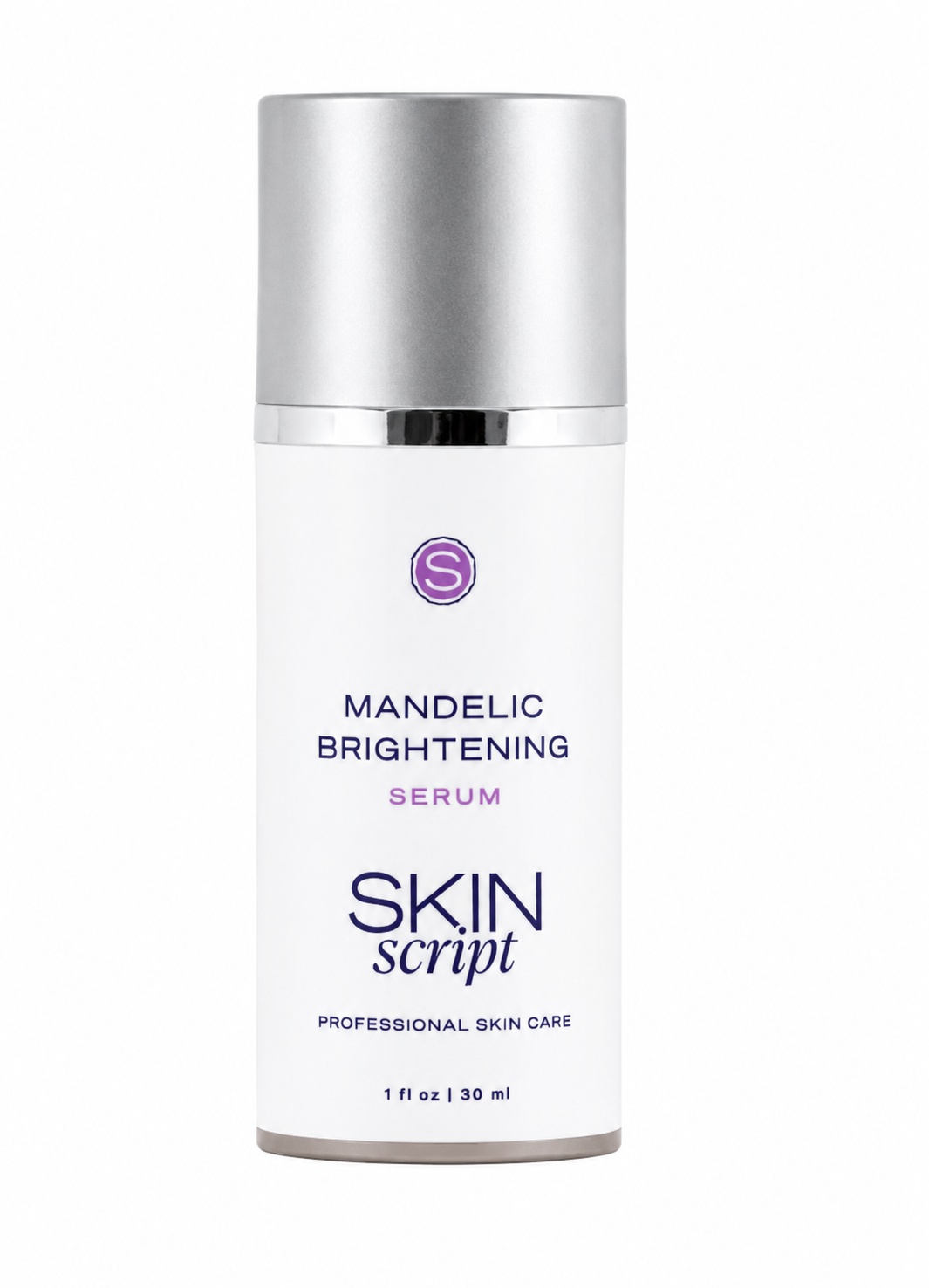
Mandelic Brightening Serum
Ingredients overview
Highlights
Key Ingredients
Other Ingredients
Skim through
Skin Script Mandelic Brightening SerumIngredients explained
Good old water, aka H2O. The most common skincare ingredient of all. You can usually find it right in the very first spot of the ingredient list, meaning it’s the biggest thing out of all the stuff that makes up the product.
It’s mainly a solvent for ingredients that do not like to dissolve in oils but rather in water.
Once inside the skin, it hydrates, but not from the outside - putting pure water on the skin (hello long baths!) is drying.
One more thing: the water used in cosmetics is purified and deionized (it means that almost all of the mineral ions inside it is removed). Like this, the products can stay more stable over time.
The distillate created from different parts of the hazelnut-bush-like magic tree, commonly called Witch Hazel. Hamamelis Virginiana Water is a bit of a sloppy ingredient name as the leaves, the twigs and the bark can be used to create extracts or distillates and the different parts contain different amounts of biologically active components. But what you are getting is probably a nice water with astringent, soothing, antioxidant and antibacterial magic properties.
We went into great detail about Witch Hazel in cosmetics here, detailing the main biologically active components and how they are different in different parts of the plant. Click here and read more >>
- A natural moisturizer that’s also in our skin
- A super common, safe, effective and cheap molecule used for more than 50 years
- Not only a simple moisturizer but knows much more: keeps the skin lipids between our skin cells in a healthy (liquid crystal) state, protects against irritation, helps to restore barrier
- Effective from as low as 3% with even more benefits for dry skin at higher concentrations up to 20-40%
- High-glycerin moisturizers are awesome for treating severely dry skin
Simply alcohol refers to ethanol and it's a pretty controversial ingredient. It has many instant benefits: it's a great solvent, penetration enhancer, creates cosmetically elegant, light formulas, great astringent and antimicrobial. No wonder it's popular in toners and oily skin formulas.
The downside is that it can be very drying if it's in the first few ingredients on an ingredient list.
Some experts even think that regular exposure to alcohol damages skin barrier and causes inflammation though it's a debated opinion. If you wanna know more, we wrote a more detailed explanation about what's the deal with alcohol in skincare products at alcohol denat. (it's also alcohol, but with some additives to make sure no one drinks it).
- Mandelic acid is an AHA that comes from bitter almond
- It can gently lift off dead surface skin cells and make the skin more smooth and even
- It has antibacterial properties
- It’s promising against acne and post inflammatory hyperpigmentation
- It’s light sensitive, so choose a product with opaque packaging
A super common emollient that makes your skin feel nice and smooth. It comes from coconut oil and glycerin, it’s light-textured, clear, odorless and non-greasy. It’s a nice ingredient that just feels good on the skin, is super well tolerated by every skin type and easy to formulate with. No wonder it’s popular.
Probably the most common silicone of all. It is a polymer (created from repeating subunits) molecule and has different molecular weight and thus different viscosity versions from water-light to thick liquid.
As for skincare, it makes the skin silky smooth, creates a subtle gloss and forms a protective barrier (aka occlusive). Also, works well to fill in fine lines and wrinkles and give skin a plump look (of course that is only temporary, but still, it's nice). There are also scar treatment gels out there using dimethicone as their base ingredient. It helps to soften scars and increase their elasticity.
As for hair care, it is a non-volatile silicone meaning that it stays on the hair rather than evaporates from it and smoothes the hair like no other thing. Depending on your hair type, it can be a bit difficult to wash out and might cause some build-up (btw, this is not true to all silicones, only the non-volatile types).
It's a common little helper ingredient that helps water and oil to mix together. Also, it can help to increase the solubility of some other ingredients in the formula.
Lactobacillus ferment is an interesting probiotic ingredient with some promising properties.
First, according to a 2009 Estee Lauder patent, it’s a DNA repair enzyme and it can help to protect the skin against environmental aggressors.
Second, still according to Estee Lauder research but now from 2012 the ingredient has anti-microbial and anti-inflammatory properties and holds promise in the treatment of acne and rosacea. For the former one 5% was needed to show effectiveness, but for reducing skin sensitivity already 1% showed results.
The anti-acne effect is confirmed also by US manufacturer, Barnet, that says that Lactobacillus ferment is helpful in killing harmful bacteria and creating a healthy balanced microflora. Compared to well-known anti-acne and anti-inflammatory salicylic acid the probiotic worked faster at reducing the size and redness of acne lesions.
It also goes by the trade name Leucidal Liquid SF and can serve in the formula as a natural preservative.
Bottom line: It’s not the most proven ingredient (yet) but definitely a very promising one especially if you have sensitive skin, acne or rosacea.
A derivative of clinically proven, superstar ingredient Azelaic Acid and hydrating amino acid Glycine. Azelaic acid is an awesome ingredient with anti-inflammatory, skin lightening and anti-acne effects, but its insolubility (it's soluble neither in water nor in oil) makes it difficult to use it in a cosmetically elegant and versatile way.
The solution is supposed to be Potassium Azeloyl Diglycinate, at least according to the manufacturer. The derivative is very water soluble, easy to use in nice formulas and inherits all the lovely properties of Azelaic acid. It acts as a skin brightening agent via Tyrosinase (a famous enzyme needed to make melanin) inhibition and also has significant sebum normalizing activity.
Regarding research, we could find two studies where Potassium Azeloyl Diglycinate's name popped up. One study examined the management of rosacea and the other one researched the treatment of melasma. Both were successful (we mean people showed improvement :)) but our Azelaic acid derivative was combined with other actives so it's hard to know what to attribute to this guy only.
Overall, a promising multi-function active that's worth checking out if you have pigmentation-prone, acne-prone or rosacea-prone skin.
- A multi-functional skincare superstar with several proven benefits for the skin
- Great anti-aging, wrinkle smoothing ingredient used at 4-5% concentration
- Fades brown spots alone or in combination with amino sugar, acetyl glucosamine
- Increases ceramide synthesis that results in a stronger, healthier skin barrier and better skin hydration
- Can help to improve several skin conditions including acne, rosacea, and atopic dermatitis
A molecule that is naturally present in the bran of rye and other cereals. It has been used for a long time in the food industry as an "anti-browning agent" for fresh-cut fruits or shrimps.
It turns out that Hexylresorcinol works as an "anti-browning agent" also in cosmetic products. It is a pretty well-researched molecule with significant tyrosinase (the famous enzyme needed to produce melanin) inhibiting abilities. The clinical study of the manufacturer showed that 0.5% Hexylresorcinol has a comparable skin-lightening effect to gold-standard, 2% Hydroquinone.
Even better, a 12-weeks, double-blind, placebo-controlled study with 65 volunteers confirmed the effectiveness of our skin-lightening molecule and it measured an average of 88% skin-lightening improvement. The study also included before and after photos (always a good sign!) and the skin-lightening was indeed visible and significant (though the pigmentation spots did not completely disappear, just so you have realistic expectations).
Our molecule is also a good team player and seems to work in synergy with skincare-do-it-all Niacinamide. A 2022 study compared 3% Niacinamide on its own and a combination of 0.4% Hexylresorcinol + 3% Niacinamide and found that the combo delivered superior skin tone and anti-ageing benefits significantly better than Niacinamide alone.
It’s the - sodium form - cousin of the famous NMF, hyaluronic acid (HA). If HA does not tell you anything we have a super detailed, geeky explanation about it here. The TL; DR version of HA is that it's a huge polymer (big molecule from repeated subunits) found in the skin that acts as a sponge helping the skin to hold onto water, being plump and elastic. HA is famous for its crazy water holding capacity as it can bind up to 1000 times its own weight in water.
As far as skincare goes, sodium hyaluronate and hyaluronic acid are pretty much the same and the two names are used interchangeably. As cosmetic chemist kindofstephen writes on reddit "sodium hyaluronate disassociates into hyaluronic acid molecule and a sodium atom in solution".
In spite of this, if you search for "hyaluronic acid vs sodium hyaluronate" you will find on multiple places that sodium hyaluronate is smaller and can penetrate the skin better. Chemically, this is definitely not true, as the two forms are almost the same, both are polymers and the subunits can be repeated in both forms as much as you like. (We also checked Prospector for sodium hyaluronate versions actually used in cosmetic products and found that the most common molecular weight was 1.5-1.8 million Da that absolutely counts as high molecular weight).
What seems to be a true difference, though, is that the salt form is more stable, easier to formulate and cheaper so it pops up more often on the ingredient lists.
If you wanna become a real HA-and-the-skin expert you can read way more about the topic at hyaluronic acid (including penetration-questions, differences between high and low molecular weight versions and a bunch of references to scientific literature).
 We don't have description for this ingredient yet.
We don't have description for this ingredient yet.
The essential oil created by steam distilling the leaves of the Eucalyptus tree. It's a colorless, pale yellow oil with a camphoraceous aroma used traditionally in vapor rubs to treat coughs. Its name-giving main component is eucalyptol (also called 1,8-cineole, 80-91%) that has significant antibacterial and expectorant properties.
Among essential oils, Eucalyptus Globulus counts as rather non-sensitising with an EU sensitizer total of 5% (due to limonene). However, if your skin is super-sensitive or you are allergic to fragrances, it is still better to avoid it.
We don't have description for this ingredient yet.
We don't have description for this ingredient yet.
The essential oil coming from the rind of the orange (the sweet one). In general, the main component of citrus peel oils is limonene (83-97% for sweet orange peel), a super common fragrant ingredient that makes everything smell nice (but counts as a frequent skin sensitizer).
Other than that, citrus peel also contains the problematic compound called furanocoumarin that makes them mildly phototoxic. Orange peel contains less of it than some other citruses (like bergamot or lime), but still, be careful with it especially if it is in a product for daytime use.
The essential oil coming from the rind of the lemon that we make (or should make) lemonade from. In general, there are two problems with citrus peel oils: first, they are essentially the fragrant component, limonene in disguise (they are about 85-98% limonene).
Second, they contain the problematic compounds called furanocoumarins that make them mildly phototoxic. Lemon peel contains a medium amount of them, more than sweet orange but less than bergamot. Be careful with it especially if it is in a product for daytime use.
We don't have description for this ingredient yet.
We don't have description for this ingredient yet.
The essential oil coming from the fruit (probably the rind) of the bergamot orange. It's a common top note in perfumes and contains (among others) fragrant compounds limonene (37%), linalyl acetate (30%) and linalool (8.8%).
A well-known issue with bergamot oil (apart from the fragrance allergens) is that it contains phototoxic compounds called furanocoumarins, but more and more commonly furanocoumarin-free versions are used in cosmetic products. Still, if you have sensitive skin and prefer fragrance-free products, bergamot oil is not for you.
We don't have description for this ingredient yet.
A pale yellow solid material that helps cosmetic products not to go wrong too soon aka preservative.
It has antioxidant and antibacterial activity and can be used synergistically with IT-preservative phenoxyethanol or 1,2-Hexanediol and Caprylyl Glycol to form a broad spectrum preservative system for cosmetic formulas.
The neutralized form of gluconic acid. It's a great ingredient to neutralize metal (especially iron and copper) ions in a cosmetic product. This helps to prevent discoloration of the formula over time or rancidity of cosmetic oils. It can also be a pH regulator and a humectant (helps skin to cling onto water).
It's also used in oral care products where it reduces the bitterness of other ingredients. And it's natural, both Ecocert and Cosmos approved. (source: manufacturer info)
It's a helper ingredient that helps to thicken up formulas and form a nice gel texture. It leaves a rich, elegant feel with a velvety finish on the skin and works over a wide pH range.
A really multi-functional helper ingredient that can do several things in a skincare product: it can bring a soft and pleasant feel to the formula, it can act as a humectant and emollient, it can be a solvent for some other ingredients (for example it can help to stabilize perfumes in watery products) and it can also help to disperse pigments more evenly in makeup products. And that is still not all: it can also boost the antimicrobial activity of preservatives.
It’s a handy multi-tasking ingredient that gives the skin a nice, soft feel. At the same time, it also boosts the effectiveness of other preservatives, such as the nowadays super commonly used phenoxyethanol.
The blend of these two (caprylyl glycol + phenoxyethanol) is called Optiphen, which not only helps to keep your cosmetics free from nasty things for a long time but also gives a good feel to the finished product. It's a popular duo.
This long-named, polymer molecule (big molecule from repeated subunits) is a helper ingredient that's good at emulsifying and stabilizing oils into water-based formulas. It also acts as a thickening and gelling agent that creates nice, non-sticky and supple textures. It works over a very wide pH range (3-12) and can be used to thicken up low-ph formulas, such as exfoliants. Its recommended used range is 0.3-3%.
We don't have description for this ingredient yet.
Lonicera Japonica, or Japanese Honeysuckle as normal people call it, is a white-flowered honeysuckle known for being a traditional Chinese medicine. Modern research confirms that the plant has a super complex chemical composition with more than 140 compounds identified with possible anti-inflammatory, antibacterial, antiviral, antioxidative and hepatoprotective activities.
As for Lonicera Japonica Flower Extract in skin care, it can have two main roles. The first one is being an anti-inflammatory and soothing ingredient, probably due to chlorogenic acid, a polyphenol thought to be the main bioactive component of the flower.
The other possible role is being a natural preservative. If this is the case, it is coupled with its Italian Honeysuckle cousin to form a broad spectrum antimicrobial preservative blend. You can read about this more here.
A handy helper ingredient that helps products to remain nice and stable for a longer time. It does so by neutralizing the metal ions in the formula (that usually get into there from water) that would otherwise cause some not so nice changes.
Citric acid comes from citrus fruits and is an AHA. If these magic three letters don’t tell you anything, click here and read our detailed description on glycolic acid, the most famous AHA.
So citric acid is an exfoliant, that can - just like other AHAs - gently lift off the dead skin cells of your skin and make it more smooth and fresh.
There is also some research showing that citric acid with regular use (think three months and 20% concentration) can help sun-damaged skin, increase skin thickness and some nice hydrating things called glycosaminoglycans in the skin.
But according to a comparative study done in 1995, citric acid has less skin improving magic properties than glycolic or lactic acid. Probably that’s why citric acid is usually not used as an exfoliant but more as a helper ingredient in small amounts to adjust the pH of a formulation.
The unfancy name for it is lye. It’s a solid white stuff that’s very alkaline and used in small amounts to adjust the pH of the product and make it just right.
For example, in case of AHA or BHA exfoliants, the right pH is super-duper important, and pH adjusters like sodium hydroxide are needed.
BTW, lye is not something new. It was already used by ancient Egyptians to help oil and fat magically turn into something else. Can you guess what? Yes, it’s soap. It still often shows up in the ingredient list of soaps and other cleansers.
Sodium hydroxide in itself is a potent skin irritant, but once it's reacted (as it is usually in skin care products, like exfoliants) it is totally harmless.
You may also want to take a look at...
| what‑it‑does | solvent |
| what‑it‑does | soothing |
| what‑it‑does | skin-identical ingredient | moisturizer/humectant |
| irritancy, com. | 0, 0 |
| what‑it‑does | antimicrobial/antibacterial | solvent | viscosity controlling |
| what‑it‑does | exfoliant | antimicrobial/antibacterial |
| what‑it‑does | emollient |
| what‑it‑does | emollient |
| irritancy, com. | 0, 1 |
| what‑it‑does | emulsifying | surfactant/cleansing |
| irritancy, com. | 0, 0 |
| what‑it‑does | soothing | preservative |
| what‑it‑does | skin brightening | anti-acne | soothing |
| what‑it‑does | cell-communicating ingredient | skin brightening | anti-acne | moisturizer/humectant |
| what‑it‑does | skin brightening | antimicrobial/antibacterial |
| what‑it‑does | anti-acne |
| what‑it‑does | skin-identical ingredient | moisturizer/humectant |
| irritancy, com. | 0, 0 |
| what‑it‑does | perfuming |
| what‑it‑does | perfuming | antimicrobial/antibacterial |
| what‑it‑does | emollient |
| what‑it‑does | perfuming |
| what‑it‑does | perfuming |
| what‑it‑does | perfuming |
| what‑it‑does | perfuming |
| what‑it‑does | perfuming |
| what‑it‑does | preservative |
| what‑it‑does | chelating | moisturizer/humectant |
| what‑it‑does | viscosity controlling |
| what‑it‑does | solvent |
| what‑it‑does | moisturizer/humectant | emollient |
| what‑it‑does | viscosity controlling |
| what‑it‑does | perfuming |
| what‑it‑does | soothing | antimicrobial/antibacterial |
| what‑it‑does | chelating |
| what‑it‑does | buffering |
| what‑it‑does | buffering |