




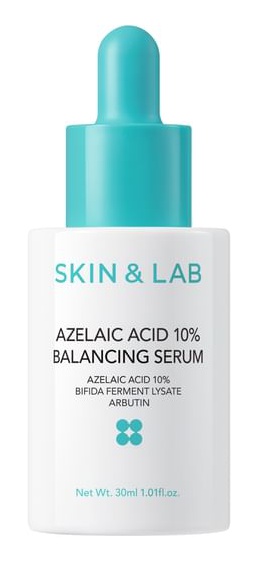
Azelaic Acid 10% Balancing Serum
Ingredients overview
Highlights
Key Ingredients
Other Ingredients
Skim through
Skin&Lab Azelaic Acid 10% Balancing SerumIngredients explained
Good old water, aka H2O. The most common skincare ingredient of all. You can usually find it right in the very first spot of the ingredient list, meaning it’s the biggest thing out of all the stuff that makes up the product.
It’s mainly a solvent for ingredients that do not like to dissolve in oils but rather in water.
Once inside the skin, it hydrates, but not from the outside - putting pure water on the skin (hello long baths!) is drying.
One more thing: the water used in cosmetics is purified and deionized (it means that almost all of the mineral ions inside it is removed). Like this, the products can stay more stable over time.
- Superstar ingredient with antibacterial, skin cell regulating, anti-inflammatory and skin-lightening magic properties
- It is especially useful for acne-prone or rosacea-prone skin types (in concentration 10% and up)
- It is a prescription drug in the US but can be freely purchased in the EU in an up to 10% concentration
Butylene glycol, or let’s just call it BG, is a multi-tasking colorless, syrupy liquid. It’s a great pick for creating a nice feeling product.
BG’s main job is usually to be a solvent for the other ingredients. Other tasks include helping the product to absorb faster and deeper into the skin (penetration enhancer), making the product spread nicely over the skin (slip agent), and attracting water (humectant) into the skin.
It’s an ingredient whose safety hasn’t been questioned so far by anyone (at least not that we know about). BG is approved by Ecocert and is also used enthusiastically in natural products. BTW, it’s also a food additive.
A type of bucket or donut-shaped molecule with a water-loving outer side and an oil-loving inner side that is used mostly to encapsulate other actives in cosmetics.
- A natural moisturizer that’s also in our skin
- A super common, safe, effective and cheap molecule used for more than 50 years
- Not only a simple moisturizer but knows much more: keeps the skin lipids between our skin cells in a healthy (liquid crystal) state, protects against irritation, helps to restore barrier
- Effective from as low as 3% with even more benefits for dry skin at higher concentrations up to 20-40%
- High-glycerin moisturizers are awesome for treating severely dry skin
A really multi-functional helper ingredient that can do several things in a skincare product: it can bring a soft and pleasant feel to the formula, it can act as a humectant and emollient, it can be a solvent for some other ingredients (for example it can help to stabilize perfumes in watery products) and it can also help to disperse pigments more evenly in makeup products. And that is still not all: it can also boost the antimicrobial activity of preservatives.
- A multi-functional skincare superstar with several proven benefits for the skin
- Great anti-aging, wrinkle smoothing ingredient used at 4-5% concentration
- Fades brown spots alone or in combination with amino sugar, acetyl glucosamine
- Increases ceramide synthesis that results in a stronger, healthier skin barrier and better skin hydration
- Can help to improve several skin conditions including acne, rosacea, and atopic dermatitis
A pretty well-known and often used ingredient with the magic ability to fade brown spots. It's used traditionally in Japan and can be found naturally in a couple of plants, including the leaves of pear trees, wheat and bearberry.
Arbutin seems to work its magic and hinder the pigmentation process at the second step of it. An enzyme called tyrosinase is needed to create melanin (the pigment that causes the brown spots) and while several other skin lightening agents work to inhibit the synthesis of tyrosinase itself (like vitamin C or licorice), arbutin lets tyrosinase be and rather hinders the melanin-forming activity of the enzyme. (So it might be a good idea to combine arbutin with some direct tyrosinase inhibitors for more skin lightening effect.)
All in all, arbutin is one of the better-known skin brightening agents, that's probably worth a try if pigmentation is an issue for you.
It's a little helper ingredient coming from corn, rice or potato starch that can help to keep skin mat (absorbent), to stabilise emulsions, and to keep the product together (binding).
A nice little helper ingredient that can thicken up cosmetic products and create beautiful gel formulas. It's derived from cellulose, the major component of the cell wall of green plants. It is compatible with most co-ingredients and gives a very good slip to the formulas.
Bifida Ferment Lysate is a probiotic ingredient that’s used in one of the most iconic serums in the world, the Estee Lauder Advanced Night Repair. Based on manufacturer info it potently protects against UV-induced damage in the skin and helps with DNA repair. An Estee Lauder patent from 2009 also talks about DNA repair activity.
As far as published research goes we could find one promising one. It showed that applying 10% bacterial extract to sensitive, reactive skin helped with better barrier function and decreased skin sensitivity.
Overall, it is definitely a promising ingredient, even for sensitive skin types but not the most proven one (yet).
A helper ingredient that helps to neutralize the metal ions in the formula (they usually come from water) so it stays nice longer. The special property of this particular ingredient is that it's more effective against more problematic ions, like Cu (copper) and Fe (iron) compared to less problematic ones like Ca (calcium) and Mg (magnesium).
If you have spotted ethylhexylglycerin on the ingredient list, most probably you will see there also the current IT-preservative, phenoxyethanol. They are good friends because ethylhexylglycerin can boost the effectiveness of phenoxyethanol (and other preservatives) and as an added bonus it feels nice on the skin too.
Also, it's an effective deodorant and a medium spreading emollient.
Adenosine is an important little compound in our body that has a vital cell-signalling role. Research on smearing it on our face is also promising and shows so far a couple of things:
- It can help with wound healing
- It’s a good anti-inflammatory agent
- It might even help with skin’s own collagen production and improve skin firmness and elasticity
- It helps with barrier repair and protection
- It might be even useful for the hair helping with hair thickness and hair growth
A semi-essential (infants cannot synthesize it, but adults can) amino acid that is one of the primary building blocks of hair keratin and skin collagen. It's a natural moisturizing factor, a skin hydrator and might also help to speed up wound healing.
Arginine usually has a positive charge (cationic) that makes it substantive to skin and hair (those are more negatively charged surfaces) and an excellent film former. Thanks to the positive charge, it also creates a complex with AHAs (AHAs like to lose a hydrogen ion and be negatively charged, so the positive and the negative ions attract each other) that causes a "time-release AHA effect" and reduces the irritation associated with AHAs.
The extract coming from the root of the traditional medicinal herb, Coptis Japonica or Japanese Goldthread. The plant is used traditionally in East Asia for its anti-inflammatory, antioxidant and antimicrobial abilities.
Other than that, there is also an abstract from the International Journal of Cosmetic Science that found Coptis Japonica Root Extract and its active component called berberine to show potent inhibition of triglyceride (aka fat) accumulation and subcutaneous preadipocytes (the cells that become later fat cells) differentiation meaning that Goldthread Extract might also be useful in slimming and anti-cellulite products.
Lactococcus Ferment Lysate is a fairly new probiotic ingredient that is obtained from the Gram-positive bacteria, Lactococcus lactis. The lysate is a fluid substance that is produced when you break down the cell membrane, which means it contains interesting things including cytoplasm and cell wall fragments.
According to the manufacturer, it positively influences both the speed and quality of epidermal growth that results in better barrier function and overall skin quality. To prove their point, the German manufacturer conducted several in-vitro (made in test tubes) tests examining how the treatment with Lactococcus Ferment Lysate (LFL) affects important skin proteins.
They found that gene expression influencing the proteins binding the live skin cells together (such as Occludin, Desmocollin 1 and Desmoglein 1) is stimulated by LFL, as well as the expression of enzymes (Kallikrein 5 and 7) breaking the bonds between the shedding dead skin cells. LFL also had a positive influence on epidermal growth and on the thickness of the stratum corneum (the outermost layer of the skin). Another positive finding was that LFL stimulated the production of antimicrobial peptides that play an important role in the immunocompetence of the skin cells.
As for in-vivo tests, the manufacturer only did one and that had only 5 volunteers. They did some tape stripping (exactly what it sounds, hurting the skin by stripping off the top layers) and examined skin renewal and barrier recovery. 4 days after the experiment 3% Lactococcus Ferment Lysate used twice daily resulted in thicker stratum corneum (the difference was about 2 µm) and less trans-epidermal water loss.
Overall, Lactococcus Ferment Lysate is a promising but fairly unproven ingredient that might help with the natural skin renewal process as well as with a healthy skin barrier and skin flora.
 We don't have description for this ingredient yet.
Centella Asiatica - or sometimes also called Gotu Kola or Cica - has been used in folk medicine for hundreds of years. It’s traditionally used to improve small wounds, burns and scratches and it’s also a well known anti-inflammatory agent for eczema.
Recently science has taken an interest in Gotu Kola as well and it turns out it really has many active compounds with several benefits. Just for hard-core geeks, the main biologically active compounds are pentacyclic triterpenoid saponins called asiaticoside, madecassoside, asiatic and madecassic acid (also called centellosides).
One of the biological activities of the centellosides is to be able to stimulate GAGs (glycosaminoglycans - polysaccharides that are part of the liquidy stuff between our skin cells), and especially hyaluronic acid synthesis in our skin. This is probably one of the reasons why Centella Asiatica Extract has nice skin moisturizing properties that was confirmed by a 25 people, four weeks study along with Centella's anti-inflammatory effects.
Madecassoside can also help in burn wound healing through increasing antioxidant activity and enhancing collagen synthesis. Asiaticoside was shown to increase antioxidant levels on rats skin when applied at 0.2%.
Centella Asiatica also often shows up in products that try to treat cellulite or striae. Of course, it cannot make a miracle but it might have some effect via regulating microcirculation and normalizing the metabolism in the cells of connective tissues.
Bottom line: Gotu Kola is a great plant ingredient with proven wound healing, anti-inflammatory, and antioxidant properties. Nice to spot on any ingredient list.
We don't have description for this ingredient yet.
Sodium chloride is the fancy name of salt. Normal, everyday table salt.
If (similar to us) you are in the weird habit of reading the label on your shower gel while taking a shower, you might have noticed that sodium chloride is almost always on the ingredient list. The reason for this is that salt acts as a fantastic thickener in cleansing formulas created with ionic cleansing agents (aka surfactants) such as Sodium Laureth Sulfate. A couple of percents (typically 1-3%) turns a runny surfactant solution into a nice gel texture.
If you are into chemistry (if not, we understand, just skip this paragraph), the reason is that electrolytes (you know, the Na+ and Cl- ions) screen the electrostatic repulsion between the head groups of ionic surfactants and thus support the formation of long shaped micelles (instead of spherical ones) that entangle like spaghetti, and viola, a gel is formed. However, too much of it causes the phenomenon called "salting out", and the surfactant solution goes runny again.
Other than that, salt also works as an emulsion stabilizer in water-in-oil emulsions, that is when water droplets are dispersed in the outer oil (or silicone) phase. And last but not least, when salt is right at the first spot of the ingredient list (and is not dissolved), the product is usually a body scrub where salt is the physical exfoliating agent.
Propanediol is a natural alternative for the often used and often bad-mouthed propylene glycol. It's produced sustainably from corn sugar and it's Ecocert approved.
It's quite a multi-tasker: can be used to improve skin moisturization, as a solvent, to boost preservative efficacy or to influence the sensory properties of the end formula.
It's the chemically chopped up version of normal lecithin. Most often it's used to create liposomes and to coat and stabilize other ingredients.
We don't have description for this ingredient yet.
A super common emollient that makes your skin feel nice and smooth. It comes from coconut oil and glycerin, it’s light-textured, clear, odorless and non-greasy. It’s a nice ingredient that just feels good on the skin, is super well tolerated by every skin type and easy to formulate with. No wonder it’s popular.
We don't have description for this ingredient yet.
You may also want to take a look at...
| what‑it‑does | solvent |
| what‑it‑does | anti-acne | soothing | buffering |
| what‑it‑does | moisturizer/humectant | solvent |
| irritancy, com. | 0, 1 |
| what‑it‑does | skin-identical ingredient | moisturizer/humectant |
| irritancy, com. | 0, 0 |
| what‑it‑does | buffering |
| what‑it‑does | solvent |
| what‑it‑does | cell-communicating ingredient | skin brightening | anti-acne | moisturizer/humectant |
| what‑it‑does | antioxidant | skin brightening |
| what‑it‑does | viscosity controlling |
| what‑it‑does | chelating |
| what‑it‑does | preservative |
| what‑it‑does | cell-communicating ingredient |
| what‑it‑does | antioxidant |
| what‑it‑does | skin-identical ingredient |
| what‑it‑does | soothing | antioxidant |
| what‑it‑does | moisturizer/humectant |
| what‑it‑does | soothing | antioxidant | moisturizer/humectant |
| what‑it‑does | viscosity controlling |
| what‑it‑does | solvent | moisturizer/humectant |
| what‑it‑does | emollient | emulsifying |
| what‑it‑does | skin brightening |
| what‑it‑does | emollient |
| what‑it‑does | emollient | emulsifying | surfactant/cleansing |
| irritancy, com. | 2, 0 |