




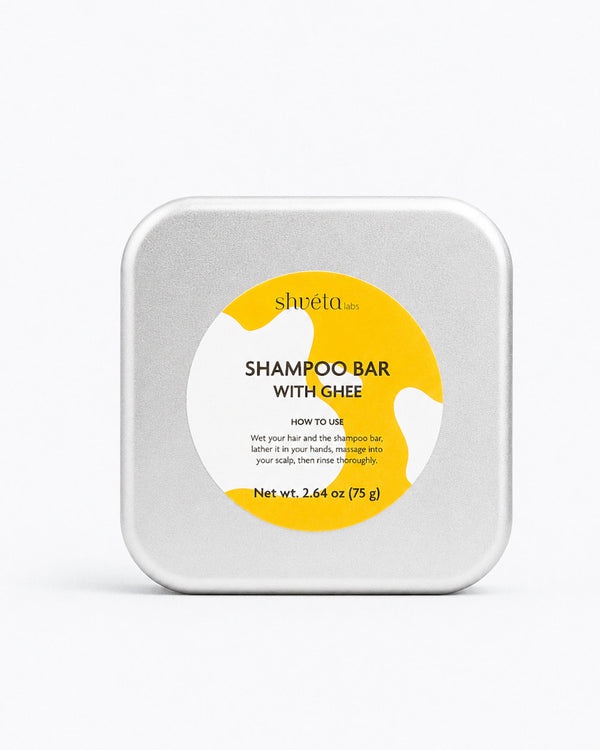
Conditioner Bar With Ghee & Argan
Highlights
Key Ingredients
Other Ingredients
Skim through
| Ingredient name | what-it-does | irr., com. | ID-Rating |
|---|---|---|---|
| Behentrimonium Methosulfate | surfactant/cleansing | ||
| Cetyl Alcohol | emollient, viscosity controlling | 2, 2 | |
| ***Isoamyl Laurate | emollient | ||
| Cetearyl Alcohol | emollient, viscosity controlling, emulsifying, surfactant/cleansing | 1, 2 | |
| Water/Aqua | solvent | ||
| ***Argania Spinosa Kernel Oil | antioxidant, emollient | goodie | |
| Ghee | |||
| Ceteareth-20 | emulsifying, surfactant/cleansing | 3, 2 | |
| Cetrimonium Chloride | antimicrobial/antibacterial, emulsifying, preservative, surfactant/cleansing |
Shveta Labs Conditioner Bar With Ghee & ArganIngredients explained
In itself, it's an antistatic (stops your hair from flying around because of electricity), hair conditioning and softening ingredient used mainly in haircare products.
Coupled with Cetearyl Alcohol, they form an easy to handle, super stable emulsifier duo that has exceptional spreadability and gives a pleasant final touch to the products.
A so-called fatty (the good, non-drying kind of) alcohol that does all kinds of things in a skincare product: it makes your skin feel smooth and nice (emollient), helps to thicken up products and also helps water and oil to blend (emulsifier). Can be derived from coconut or palm kernel oil.
A naturally derived (Ecocert approved) colorless to yellowish oily liquid that's touted as a natural silicone alternative. It's claimed to have great sensorial properties: light but caring, velvety, silky and non-sticky.
It's also great at dissolving UV-filters in sunscreens or dispersing pigments in makeup products. You can also bump into Isoamyl Laurate in hair care products as a hair conditioner that makes combing easier without build up.
An extremely common multitasker ingredient that gives your skin a nice soft feel (emollient) and gives body to creams and lotions. It also helps to stabilize oil-water mixes (emulsions), though it does not function as an emulsifier in itself. Its typical use level in most cream type formulas is 2-3%.
It’s a so-called fatty alcohol, a mix of cetyl and stearyl alcohol, other two emollient fatty alcohols. Though chemically speaking, it is alcohol (as in, it has an -OH group in its molecule), its properties are totally different from the properties of low molecular weight or drying alcohols such as denat. alcohol. Fatty alcohols have a long oil-soluble (and thus emollient) tail part that makes them absolutely non-drying and non-irritating and are totally ok for the skin.
Good old water, aka H2O. The most common skincare ingredient of all. You can usually find it right in the very first spot of the ingredient list, meaning it’s the biggest thing out of all the stuff that makes up the product.
It’s mainly a solvent for ingredients that do not like to dissolve in oils but rather in water.
Once inside the skin, it hydrates, but not from the outside - putting pure water on the skin (hello long baths!) is drying.
One more thing: the water used in cosmetics is purified and deionized (it means that almost all of the mineral ions inside it is removed). Like this, the products can stay more stable over time.
When it comes to cosmetic oils and hype, argan oil is for sure leading the way. Dubbed as the "liquid gold of Morocco", we have to admit we have some trouble determining why this oil enjoys such a special miracle status. Not that it's not good, it is good, even great but reading the research about argan and a bunch of other plant oils we just do not see the big, unique differentiating factor (though that might be our fault not reading enough, obvs.)
So, argan oil comes from the kernel of the argan fruit that comes from the argan tree that grows only in Morocco. The tree is slow growing and getting the oil is a hard job. The traditional process is that the ripe argan fruits fall from the tree, then goats eat them up and poop out the seeds. The seeds are collected and smashed with a stone to get the kernels inside. This part is the hard one as the seeds have extremely hard shells. Once the kernels are obtained, the oil is pressed out from them (the kernels contain about 50% oil).
As for skincare, argan oil is loaded with lots of skin goodies (but so are many other plant oils): it contains 80% nourishing and moisturizing unsaturated fatty acids, mainly oleic (38-50%), linoleic (28-38%) and palmitic (10-18%). It also contains a relatively large amount of antioxidant vitamin E (600-900 mg/kg, about twice as much as olive), small amounts of antioxidant phenols (including caffeic acid, ferulic acid, and epicatechin), as well as some rare sterols with soothing and anti-inflammatory properties.
Thanks to all the above goodness in argan oil, it can greatly nourish and moisturize the skin and hair. It's also claimed to be able to neutralize collagen-damaging free radicals, help reduce scars, and revitalize and improve skin elasticity. You can even read that argan might help acne-prone skin, but being a high oleic oil, we would be careful with that.
All in all, argan oil is a real goodie but we do not fully understand the special miracle status it enjoys.
This ingredient name is not according to the INCI-standard. :( What, why?!
A common functional ingredient that helps to keep the oil-loving and water-loving ingredients together (emulsifier), stabilizes and thickens the products.
Chemically speaking, it is ethoxylated Cetearyl alcohol, meaning that some ethylene oxide is added to the fatty alcohol to increase the water-soluble part in the molecule. The result is that the mainly oil soluble, emollient fatty alcohol is converted to an emulsifier molecule that keeps oil and water mixed in creams. The number in the name of Ceteareth emulsifiers refers to the average number of ethylene oxide molecules added and 20 makes a good emulsifier.
 We don't have description for this ingredient yet.
You may also want to take a look at...
| what‑it‑does | surfactant/cleansing |
| what‑it‑does | emollient | viscosity controlling |
| irritancy, com. | 2, 2 |
| what‑it‑does | emollient |
| what‑it‑does | emollient | viscosity controlling | emulsifying | surfactant/cleansing |
| irritancy, com. | 1, 2 |
| what‑it‑does | solvent |
| what‑it‑does | antioxidant | emollient |
| what‑it‑does | emulsifying | surfactant/cleansing |
| irritancy, com. | 3, 2 |
| what‑it‑does | antimicrobial/antibacterial | emulsifying | preservative | surfactant/cleansing |