




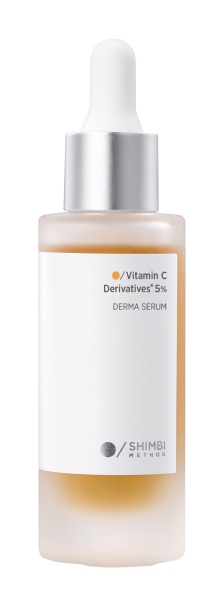
Derma Serum Vitamin C Derivative 5%
Highlights
Key Ingredients
Other Ingredients
Skim through
| Ingredient name | what-it-does | irr., com. | ID-Rating |
|---|---|---|---|
| Water | solvent | ||
| Isopentyldiol | solvent, moisturizer/humectant, emollient | ||
| Glycerin | skin-identical ingredient, moisturizer/humectant | 0, 0 | superstar |
| Sodium Ascorbyl Phosphate | antioxidant, anti-acne | goodie | |
| Betaine | moisturizer/humectant | goodie | |
| Pentylene Glycol | solvent, moisturizer/humectant | ||
| Bis-PEG-18 Methyl Ether Dimethyl Silane | emollient, moisturizer/humectant, surfactant/cleansing | ||
| PPG-13-Decyltetradeceth-24 | emulsifying, surfactant/cleansing | ||
| Phenoxyethanol | preservative | ||
| EDTA-4 Na | chelating | ||
| Xanthan Gum | viscosity controlling | ||
| Citric Acid | buffering | ||
| Sodium Citrate | chelating, buffering | ||
| BG | moisturizer/humectant, solvent | 0, 1 | |
| Caramel | colorant | ||
| Biosaccharide Gum-1 | soothing, moisturizer/humectant | goodie | |
| Coptis Japonica Root Extract | soothing, antioxidant | goodie | |
| Tocopherol | antioxidant | 0-3, 0-3 | goodie |
Shimbi Method Derma Serum Vitamin C Derivative 5%Ingredients explained
Good old water, aka H2O. The most common skincare ingredient of all. You can usually find it right in the very first spot of the ingredient list, meaning it’s the biggest thing out of all the stuff that makes up the product.
It’s mainly a solvent for ingredients that do not like to dissolve in oils but rather in water.
Once inside the skin, it hydrates, but not from the outside - putting pure water on the skin (hello long baths!) is drying.
One more thing: the water used in cosmetics is purified and deionized (it means that almost all of the mineral ions inside it is removed). Like this, the products can stay more stable over time.
A water-soluble, colorless, odorless humectant liquid that makes your skin nice and smooth (aka emollient) and gives a dry, non-tacky skin feel. It also has great instant and some longer-lasting moisturizing effect and works in synergy with fellow moisturizer, sorbitol.
- A natural moisturizer that’s also in our skin
- A super common, safe, effective and cheap molecule used for more than 50 years
- Not only a simple moisturizer but knows much more: keeps the skin lipids between our skin cells in a healthy (liquid crystal) state, protects against irritation, helps to restore barrier
- Effective from as low as 3% with even more benefits for dry skin at higher concentrations up to 20-40%
- High-glycerin moisturizers are awesome for treating severely dry skin
The sodium salt form of skincare superstar, vitamin C. If you do not know what the big fuss about vitamin C is, you are missing out and you have to click here and read all the geeky details about it.
Pure vitamin C (aka ascorbic acid, AA) is great and all, but its lack of stability is a big challenge for the cosmetics industry. One solution is to create stable derivatives that can be absorbed into the skin, convert there to AA and do all the magic AA is proven to do (which is being an antioxidant, a collagen booster, and a skin brightener).
SAP (the vit C derivative, not the enterprise software, obvs) is a promising derivative that has great stability up to pH 7. The challenge with it though is skin penetration. Unfortunately, it seems to be limited, or to quote a great article from the Journal of Cosmetic Dermatology "topically applied ascorbyl phosphate salts are, at very best, poorly absorbed in comparison with AA". Regarding conversion to AA, there seems to be no data about it, so we can neither deny nor confirm it.
We have better news regarding the three magic abilities of vitamin C: there is in-vivo (tested on real people) data showing that SAP does have photo-protective (aka antioxidant) properties, though less than pure AA. SAP might also aid collagen boosting; in-vitro (made in the lab) data shows that it works, but is less effective than another vitamin C derivative, called MAP (that seems to be as effective as pure AA). As for skin-brightening, there is a trade publication with in-vivo data showing that SAP can fade brown spots.
Another thing SAP might be able to do is to help with acne. A 2005 study showed in vitro (in test tubes) that 1% SAP has a strong antimicrobial activity on evil acne causing P. acnes and it also showed in vivo (on real people) that 5% SAP can strongly improve the inflammatory and non-inflammatory lesions of acne vulgaris. In fact, the results were comparable or even slightly better than with 5% benzoyl peroxide.
And there is even more regarding SAP and acne. A nice double-blind study from 2009 showed that 5% SAP reduced the inflammatory lesions by 20.14% and 48.82% within 4 and 8 weeks respectively and when combined with 0.2% retinol the results were even better. With this combination treatment, the improvement was 29.28% after 4 weeks and 63.10% after 8 weeks of application.
Aside from research studies, anecdotal evidence also supports SAP being a promising vitamin C derivative. One of the best-selling (vitamin C) serums in Sephora is the Ole Henriksen Truth Serum, while on Amazon it's the OzNaturals Vitamin C 20 Serum. Another popular choice is the Mad Hippie Vitamin C serum, and all of these contain vitamin C in the form of SAP.
Overall, we think SAP is a goody! In terms of anti-aging, it's probably not as effective as pure Ascorbic Acid, but it's totally worth a try. However, if your skin is acne-prone, SAP is your form of Vitamin C and it's a must-try.
A sugar beet-derived amino acid derivative with nice skin protection and moisturization properties. Betaine's special thing is being an osmolyte, a molecule that helps to control cell-water balance. It is also a natural osmoprotectant, meaning that it attracts water away from the protein surface and thus protects them from denaturation and increases their thermodynamic stability.
It also gives sensorial benefits to the formula and when used in cleansers, it helps to make them milder and gentler.
A multi-functional, silky feeling helper ingredient that can do quite many things. It's used as an emulsion stabilizer, solvent and a broad spectrum antimicrobial. According to manufacturer info, it's also a moisturizer and helps to make the product feel great on the skin. It works synergistically with preservatives and helps to improve water-resistance of sunscreens.
Bis-PEG-18 Methyl Ether Dimethyl Silane is a silicone that is water dispersible (as opposed to most other silicones that are usually oil dispersible). It makes the skin smooth and nice (emollient), moisturizes, helps to reduce tackiness, and also has some foam boosting properties. It is often used in light, watery formulas to give them an extra silky feel.
 We don't have description for this ingredient yet.
It’s pretty much the current IT-preservative. It’s safe and gentle, but even more importantly, it’s not a feared-by-everyone-mostly-without-scientific-reason paraben.
It’s not something new: it was introduced around 1950 and today it can be used up to 1% worldwide. It can be found in nature - in green tea - but the version used in cosmetics is synthetic.
Other than having a good safety profile and being quite gentle to the skin it has some other advantages too. It can be used in many types of formulations as it has great thermal stability (can be heated up to 85°C) and works on a wide range of pH levels (ph 3-10).
It’s often used together with ethylhexylglycerin as it nicely improves the preservative activity of phenoxyethanol.
A handy helper ingredient that helps products to remain nice and stable for a longer time. It does so by neutralizing the metal ions in the formula (that usually get into there from water) that would otherwise cause some not so nice changes.
It's one of the most commonly used thickeners and emulsion stabilizers. If the product is too runny, a little xanthan gum will make it more gel-like. Used alone, it can make the formula sticky and it is a good team player so it is usually combined with other thickeners and so-called rheology modifiers (helper ingredients that adjust the flow and thus the feel of the formula). The typical use level of Xantha Gum is below 1%, it is usually in the 0.1-0.5% range.
Btw, Xanthan gum is all natural, a chain of sugar molecules (polysaccharide) produced from individual sugar molecules (glucose and sucrose) via fermentation. It’s approved by Ecocert and also used in the food industry (E415).
Citric acid comes from citrus fruits and is an AHA. If these magic three letters don’t tell you anything, click here and read our detailed description on glycolic acid, the most famous AHA.
So citric acid is an exfoliant, that can - just like other AHAs - gently lift off the dead skin cells of your skin and make it more smooth and fresh.
There is also some research showing that citric acid with regular use (think three months and 20% concentration) can help sun-damaged skin, increase skin thickness and some nice hydrating things called glycosaminoglycans in the skin.
But according to a comparative study done in 1995, citric acid has less skin improving magic properties than glycolic or lactic acid. Probably that’s why citric acid is usually not used as an exfoliant but more as a helper ingredient in small amounts to adjust the pH of a formulation.
A little helper ingredient that is used to adjust the pH of the product. It also helps to keep products stay nice longer by neutralizing the metal ions in the formula (they usually come from water).
Butylene glycol, or let’s just call it BG, is a multi-tasking colorless, syrupy liquid. It’s a great pick for creating a nice feeling product.
BG’s main job is usually to be a solvent for the other ingredients. Other tasks include helping the product to absorb faster and deeper into the skin (penetration enhancer), making the product spread nicely over the skin (slip agent), and attracting water (humectant) into the skin.
It’s an ingredient whose safety hasn’t been questioned so far by anyone (at least not that we know about). BG is approved by Ecocert and is also used enthusiastically in natural products. BTW, it’s also a food additive.
The caramel in cosmetics is pretty much the same one that you know from the kitchen. It is derived by controlled heat treatment of food-grade carbohydrates (sugars) and works as a brown colorant.
Biosaccharide Gum-1 is a pretty interesting kind of sugar ingredient that is created from sorbitol via bacterial fermentation.
According to the manufacturer it’s a “S.M.A.R.T.” sugar: it has Soothing, Moisturizing, Anti-aging, Restructuring and Touch properties. Let’s look at them quickly one by one.
Soothing: the manufacturer tested out the soothing effect in vivo (meaning on humans that is always a good thing!) by measuring how 3% Biosaccharide Gum-1 decreased the tingling sensation caused by 10% lactic acid. The result was good: the tingling was decreased by 47%.
Moisturizing: Compared to famous hyaluronic acid, it turns out that the two are great together. HA has a quicker effect and provides more instant hydration (much more hydration was measured after 1h of application), while our nice sugar has a somewhat delayed effect demonstrating stronger hydration after 3h of application. After 8 hours both had similar moisturizing effect.
Anti-aging: According to ex-vivo tests (meaning not on humans, so do not trust it too much) Biosaccharide Gum-1 can stimulate a protein in our skin called sirtuin-1. This is supposed to help our skin cells to live longer, and function better.
Resurfacing: The sirtuin-1 stimulation also results in quicker cell renewal - something that happens anyway but slows down as we age. And the quicker cell renewal is good because it helps the regeneration of the barrier function. That is especially nice for fragile, sensitive skin.
Touch: our fermented sugar is not only good to the skin, but it also feels great on the skin. It gives a nice “soft touch” feeling and makes the products pleasant to use.
The bottom line is that the above info is from the manufacturer (and we could not find any relevant independent research) so obviously take it with a grain of salt. But Biosaccharide Gum-1 does look as an interesting and promising ingredient that’s why it earned our goodie rating.
The extract coming from the root of the traditional medicinal herb, Coptis Japonica or Japanese Goldthread. The plant is used traditionally in East Asia for its anti-inflammatory, antioxidant and antimicrobial abilities.
Other than that, there is also an abstract from the International Journal of Cosmetic Science that found Coptis Japonica Root Extract and its active component called berberine to show potent inhibition of triglyceride (aka fat) accumulation and subcutaneous preadipocytes (the cells that become later fat cells) differentiation meaning that Goldthread Extract might also be useful in slimming and anti-cellulite products.
- Primary fat-soluble antioxidant in our skin
- Significant photoprotection against UVB rays
- Vit C + Vit E work in synergy and provide great photoprotection
- Has emollient properties
- Easy to formulate, stable and relatively inexpensive
You may also want to take a look at...
| what‑it‑does | solvent |
| what‑it‑does | solvent | moisturizer/humectant | emollient |
| what‑it‑does | skin-identical ingredient | moisturizer/humectant |
| irritancy, com. | 0, 0 |
| what‑it‑does | antioxidant | anti-acne |
| what‑it‑does | moisturizer/humectant |
| what‑it‑does | solvent | moisturizer/humectant |
| what‑it‑does | emollient | moisturizer/humectant | surfactant/cleansing |
| what‑it‑does | emulsifying | surfactant/cleansing |
| what‑it‑does | preservative |
| what‑it‑does | chelating |
| what‑it‑does | viscosity controlling |
| what‑it‑does | buffering |
| what‑it‑does | chelating | buffering |
| what‑it‑does | moisturizer/humectant | solvent |
| irritancy, com. | 0, 1 |
| what‑it‑does | colorant |
| what‑it‑does | soothing | moisturizer/humectant |
| what‑it‑does | soothing | antioxidant |
| what‑it‑does | antioxidant |
| irritancy, com. | 0-3, 0-3 |