




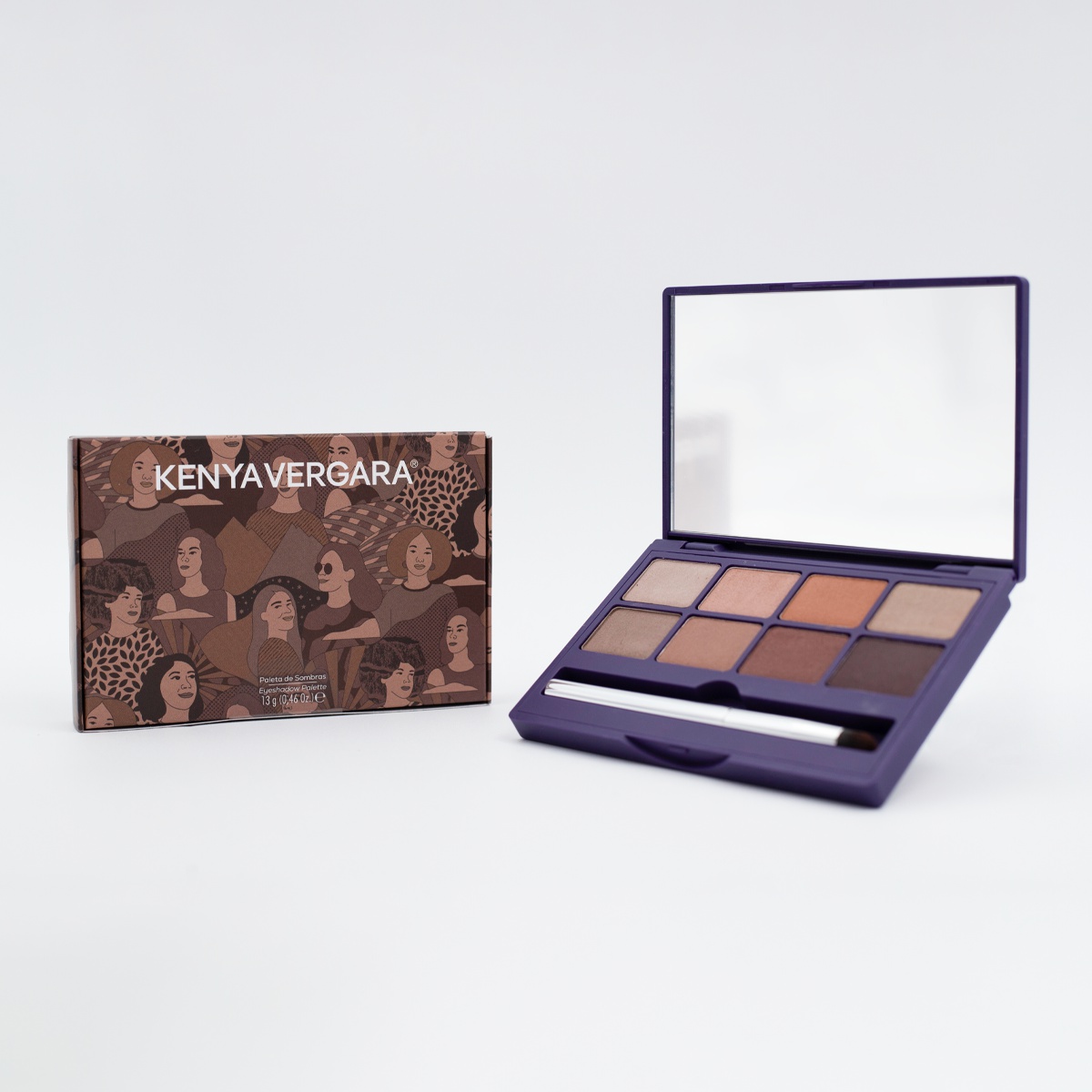
Brown Eyeshadow Palette
Ingredients overview
Highlights
Skim through
Seytu Brown Eyeshadow PaletteIngredients explained
A super versatile and common mineral powder that comes in different particle sizes. It is a multi-tasker used to improve skin feel, increase product slip, give the product light-reflecting properties, enhance skin adhesion or serve as an anti-caking agent.
It is also the most commonly used "base" material for layered composite pigments such as pearl-effect pigments. In this case, mica is coated with one or more metal oxides (most commonly titanium dioxide) to achieve pearl effect via the physical phenomenon known as interference.
Talc is the major component of most powder makeup products (think face powder, eyeshadows, and blushers) that usually contain it up to 70%. Its two winning properties that make it very suitable for this role is its outstanding spreadability for a smooth application and its low covering power, aka translucency to avoid clown-like effects.
Chemically speaking, it is a clay mineral (hydrated magnesium silicate) that is mined in several countries. The drawback of mined minerals is potential impurities and the version used in cosmetics has to be white (not gray like cheaper grades), free from asbestos, sterilized and have thin plates for a maximum slip.
 We don't have description for this ingredient yet.
A clear, colorless oil-like liquid that makes the skin feel smooth and nice (aka emollient) and it does so without it being greasy.
What's more, it can even reduce the heavy, greasy feel in products with high oil content. It's also fast-spreading meaning that it gives the formula a good, nice slip. It absorbs quickly into the skin and helps other ingredients to penetrate quicker and deeper.
Thanks to all this, it's one of the most commonly used emollients out there. There is just one little drawback: it has a high comedogenic index (5 out of 5...), so it might clog pores if you're prone to it.
The famous or maybe rather infamous mineral oil. The clear oily liquid that is the "cheap by-product" of refining crude oil and the one that gets a lot of heat for its poor provenance. It is a very controversial ingredient with pros and cons and plenty of myths around it. So let us see them:
The pros of mineral oil
Trust us, if something is used for more than 100 years in cosmetic products, it has advantages. Chemically speaking, cosmetic grade mineral oil is a complex mixture of highly refined saturated hydrocarbons with C15-50 chain length. It is not merely a "by-product" but rather a specifically isolated part of petroleum that is very pure and inert.
It is a great emollient and moisturizer working mainly by occlusivity. Occlusivity is one of the basic mechanisms of how moisturizers work and it means that mineral oil sits on top of the skin and hinders so-called trans-epidermal water loss, i.e water evaporating out of your skin. When compared to heavy-duty plant oil, extra virgin coconut oil, the two of them were equally efficient and safe as moisturizers in treating xerosis, a skin condition connected to very dry skin.
The other thing that mineral oil is really good at is being non-irritating to the skin. The chemical composition of plant oils is more complex with many more possible allergens or irritating components, while mineral oil is simple, pure and sensitivity to it is extremely rare. If you check out the classic French pharmacy brands and their moisturizers for the most sensitive, allergy prone skin, they usually contain mineral oil. This is no coincidence.
The cons of mineral oil
The pros of mineral oil can be interpreted as cons if we look at them from another perspective. Not penetrating the skin but mostly just sitting on top of it and not containing biologically active components, like nice fatty acids and vitamins mean that mineral oil does not "nourish" the skin in the way plant oils do. Mineral oil does not give the skin any extra goodness, it is simply a non-irritating moisturizer working mainly by occlusivity.
The myths around mineral oil
Badmouthing mineral oil is a favorite sport of many, it is a cheap material and being connected to petrolatum makes it fairly easy to demonize.
While it is true that industrial grade mineral oil contains carcinogenic components (so-called polycyclic compounds), these are completely removed from cosmetic and food grade mineral oil and there is no scientific data showing that the pure, cosmetic grade version is carcinogenic.
What is more, in terms of the general health effects of mineral oils used in cosmetics, a 2017 study reviewed the data on their skin penetration and concluded that "the cosmetic use of mineral oils and waxes does not present a risk to consumers due to a lack of systemic exposure."
Another super common myth surrounding mineral oil is that it is comedogenic. A 2005 study titled "Is mineral oil comedogenic?" examined this very question and guess what happened? The study concluded that "based on the animal and human data reported, along with the AAD recommendation, it would appear reasonable to conclude that mineral oil is noncomedogenic in humans."
Overall, we feel that the scaremongering around mineral oil is not justified. For dry and super-sensitive skin types it is a great option. However, if you do not like its origin or its heavy feeling or anything else about it, avoiding it has never been easier. Mineral oil has such a bad reputation nowadays that cosmetic companies hardly dare to use it anymore.
Polyethylene is the most common plastic in the world. It is a super versatile polymer (molecule from repeated subunits) and when it comes to cosmetics, it is often referred to as microbeads. Well, it used to be referred to as microbeads, as it was banned in 2015 in the " Microbead-Free Waters Act" due to the small plastic spheres accumulating in the waters and looking like food to fish. Well done by Obama.
But being versatile means that polyethylene does not only come as scrub particles but also as a white wax. In its wax-form, it is still well, alive and pretty popular. It thickens up water-free formulas, increases hardness and raises the melting point of emulsions and water-less balms. It is particularly common in cleansing balms and stick-type makeup products due to its ability to add body, hardness and slip to these formulas.
It's one of those things that help your cosmetics not to go wrong too soon, aka a preservative. It’s not a strong one and doesn’t really work against bacteria, but more against mold and yeast. To do that it has to break down to its active form, sorbic acid. For that to happen, there has to be water in the product and the right pH value (pH 3-4).
But even if everything is right, it’s not enough on its own. If you see potassium sorbate you should see some other preservative next to it too.
BTW, it’s also a food preservative and even has an E number, E202.
We don't have description for this ingredient yet.
We don't have description for this ingredient yet.
It’s pretty much the current IT-preservative. It’s safe and gentle, but even more importantly, it’s not a feared-by-everyone-mostly-without-scientific-reason paraben.
It’s not something new: it was introduced around 1950 and today it can be used up to 1% worldwide. It can be found in nature - in green tea - but the version used in cosmetics is synthetic.
Other than having a good safety profile and being quite gentle to the skin it has some other advantages too. It can be used in many types of formulations as it has great thermal stability (can be heated up to 85°C) and works on a wide range of pH levels (ph 3-10).
It’s often used together with ethylhexylglycerin as it nicely improves the preservative activity of phenoxyethanol.
Ci 77891 is the color code of titanium dioxide. It's a white pigment with great color consistency and dispersibility.
An inorganic (as in no carbon in its molecule) pigment that can range in shade from blue (most common) to violet, pink or even green. It is not permitted in lip products in the US.
We don't have description for this ingredient yet.
An inorganic (as in no carbon in its molecule) pigment that gives purple or violet shade.
A bit of a sloppy ingredient name as it covers not one but three pigments: red, yellow and black iron oxide.
The trio is invaluable for "skin-colored" makeup products (think your foundation and pressed powder) as blending these three shades carefully can produce almost any shade of natural-looking flesh tones.
A super versatile and common mineral powder that comes in different particle sizes. It is a multi-tasker used to improve skin feel, increase product slip, give the product light-reflecting properties, enhance skin adhesion or serve as an anti-caking agent.
It is also the most commonly used "base" material for layered composite pigments such as pearl-effect pigments. In this case, mica is coated with one or more metal oxides (most commonly titanium dioxide) to achieve pearl effect via the physical phenomenon known as interference.
Talc is the major component of most powder makeup products (think face powder, eyeshadows, and blushers) that usually contain it up to 70%. Its two winning properties that make it very suitable for this role is its outstanding spreadability for a smooth application and its low covering power, aka translucency to avoid clown-like effects.
Chemically speaking, it is a clay mineral (hydrated magnesium silicate) that is mined in several countries. The drawback of mined minerals is potential impurities and the version used in cosmetics has to be white (not gray like cheaper grades), free from asbestos, sterilized and have thin plates for a maximum slip.
We don't have description for this ingredient yet.
A clear, colorless oil-like liquid that makes the skin feel smooth and nice (aka emollient) and it does so without it being greasy.
What's more, it can even reduce the heavy, greasy feel in products with high oil content. It's also fast-spreading meaning that it gives the formula a good, nice slip. It absorbs quickly into the skin and helps other ingredients to penetrate quicker and deeper.
Thanks to all this, it's one of the most commonly used emollients out there. There is just one little drawback: it has a high comedogenic index (5 out of 5...), so it might clog pores if you're prone to it.
The famous or maybe rather infamous mineral oil. The clear oily liquid that is the "cheap by-product" of refining crude oil and the one that gets a lot of heat for its poor provenance. It is a very controversial ingredient with pros and cons and plenty of myths around it. So let us see them:
The pros of mineral oil
Trust us, if something is used for more than 100 years in cosmetic products, it has advantages. Chemically speaking, cosmetic grade mineral oil is a complex mixture of highly refined saturated hydrocarbons with C15-50 chain length. It is not merely a "by-product" but rather a specifically isolated part of petroleum that is very pure and inert.
It is a great emollient and moisturizer working mainly by occlusivity. Occlusivity is one of the basic mechanisms of how moisturizers work and it means that mineral oil sits on top of the skin and hinders so-called trans-epidermal water loss, i.e water evaporating out of your skin. When compared to heavy-duty plant oil, extra virgin coconut oil, the two of them were equally efficient and safe as moisturizers in treating xerosis, a skin condition connected to very dry skin.
The other thing that mineral oil is really good at is being non-irritating to the skin. The chemical composition of plant oils is more complex with many more possible allergens or irritating components, while mineral oil is simple, pure and sensitivity to it is extremely rare. If you check out the classic French pharmacy brands and their moisturizers for the most sensitive, allergy prone skin, they usually contain mineral oil. This is no coincidence.
The cons of mineral oil
The pros of mineral oil can be interpreted as cons if we look at them from another perspective. Not penetrating the skin but mostly just sitting on top of it and not containing biologically active components, like nice fatty acids and vitamins mean that mineral oil does not "nourish" the skin in the way plant oils do. Mineral oil does not give the skin any extra goodness, it is simply a non-irritating moisturizer working mainly by occlusivity.
The myths around mineral oil
Badmouthing mineral oil is a favorite sport of many, it is a cheap material and being connected to petrolatum makes it fairly easy to demonize.
While it is true that industrial grade mineral oil contains carcinogenic components (so-called polycyclic compounds), these are completely removed from cosmetic and food grade mineral oil and there is no scientific data showing that the pure, cosmetic grade version is carcinogenic.
What is more, in terms of the general health effects of mineral oils used in cosmetics, a 2017 study reviewed the data on their skin penetration and concluded that "the cosmetic use of mineral oils and waxes does not present a risk to consumers due to a lack of systemic exposure."
Another super common myth surrounding mineral oil is that it is comedogenic. A 2005 study titled "Is mineral oil comedogenic?" examined this very question and guess what happened? The study concluded that "based on the animal and human data reported, along with the AAD recommendation, it would appear reasonable to conclude that mineral oil is noncomedogenic in humans."
Overall, we feel that the scaremongering around mineral oil is not justified. For dry and super-sensitive skin types it is a great option. However, if you do not like its origin or its heavy feeling or anything else about it, avoiding it has never been easier. Mineral oil has such a bad reputation nowadays that cosmetic companies hardly dare to use it anymore.
Polyethylene is the most common plastic in the world. It is a super versatile polymer (molecule from repeated subunits) and when it comes to cosmetics, it is often referred to as microbeads. Well, it used to be referred to as microbeads, as it was banned in 2015 in the " Microbead-Free Waters Act" due to the small plastic spheres accumulating in the waters and looking like food to fish. Well done by Obama.
But being versatile means that polyethylene does not only come as scrub particles but also as a white wax. In its wax-form, it is still well, alive and pretty popular. It thickens up water-free formulas, increases hardness and raises the melting point of emulsions and water-less balms. It is particularly common in cleansing balms and stick-type makeup products due to its ability to add body, hardness and slip to these formulas.
It's one of those things that help your cosmetics not to go wrong too soon, aka a preservative. It’s not a strong one and doesn’t really work against bacteria, but more against mold and yeast. To do that it has to break down to its active form, sorbic acid. For that to happen, there has to be water in the product and the right pH value (pH 3-4).
But even if everything is right, it’s not enough on its own. If you see potassium sorbate you should see some other preservative next to it too.
BTW, it’s also a food preservative and even has an E number, E202.
We don't have description for this ingredient yet.
We don't have description for this ingredient yet.
A clear, light yellow liquid that is used to coat pigments (such as inorganic sunscreen agents or colorants) in cosmetic products. The coating helps to stabilize pigments in the formulas and also helps them to spread easily and evenly on the skin.
It’s pretty much the current IT-preservative. It’s safe and gentle, but even more importantly, it’s not a feared-by-everyone-mostly-without-scientific-reason paraben.
It’s not something new: it was introduced around 1950 and today it can be used up to 1% worldwide. It can be found in nature - in green tea - but the version used in cosmetics is synthetic.
Other than having a good safety profile and being quite gentle to the skin it has some other advantages too. It can be used in many types of formulations as it has great thermal stability (can be heated up to 85°C) and works on a wide range of pH levels (ph 3-10).
It’s often used together with ethylhexylglycerin as it nicely improves the preservative activity of phenoxyethanol.
Ci 77891 is the color code of titanium dioxide. It's a white pigment with great color consistency and dispersibility.
An inorganic (as in no carbon in its molecule) pigment that can range in shade from blue (most common) to violet, pink or even green. It is not permitted in lip products in the US.
A bit of a sloppy ingredient name as it covers not one but three pigments: red, yellow and black iron oxide.
The trio is invaluable for "skin-colored" makeup products (think your foundation and pressed powder) as blending these three shades carefully can produce almost any shade of natural-looking flesh tones.
You may also want to take a look at...
| what‑it‑does | colorant |
| what‑it‑does | abrasive/scrub |
| irritancy, com. | 0, 1 |
| what‑it‑does | colorant | moisturizer/humectant |
| irritancy, com. | 0, 1 |
| what‑it‑does | emollient | perfuming |
| irritancy, com. | 3, 3-5 |
| what‑it‑does | emollient | solvent |
| irritancy, com. | 0, 0-2 |
| what‑it‑does | viscosity controlling |
| what‑it‑does | preservative |
| what‑it‑does | preservative |
| what‑it‑does | abrasive/scrub |
| what‑it‑does | antimicrobial/antibacterial |
| what‑it‑does | abrasive/scrub |
| what‑it‑does | preservative |
| what‑it‑does | colorant |
| irritancy, com. | 0, 0 |
| what‑it‑does | colorant |
| irritancy, com. | 0, 0 |
| what‑it‑does | colorant |
| irritancy, com. | 0, 1 |
| what‑it‑does | colorant |
| what‑it‑does | colorant |
| irritancy, com. | 0, 0 |
| what‑it‑does | colorant |
| what‑it‑does | abrasive/scrub |
| irritancy, com. | 0, 1 |
| what‑it‑does | colorant | moisturizer/humectant |
| irritancy, com. | 0, 1 |
| what‑it‑does | emollient | perfuming |
| irritancy, com. | 3, 3-5 |
| what‑it‑does | emollient | solvent |
| irritancy, com. | 0, 0-2 |
| what‑it‑does | viscosity controlling |
| what‑it‑does | preservative |
| what‑it‑does | preservative |
| what‑it‑does | abrasive/scrub |
| what‑it‑does | antimicrobial/antibacterial |
| what‑it‑does | abrasive/scrub |
| what‑it‑does | preservative |
| what‑it‑does | colorant |
| irritancy, com. | 0, 0 |
| what‑it‑does | colorant |
| irritancy, com. | 0, 0 |
| what‑it‑does | colorant |
| irritancy, com. | 0, 0 |