




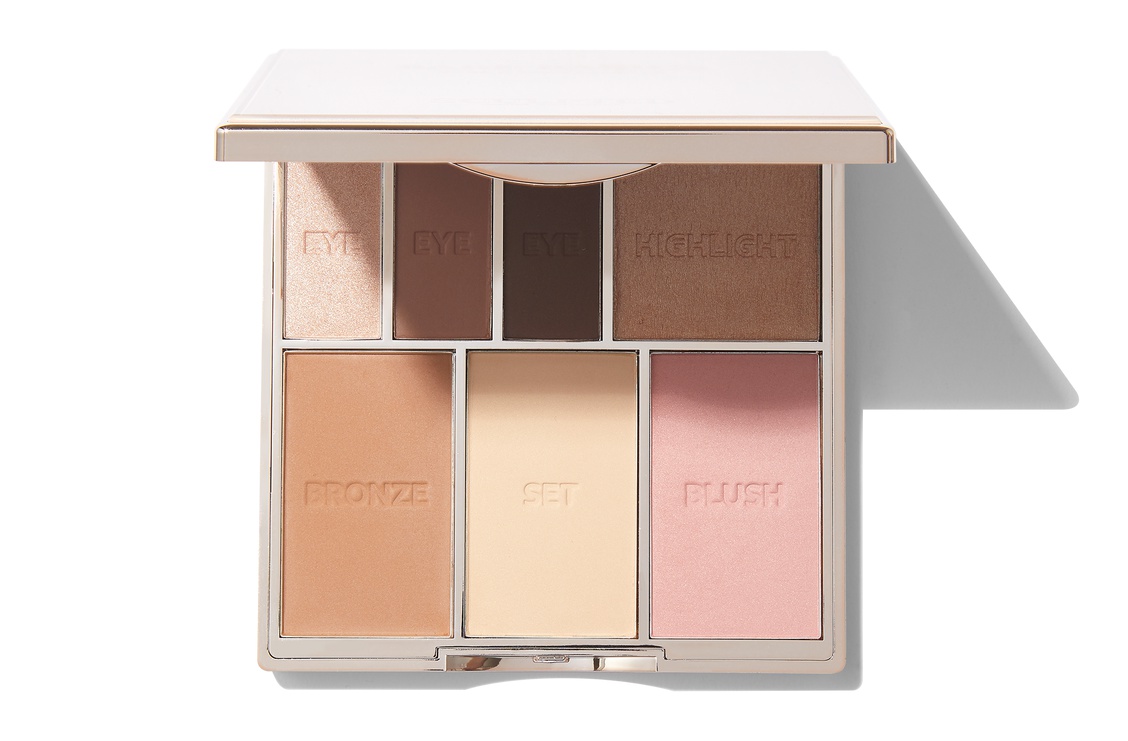
Bare Basics Palette Nude 01
Ingredients overview
 INCI photo pending approval
Highlights
Key Ingredients
Other Ingredients
Skim through
Sculpted by Aimee Bare Basics Palette Nude 01Ingredients explained
A super versatile and common mineral powder that comes in different particle sizes. It is a multi-tasker used to improve skin feel, increase product slip, give the product light-reflecting properties, enhance skin adhesion or serve as an anti-caking agent.
It is also the most commonly used "base" material for layered composite pigments such as pearl-effect pigments. In this case, mica is coated with one or more metal oxides (most commonly titanium dioxide) to achieve pearl effect via the physical phenomenon known as interference.
Talc is the major component of most powder makeup products (think face powder, eyeshadows, and blushers) that usually contain it up to 70%. Its two winning properties that make it very suitable for this role is its outstanding spreadability for a smooth application and its low covering power, aka translucency to avoid clown-like effects.
Chemically speaking, it is a clay mineral (hydrated magnesium silicate) that is mined in several countries. The drawback of mined minerals is potential impurities and the version used in cosmetics has to be white (not gray like cheaper grades), free from asbestos, sterilized and have thin plates for a maximum slip.
A white powdery thing that's the major component of glass and sand. In cosmetics, it’s often in products that are supposed to keep your skin matte as it has great oil-absorbing abilities. It’s also used as a helper ingredient to thicken up products or suspend insoluble particles.
 We don't have description for this ingredient yet.
A liquid emollient derived from isostearic acid that gives a rich, cushiony skin-feel and unusually high levels of gloss. It also has film-forming abilities but without leaving a sticky residue and it aids long-lasting and water-resistant properties. All this makes Pentaerythrityl Tetraisostearate an ideal emollient for long-lasting protective emulsions, like lip balms.
An odorless, slightly yellowish powder that's used as a polymer microsphere (a tiny little ball from repeated subunits). It gives products an elegant, silky texture and better slip. It can also scatter light to blur fine lines while letting enough light through so that the skin still looks natural.
A clear, slightly yellow, odorless oil that's a very common, medium-spreading emollient. It makes the skin feel nice and smooth and works in a wide range of formulas.
Boron Nitride is a graphite-like, crystalline material that has light-diffusing and texture improving properties. It is quite the multi-tasker as it can blur imperfections, add an exceptional creamy feel to products and act as a mattifying agent.
In powder makeup products (think blushers, highlighters), it enhances the skin feel and improves the color pay-off. In lipsticks, it gives a creamy feel and a better color on the lips.
We don't have description for this ingredient yet.
It’s pretty much the current IT-preservative. It’s safe and gentle, but even more importantly, it’s not a feared-by-everyone-mostly-without-scientific-reason paraben.
It’s not something new: it was introduced around 1950 and today it can be used up to 1% worldwide. It can be found in nature - in green tea - but the version used in cosmetics is synthetic.
Other than having a good safety profile and being quite gentle to the skin it has some other advantages too. It can be used in many types of formulations as it has great thermal stability (can be heated up to 85°C) and works on a wide range of pH levels (ph 3-10).
It’s often used together with ethylhexylglycerin as it nicely improves the preservative activity of phenoxyethanol.
It’s a handy multi-tasking ingredient that gives the skin a nice, soft feel. At the same time, it also boosts the effectiveness of other preservatives, such as the nowadays super commonly used phenoxyethanol.
The blend of these two (caprylyl glycol + phenoxyethanol) is called Optiphen, which not only helps to keep your cosmetics free from nasty things for a long time but also gives a good feel to the finished product. It's a popular duo.
There is definitely some craze going on for coconut oil both in the healthy eating space (often claimed to be the healthiest oil to cook with but this is a topic for another site) and in the skin and hair care space.
We will talk here about the latter two and see why we might want to smear it all over ourselves. Chemically speaking, coconut oil has a unique fatty acid profile. Unlike many plant oils that mostly contain unsaturated fatty acids (fatty acids with double bonds and kinky structure such as linoleic or oleic), coconut oil is mostly saturated (fatty acids with single bonds only) and its most important fatty acid is Lauric Acid (about 50%). Saturated fatty acids have a linear structure that can stack nice and tight and hence they are normally solid at room temperature. Coconut oil melts around 25 °C so it is solid in the tub but melts on contact with the skin.
The saturated nature of coconut oil also means that it is a heavy-duty-oil ideal for dry skin types. A double-blind research confirmed that extra virgin coconut oil is as effective in treating xerosis (aka very dry skin) as mineral oil. Another study found that coconut oil is more effective than mineral oil in treating mild to moderate atopic dermatitis (aka eczema) in children.
So when it comes to dry skin, coconut oil is a goodie, no question there. The question is if it is good or bad for acne-prone skin. Its main fatty acid, Lauric Acid has some research showing that it is a promising ingredient against evil acne-causing bacteria, P. acnes but at the same time, both Lauric Acid and coconut oil have a very high comedogenic rating (4 out of 5). Though comedogenic ratings are not very reliable, anecdotal evidence (i.e. people commenting in forums) shows that people have mixed experiences. While some claim that it worked wonders on their acne others say that it gave them serious blackheads and zits. Try it at your own risk.
As for hair care, coconut oil has pretty solid research showing that it can penetrate into the hair very well (better than mineral oil and sunflower oil) and it can prevent hair protein loss as well as combing damage. If you have problems with damaged hair, split ends, coconut oil is worth trying as a pre- or/and post-wash treatment. Labmuffin has an awesome blogpost explaining in more detail why coconut oil is good for your hair.
A couple of other things worth mentioning: coconut oil might help with wound healing (promising animal study), it has some antifungal activity (against dermatophytes that cause the thing known as ringworm) and it also works as an insect repellent against black flies.
Overall, coconut oil is definitely a goodie for the hair and dry skin. If that warrants for the magic oil status it enjoys, we don't know.
The extract coming from the juice containing leaves of the Aloe vera plant. It's usually a hydroglycolic extract (though oil extract for the lipid parts also exists) that has similar moisturizing, emollient and anti-inflammatory properties as the juice itself. We have written some more about aloe here.
Chamomile probably needs no introduction as it's one of the most widely used medicinal herbs. You probably drink it regularly as a nice, calming cup of tea and it's also a regular on skincare ingredient lists.
Cosmetic companies use it mainly for its anti-inflammatory properties. It contains the terpenoids chamazulene and bisabolol both of which show great anti-inflammatory action in animal studies. On top of that chamomile also has some antioxidant activity (thanks to some other active ingredients called matricine, apigenin and luteolin).
Though chamomile is usually a goodie for the skin, it's also not uncommon to have an allergic reaction to it.
Yellow Iron Oxide is the super common inorganic (as in no carbon atom in the molecule) pigment that gives the yellow tones in your foundation. Blended with red and black iron oxides, it is essential in all "flesh-toned" makeup products.
Chemically speaking, it is hydrated iron III oxide and depending on the conditions of manufacture, it can range from a light lemon to an orange-yellow shade.
Red Iron Oxide is the super common pigment that gives the familiar, "rust" red color. It is also the one that gives the pink tones in your foundation. Chemically speaking, it is iron III oxide (Fe2O3).
Black Iron Oxide is the super common inorganic (as in no carbon atom in the molecule) pigment that controls the darkness of your foundation or gives the blackness to your mascara. Blended with red and black iron oxides, it is essential in all "flesh-toned" makeup products.
Chemically speaking, it is a mixture of iron II and iron III oxide. Btw, this guy, unlike the yellow and red pigments, is magnetic.
A super versatile and common mineral powder that comes in different particle sizes. It is a multi-tasker used to improve skin feel, increase product slip, give the product light-reflecting properties, enhance skin adhesion or serve as an anti-caking agent.
It is also the most commonly used "base" material for layered composite pigments such as pearl-effect pigments. In this case, mica is coated with one or more metal oxides (most commonly titanium dioxide) to achieve pearl effect via the physical phenomenon known as interference.
A white powdery thing that's the major component of glass and sand. In cosmetics, it’s often in products that are supposed to keep your skin matte as it has great oil-absorbing abilities. It’s also used as a helper ingredient to thicken up products or suspend insoluble particles.
It’s pretty much the current IT-preservative. It’s safe and gentle, but even more importantly, it’s not a feared-by-everyone-mostly-without-scientific-reason paraben.
It’s not something new: it was introduced around 1950 and today it can be used up to 1% worldwide. It can be found in nature - in green tea - but the version used in cosmetics is synthetic.
Other than having a good safety profile and being quite gentle to the skin it has some other advantages too. It can be used in many types of formulations as it has great thermal stability (can be heated up to 85°C) and works on a wide range of pH levels (ph 3-10).
It’s often used together with ethylhexylglycerin as it nicely improves the preservative activity of phenoxyethanol.
It’s a handy multi-tasking ingredient that gives the skin a nice, soft feel. At the same time, it also boosts the effectiveness of other preservatives, such as the nowadays super commonly used phenoxyethanol.
The blend of these two (caprylyl glycol + phenoxyethanol) is called Optiphen, which not only helps to keep your cosmetics free from nasty things for a long time but also gives a good feel to the finished product. It's a popular duo.
Probably the most common silicone of all. It is a polymer (created from repeating subunits) molecule and has different molecular weight and thus different viscosity versions from water-light to thick liquid.
As for skincare, it makes the skin silky smooth, creates a subtle gloss and forms a protective barrier (aka occlusive). Also, works well to fill in fine lines and wrinkles and give skin a plump look (of course that is only temporary, but still, it's nice). There are also scar treatment gels out there using dimethicone as their base ingredient. It helps to soften scars and increase their elasticity.
As for hair care, it is a non-volatile silicone meaning that it stays on the hair rather than evaporates from it and smoothes the hair like no other thing. Depending on your hair type, it can be a bit difficult to wash out and might cause some build-up (btw, this is not true to all silicones, only the non-volatile types).
A super common emollient that makes your skin feel nice and smooth. It comes from coconut oil and glycerin, it’s light-textured, clear, odorless and non-greasy. It’s a nice ingredient that just feels good on the skin, is super well tolerated by every skin type and easy to formulate with. No wonder it’s popular.
It’s the most commonly used version of pure vitamin E in cosmetics. You can read all about the pure form here. This one is the so-called esterified version.
According to famous dermatologist, Leslie Baumann while tocopheryl acetate is more stable and has a longer shelf life, it’s also more poorly absorbed by the skin and may not have the same awesome photoprotective effects as pure Vit E.
Officially, CosIng (the official EU ingredient database) lists Aluminum Hydroxide 's functions as opacifying (making the product white and non-transparent), as well as emollient and skin protectant.
However, with a little bit of digging, it turns out Aluminum Hyroxide often moonlights as a protective coating for UV filter superstar Titanium Dioxide. Specifically, it protects our skin from the harmful effects of nasty Reactive Oxygen Species (free radicals derived from oxygen such as Superoxide and Hydrogen Peroxide) generated when Titanium Dioxide is exposed to UV light. Btw, chlorine in swimming pool water depletes this protective coating, so one more reason to reapply your sunscreen after a dip in the pool on holiday.
Other than that, Aluminum Hydroxide also often shows up in composite pigment technologies where it is used the other way around (as the base material and not as the coating material) and helps to achieve higher color coverage with less pigment.
Ci 77891 is the color code of titanium dioxide. It's a white pigment with great color consistency and dispersibility.
Yellow Iron Oxide is the super common inorganic (as in no carbon atom in the molecule) pigment that gives the yellow tones in your foundation. Blended with red and black iron oxides, it is essential in all "flesh-toned" makeup products.
Chemically speaking, it is hydrated iron III oxide and depending on the conditions of manufacture, it can range from a light lemon to an orange-yellow shade.
Red Iron Oxide is the super common pigment that gives the familiar, "rust" red color. It is also the one that gives the pink tones in your foundation. Chemically speaking, it is iron III oxide (Fe2O3).
Black Iron Oxide is the super common inorganic (as in no carbon atom in the molecule) pigment that controls the darkness of your foundation or gives the blackness to your mascara. Blended with red and black iron oxides, it is essential in all "flesh-toned" makeup products.
Chemically speaking, it is a mixture of iron II and iron III oxide. Btw, this guy, unlike the yellow and red pigments, is magnetic.
We don't have description for this ingredient yet.
A super versatile and common mineral powder that comes in different particle sizes. It is a multi-tasker used to improve skin feel, increase product slip, give the product light-reflecting properties, enhance skin adhesion or serve as an anti-caking agent.
It is also the most commonly used "base" material for layered composite pigments such as pearl-effect pigments. In this case, mica is coated with one or more metal oxides (most commonly titanium dioxide) to achieve pearl effect via the physical phenomenon known as interference.
Talc is the major component of most powder makeup products (think face powder, eyeshadows, and blushers) that usually contain it up to 70%. Its two winning properties that make it very suitable for this role is its outstanding spreadability for a smooth application and its low covering power, aka translucency to avoid clown-like effects.
Chemically speaking, it is a clay mineral (hydrated magnesium silicate) that is mined in several countries. The drawback of mined minerals is potential impurities and the version used in cosmetics has to be white (not gray like cheaper grades), free from asbestos, sterilized and have thin plates for a maximum slip.
An odorless, slightly yellowish powder that's used as a polymer microsphere (a tiny little ball from repeated subunits). It gives products an elegant, silky texture and better slip. It can also scatter light to blur fine lines while letting enough light through so that the skin still looks natural.
A clear, slightly yellow, odorless oil that's a very common, medium-spreading emollient. It makes the skin feel nice and smooth and works in a wide range of formulas.
We don't have description for this ingredient yet.
It’s pretty much the current IT-preservative. It’s safe and gentle, but even more importantly, it’s not a feared-by-everyone-mostly-without-scientific-reason paraben.
It’s not something new: it was introduced around 1950 and today it can be used up to 1% worldwide. It can be found in nature - in green tea - but the version used in cosmetics is synthetic.
Other than having a good safety profile and being quite gentle to the skin it has some other advantages too. It can be used in many types of formulations as it has great thermal stability (can be heated up to 85°C) and works on a wide range of pH levels (ph 3-10).
It’s often used together with ethylhexylglycerin as it nicely improves the preservative activity of phenoxyethanol.
It’s a handy multi-tasking ingredient that gives the skin a nice, soft feel. At the same time, it also boosts the effectiveness of other preservatives, such as the nowadays super commonly used phenoxyethanol.
The blend of these two (caprylyl glycol + phenoxyethanol) is called Optiphen, which not only helps to keep your cosmetics free from nasty things for a long time but also gives a good feel to the finished product. It's a popular duo.
There is definitely some craze going on for coconut oil both in the healthy eating space (often claimed to be the healthiest oil to cook with but this is a topic for another site) and in the skin and hair care space.
We will talk here about the latter two and see why we might want to smear it all over ourselves. Chemically speaking, coconut oil has a unique fatty acid profile. Unlike many plant oils that mostly contain unsaturated fatty acids (fatty acids with double bonds and kinky structure such as linoleic or oleic), coconut oil is mostly saturated (fatty acids with single bonds only) and its most important fatty acid is Lauric Acid (about 50%). Saturated fatty acids have a linear structure that can stack nice and tight and hence they are normally solid at room temperature. Coconut oil melts around 25 °C so it is solid in the tub but melts on contact with the skin.
The saturated nature of coconut oil also means that it is a heavy-duty-oil ideal for dry skin types. A double-blind research confirmed that extra virgin coconut oil is as effective in treating xerosis (aka very dry skin) as mineral oil. Another study found that coconut oil is more effective than mineral oil in treating mild to moderate atopic dermatitis (aka eczema) in children.
So when it comes to dry skin, coconut oil is a goodie, no question there. The question is if it is good or bad for acne-prone skin. Its main fatty acid, Lauric Acid has some research showing that it is a promising ingredient against evil acne-causing bacteria, P. acnes but at the same time, both Lauric Acid and coconut oil have a very high comedogenic rating (4 out of 5). Though comedogenic ratings are not very reliable, anecdotal evidence (i.e. people commenting in forums) shows that people have mixed experiences. While some claim that it worked wonders on their acne others say that it gave them serious blackheads and zits. Try it at your own risk.
As for hair care, coconut oil has pretty solid research showing that it can penetrate into the hair very well (better than mineral oil and sunflower oil) and it can prevent hair protein loss as well as combing damage. If you have problems with damaged hair, split ends, coconut oil is worth trying as a pre- or/and post-wash treatment. Labmuffin has an awesome blogpost explaining in more detail why coconut oil is good for your hair.
A couple of other things worth mentioning: coconut oil might help with wound healing (promising animal study), it has some antifungal activity (against dermatophytes that cause the thing known as ringworm) and it also works as an insect repellent against black flies.
Overall, coconut oil is definitely a goodie for the hair and dry skin. If that warrants for the magic oil status it enjoys, we don't know.
The extract coming from the juice containing leaves of the Aloe vera plant. It's usually a hydroglycolic extract (though oil extract for the lipid parts also exists) that has similar moisturizing, emollient and anti-inflammatory properties as the juice itself. We have written some more about aloe here.
Probably the most common silicone of all. It is a polymer (created from repeating subunits) molecule and has different molecular weight and thus different viscosity versions from water-light to thick liquid.
As for skincare, it makes the skin silky smooth, creates a subtle gloss and forms a protective barrier (aka occlusive). Also, works well to fill in fine lines and wrinkles and give skin a plump look (of course that is only temporary, but still, it's nice). There are also scar treatment gels out there using dimethicone as their base ingredient. It helps to soften scars and increase their elasticity.
As for hair care, it is a non-volatile silicone meaning that it stays on the hair rather than evaporates from it and smoothes the hair like no other thing. Depending on your hair type, it can be a bit difficult to wash out and might cause some build-up (btw, this is not true to all silicones, only the non-volatile types).
It’s the most commonly used version of pure vitamin E in cosmetics. You can read all about the pure form here. This one is the so-called esterified version.
According to famous dermatologist, Leslie Baumann while tocopheryl acetate is more stable and has a longer shelf life, it’s also more poorly absorbed by the skin and may not have the same awesome photoprotective effects as pure Vit E.
A thick, paste-like emollient ester that is touted as a vegetable-derived lanolin alternative. It has a smooth spreadability and touch, and it gives a substantive film to protect and moisturize the skin.
Officially, CosIng (the official EU ingredient database) lists Aluminum Hydroxide 's functions as opacifying (making the product white and non-transparent), as well as emollient and skin protectant.
However, with a little bit of digging, it turns out Aluminum Hyroxide often moonlights as a protective coating for UV filter superstar Titanium Dioxide. Specifically, it protects our skin from the harmful effects of nasty Reactive Oxygen Species (free radicals derived from oxygen such as Superoxide and Hydrogen Peroxide) generated when Titanium Dioxide is exposed to UV light. Btw, chlorine in swimming pool water depletes this protective coating, so one more reason to reapply your sunscreen after a dip in the pool on holiday.
Other than that, Aluminum Hydroxide also often shows up in composite pigment technologies where it is used the other way around (as the base material and not as the coating material) and helps to achieve higher color coverage with less pigment.
Ci 77891 is the color code of titanium dioxide. It's a white pigment with great color consistency and dispersibility.
Yellow Iron Oxide is the super common inorganic (as in no carbon atom in the molecule) pigment that gives the yellow tones in your foundation. Blended with red and black iron oxides, it is essential in all "flesh-toned" makeup products.
Chemically speaking, it is hydrated iron III oxide and depending on the conditions of manufacture, it can range from a light lemon to an orange-yellow shade.
Red Iron Oxide is the super common pigment that gives the familiar, "rust" red color. It is also the one that gives the pink tones in your foundation. Chemically speaking, it is iron III oxide (Fe2O3).
We don't have description for this ingredient yet.
A super versatile and common mineral powder that comes in different particle sizes. It is a multi-tasker used to improve skin feel, increase product slip, give the product light-reflecting properties, enhance skin adhesion or serve as an anti-caking agent.
It is also the most commonly used "base" material for layered composite pigments such as pearl-effect pigments. In this case, mica is coated with one or more metal oxides (most commonly titanium dioxide) to achieve pearl effect via the physical phenomenon known as interference.
Talc is the major component of most powder makeup products (think face powder, eyeshadows, and blushers) that usually contain it up to 70%. Its two winning properties that make it very suitable for this role is its outstanding spreadability for a smooth application and its low covering power, aka translucency to avoid clown-like effects.
Chemically speaking, it is a clay mineral (hydrated magnesium silicate) that is mined in several countries. The drawback of mined minerals is potential impurities and the version used in cosmetics has to be white (not gray like cheaper grades), free from asbestos, sterilized and have thin plates for a maximum slip.
A white powdery thing that's the major component of glass and sand. In cosmetics, it’s often in products that are supposed to keep your skin matte as it has great oil-absorbing abilities. It’s also used as a helper ingredient to thicken up products or suspend insoluble particles.
It’s pretty much the current IT-preservative. It’s safe and gentle, but even more importantly, it’s not a feared-by-everyone-mostly-without-scientific-reason paraben.
It’s not something new: it was introduced around 1950 and today it can be used up to 1% worldwide. It can be found in nature - in green tea - but the version used in cosmetics is synthetic.
Other than having a good safety profile and being quite gentle to the skin it has some other advantages too. It can be used in many types of formulations as it has great thermal stability (can be heated up to 85°C) and works on a wide range of pH levels (ph 3-10).
It’s often used together with ethylhexylglycerin as it nicely improves the preservative activity of phenoxyethanol.
It’s a handy multi-tasking ingredient that gives the skin a nice, soft feel. At the same time, it also boosts the effectiveness of other preservatives, such as the nowadays super commonly used phenoxyethanol.
The blend of these two (caprylyl glycol + phenoxyethanol) is called Optiphen, which not only helps to keep your cosmetics free from nasty things for a long time but also gives a good feel to the finished product. It's a popular duo.
There is definitely some craze going on for coconut oil both in the healthy eating space (often claimed to be the healthiest oil to cook with but this is a topic for another site) and in the skin and hair care space.
We will talk here about the latter two and see why we might want to smear it all over ourselves. Chemically speaking, coconut oil has a unique fatty acid profile. Unlike many plant oils that mostly contain unsaturated fatty acids (fatty acids with double bonds and kinky structure such as linoleic or oleic), coconut oil is mostly saturated (fatty acids with single bonds only) and its most important fatty acid is Lauric Acid (about 50%). Saturated fatty acids have a linear structure that can stack nice and tight and hence they are normally solid at room temperature. Coconut oil melts around 25 °C so it is solid in the tub but melts on contact with the skin.
The saturated nature of coconut oil also means that it is a heavy-duty-oil ideal for dry skin types. A double-blind research confirmed that extra virgin coconut oil is as effective in treating xerosis (aka very dry skin) as mineral oil. Another study found that coconut oil is more effective than mineral oil in treating mild to moderate atopic dermatitis (aka eczema) in children.
So when it comes to dry skin, coconut oil is a goodie, no question there. The question is if it is good or bad for acne-prone skin. Its main fatty acid, Lauric Acid has some research showing that it is a promising ingredient against evil acne-causing bacteria, P. acnes but at the same time, both Lauric Acid and coconut oil have a very high comedogenic rating (4 out of 5). Though comedogenic ratings are not very reliable, anecdotal evidence (i.e. people commenting in forums) shows that people have mixed experiences. While some claim that it worked wonders on their acne others say that it gave them serious blackheads and zits. Try it at your own risk.
As for hair care, coconut oil has pretty solid research showing that it can penetrate into the hair very well (better than mineral oil and sunflower oil) and it can prevent hair protein loss as well as combing damage. If you have problems with damaged hair, split ends, coconut oil is worth trying as a pre- or/and post-wash treatment. Labmuffin has an awesome blogpost explaining in more detail why coconut oil is good for your hair.
A couple of other things worth mentioning: coconut oil might help with wound healing (promising animal study), it has some antifungal activity (against dermatophytes that cause the thing known as ringworm) and it also works as an insect repellent against black flies.
Overall, coconut oil is definitely a goodie for the hair and dry skin. If that warrants for the magic oil status it enjoys, we don't know.
The extract coming from the juice containing leaves of the Aloe vera plant. It's usually a hydroglycolic extract (though oil extract for the lipid parts also exists) that has similar moisturizing, emollient and anti-inflammatory properties as the juice itself. We have written some more about aloe here.
It’s the most commonly used version of pure vitamin E in cosmetics. You can read all about the pure form here. This one is the so-called esterified version.
According to famous dermatologist, Leslie Baumann while tocopheryl acetate is more stable and has a longer shelf life, it’s also more poorly absorbed by the skin and may not have the same awesome photoprotective effects as pure Vit E.
A super common, medium-spreading emollient ester that gives richness to the formula and a mild feel during rubout. It can be a replacement for mineral oil and is often combined with other emollients to achieve different sensorial properties.
An emollient ester (oily liquid from Isostearyl Alcohol + Isostearic Acid) that gives excellent slip, lubricity and luxurious softness on skin. It's also popular in makeup products to disperse pigments nicely and evenly.
A handy helper ingredient that comes in a white powder form and works as an anti-caking and oil-absorbing agent. It also gives products good spreadability, long lasting and velvet touch characteristics. It is popular both in skincare and makeup products.
Synthetic Fluorphlogopite is the synthetic version of the super commonly used mineral, Mica. The advantage of being synthetic is that it has a more consistent quality, fewer impurities and an even lower heavy metal content than Mica (not that Mica's heavy metal content is high). It is also more transparent and has improved light reflection.
The two main use cases for Synthetic Fluorphlogopite is being used neat as a superior "filler" or skin tone enhancer or it can also serve as a base for multi-layered, composite pigments such as pearl effect pigments where it is coated with one or more layers of metal oxide, most commonly titanium dioxide.
A vegetable wax coming from the leaves of the Brazilian tropical palm tree, Copernicia cerifera. Similar to other waxes, it is used to stabilize and give body to products, or to keep stick type formulas solid. It is the hardest natural wax with a high melting point (around 85C) and high gloss making it a great wax choice for lip products.
We don't have description for this ingredient yet.
We don't have description for this ingredient yet.
A low molecular weight dry, silky emollient ester that gives a light and non-greasy feel to the formulas. It's great at reducing the oily or heavy feeling caused by certain ingredients such as sunscreen agents or pigments. It also gives improved emolliency, spreadability and a smooth, elegant feel on the skin.
We don't have description for this ingredient yet.
Far from the tin cans you find in the supermarket, Tin Oxide is mostly used when dealing with so-called effect pigments, tricky composite pigments that can do color travel (change color depending on the viewing angle) or give multiple color effect.
It's often found alongside Mica (as a base material) and Titanium Dioxide (as a coating) to give a glossy, pearlescent effect. Together, they make up a trademarked technology called RonaFlair Blanace from the German manufacturer Merck. According to their info, this combination can balance out undesirable tones in the skin, making it a popular choice for brightening products and highlighters.
Other than that, CosIng (the official EU INCI database) lists its uses as being a bulking agent (to increase the volume of products), as well as a physical exfoliant or an opacifying agent, but being part of composite effect pigments is a much more common use case.
Ci 77891 is the color code of titanium dioxide. It's a white pigment with great color consistency and dispersibility.
Yellow Iron Oxide is the super common inorganic (as in no carbon atom in the molecule) pigment that gives the yellow tones in your foundation. Blended with red and black iron oxides, it is essential in all "flesh-toned" makeup products.
Chemically speaking, it is hydrated iron III oxide and depending on the conditions of manufacture, it can range from a light lemon to an orange-yellow shade.
Red Iron Oxide is the super common pigment that gives the familiar, "rust" red color. It is also the one that gives the pink tones in your foundation. Chemically speaking, it is iron III oxide (Fe2O3).
Black Iron Oxide is the super common inorganic (as in no carbon atom in the molecule) pigment that controls the darkness of your foundation or gives the blackness to your mascara. Blended with red and black iron oxides, it is essential in all "flesh-toned" makeup products.
Chemically speaking, it is a mixture of iron II and iron III oxide. Btw, this guy, unlike the yellow and red pigments, is magnetic.
A super versatile and common mineral powder that comes in different particle sizes. It is a multi-tasker used to improve skin feel, increase product slip, give the product light-reflecting properties, enhance skin adhesion or serve as an anti-caking agent.
It is also the most commonly used "base" material for layered composite pigments such as pearl-effect pigments. In this case, mica is coated with one or more metal oxides (most commonly titanium dioxide) to achieve pearl effect via the physical phenomenon known as interference.
A clear, slightly yellow, odorless oil that's a very common, medium-spreading emollient. It makes the skin feel nice and smooth and works in a wide range of formulas.
We don't have description for this ingredient yet.
It’s pretty much the current IT-preservative. It’s safe and gentle, but even more importantly, it’s not a feared-by-everyone-mostly-without-scientific-reason paraben.
It’s not something new: it was introduced around 1950 and today it can be used up to 1% worldwide. It can be found in nature - in green tea - but the version used in cosmetics is synthetic.
Other than having a good safety profile and being quite gentle to the skin it has some other advantages too. It can be used in many types of formulations as it has great thermal stability (can be heated up to 85°C) and works on a wide range of pH levels (ph 3-10).
It’s often used together with ethylhexylglycerin as it nicely improves the preservative activity of phenoxyethanol.
It’s a handy multi-tasking ingredient that gives the skin a nice, soft feel. At the same time, it also boosts the effectiveness of other preservatives, such as the nowadays super commonly used phenoxyethanol.
The blend of these two (caprylyl glycol + phenoxyethanol) is called Optiphen, which not only helps to keep your cosmetics free from nasty things for a long time but also gives a good feel to the finished product. It's a popular duo.
There is definitely some craze going on for coconut oil both in the healthy eating space (often claimed to be the healthiest oil to cook with but this is a topic for another site) and in the skin and hair care space.
We will talk here about the latter two and see why we might want to smear it all over ourselves. Chemically speaking, coconut oil has a unique fatty acid profile. Unlike many plant oils that mostly contain unsaturated fatty acids (fatty acids with double bonds and kinky structure such as linoleic or oleic), coconut oil is mostly saturated (fatty acids with single bonds only) and its most important fatty acid is Lauric Acid (about 50%). Saturated fatty acids have a linear structure that can stack nice and tight and hence they are normally solid at room temperature. Coconut oil melts around 25 °C so it is solid in the tub but melts on contact with the skin.
The saturated nature of coconut oil also means that it is a heavy-duty-oil ideal for dry skin types. A double-blind research confirmed that extra virgin coconut oil is as effective in treating xerosis (aka very dry skin) as mineral oil. Another study found that coconut oil is more effective than mineral oil in treating mild to moderate atopic dermatitis (aka eczema) in children.
So when it comes to dry skin, coconut oil is a goodie, no question there. The question is if it is good or bad for acne-prone skin. Its main fatty acid, Lauric Acid has some research showing that it is a promising ingredient against evil acne-causing bacteria, P. acnes but at the same time, both Lauric Acid and coconut oil have a very high comedogenic rating (4 out of 5). Though comedogenic ratings are not very reliable, anecdotal evidence (i.e. people commenting in forums) shows that people have mixed experiences. While some claim that it worked wonders on their acne others say that it gave them serious blackheads and zits. Try it at your own risk.
As for hair care, coconut oil has pretty solid research showing that it can penetrate into the hair very well (better than mineral oil and sunflower oil) and it can prevent hair protein loss as well as combing damage. If you have problems with damaged hair, split ends, coconut oil is worth trying as a pre- or/and post-wash treatment. Labmuffin has an awesome blogpost explaining in more detail why coconut oil is good for your hair.
A couple of other things worth mentioning: coconut oil might help with wound healing (promising animal study), it has some antifungal activity (against dermatophytes that cause the thing known as ringworm) and it also works as an insect repellent against black flies.
Overall, coconut oil is definitely a goodie for the hair and dry skin. If that warrants for the magic oil status it enjoys, we don't know.
The extract coming from the juice containing leaves of the Aloe vera plant. It's usually a hydroglycolic extract (though oil extract for the lipid parts also exists) that has similar moisturizing, emollient and anti-inflammatory properties as the juice itself. We have written some more about aloe here.
Probably the most common silicone of all. It is a polymer (created from repeating subunits) molecule and has different molecular weight and thus different viscosity versions from water-light to thick liquid.
As for skincare, it makes the skin silky smooth, creates a subtle gloss and forms a protective barrier (aka occlusive). Also, works well to fill in fine lines and wrinkles and give skin a plump look (of course that is only temporary, but still, it's nice). There are also scar treatment gels out there using dimethicone as their base ingredient. It helps to soften scars and increase their elasticity.
As for hair care, it is a non-volatile silicone meaning that it stays on the hair rather than evaporates from it and smoothes the hair like no other thing. Depending on your hair type, it can be a bit difficult to wash out and might cause some build-up (btw, this is not true to all silicones, only the non-volatile types).
It’s the most commonly used version of pure vitamin E in cosmetics. You can read all about the pure form here. This one is the so-called esterified version.
According to famous dermatologist, Leslie Baumann while tocopheryl acetate is more stable and has a longer shelf life, it’s also more poorly absorbed by the skin and may not have the same awesome photoprotective effects as pure Vit E.
A thick, paste-like emollient ester that is touted as a vegetable-derived lanolin alternative. It has a smooth spreadability and touch, and it gives a substantive film to protect and moisturize the skin.
A super common, medium-spreading emollient ester that gives richness to the formula and a mild feel during rubout. It can be a replacement for mineral oil and is often combined with other emollients to achieve different sensorial properties.
Synthetic Fluorphlogopite is the synthetic version of the super commonly used mineral, Mica. The advantage of being synthetic is that it has a more consistent quality, fewer impurities and an even lower heavy metal content than Mica (not that Mica's heavy metal content is high). It is also more transparent and has improved light reflection.
The two main use cases for Synthetic Fluorphlogopite is being used neat as a superior "filler" or skin tone enhancer or it can also serve as a base for multi-layered, composite pigments such as pearl effect pigments where it is coated with one or more layers of metal oxide, most commonly titanium dioxide.
Far from the tin cans you find in the supermarket, Tin Oxide is mostly used when dealing with so-called effect pigments, tricky composite pigments that can do color travel (change color depending on the viewing angle) or give multiple color effect.
It's often found alongside Mica (as a base material) and Titanium Dioxide (as a coating) to give a glossy, pearlescent effect. Together, they make up a trademarked technology called RonaFlair Blanace from the German manufacturer Merck. According to their info, this combination can balance out undesirable tones in the skin, making it a popular choice for brightening products and highlighters.
Other than that, CosIng (the official EU INCI database) lists its uses as being a bulking agent (to increase the volume of products), as well as a physical exfoliant or an opacifying agent, but being part of composite effect pigments is a much more common use case.
Ci 77891 is the color code of titanium dioxide. It's a white pigment with great color consistency and dispersibility.
Red Iron Oxide is the super common pigment that gives the familiar, "rust" red color. It is also the one that gives the pink tones in your foundation. Chemically speaking, it is iron III oxide (Fe2O3).
A super versatile and common mineral powder that comes in different particle sizes. It is a multi-tasker used to improve skin feel, increase product slip, give the product light-reflecting properties, enhance skin adhesion or serve as an anti-caking agent.
It is also the most commonly used "base" material for layered composite pigments such as pearl-effect pigments. In this case, mica is coated with one or more metal oxides (most commonly titanium dioxide) to achieve pearl effect via the physical phenomenon known as interference.
Talc is the major component of most powder makeup products (think face powder, eyeshadows, and blushers) that usually contain it up to 70%. Its two winning properties that make it very suitable for this role is its outstanding spreadability for a smooth application and its low covering power, aka translucency to avoid clown-like effects.
Chemically speaking, it is a clay mineral (hydrated magnesium silicate) that is mined in several countries. The drawback of mined minerals is potential impurities and the version used in cosmetics has to be white (not gray like cheaper grades), free from asbestos, sterilized and have thin plates for a maximum slip.
A white powdery thing that's the major component of glass and sand. In cosmetics, it’s often in products that are supposed to keep your skin matte as it has great oil-absorbing abilities. It’s also used as a helper ingredient to thicken up products or suspend insoluble particles.
Boron Nitride is a graphite-like, crystalline material that has light-diffusing and texture improving properties. It is quite the multi-tasker as it can blur imperfections, add an exceptional creamy feel to products and act as a mattifying agent.
In powder makeup products (think blushers, highlighters), it enhances the skin feel and improves the color pay-off. In lipsticks, it gives a creamy feel and a better color on the lips.
It’s pretty much the current IT-preservative. It’s safe and gentle, but even more importantly, it’s not a feared-by-everyone-mostly-without-scientific-reason paraben.
It’s not something new: it was introduced around 1950 and today it can be used up to 1% worldwide. It can be found in nature - in green tea - but the version used in cosmetics is synthetic.
Other than having a good safety profile and being quite gentle to the skin it has some other advantages too. It can be used in many types of formulations as it has great thermal stability (can be heated up to 85°C) and works on a wide range of pH levels (ph 3-10).
It’s often used together with ethylhexylglycerin as it nicely improves the preservative activity of phenoxyethanol.
A super common, medium-spreading emollient ester that gives richness to the formula and a mild feel during rubout. It can be a replacement for mineral oil and is often combined with other emollients to achieve different sensorial properties.
A silicone fluid that gives a nonoily, easy to spread emolliency to the formulas. It is also used as a water repellent additive and to reduce the tackiness and stickiness of other ingredients. It also imparts gloss, softness and better manageability to hair.
If you have spotted ethylhexylglycerin on the ingredient list, most probably you will see there also the current IT-preservative, phenoxyethanol. They are good friends because ethylhexylglycerin can boost the effectiveness of phenoxyethanol (and other preservatives) and as an added bonus it feels nice on the skin too.
Also, it's an effective deodorant and a medium spreading emollient.
Officially, CosIng (the official EU ingredient database) lists Aluminum Hydroxide 's functions as opacifying (making the product white and non-transparent), as well as emollient and skin protectant.
However, with a little bit of digging, it turns out Aluminum Hyroxide often moonlights as a protective coating for UV filter superstar Titanium Dioxide. Specifically, it protects our skin from the harmful effects of nasty Reactive Oxygen Species (free radicals derived from oxygen such as Superoxide and Hydrogen Peroxide) generated when Titanium Dioxide is exposed to UV light. Btw, chlorine in swimming pool water depletes this protective coating, so one more reason to reapply your sunscreen after a dip in the pool on holiday.
Other than that, Aluminum Hydroxide also often shows up in composite pigment technologies where it is used the other way around (as the base material and not as the coating material) and helps to achieve higher color coverage with less pigment.
Ci 77891 is the color code of titanium dioxide. It's a white pigment with great color consistency and dispersibility.
Yellow Iron Oxide is the super common inorganic (as in no carbon atom in the molecule) pigment that gives the yellow tones in your foundation. Blended with red and black iron oxides, it is essential in all "flesh-toned" makeup products.
Chemically speaking, it is hydrated iron III oxide and depending on the conditions of manufacture, it can range from a light lemon to an orange-yellow shade.
Red Iron Oxide is the super common pigment that gives the familiar, "rust" red color. It is also the one that gives the pink tones in your foundation. Chemically speaking, it is iron III oxide (Fe2O3).
Black Iron Oxide is the super common inorganic (as in no carbon atom in the molecule) pigment that controls the darkness of your foundation or gives the blackness to your mascara. Blended with red and black iron oxides, it is essential in all "flesh-toned" makeup products.
Chemically speaking, it is a mixture of iron II and iron III oxide. Btw, this guy, unlike the yellow and red pigments, is magnetic.
We don't have description for this ingredient yet.
CI 42090 or Blue 1 is a super common synthetic colorant in beauty & food. Used alone, it adds a brilliant smurf-like blue color, combined with Tartrazine, it gives the fifty shades of green.
An inorganic (as in no carbon in its molecule) pigment that can range in shade from blue (most common) to violet, pink or even green. It is not permitted in lip products in the US.
You may also want to take a look at...
| what‑it‑does | colorant |
| what‑it‑does | abrasive/scrub |
| irritancy, com. | 0, 1 |
| what‑it‑does | viscosity controlling |
| what‑it‑does | emollient | viscosity controlling |
| irritancy, com. | 0, 0 |
| what‑it‑does | emollient |
| irritancy, com. | 0, 2 |
| what‑it‑does | viscosity controlling |
| what‑it‑does | emollient | perfuming |
| what‑it‑does | colorant | moisturizer/humectant |
| irritancy, com. | 0, 1 |
| what‑it‑does | preservative |
| what‑it‑does | moisturizer/humectant | emollient |
| what‑it‑does | emollient | perfuming |
| irritancy, com. | 0, 4 |
| what‑it‑does | soothing | emollient | moisturizer/humectant |
| what‑it‑does | soothing | antioxidant |
| irritancy, com. | 0, 0 |
| what‑it‑does | colorant |
| irritancy, com. | 0, 0 |
| what‑it‑does | colorant |
| irritancy, com. | 0, 0 |
| what‑it‑does | colorant |
| irritancy, com. | 0, 0 |
| what‑it‑does | colorant |
| what‑it‑does | viscosity controlling |
| what‑it‑does | preservative |
| what‑it‑does | moisturizer/humectant | emollient |
| what‑it‑does | emollient |
| irritancy, com. | 0, 1 |
| what‑it‑does | emollient |
| what‑it‑does | antioxidant |
| irritancy, com. | 0, 0 |
| what‑it‑does | emollient | moisturizer/humectant | viscosity controlling |
| what‑it‑does | colorant |
| irritancy, com. | 0, 0 |
| what‑it‑does | colorant |
| irritancy, com. | 0, 0 |
| what‑it‑does | colorant |
| irritancy, com. | 0, 0 |
| what‑it‑does | colorant |
| irritancy, com. | 0, 0 |
| what‑it‑does | colorant |
| irritancy, com. | 0, 3 |
| what‑it‑does | colorant |
| what‑it‑does | abrasive/scrub |
| irritancy, com. | 0, 1 |
| what‑it‑does | viscosity controlling |
| what‑it‑does | emollient | perfuming |
| what‑it‑does | colorant | moisturizer/humectant |
| irritancy, com. | 0, 1 |
| what‑it‑does | preservative |
| what‑it‑does | moisturizer/humectant | emollient |
| what‑it‑does | emollient | perfuming |
| irritancy, com. | 0, 4 |
| what‑it‑does | soothing | emollient | moisturizer/humectant |
| what‑it‑does | emollient |
| irritancy, com. | 0, 1 |
| what‑it‑does | antioxidant |
| irritancy, com. | 0, 0 |
| what‑it‑does | emollient |
| what‑it‑does | emollient | moisturizer/humectant | viscosity controlling |
| what‑it‑does | colorant |
| irritancy, com. | 0, 0 |
| what‑it‑does | colorant |
| irritancy, com. | 0, 0 |
| what‑it‑does | colorant |
| irritancy, com. | 0, 0 |
| what‑it‑does | colorant |
| irritancy, com. | 0, 3 |
| what‑it‑does | colorant |
| what‑it‑does | abrasive/scrub |
| irritancy, com. | 0, 1 |
| what‑it‑does | viscosity controlling |
| what‑it‑does | preservative |
| what‑it‑does | moisturizer/humectant | emollient |
| what‑it‑does | emollient | perfuming |
| irritancy, com. | 0, 4 |
| what‑it‑does | soothing | emollient | moisturizer/humectant |
| what‑it‑does | antioxidant |
| irritancy, com. | 0, 0 |
| what‑it‑does | emollient |
| irritancy, com. | 0, 2-4 |
| what‑it‑does | emollient |
| irritancy, com. | 1, 4 |
| what‑it‑does | viscosity controlling |
| what‑it‑does | viscosity controlling |
| what‑it‑does | emollient |
| irritancy, com. | 0, 1 |
| what‑it‑does | viscosity controlling |
| what‑it‑does | emollient |
| what‑it‑does | viscosity controlling | perfuming |
| what‑it‑does | colorant | abrasive/scrub | viscosity controlling |
| what‑it‑does | colorant |
| irritancy, com. | 0, 0 |
| what‑it‑does | colorant |
| irritancy, com. | 0, 0 |
| what‑it‑does | colorant |
| irritancy, com. | 0, 0 |
| what‑it‑does | colorant |
| irritancy, com. | 0, 0 |
| what‑it‑does | colorant |
| what‑it‑does | emollient | perfuming |
| what‑it‑does | colorant | moisturizer/humectant |
| irritancy, com. | 0, 1 |
| what‑it‑does | preservative |
| what‑it‑does | moisturizer/humectant | emollient |
| what‑it‑does | emollient | perfuming |
| irritancy, com. | 0, 4 |
| what‑it‑does | soothing | emollient | moisturizer/humectant |
| what‑it‑does | emollient |
| irritancy, com. | 0, 1 |
| what‑it‑does | antioxidant |
| irritancy, com. | 0, 0 |
| what‑it‑does | emollient |
| what‑it‑does | emollient |
| irritancy, com. | 0, 2-4 |
| what‑it‑does | viscosity controlling |
| what‑it‑does | colorant | abrasive/scrub | viscosity controlling |
| what‑it‑does | colorant |
| irritancy, com. | 0, 0 |
| what‑it‑does | colorant |
| irritancy, com. | 0, 0 |
| what‑it‑does | colorant |
| what‑it‑does | abrasive/scrub |
| irritancy, com. | 0, 1 |
| what‑it‑does | viscosity controlling |
| what‑it‑does | preservative |
| what‑it‑does | emollient |
| irritancy, com. | 0, 2-4 |
| what‑it‑does | emollient |
| what‑it‑does | preservative |
| what‑it‑does | emollient | moisturizer/humectant | viscosity controlling |
| what‑it‑does | colorant |
| irritancy, com. | 0, 0 |
| what‑it‑does | colorant |
| irritancy, com. | 0, 0 |
| what‑it‑does | colorant |
| irritancy, com. | 0, 0 |
| what‑it‑does | colorant |
| irritancy, com. | 0, 0 |
| what‑it‑does | colorant |
| irritancy, com. | 0, 3 |
| what‑it‑does | colorant |
| what‑it‑does | colorant |
| irritancy, com. | 0, 0 |
| what‑it‑does | colorant |
| what‑it‑does | abrasive/scrub |
| irritancy, com. | 0, 1 |
| what‑it‑does | viscosity controlling |
| what‑it‑does | preservative |
| what‑it‑does | emollient |
| irritancy, com. | 0, 2-4 |
| what‑it‑does | emollient |
| what‑it‑does | preservative |
| what‑it‑does | emollient | moisturizer/humectant | viscosity controlling |
| what‑it‑does | colorant |
| irritancy, com. | 0, 0 |
| what‑it‑does | colorant |
| irritancy, com. | 0, 0 |
| what‑it‑does | colorant |
| irritancy, com. | 0, 0 |
| what‑it‑does | colorant |
| irritancy, com. | 0, 0 |
| what‑it‑does | colorant |
| irritancy, com. | 0, 3 |
| what‑it‑does | colorant |
| what‑it‑does | colorant |
| irritancy, com. | 0, 0 |