




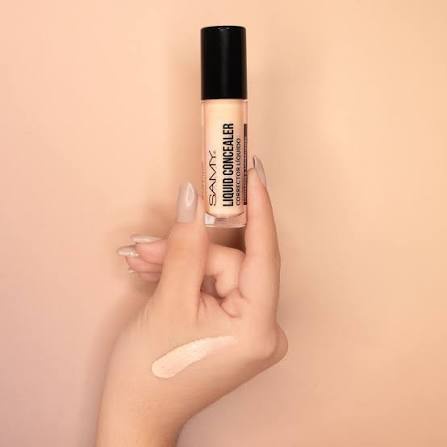
Ingredients overview
 INCI photo pending approval
Highlights
Key Ingredients
Skim through
Samy Corrector ConcelearIngredients explained
Good old water, aka H2O. The most common skincare ingredient of all. You can usually find it right in the very first spot of the ingredient list, meaning it’s the biggest thing out of all the stuff that makes up the product.
It’s mainly a solvent for ingredients that do not like to dissolve in oils but rather in water.
Once inside the skin, it hydrates, but not from the outside - putting pure water on the skin (hello long baths!) is drying.
One more thing: the water used in cosmetics is purified and deionized (it means that almost all of the mineral ions inside it is removed). Like this, the products can stay more stable over time.
Jojoba-derived emollient wax esters (fatty acid + fatty alcohol) that make your skin feel nice and smooth. Chemically speaking, pure jojoba oil is also a wax ester (read our shiny explanation here), however, the ingredients called jojoba esters on the ingredient lists are made from jojoba oil and/or hydrogenated jojoba oil via interesterification.
They have multiple versions with variable fatty acid chain length and the ingredient can have a liquid, a creamy, a soft or firm paste, or even a hard wax consistency. The common thing between all versions is, that unlike most normal triglyceride oils, jojoba esters have superior stability, provide non-greasy emolliency and are readily absorbed into the skin.
 We don't have description for this ingredient yet.
- A natural moisturizer that’s also in our skin
- A super common, safe, effective and cheap molecule used for more than 50 years
- Not only a simple moisturizer but knows much more: keeps the skin lipids between our skin cells in a healthy (liquid crystal) state, protects against irritation, helps to restore barrier
- Effective from as low as 3% with even more benefits for dry skin at higher concentrations up to 20-40%
- High-glycerin moisturizers are awesome for treating severely dry skin
It's a Vitamin F Ethyl Ester, that is used as an emollient. Coupled with other two forms of vitamin F ethyl ester (ethyl linoleate and ethyl linolenate), the trio is intended to treat dry, seborrheic skin with damaged lipid barrier and dry scalps with brittle and shine-less hair.
We don't have description for this ingredient yet.
It’s pretty much the current IT-preservative. It’s safe and gentle, but even more importantly, it’s not a feared-by-everyone-mostly-without-scientific-reason paraben.
It’s not something new: it was introduced around 1950 and today it can be used up to 1% worldwide. It can be found in nature - in green tea - but the version used in cosmetics is synthetic.
Other than having a good safety profile and being quite gentle to the skin it has some other advantages too. It can be used in many types of formulations as it has great thermal stability (can be heated up to 85°C) and works on a wide range of pH levels (ph 3-10).
It’s often used together with ethylhexylglycerin as it nicely improves the preservative activity of phenoxyethanol.
A helper ingredient that is used as a bulking and viscosity controlling agent. It is also an emulsion stabilizer in water-in-oil emulsions, where water droplets are dispersed in the continuous oil phase and not the other way round.
It can also be used as a heat generating agent in water-less formulas as it has an instant heat-generating chemical reaction with water.
An organic derivative of hectorite clay, Disteardimonium Hectorite is used as a viscosity controller - it thickens up formulations to make them less runny.
It’s most popular use in cosmetics is in sunscreens, under the trademarked name Bentone 38 from Elementis. According to the manufacturer info, it is a real multi-tasker, including the ability to prevent pigments settling during storage, stabilizing a formula for longer, creating a light and smooth skin feel and enhancing the water-resistance of sunscreen formulas.
A type of oil soluble vitamin F that is used as an emollient. Read more at ethyl oleate.
We don't have description for this ingredient yet.
We don't have description for this ingredient yet.
Officially, CosIng (the official EU ingredient database) lists Aluminum Hydroxide 's functions as opacifying (making the product white and non-transparent), as well as emollient and skin protectant.
However, with a little bit of digging, it turns out Aluminum Hyroxide often moonlights as a protective coating for UV filter superstar Titanium Dioxide. Specifically, it protects our skin from the harmful effects of nasty Reactive Oxygen Species (free radicals derived from oxygen such as Superoxide and Hydrogen Peroxide) generated when Titanium Dioxide is exposed to UV light. Btw, chlorine in swimming pool water depletes this protective coating, so one more reason to reapply your sunscreen after a dip in the pool on holiday.
Other than that, Aluminum Hydroxide also often shows up in composite pigment technologies where it is used the other way around (as the base material and not as the coating material) and helps to achieve higher color coverage with less pigment.
We don't have description for this ingredient yet.
We don't have description for this ingredient yet.
- It's a helper ingredient that improves the freeze-thaw stability of products
- It's also a solvent, humectant and to some extent a penetration enhancer
- It has a bad reputation among natural cosmetics advocates but cosmetic scientists and toxicology experts do not agree (read more in the geeky details section)
If you have spotted ethylhexylglycerin on the ingredient list, most probably you will see there also the current IT-preservative, phenoxyethanol. They are good friends because ethylhexylglycerin can boost the effectiveness of phenoxyethanol (and other preservatives) and as an added bonus it feels nice on the skin too.
Also, it's an effective deodorant and a medium spreading emollient.
A form of skincare superstar, vitamin C. Even though we are massive vitamin C fans, Ascorbyl Palmitate (AP) is our least favorite. (Btw, if you do not know what the big deal with vitamin C is then you are missing out. You must go and read our geeky details about it.)
So, AP is one of the attempts by the cosmetics industry to solve the stability issues with vitamin C while preserving its benefits, but it seems to fall short on several things.
What's the problem?
Firstly, it's stability is only similar to that of pure ascorbic acid (AA), which means it is not really stable. A great study in the Journal of Cosmetic Dermatology compared a bunch of vitamin C derivatives and this derivative was the only one where the study said in terms of stability that it's "similar to AA". Not really that good.
Second, a study that examined the skin absorption of vitamin C found that ascorbyl palmitate did not increase the skin levels of AA. This does not mean that ascorbyl palmitate cannot penetrate the skin (because it can, it's oil soluble and the skin likes to absorb oil soluble things) but this means that it's questionable if ascorbyl palmitate can be converted into pure Vit C in the skin. Even if it can be converted, the palmitate part of the molecule is more than the half of it, so the efficacy will not be good and we have never seen a serum that contains a decent (and proudly disclosed) amount of AP. We are highly skeptical what effect a tiny amount of AP has in a formula.
Third, another study that wanted to examine the antioxidant properties of AP was surprised to find that even though AP does have nice antioxidant properties; following UVB radiation (the same one that comes from the sun) it also promotes lipid peroxidation and cytotoxicity. It was only an in-vitro study meaning that it was done on cell cultures and not on real people, but still, this also does not support the use of AP too much.
The only good thing we can write about Ascorbyl Palmitate is that there is an in-vitro (made in the lab, not on real people) study showing that it might be able to boost collagen production.
Regarding the skin-brightening properties of pure vitamin C, this is another magic property AP does not have, or at least there is no data, not even in-vitro, about it.
Overall, Ascorbyl Palmitate is our least favorite vitamin C derivative. It is there in lots of products in tiny amounts (honestly, we do not really understand why), however, we do not know about any vitamin C serum featuring AP in high amounts. That is probably no coincidence. If you are into vitamin C, you can take a look at more promising derivatives here.
We don't have description for this ingredient yet.
- A multi-functional skincare superstar with several proven benefits for the skin
- Great anti-aging, wrinkle smoothing ingredient used at 4-5% concentration
- Fades brown spots alone or in combination with amino sugar, acetyl glucosamine
- Increases ceramide synthesis that results in a stronger, healthier skin barrier and better skin hydration
- Can help to improve several skin conditions including acne, rosacea, and atopic dermatitis
- Works best between a concentration of 5-20%
- Boosts the skin’s own collagen production
- Fades pigmentation and brown spots
- If used under sunscreen it boosts its UV protection
- Extremely unstable and oxidizes very easily in presence of light or air
- Stable in solutions with water only if pH is less than 3.5 or in waterless formulations
- Vit E + C work in synergy and provide superb photoprotection
- Ferulic acid doubles the photoprotection effect of Vit C+E and helps to stabilize Vit C
- Potent Vit. C serums might cause a slight tingling on sensitive skin
We don't have description for this ingredient yet.
It’s the - sodium form - cousin of the famous NMF, hyaluronic acid (HA). If HA does not tell you anything we have a super detailed, geeky explanation about it here. The TL; DR version of HA is that it's a huge polymer (big molecule from repeated subunits) found in the skin that acts as a sponge helping the skin to hold onto water, being plump and elastic. HA is famous for its crazy water holding capacity as it can bind up to 1000 times its own weight in water.
As far as skincare goes, sodium hyaluronate and hyaluronic acid are pretty much the same and the two names are used interchangeably. As cosmetic chemist kindofstephen writes on reddit "sodium hyaluronate disassociates into hyaluronic acid molecule and a sodium atom in solution".
In spite of this, if you search for "hyaluronic acid vs sodium hyaluronate" you will find on multiple places that sodium hyaluronate is smaller and can penetrate the skin better. Chemically, this is definitely not true, as the two forms are almost the same, both are polymers and the subunits can be repeated in both forms as much as you like. (We also checked Prospector for sodium hyaluronate versions actually used in cosmetic products and found that the most common molecular weight was 1.5-1.8 million Da that absolutely counts as high molecular weight).
What seems to be a true difference, though, is that the salt form is more stable, easier to formulate and cheaper so it pops up more often on the ingredient lists.
If you wanna become a real HA-and-the-skin expert you can read way more about the topic at hyaluronic acid (including penetration-questions, differences between high and low molecular weight versions and a bunch of references to scientific literature).
Ci 77891 is the color code of titanium dioxide. It's a white pigment with great color consistency and dispersibility.
Yellow Iron Oxide is the super common inorganic (as in no carbon atom in the molecule) pigment that gives the yellow tones in your foundation. Blended with red and black iron oxides, it is essential in all "flesh-toned" makeup products.
Chemically speaking, it is hydrated iron III oxide and depending on the conditions of manufacture, it can range from a light lemon to an orange-yellow shade.
Red Iron Oxide is the super common pigment that gives the familiar, "rust" red color. It is also the one that gives the pink tones in your foundation. Chemically speaking, it is iron III oxide (Fe2O3).
Black Iron Oxide is the super common inorganic (as in no carbon atom in the molecule) pigment that controls the darkness of your foundation or gives the blackness to your mascara. Blended with red and black iron oxides, it is essential in all "flesh-toned" makeup products.
Chemically speaking, it is a mixture of iron II and iron III oxide. Btw, this guy, unlike the yellow and red pigments, is magnetic.
You may also want to take a look at...
| what‑it‑does | solvent |
| what‑it‑does | soothing | emollient | moisturizer/humectant |
| what‑it‑does | emollient |
| what‑it‑does | emulsifying |
| what‑it‑does | perfuming |
| what‑it‑does | skin-identical ingredient | moisturizer/humectant |
| irritancy, com. | 0, 0 |
| what‑it‑does | emollient | perfuming |
| what‑it‑does | emollient | perfuming |
| what‑it‑does | preservative |
| what‑it‑does | viscosity controlling |
| what‑it‑does | viscosity controlling |
| what‑it‑does | emollient | perfuming |
| what‑it‑does | emollient | emulsifying |
| what‑it‑does | emollient | moisturizer/humectant | viscosity controlling |
| what‑it‑does | emollient | perfuming |
| what‑it‑does | moisturizer/humectant | solvent |
| irritancy, com. | 0, 0 |
| what‑it‑does | preservative |
| what‑it‑does | antioxidant |
| irritancy, com. | 0, 2 |
| what‑it‑does | cell-communicating ingredient | skin brightening | anti-acne | moisturizer/humectant |
| what‑it‑does | antioxidant | skin brightening | buffering |
| what‑it‑does | emulsifying | surfactant/cleansing |
| what‑it‑does | skin-identical ingredient | moisturizer/humectant |
| irritancy, com. | 0, 0 |
| what‑it‑does | colorant |
| irritancy, com. | 0, 0 |
| what‑it‑does | colorant |
| irritancy, com. | 0, 0 |
| what‑it‑does | colorant |
| irritancy, com. | 0, 0 |
| what‑it‑does | colorant |
| irritancy, com. | 0, 0 |