




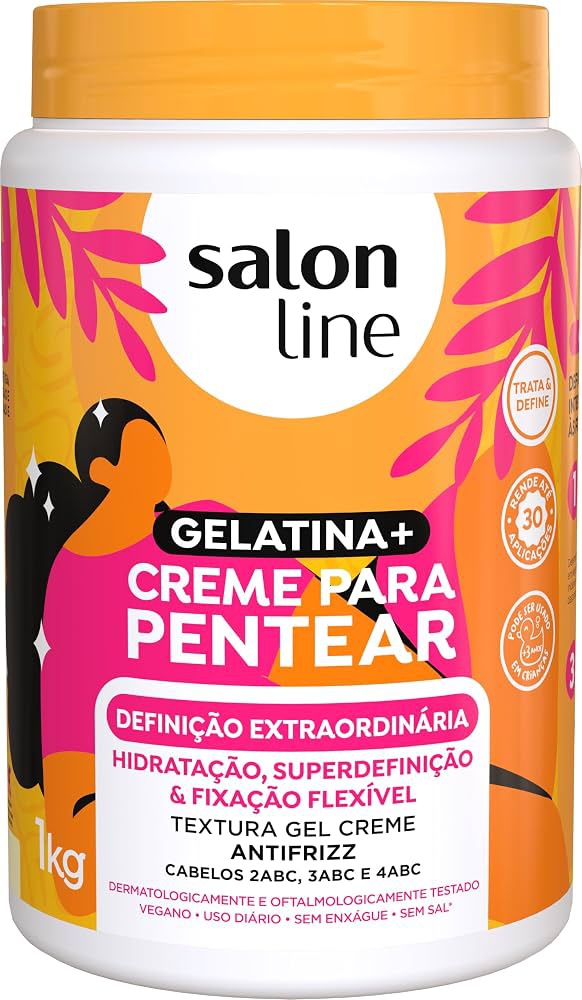
Gelatina + Creme Para Pentear Definição Extraordinária
Ingredients overview
Highlights
Key Ingredients
Other Ingredients
Skim through
Salon Line Gelatina + Creme Para Pentear Definição ExtraordináriaIngredients explained
Good old water, aka H2O. The most common skincare ingredient of all. You can usually find it right in the very first spot of the ingredient list, meaning it’s the biggest thing out of all the stuff that makes up the product.
It’s mainly a solvent for ingredients that do not like to dissolve in oils but rather in water.
Once inside the skin, it hydrates, but not from the outside - putting pure water on the skin (hello long baths!) is drying.
One more thing: the water used in cosmetics is purified and deionized (it means that almost all of the mineral ions inside it is removed). Like this, the products can stay more stable over time.
A big molecule created from repeated subunits (a polymer of acrylic acid) that magically converts a liquid into a nice gel formula. It usually has to be neutralized with a base (such as sodium hydroxide) for the thickening to occur and it creates viscous, clear gels that also feel nice and non-tacky on the skin. No wonder, it is a very popular and common ingredient. Typically used at 1% or less in most formulations.
- A natural moisturizer that’s also in our skin
- A super common, safe, effective and cheap molecule used for more than 50 years
- Not only a simple moisturizer but knows much more: keeps the skin lipids between our skin cells in a healthy (liquid crystal) state, protects against irritation, helps to restore barrier
- Effective from as low as 3% with even more benefits for dry skin at higher concentrations up to 20-40%
- High-glycerin moisturizers are awesome for treating severely dry skin
Super common little helper ingredient that helps products to remain nice and stable for a longer time. It does so by neutralizing the metal ions in the formula (that usually get into there from water) that would otherwise cause some not so nice changes.
It is typically used in tiny amounts, around 0.1% or less.
A water-soluble, chemical sunscreen agent that is a secondary UVB absorber with some activity in the short UVA range as well. Being a secondary UV absorber means that its protection is weak and it has to be combined with other sunscreen filters for proper sun protection.
More often than not, Benzophenone-4 is not used as a sunscreen agent but as a photoprotectant to extend product shelf life, or as a color-protectant for products in clear packages.
A Contact Dermatitis article from 2007 names BP-4 as an emerging allergen, as it was the most frequently positive chemical UV filter and third most frequently positive ingredient overall among the 35 substances patch tested in the study (13 positives of 1693 people tested).
These three letters stand for Poly Vinyl Pyrollidone, a big molecule created from repeated units of Vinyl Pyrrolidone, aka VP. Its main thing is being an important film former. It was the first synthetic polymer introduced as a hair fixative in the 1950s instead of insect-derived Shellac.
So PVP likes to attach itself to surfaces such as the hair and the skin and forms a nice, thin, even film there. The film is useful for holding a hairstyle or extending the wear of color cosmetics and sunscreens. The disadvantage of PVP is that the film is a bit brittle and that PVP loves water (hygroscopic) that tends to destroy the film. This is the reason why hair styled with a PVP based product loses its style in high humidity. To fix this problem, there are now several versions of VP containing film formers that are less sensitive to humidity, for example, the molecule called VP/VA Copolymer.
It’s a little helper ingredient that helps to set the pH of a cosmetic formulation to be just right. It’s very alkaline (you know the opposite of being very acidic): a 1% solution has a pH of around 10.
It does not have the very best safety reputation but in general, you do not have to worry about it.
What is true is that if a product contains so-called N-nitrogenating agents (e.g.: preservatives like 2-Bromo-2-Nitropropane-1,3-Diol, 5-Bromo-5-Nitro- 1,3-Dioxane or sodium nitrate - so look out for things with nitro, nitra in the name) that together with TEA can form some not nice carcinogenic stuff (that is called nitrosamines). But with proper formulation that does not happen, TEA in itself is not a bad guy.
But let’s assume a bad combination of ingredients were used and the nitrosamines formed. :( Even in that case you are probably fine because as far as we know it cannot penetrate the skin.
But to be on the safe side, if you see Triethanolamine in an INCI and also something with nitra, nitro in the name of it just skip the product, that cannot hurt.
A super common, waxy, white, solid stuff that helps water and oil to mix together, gives body to creams and leaves the skin feeling soft and smooth.
Chemically speaking, it is the attachment of a glycerin molecule to the fatty acid called stearic acid. It can be produced from most vegetable oils (in oils three fatty acid molecules are attached to glycerin instead of just one like here) in a pretty simple, "green" process that is similar to soap making. It's readily biodegradable.
It also occurs naturally in our body and is used as a food additive. As cosmetic chemist Colins writes it, "its safety really is beyond any doubt".
 We don't have description for this ingredient yet.
We don't have description for this ingredient yet.
A super commonly used 5 unit long, cyclic structured silicone that is water-thin and does not stay on the skin but evaporates from it (called volatile silicone). Similar to other silicones, it gives skin and hair a silky, smooth feel.
It's often combined with the non-volatile (i.e. stays on the skin) dimethicone as the two together form a water-resistant, breathable protective barrier on the skin without a negative tacky feel.
A thick, high molecular weight silicone that is usually diluted in another, lighter silicone fluid (like dimethicone or cyclopentasiloxane). The dimethiconol containing silicone blends leave a silky smooth, non-greasy film on the skin.
Exactly what it sounds: nice smelling stuff put into cosmetic products so that the end product also smells nice. Fragrance in the US and parfum in the EU is a generic term on the ingredient list that is made up of 30 to 50 chemicals on average (but it can have as much as 200 components!).
If you are someone who likes to know what you put on your face then fragrance is not your best friend - there's no way to know what’s really in it.
Also, if your skin is sensitive, fragrance is again not your best friend. It’s the number one cause of contact allergy to cosmetics. It’s definitely a smart thing to avoid with sensitive skin (and fragrance of any type - natural is just as allergic as synthetic, if not worse!).
If you have spotted ethylhexylglycerin on the ingredient list, most probably you will see there also the current IT-preservative, phenoxyethanol. They are good friends because ethylhexylglycerin can boost the effectiveness of phenoxyethanol (and other preservatives) and as an added bonus it feels nice on the skin too.
Also, it's an effective deodorant and a medium spreading emollient.
It’s pretty much the current IT-preservative. It’s safe and gentle, but even more importantly, it’s not a feared-by-everyone-mostly-without-scientific-reason paraben.
It’s not something new: it was introduced around 1950 and today it can be used up to 1% worldwide. It can be found in nature - in green tea - but the version used in cosmetics is synthetic.
Other than having a good safety profile and being quite gentle to the skin it has some other advantages too. It can be used in many types of formulations as it has great thermal stability (can be heated up to 85°C) and works on a wide range of pH levels (ph 3-10).
It’s often used together with ethylhexylglycerin as it nicely improves the preservative activity of phenoxyethanol.
A clear, colorless liquid that works as a solvent and viscosity decreasing ingredient. It also has great skin-moisturizing abilities.
It's one of those things that help your cosmetics not to go wrong too soon, aka a preservative. Its strong point is being effective against yeasts and molds, and as a nice bonus seems to be non-comedogenic as well.
It is safe in concentrations of less than 0.1% but is acutely toxic when inhaled, so it's not the proper preservative choice for aerosol formulas like hairsprays. Used at 0.1%, Iodopropynyl Butylcarbamate has an extremely low rate of skin-irritation when applied directly for 24 hours (around 0.1% of 4,883 participants) and after 48 hours that figure was 0.5%, so it counts as mild and safe unless your skin is super-duper sensitive.
We don't have description for this ingredient yet.
Fancy name for fruit sugar. It has nice water-binding properties and helps to keep skin hydrated.
- It’s a polyhydroxy acid (PHA), that is often referred to as next generation AHA
- It gently lifts off dead skin cells form the skin surface making skin smooth and even
- In the long term it provides anti-aging benefits, like increased skin thickness and decreased wrinkles (though a tad less than even more proven superstar AHAs)
- It’s a great moisturizer and even helps to repair impaired skin barrier
- It’s antioxidant, and does not make your skin more sensitive to the sun
- It can be used even if your skin is very sensitive, rosacea prone or if you are post cosmetic procedure
A fancy name for sugar. Luckily when you put it on your skin it's good for you not like when you eat it. :) It has water-binding properties, which means that it helps to keep your skin nice and hydrated.
Apple needs no introduction as one of the most common fruits on planet Earth. It's not only a healthy fruit snack, it's also a goodie if you put in all over your face.
It's loaded with proteins, starch, sugars, acids, vitamins and salts. The sugars (mainly fructose, glucose, sucrose) give apple fruit extract nice moisturizing and smoothing properties, while the acids (mainly malic and gallic acid) give it mild exfoliant, skin brightening and antibacterial properties.
The thing that you put on your salad with some olive oil. But in a more scientific sense vinegar is usually a 5% solution of acetic acid. It's used in cosmetic products to adjust pH. Larg amounts of vinegar on the skin could be irritating and drying.
We don't have description for this ingredient yet.
Glutamic acid is a little molecule and non-essential (our body can synthesize it) amino acid with the important job of being a neurotransmitter in the human body meaning that it helps your nervous system work correctly.
As for what it's doing in cosmetics, Glutamic acids' main thing (similar to other amino acids) is being a humectant moisturizer and skin-conditioning agent (sidenote: if you attach lots of glutamic acid molecules, you get polyglutamic acid that is claimed to be a better than hyaluronic acid humectant). It also seems to affect skin barrier repair, however, it is not clear-cut in which direction.
The complication is that glutamic acid has two distinct forms, L-glutamic acid and D-glutamic acid, that are the mirror images of each other (think of it like your left and right hand). Studies show that a topical application of L-glutamic acid on damaged skin delayed skin repair, while D-glutamic acid application sped up skin repair. As both forms are used by the industry, it is a bit uncertain what you are getting with just glutamic acid on the ingredient list (but if it is a Shiseido group product, it is probably the goodie D-form :)).
Other than that, Glutamic acid can also be used as a pH adjuster and can be processed via biological pathways into pyrrolidone carboxylic acid, the sodium salt of which is a goodie and one of your skin’s natural moisturizing factors.
We don't have description for this ingredient yet.
A chemically chopped up version of wheat protein that consists mainly of amino acids (the building blocks), peptides (a couple of amino acids together), and proteins (lots of amino acids together).
It has moisturizing and film-forming properties and might be able to counteract the irritating effects of cleansing agents in cleansers and shampoos. It can also condition and repair damaged hair leaving it soft, silky and smooth.
It's one of those things that help your cosmetics not to go wrong too soon, aka a preservative. It’s not a strong one and doesn’t really work against bacteria, but more against mold and yeast. To do that it has to break down to its active form, sorbic acid. For that to happen, there has to be water in the product and the right pH value (pH 3-4).
But even if everything is right, it’s not enough on its own. If you see potassium sorbate you should see some other preservative next to it too.
BTW, it’s also a food preservative and even has an E number, E202.
Serine is an amino acid that most often comes to the formula as part of a moisturizing complex. It's a non-essential amino acid (meaning that our body can synthesize it) and serves as a water-binding ingredient.
In general, amino acids are great skincare ingredients that play an important role in proper skin hydration but there is not much info out there about what specifically serine can do for the skin.
A helper ingredient that helps to make the products stay nice longer, aka preservative. It works mainly against fungi.
It’s pH dependent and works best at acidic pH levels (3-5). It’s not strong enough to be used in itself so it’s always combined with something else, often with potassium sorbate.
A handy helper ingredient that helps products to remain nice and stable for a longer time. It does so by neutralizing the metal ions in the formula (that usually get into there from water) that would otherwise cause some not so nice changes.
An essential amino acid that's also a key building block of collagen and elastin. When taken orally, it helps the digestive and intestinal tracts function more smoothly and also helps the absorption of nutrients. As for skincare, it is not clear what it does other than being a skin hydrator.
Citronellol is a very common fragrance ingredient with a nice rose-like odor. In the UK, it’s actually the third most often listed perfume on the ingredient lists.
It can be naturally found in geranium oil (about 30%) or rose oil (about 25%).
As with all fragrance ingredients, citronellol can also cause allergic contact dermatitis and should be avoided if you have perfume allergy. In a 2001 worldwide study with 178 people with known sensitization to fragrances citronellol tested positive in 5.6% of the cases.
There is no known anti-aging or positive skin benefits of the ingredient. It’s in our products to make it smell nice.
A common fragrance ingredient that has a sweet, vanilla, nutty scent. When diluted it smells like freshly-mown hay.
It’s one of the “EU 26 fragrances” that has to be labelled separately (and cannot be simply included in the term “fragrance/perfume” on the label) because of allergen potential. Best to avoid if your skin is sensitive.
Geraniol is a common fragrance ingredient. It smells like rose and can be found in rose oil or in small quantities in geranium, lemon and many other essential oils.
Just like other similar fragrance ingredients (like linalool and limonene) geraniol also oxidises on air exposure and becomes allergenic. Best to avoid if you have sensitive skin.
A common fragrance ingredient that smells like jasmine. It is one of the “EU 26 fragrances” that has to be labelled separately because of allergen potential. Best to avoid if your skin is sensitive.
A super common and cheap fragrance ingredient. It's in many plants, e.g. rosemary, eucalyptus, lavender, lemongrass, peppermint and it's the main component (about 50-90%) of the peel oil of citrus fruits.
It does smell nice but the problem is that it oxidizes on air exposure and the resulting stuff is not good for the skin. Oxidized limonene can cause allergic contact dermatitis and counts as a frequent skin sensitizer.
Limonene's nr1 function is definitely being a fragrance component, but there are several studies showing that it's also a penetration enhancer, mainly for oil-loving components.
All in all, limonene has some pros and cons, but - especially if your skin is sensitive - the cons probably outweigh the pros.
Linalool is a super common fragrance ingredient. It’s kind of everywhere - both in plants and in cosmetic products. It’s part of 200 natural oils including lavender, ylang-ylang, bergamot, jasmine, geranium and it can be found in 90-95% of prestige perfumes on the market.
The problem with linalool is, that just like limonene it oxidises on air exposure and becomes allergenic. That’s why a product containing linalool that has been opened for several months is more likely to be allergenic than a fresh one.
A study made in the UK with 483 people tested the allergic reaction to 3% oxidised linalool and 2.3% had positive test results.
You may also want to take a look at...
| what‑it‑does | solvent |
| what‑it‑does | viscosity controlling |
| irritancy, com. | 0, 1 |
| what‑it‑does | skin-identical ingredient | moisturizer/humectant |
| irritancy, com. | 0, 0 |
| what‑it‑does | chelating |
| what‑it‑does | sunscreen |
| what‑it‑does | viscosity controlling |
| irritancy, com. | 0, 0 |
| what‑it‑does | buffering |
| irritancy, com. | 0, 2 |
| what‑it‑does | emollient | emulsifying |
| irritancy, com. | 0, 1 |
| what‑it‑does | viscosity controlling |
| what‑it‑does | emollient | solvent |
| what‑it‑does | emollient | moisturizer/humectant |
| what‑it‑does | perfuming |
| what‑it‑does | preservative |
| what‑it‑does | preservative |
| what‑it‑does | solvent |
| what‑it‑does | preservative |
| what‑it‑does | viscosity controlling |
| what‑it‑does | moisturizer/humectant |
| what‑it‑does | chelating | perfuming |
| what‑it‑does | exfoliant | chelating |
| what‑it‑does | moisturizer/humectant |
| what‑it‑does | moisturizer/humectant |
| what‑it‑does | moisturizer/humectant |
| what‑it‑does | moisturizer/humectant |
| what‑it‑does | moisturizer/humectant |
| what‑it‑does | preservative |
| what‑it‑does | skin-identical ingredient |
| what‑it‑does | preservative |
| what‑it‑does | chelating |
| what‑it‑does | skin-identical ingredient |
| what‑it‑does | perfuming |
| what‑it‑does | perfuming |
| what‑it‑does | perfuming |
| what‑it‑does | perfuming |
| what‑it‑does | perfuming | solvent |
| what‑it‑does | perfuming |