




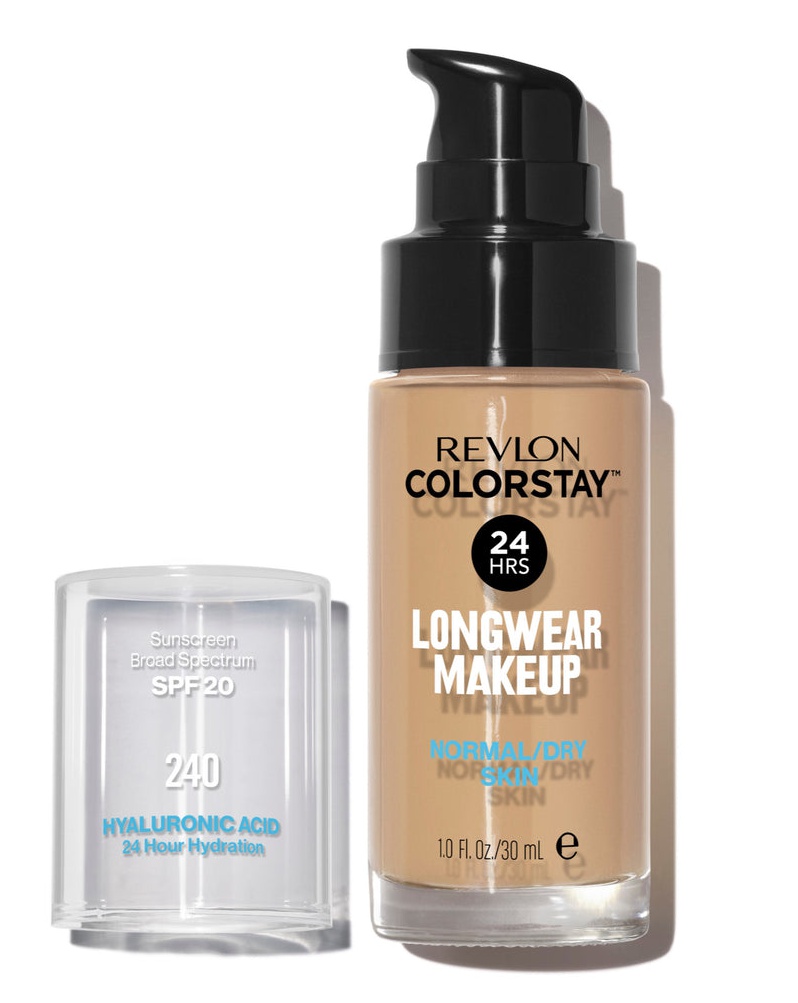
Colorstay Longwear Makeup
Ingredients overview
 INCI photo pending approval
Highlights
Key Ingredients
Skim through
Revlon Colorstay Longwear MakeupIngredients explained
Good old water, aka H2O. The most common skincare ingredient of all. You can usually find it right in the very first spot of the ingredient list, meaning it’s the biggest thing out of all the stuff that makes up the product.
It’s mainly a solvent for ingredients that do not like to dissolve in oils but rather in water.
Once inside the skin, it hydrates, but not from the outside - putting pure water on the skin (hello long baths!) is drying.
One more thing: the water used in cosmetics is purified and deionized (it means that almost all of the mineral ions inside it is removed). Like this, the products can stay more stable over time.
A super commonly used 5 unit long, cyclic structured silicone that is water-thin and does not stay on the skin but evaporates from it (called volatile silicone). Similar to other silicones, it gives skin and hair a silky, smooth feel.
It's often combined with the non-volatile (i.e. stays on the skin) dimethicone as the two together form a water-resistant, breathable protective barrier on the skin without a negative tacky feel.
Probably the most common silicone of all. It is a polymer (created from repeating subunits) molecule and has different molecular weight and thus different viscosity versions from water-light to thick liquid.
As for skincare, it makes the skin silky smooth, creates a subtle gloss and forms a protective barrier (aka occlusive). Also, works well to fill in fine lines and wrinkles and give skin a plump look (of course that is only temporary, but still, it's nice). There are also scar treatment gels out there using dimethicone as their base ingredient. It helps to soften scars and increase their elasticity.
As for hair care, it is a non-volatile silicone meaning that it stays on the hair rather than evaporates from it and smoothes the hair like no other thing. Depending on your hair type, it can be a bit difficult to wash out and might cause some build-up (btw, this is not true to all silicones, only the non-volatile types).
A solid silicone resin that creates a permeable film over the skin. It makes makeup formulas more long-lasting and can enhance the water resistance of sunscreens. It leaves a non-tacky film when dried.
A silicone emulsifier that helps water to mix nicely with silicone oils (aka water-in-silicone emulsifier).
Butylene glycol, or let’s just call it BG, is a multi-tasking colorless, syrupy liquid. It’s a great pick for creating a nice feeling product.
BG’s main job is usually to be a solvent for the other ingredients. Other tasks include helping the product to absorb faster and deeper into the skin (penetration enhancer), making the product spread nicely over the skin (slip agent), and attracting water (humectant) into the skin.
It’s an ingredient whose safety hasn’t been questioned so far by anyone (at least not that we know about). BG is approved by Ecocert and is also used enthusiastically in natural products. BTW, it’s also a food additive.
It's the triglyceride of behenic acid that works as a thickening or gelling agent, as a compacting agent for pressed powders, and improves heat stability of emulsions.
A silicone fluid that gives a nonoily, easy to spread emolliency to the formulas. It is also used as a water repellent additive and to reduce the tackiness and stickiness of other ingredients. It also imparts gloss, softness and better manageability to hair.
An odorless, slightly yellowish powder that's used as a polymer microsphere (a tiny little ball from repeated subunits). It gives products an elegant, silky texture and better slip. It can also scatter light to blur fine lines while letting enough light through so that the skin still looks natural.
- It's a super common and super debated skincare ingredient
- It has several benefits: great solvent, penetration enhancer, creates cosmetically elegant, light formulas, great astringent and antimicrobial
- It can be very drying if it's in the first few ingredients on an ingredient list
- Some experts even think that regular exposure to alcohol damages skin barrier and causes inflammation though it's a debated opinion (read more in geeky details tab)
A multi-functional helper ingredient that's used mainly as a pigment carrier. The pigment can be an inorganic sunscreen (such as titanium dioxide) or a colorant that is blended with alumina platelets and then often coated with some kind of silicone (such as triethoxycaprylylsilane). This special treatment enables pigments to be evenly dispersed in the formula and to be spread out easily and evenly upon application. It is super useful both for mineral sunscreens as well as for makeup products.
Other than that, alumina can also be used as an absorbent (sometimes combined with the mattifying powder called polymethylsilsesquioxane), a viscosity controlling or an opacifying (reduces the transparency of the formula) agent.
A PEG-modified self-emulsifying crosslinked silicone elastomer surfactant that helps water to mix nicely with silicone oils, aka a water in silicone emulsifier. It creates highly stable micelle structures that break upon application of the product so it is ideal for “water drop” like cream formulations.
A silicone molecule that is half-way between Dimethicone and Methicone, meaning that some of the methyl (-CH3) groups are replaced with a hydrogen atom (in Methicone half of the CH3 groups are replaced). This makes Hydrogen Dimethicone a handy pigment bonding agent used for the hydrophobization treatment of powders as the H atoms can absorb traces of water from the surface of pigments.
It almost always comes stuck together with either Titanium Dioxide, Zinc Oxide or Mica. In suncare products, it binds to physical UV filters to maximize their protection while minimizing any white casts. It also has good chemical stability with no irritation. In makeup, it is often paired with Mica where it offers nice hydrophobic properties and improves skin adhesion - meaning it will make it easier for products to stay where they should be.
 We don't have description for this ingredient yet.
A not-very-interesting helper ingredient that is used as an emulsifier and/or surfactant. Comes from a coconut oil derived fatty alcohol, lauryl alcohol.
A helper ingredient that is used as a bulking and viscosity controlling agent. It is also an emulsion stabilizer in water-in-oil emulsions, where water droplets are dispersed in the continuous oil phase and not the other way round.
It can also be used as a heat generating agent in water-less formulas as it has an instant heat-generating chemical reaction with water.
Bearing a close relationship to the famous Dimethicone, Methicone is the slightly trimmed down version missing the methyl (-CH3) groups on one side of the silicone chain. Like most silicones, it has nice emollient properties and improves the spreadability of products.
But Methicone's main thing in practice is not being an emollient but a silicone fluid for hydrophobization treatment of powders, i.e. making solid powders (mineral filters & color pigments) very water resistant and easily spreadable. Methicone does this by absorbing traces of water from the surface of pigments that is very useful for mineral sunscreens and makeup products.
A natural emulsifier that brings a soft and powdery feel to the formula. It's also very gentle and is recommended for sensitive or baby skin products.
A white powdery thing that's the major component of glass and sand. In cosmetics, it’s often in products that are supposed to keep your skin matte as it has great oil-absorbing abilities. It’s also used as a helper ingredient to thicken up products or suspend insoluble particles.
A handy helper ingredient that helps products to remain nice and stable for a longer time. It does so by neutralizing the metal ions in the formula (that usually get into there from water) that would otherwise cause some not so nice changes.
It’s the most commonly used version of pure vitamin E in cosmetics. You can read all about the pure form here. This one is the so-called esterified version.
According to famous dermatologist, Leslie Baumann while tocopheryl acetate is more stable and has a longer shelf life, it’s also more poorly absorbed by the skin and may not have the same awesome photoprotective effects as pure Vit E.
A clear, light yellow liquid that is used to coat pigments (such as inorganic sunscreen agents or colorants) in cosmetic products. The coating helps to stabilize pigments in the formulas and also helps them to spread easily and evenly on the skin.
A very common type of feared-by-everyone-mostly-without-scientific-reason paraben. It's a cheap, effective and well-tolerated ingredient to make sure the cosmetic formula does not go wrong too soon. Read more about parabens here >>
The most common type of feared-by-everyone-mostly-without-scientific-reason parabens. It's a cheap, effective and well-tolerated ingredient to make sure the cosmetic formula does not go wrong too soon.
Apart from the general controversy around parabens (we wrote about it more here), there is a 2006 in-vitro (made in the lab not on real people) research about methylparaben (MP) showing that when exposed to sunlight, MP treated skin cells suffered more harm than non-MP treated skin cells. The study was not done with real people on real skin but still - using a good sunscreen next to MP containing products is a good idea. (Well, in fact using a sunscreen is always a good idea. :))
It’s pretty much the current IT-preservative. It’s safe and gentle, but even more importantly, it’s not a feared-by-everyone-mostly-without-scientific-reason paraben.
It’s not something new: it was introduced around 1950 and today it can be used up to 1% worldwide. It can be found in nature - in green tea - but the version used in cosmetics is synthetic.
Other than having a good safety profile and being quite gentle to the skin it has some other advantages too. It can be used in many types of formulations as it has great thermal stability (can be heated up to 85°C) and works on a wide range of pH levels (ph 3-10).
It’s often used together with ethylhexylglycerin as it nicely improves the preservative activity of phenoxyethanol.
- It's one of the gold standard ingredients for treating problem skin
- It can exfoliate skin both on the surface and in the pores
- It's a potent anti-inflammatory agent
- It's more effective for treating blackheads than acne
- For acne combine it with antibacterial agents like benzoyl peroxide or azelaic acid
A bit of a sloppy ingredient name as it covers not one but three pigments: red, yellow and black iron oxide.
The trio is invaluable for "skin-colored" makeup products (think your foundation and pressed powder) as blending these three shades carefully can produce almost any shade of natural-looking flesh tones.
Ci 77891 is the color code of titanium dioxide. It's a white pigment with great color consistency and dispersibility.
You may also want to take a look at...
| what‑it‑does | solvent |
| what‑it‑does | emollient | solvent |
| what‑it‑does | emollient |
| irritancy, com. | 0, 1 |
| what‑it‑does | emollient |
| what‑it‑does | emulsifying |
| what‑it‑does | moisturizer/humectant | solvent |
| irritancy, com. | 0, 1 |
| what‑it‑does | emollient |
| what‑it‑does | emollient |
| what‑it‑does | viscosity controlling |
| what‑it‑does | antimicrobial/antibacterial | solvent | viscosity controlling |
| what‑it‑does | viscosity controlling | abrasive/scrub |
| what‑it‑does | emulsifying |
| what‑it‑does | perfuming |
| what‑it‑does | emulsifying | surfactant/cleansing |
| what‑it‑does | viscosity controlling |
| what‑it‑does | emollient |
| what‑it‑does | emulsifying |
| irritancy, com. | 0, 4 |
| what‑it‑does | viscosity controlling |
| what‑it‑does | chelating |
| what‑it‑does | antioxidant |
| irritancy, com. | 0, 0 |
| what‑it‑does | preservative |
| what‑it‑does | preservative |
| irritancy, com. | 0, 0 |
| what‑it‑does | preservative |
| what‑it‑does | exfoliant | anti-acne | soothing | preservative |
| what‑it‑does | colorant |
| irritancy, com. | 0, 0 |
| what‑it‑does | colorant |
| irritancy, com. | 0, 0 |
| what‑it‑does | colorant |
| irritancy, com. | 0, 0 |
| what‑it‑does | colorant |
| irritancy, com. | 0, 0 |