




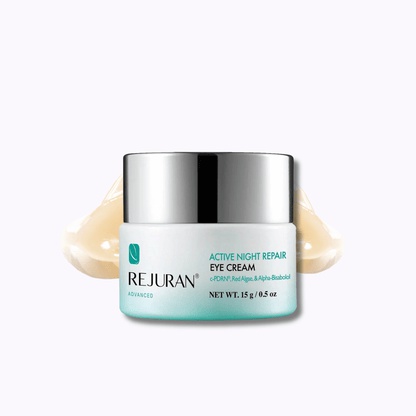
Advanced Active Night Repair Eye Cream
Ingredients overview
Highlights
Key Ingredients
Skim through
Rejuran Advanced Active Night Repair Eye CreamIngredients explained
Good old water, aka H2O. The most common skincare ingredient of all. You can usually find it right in the very first spot of the ingredient list, meaning it’s the biggest thing out of all the stuff that makes up the product.
It’s mainly a solvent for ingredients that do not like to dissolve in oils but rather in water.
Once inside the skin, it hydrates, but not from the outside - putting pure water on the skin (hello long baths!) is drying.
One more thing: the water used in cosmetics is purified and deionized (it means that almost all of the mineral ions inside it is removed). Like this, the products can stay more stable over time.
Probably the most common silicone of all. It is a polymer (created from repeating subunits) molecule and has different molecular weight and thus different viscosity versions from water-light to thick liquid.
As for skincare, it makes the skin silky smooth, creates a subtle gloss and forms a protective barrier (aka occlusive). Also, works well to fill in fine lines and wrinkles and give skin a plump look (of course that is only temporary, but still, it's nice). There are also scar treatment gels out there using dimethicone as their base ingredient. It helps to soften scars and increase their elasticity.
As for hair care, it is a non-volatile silicone meaning that it stays on the hair rather than evaporates from it and smoothes the hair like no other thing. Depending on your hair type, it can be a bit difficult to wash out and might cause some build-up (btw, this is not true to all silicones, only the non-volatile types).
Propanediol is a natural alternative for the often used and often bad-mouthed propylene glycol. It's produced sustainably from corn sugar and it's Ecocert approved.
It's quite a multi-tasker: can be used to improve skin moisturization, as a solvent, to boost preservative efficacy or to influence the sensory properties of the end formula.
 We don't have description for this ingredient yet.
A really multi-functional helper ingredient that can do several things in a skincare product: it can bring a soft and pleasant feel to the formula, it can act as a humectant and emollient, it can be a solvent for some other ingredients (for example it can help to stabilize perfumes in watery products) and it can also help to disperse pigments more evenly in makeup products. And that is still not all: it can also boost the antimicrobial activity of preservatives.
The famous Vaseline or Petroleum Jelly. Just like mineral oil, it is also a by-product of refining crude oil, aka petroleum, and it is also a mixture of hydrocarbons but with bigger (C18-90+) carbon chain length.
The unique thing about petrolatum is that it is the most effective occlusive agent known today. While the occlusivity of mineral oil is in the same league as the occlusivity of plant oils, petrolatum is in a league of its own. It sits on top of the skin and hinders so-called transepidermal water loss (TEWL) like nothing else.
This comes in handy healing cracked lips or severely dry skin patches, though overdoing it (i.e. reducing TEWL by more than 40%) is not good as it can create a nice moist place for fungi and bacteria to grow.
As for petrolatum and safety, we can write here pretty much the exact same thing as we have written at mineral oil. There is no evidence whatsoever that cosmetic, USP grade petrolatum is carcinogenic. It also does not absorb into the skin but sits on top of it and that in itself greatly minimises health risks. It also has a long history of safe use, as it was first used as a skincare product more than 100 years ago, in 1872 to be precise.
It is also non-comedogenic, though its pure form is very heavy and greasy so combination and oily skin types might want to avoid it anyway.
Overall, it is the gold-standard occlusive agent known today and a tub of Vaseline comes in handy in any household to heal cracked lips or other severely dry skin patches.
A silicone emulsifier that helps to create water in silicone emulsions.
We don't have description for this ingredient yet.
We don't have description for this ingredient yet.
Apple needs no introduction as one of the most common fruits on planet Earth. It's not only a healthy fruit snack, it's also a goodie if you put in all over your face.
It's loaded with proteins, starch, sugars, acids, vitamins and salts. The sugars (mainly fructose, glucose, sucrose) give apple fruit extract nice moisturizing and smoothing properties, while the acids (mainly malic and gallic acid) give it mild exfoliant, skin brightening and antibacterial properties.
An easy-to-formulate, commonly used, nice to have ingredient that’s also called pro-vitamin B5. As you might guess from the “pro” part, it’s a precursor to vitamin B5 (whose fancy name is pantothenic acid).
Its main job in skincare products is to moisturise the skin. It’s a humectant meaning that it can help the skin to attract water and then hold onto it. There is also research showing that panthenol can help our skin to produce more lovely lipids that are important for a strong and healthy skin barrier.
Another great thing about panthenol is that it has anti-inflammatory and skin protecting abilities. A study shows that it can reduce the irritation caused by less-nice other ingredients (e.g. fragrance, preservatives or chemical sunscreens) in the product.
Research also shows that it might be useful for wound healing as it promotes fibroblast (nice type of cells in our skin that produce skin-firming collagen) proliferation.
If that wasn’t enough panthenol is also useful in nail and hair care products. A study shows that a nail treatment liquide with 2% panthenol could effectively get into the nail and significantly increase the hydration of it.
As for the hair the hydration effect is also true there. Panthenol might make your hair softer, more elastic and helps to comb your hair more easily.
- Primary fat-soluble antioxidant in our skin
- Significant photoprotection against UVB rays
- Vit C + Vit E work in synergy and provide great photoprotection
- Has emollient properties
- Easy to formulate, stable and relatively inexpensive
Tetrahexyldecyl Ascorbate is a stable, oil-soluble form of skincare big shot Vitamin C. If you do not know, why Vitamin C is such a big deal in skincare, click here and read all about it. We are massive vitamin C fans and have written about it in excruciating detail.
So now, you know that Vitamin C is great and all, but it's really unstable and gives cosmetics companies many headaches. To solve this problem they came up with vitamin C derivatives, and one of them is Tetrahexyldecyl Ascorbate (let's call it THDA in short).
It's a really promising candidate (see below), but while reading all the goodness about it in a minute, do not forget that derivatives not only have to be absorbed into the skin but also have to be converted to pure vitamin C (ascorbic acid or AA) and the efficacy of the conversion is often unknown. In addition, vitamin C's three magic properties (antioxidant, collagen booster, skin brightener) are all properly proven in-vivo (on real people), but for the derivatives, it's mostly in-vitro studies or in the case of THDA, it's in-vitro and done by an ingredient supplier.
With this context in mind let's see what THDA might be able to do. First, it is stable (if pH < 5), easy to formulate, and a joy to work with for a cosmetic chemist.
Second, because it's oil-soluble, its skin penetration abilities seem to be great. So great in fact, that it surpasses the penetration of pure vitamin C threefold at the same concentration and it penetrates successfully into the deeper layers of the skin (that is usually important to do some anti-aging work). There is also in-vitro data showing that it converts to AA in the skin.
Third, THDA seems to have all three magic abilities of pure vitamin C: it gives antioxidant protection from both UVB and UVA rays, it increases collagen synthesis (even more than AA) and it has a skin brightening effect by reducing melanogenesis by more than 80% in human melanoma cell cultures.
So this all sounds really great, but these are only in-vitro results at this point. We could find Tetrahexyldecyl Ascorbate mentioned only in one published in-vivo study that examined the anti-aging properties of a silicone formula containing 10% AA and 7% THDA. The authors theorized that the 10% AA is released slowly from the silicon delivery system and probably stays in the upper layer of the skin to give antioxidant benefits, while THDA penetrates more rapidly and deeply and gives some wrinkle-reducing benefits. The study was a small (10 patients), double-blind experiment, and the formula did show some measurable anti-aging results. However, it is hard to know how much pure vitamin C or THDA can be thanked.
Bottom line: a really promising, but not well-proven vitamin C derivative that can be worth a try especially if you like experimenting (but if you like the tried and true, pure vitamin C will be your best bet).
A tripeptide (three amino acids attached to each other: Lys-Val-Lys) that's claimed to protect and boost collagen and improve skin texture.
The manufacturer did an in-vivo (made on real people) study with 45 volunteers and found that used twice daily for 84 days 1% and 2.5% Syn-Coll reduces the appearance of wrinkles by 7 and 12% respectively. In another study (also by the manufacturer) with 33 female Chinese volunteers, 77% of the participants felt that Syn-Coll visibly improved the firmness and elasticity of the skin after 4 weeks. What's more, 60% of the participants also noticed a reduction in the look of the pore size also after 4 weeks of treatment.
A really famous peptide that is part of Matrixyl 3000, the most sold peptide complex in the word. Before we go and find out what the big deal with Matrixyl 3000 is, let's just focus on Palmitoyl Tripeptide-1 itself for a bit.
It's a small three amino acid (they are the building blocks of all proteins) peptide with the amino sequence of glycine-histidine-lysine, or GHK. GHK is attached to palmitic acid (a fatty acid) to increase oil solubility and skin penetration.
The GHK part is the important one as it's a type I collagen fragment. When collagen naturally breaks down in the skin, the resulting peptide fragments signal to the skin that it should get to work and create some nice, new collagen. Adding in collagen fragment peptides, like GHK, might trick the skin into thinking that collagen has broken down and it's time to create some more.
Therefore, Palmitoyl Tripeptide-1 is believed to be able to stimulate collagen production in the skin, and more collagen means fewer wrinkles and younger looking skin.
In Matrixyl 3000, Palmitoyl Tripeptide-1 is coupled with Palmitoyl Tetrapeptide-7 and the duo works in synergy to reduce wrinkles and give younger looking skin. According to the manufacturer's in-vivo (made on real people) test, applying 3% Matrixyl 3000 twice a day for 2 months resulted in all of the following things:
- 39.4% reduction in surface occupied by deep wrinkles
- 32.9% reduction in main wrinkle density
- 19.9% reduction in main wrinkle average depth
- 16% improvement in roughness
- 16.2% in lifting effect
- 5.5% improvement in elasticity
- 15.5% improvement in skin tone
Manufacturer results, of course, always have to be taken with a pinch of salt, but if you like peptides, the Matryxil 3000 duo is one of the best-proven and most well-known ones and it's something that is worth trying.
It’s the - sodium form - cousin of the famous NMF, hyaluronic acid (HA). If HA does not tell you anything we have a super detailed, geeky explanation about it here. The TL; DR version of HA is that it's a huge polymer (big molecule from repeated subunits) found in the skin that acts as a sponge helping the skin to hold onto water, being plump and elastic. HA is famous for its crazy water holding capacity as it can bind up to 1000 times its own weight in water.
As far as skincare goes, sodium hyaluronate and hyaluronic acid are pretty much the same and the two names are used interchangeably. As cosmetic chemist kindofstephen writes on reddit "sodium hyaluronate disassociates into hyaluronic acid molecule and a sodium atom in solution".
In spite of this, if you search for "hyaluronic acid vs sodium hyaluronate" you will find on multiple places that sodium hyaluronate is smaller and can penetrate the skin better. Chemically, this is definitely not true, as the two forms are almost the same, both are polymers and the subunits can be repeated in both forms as much as you like. (We also checked Prospector for sodium hyaluronate versions actually used in cosmetic products and found that the most common molecular weight was 1.5-1.8 million Da that absolutely counts as high molecular weight).
What seems to be a true difference, though, is that the salt form is more stable, easier to formulate and cheaper so it pops up more often on the ingredient lists.
If you wanna become a real HA-and-the-skin expert you can read way more about the topic at hyaluronic acid (including penetration-questions, differences between high and low molecular weight versions and a bunch of references to scientific literature).
Ferulic Acid (FA) is a goodie that can be found naturally in plant cell walls. There is a lot of it especially in the bran of grasses such as rice, wheat and oats.
FA - whose main job is to be an antioxidant - owes its fame to a 2005 research that discovered that adding in 0.5% FA to a 15% Vitamin C + 1% Vitamin E solution not only stabilizes the highly unstable, divaish Vit C, but it also doubles the photoprotection abilities of the formula.
Couple of other studies show that FA just by itself is also a nice addition to cosmetic formulations: it can penetrate the skin (which is kind of important to do the job) and it has protecting properties against UV caused skin damage.
So if you spot it on the ingredient list be happy about it. :)
It's one of the active parts of Chamomile that contains about 30% of bisabolol. It's a clear oily fluid that is used in skincare as a nice anti-inflammatory and soothing ingredient.
Adenosine is an important little compound in our body that has a vital cell-signalling role. Research on smearing it on our face is also promising and shows so far a couple of things:
- It can help with wound healing
- It’s a good anti-inflammatory agent
- It might even help with skin’s own collagen production and improve skin firmness and elasticity
- It helps with barrier repair and protection
- It might be even useful for the hair helping with hair thickness and hair growth
We don't have description for this ingredient yet.
Butylene glycol, or let’s just call it BG, is a multi-tasking colorless, syrupy liquid. It’s a great pick for creating a nice feeling product.
BG’s main job is usually to be a solvent for the other ingredients. Other tasks include helping the product to absorb faster and deeper into the skin (penetration enhancer), making the product spread nicely over the skin (slip agent), and attracting water (humectant) into the skin.
It’s an ingredient whose safety hasn’t been questioned so far by anyone (at least not that we know about). BG is approved by Ecocert and is also used enthusiastically in natural products. BTW, it’s also a food additive.
A white, elastomeric silicone powder that gives a nice silky and powdery feel to the products. It also has some oil and sebum absorption capabilities.
A kind of polymer (big molecule from repeated subunits) that helps to thicken up and stabilize products. It usually comes to the formula as part of some thickener complex. For example, coupled with isohexadecane and polysorbate 80, the trio helps to create soft and supple textures.
A light, velvety, unique skin feel liquid that is a good solvent and also makes the skin feel nice and smooth (aka emollient). It's often used in makeup products mixed with silicones to give shine and slip to the product. It's also great for cleansing dirt and oil from the skin as well as for taking off make-up.
A common little helper ingredient that helps water and oil to mix together, aka emulsifier.
The number at the end refers to the oil-loving part and the bigger the number the more emulsifying power it has. 20 is a weak emulsifier, rather called solubilizer used commonly in toners while 60 and 80 are more common in serums and creams.
A white powdery thing that's the major component of glass and sand. In cosmetics, it’s often in products that are supposed to keep your skin matte as it has great oil-absorbing abilities. It’s also used as a helper ingredient to thicken up products or suspend insoluble particles.
If you have spotted ethylhexylglycerin on the ingredient list, most probably you will see there also the current IT-preservative, phenoxyethanol. They are good friends because ethylhexylglycerin can boost the effectiveness of phenoxyethanol (and other preservatives) and as an added bonus it feels nice on the skin too.
Also, it's an effective deodorant and a medium spreading emollient.
You may also want to take a look at...
| what‑it‑does | solvent |
| what‑it‑does | emollient |
| irritancy, com. | 0, 1 |
| what‑it‑does | solvent | moisturizer/humectant |
| what‑it‑does | solvent |
| what‑it‑does | emollient |
| what‑it‑does | emulsifying |
| what‑it‑does | moisturizer/humectant |
| what‑it‑does | soothing | moisturizer/humectant |
| irritancy, com. | 0, 0 |
| what‑it‑does | antioxidant |
| irritancy, com. | 0-3, 0-3 |
| what‑it‑does | antioxidant | skin brightening |
| what‑it‑does | cell-communicating ingredient |
| what‑it‑does | cell-communicating ingredient |
| what‑it‑does | skin-identical ingredient | moisturizer/humectant |
| irritancy, com. | 0, 0 |
| what‑it‑does | antioxidant | antimicrobial/antibacterial |
| what‑it‑does | soothing |
| what‑it‑does | cell-communicating ingredient |
| what‑it‑does | moisturizer/humectant | solvent |
| irritancy, com. | 0, 1 |
| what‑it‑does | viscosity controlling |
| what‑it‑does | viscosity controlling |
| what‑it‑does | emollient | solvent |
| what‑it‑does | emulsifying | surfactant/cleansing |
| irritancy, com. | 0, 0 |
| what‑it‑does | viscosity controlling |
| what‑it‑does | preservative |