




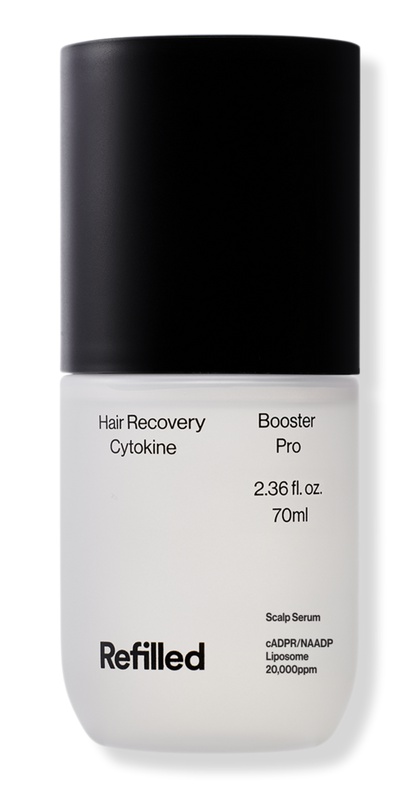
Hair Recovery Cytokine Booster Pro Daily Scalp Serum
Ingredients overview
 INCI photo pending approval
Highlights
Key Ingredients
Other Ingredients
Skim through
Refilled Hair Recovery Cytokine Booster Pro Daily Scalp SerumIngredients explained
Good old water, aka H2O. The most common skincare ingredient of all. You can usually find it right in the very first spot of the ingredient list, meaning it’s the biggest thing out of all the stuff that makes up the product.
It’s mainly a solvent for ingredients that do not like to dissolve in oils but rather in water.
Once inside the skin, it hydrates, but not from the outside - putting pure water on the skin (hello long baths!) is drying.
One more thing: the water used in cosmetics is purified and deionized (it means that almost all of the mineral ions inside it is removed). Like this, the products can stay more stable over time.
- It's a super common and super debated skincare ingredient
- It has several benefits: great solvent, penetration enhancer, creates cosmetically elegant, light formulas, great astringent and antimicrobial
- It can be very drying if it's in the first few ingredients on an ingredient list
- Some experts even think that regular exposure to alcohol damages skin barrier and causes inflammation though it's a debated opinion (read more in geeky details tab)
Butylene glycol, or let’s just call it BG, is a multi-tasking colorless, syrupy liquid. It’s a great pick for creating a nice feeling product.
BG’s main job is usually to be a solvent for the other ingredients. Other tasks include helping the product to absorb faster and deeper into the skin (penetration enhancer), making the product spread nicely over the skin (slip agent), and attracting water (humectant) into the skin.
It’s an ingredient whose safety hasn’t been questioned so far by anyone (at least not that we know about). BG is approved by Ecocert and is also used enthusiastically in natural products. BTW, it’s also a food additive.
- A natural moisturizer that’s also in our skin
- A super common, safe, effective and cheap molecule used for more than 50 years
- Not only a simple moisturizer but knows much more: keeps the skin lipids between our skin cells in a healthy (liquid crystal) state, protects against irritation, helps to restore barrier
- Effective from as low as 3% with even more benefits for dry skin at higher concentrations up to 20-40%
- High-glycerin moisturizers are awesome for treating severely dry skin
Menthol needs no introduction: it's the thing that causes the cooling sensation so well-known both from cosmetic products as well as a bunch of other things like chocolate, chewing gum, toothpaste or cigarette. It's a natural compound that comes from the essential oil of Mentha species (peppermint oil contains 40-50% menthol) and it gives them their typical minty smell and flavor.
As for skincare, menthol seems to be a mixed bag. Apart from the cool cooling sensation (that might last up to 70 mins!), it also has painkilling, itch reducing, antibacterial, antifungal and even penetration enhancing properties. On the other hand, it also seems to act as a skin irritant that increases trans-epidermal water loss (the water that evaporates from the outer layer of the skin) and thus contributes to drying out the skin.
- It's one of the gold standard ingredients for treating problem skin
- It can exfoliate skin both on the surface and in the pores
- It's a potent anti-inflammatory agent
- It's more effective for treating blackheads than acne
- For acne combine it with antibacterial agents like benzoyl peroxide or azelaic acid
An easy-to-formulate, commonly used, nice to have ingredient that’s also called pro-vitamin B5. As you might guess from the “pro” part, it’s a precursor to vitamin B5 (whose fancy name is pantothenic acid).
Its main job in skincare products is to moisturise the skin. It’s a humectant meaning that it can help the skin to attract water and then hold onto it. There is also research showing that panthenol can help our skin to produce more lovely lipids that are important for a strong and healthy skin barrier.
Another great thing about panthenol is that it has anti-inflammatory and skin protecting abilities. A study shows that it can reduce the irritation caused by less-nice other ingredients (e.g. fragrance, preservatives or chemical sunscreens) in the product.
Research also shows that it might be useful for wound healing as it promotes fibroblast (nice type of cells in our skin that produce skin-firming collagen) proliferation.
If that wasn’t enough panthenol is also useful in nail and hair care products. A study shows that a nail treatment liquide with 2% panthenol could effectively get into the nail and significantly increase the hydration of it.
As for the hair the hydration effect is also true there. Panthenol might make your hair softer, more elastic and helps to comb your hair more easily.
 We don't have description for this ingredient yet.
Exactly what it sounds: nice smelling stuff put into cosmetic products so that the end product also smells nice. Fragrance in the US and parfum in the EU is a generic term on the ingredient list that is made up of 30 to 50 chemicals on average (but it can have as much as 200 components!).
If you are someone who likes to know what you put on your face then fragrance is not your best friend - there's no way to know what’s really in it.
Also, if your skin is sensitive, fragrance is again not your best friend. It’s the number one cause of contact allergy to cosmetics. It’s definitely a smart thing to avoid with sensitive skin (and fragrance of any type - natural is just as allergic as synthetic, if not worse!).
A really multi-functional helper ingredient that can do several things in a skincare product: it can bring a soft and pleasant feel to the formula, it can act as a humectant and emollient, it can be a solvent for some other ingredients (for example it can help to stabilize perfumes in watery products) and it can also help to disperse pigments more evenly in makeup products. And that is still not all: it can also boost the antimicrobial activity of preservatives.
It's a little helper ingredient that helps to set the pH of the products to be right. It has an alkaline pH and can neutralize acidic ingredients.
Super common soothing ingredient. It can be found naturally in the roots & leaves of the comfrey plant, but more often than not what's in the cosmetic products is produced synthetically.
It's not only soothing but it' also skin-softening and protecting and can promote wound healing.
A very common ingredient that can be found in all cell membranes. In cosmetics it's quite the multi-tasker: it's an emollient and water-binding ingredient but it's also an emulsifier and can be used for stabilization purposes. It's also often used to create liposomes.
The extract coming from the juice containing leaves of the Aloe vera plant. It's usually a hydroglycolic extract (though oil extract for the lipid parts also exists) that has similar moisturizing, emollient and anti-inflammatory properties as the juice itself. We have written some more about aloe here.
The salt form of one of the main anti-inflammatory ingredients in the licorice plant, monoammonium glycyrrhizinate. It’s a yellowish powder with a nice sweet smell.
It’s used mainly for its soothing and anti-inflammatory properties, but according to manufacturer info, it’s also sebum regulating so it's a perfect ingredient for problem skin products.
Read more about licorice and why it's a skincare superstar here.
We don't have description for this ingredient yet.
We don't have description for this ingredient yet.
A nice plant extract that's used as a traditional oriental medicine in China and Korea. A 2006 study examined the cosmetic properties of the polysaccharide extract and found a couple of promising things:
The main components of the extract are water-binding sugars, namely rhamnose, galactose, and glucose. After this, it's not very surprising that the extract itself is also a great skin moisturizer almost as good as superstar NMF, hyaluronic acid. But that's not all: the researchers also found that Ulmus extract has promising anti-inflammatory and photoprotective properties. Seems like a goodie plant extract.
We don't have description for this ingredient yet.
A super common emollient that makes your skin feel nice and smooth. It comes from coconut oil and glycerin, it’s light-textured, clear, odorless and non-greasy. It’s a nice ingredient that just feels good on the skin, is super well tolerated by every skin type and easy to formulate with. No wonder it’s popular.
It's a common little helper ingredient that helps water and oil to mix together. Also, it can help to increase the solubility of some other ingredients in the formula.
A type of sugar that's part of a moisturizing trio called Aquaxyl. You can read more about its magic properties at xylitylglucoside.
It’s a handy multi-tasking ingredient that gives the skin a nice, soft feel. At the same time, it also boosts the effectiveness of other preservatives, such as the nowadays super commonly used phenoxyethanol.
The blend of these two (caprylyl glycol + phenoxyethanol) is called Optiphen, which not only helps to keep your cosmetics free from nasty things for a long time but also gives a good feel to the finished product. It's a popular duo.
We don't have description for this ingredient yet.
A type of bucket or donut-shaped molecule with a water-loving outer side and an oil-loving inner side that is used mostly to encapsulate other actives in cosmetics.
We don't have description for this ingredient yet.
Houttuynia cordata is a flowering plant native to Southeast Asia. It is eaten as a leaf vegetable, and also has a long history of use in traditional Chinese medicine, including as an attempted treatment for SARS (it didn’t really work). Regarding cosmetics, however, houttuynia cordata extract has a good bit of potential!
The main active components in the plant are these fancy chemicals called flavonoids. Houttuynia cordata specifically has a good amount of polyphenolic flavonoids, four common ones being quercetin, quercitrin, hyperoside, and rutin. All of these exhibit anti-inflammatory, antioxidant, and antibacterial properties. Quercitrin has also been shown to decrease damage from UVB rays, which is an added bonus. One thing to keep in mind, though, is that the flavonoid content of this extract can depend on if the extract is taken from the roots or the leaves, as well as if it’s a water extraction or an alcohol extraction.
Another thing Houttuynia cordata extract contains are polysaccharides, i.e. big molecules from various sugar units (in this case it is galacturonic acid (29.4%), galactose (24.0%), rhamnose (17.2%), arabinose (13.5%), glucuronic acid (6.8%), glucose (5.3%), xylose (2.1%) and mannose (1.8%) ). Polysaccharides and sugars in skincare are excellent humectants and skin hydrators, meaning they help the skin to hold onto water.
Last but not least, we also found an in-vitro (made in test tubes) study showing that houttuynia cordata extract had strong anti-allergic effects and could be helpful in treating skin allergies such as eczema (atopic dermatitis).
We don't have description for this ingredient yet.
We don't have description for this ingredient yet.
We don't have description for this ingredient yet.
If life gives the cosmetic industry lemon, it makes lemon fruit extract. As to why, we can write here extremely similar things to our shiny description of orange fruit extract. Being both of them citruses, they contain very similar active compounds with very similar (potential) effects on the skin.
Just like orange fruit, lemon fruit also contains citric acid so it is commonly used as a natural, mild exfoliating agent. If this is the case, it is usually combined with other AHA containing fruit extracts such as bilberry, sugar cane, orange, and sugar maple in a super popular ingredient mix trade named ACB Fruit Mix.
But, citrus fruits are chemically complex mixtures with a bunch of other active components such as vitamin C, flavonoids, phenolics, carbohydrates and essential oil (this latter one coming from the rind of the fruit, but still present in some amount in the fruit extract). These have the potential to give lemon extract antioxidant, antibacterial, anti-dandruff, venotonic and moisturizing properties, but the essential oil also brings some questionable compounds such as fragrance allergen limonene or phototoxic compound bergaptene. If your skin is sensitive, be careful with citrus extracts.
There is definitely some craze going on for coconut oil both in the healthy eating space (often claimed to be the healthiest oil to cook with but this is a topic for another site) and in the skin and hair care space.
We will talk here about the latter two and see why we might want to smear it all over ourselves. Chemically speaking, coconut oil has a unique fatty acid profile. Unlike many plant oils that mostly contain unsaturated fatty acids (fatty acids with double bonds and kinky structure such as linoleic or oleic), coconut oil is mostly saturated (fatty acids with single bonds only) and its most important fatty acid is Lauric Acid (about 50%). Saturated fatty acids have a linear structure that can stack nice and tight and hence they are normally solid at room temperature. Coconut oil melts around 25 °C so it is solid in the tub but melts on contact with the skin.
The saturated nature of coconut oil also means that it is a heavy-duty-oil ideal for dry skin types. A double-blind research confirmed that extra virgin coconut oil is as effective in treating xerosis (aka very dry skin) as mineral oil. Another study found that coconut oil is more effective than mineral oil in treating mild to moderate atopic dermatitis (aka eczema) in children.
So when it comes to dry skin, coconut oil is a goodie, no question there. The question is if it is good or bad for acne-prone skin. Its main fatty acid, Lauric Acid has some research showing that it is a promising ingredient against evil acne-causing bacteria, P. acnes but at the same time, both Lauric Acid and coconut oil have a very high comedogenic rating (4 out of 5). Though comedogenic ratings are not very reliable, anecdotal evidence (i.e. people commenting in forums) shows that people have mixed experiences. While some claim that it worked wonders on their acne others say that it gave them serious blackheads and zits. Try it at your own risk.
As for hair care, coconut oil has pretty solid research showing that it can penetrate into the hair very well (better than mineral oil and sunflower oil) and it can prevent hair protein loss as well as combing damage. If you have problems with damaged hair, split ends, coconut oil is worth trying as a pre- or/and post-wash treatment. Labmuffin has an awesome blogpost explaining in more detail why coconut oil is good for your hair.
A couple of other things worth mentioning: coconut oil might help with wound healing (promising animal study), it has some antifungal activity (against dermatophytes that cause the thing known as ringworm) and it also works as an insect repellent against black flies.
Overall, coconut oil is definitely a goodie for the hair and dry skin. If that warrants for the magic oil status it enjoys, we don't know.
The golden yellow oil coming from the Macadamia nut, a native Australian nut. Similar to other plant oils, it's loaded with emollient and nourishing fatty acids. It's a high oleic acid oil (50-67% oleic acid and only 0-5% linoleic acid) that makes it very emollient and ideal for dry skin types (and less ideal for acne-prone skin).
Its unique property is that it contains high amounts of a rare fatty acid called palmitoleic acid (12-25%) that give Macadamia oil a "cushiony" feel. It's also easily absorbed and makes the skin soft and supple.
We don't have description for this ingredient yet.
We don't have description for this ingredient yet.
We don't have description for this ingredient yet.
We don't have description for this ingredient yet.
A non-essential amino acid (the building blocks of skin proteins, like collagen or elastin), that the body can produce itself, but its production decreases with age. When you put it all over your face, it works as a moisturizer and maybe more.
According to great skincare blog Futurederm, glycine might help with wound healing and tissue repair and when used together with other amino acids, leucine and proline it might improve wrinkles.
BTW, it's also a building block of a bunch of important and famous peptides, including copper-tripeptide-1, palmitoyl tripeptide-1 or palmitoyl hexapeptide-12.
The essential oil coming from the whole plant of the Mandarin Orange. In general, the main component of citrus oils is limonene, a super common fragrant ingredient that makes everything smell nice (but counts as a frequent skin sensitizer). The majority of the essential oil is in the peel, but the leaf also contains some with slightly different chemical composition.
Both the peel and the leaf oil contains some phototoxic compounds (the leaf oil contains methyl-N-methyl anthranilate), so it's a good idea not to use Mandarin Orange Oil containing products during the day.
We don't have description for this ingredient yet.
Serine is an amino acid that most often comes to the formula as part of a moisturizing complex. It's a non-essential amino acid (meaning that our body can synthesize it) and serves as a water-binding ingredient.
In general, amino acids are great skincare ingredients that play an important role in proper skin hydration but there is not much info out there about what specifically serine can do for the skin.
Glutamic acid is a little molecule and non-essential (our body can synthesize it) amino acid with the important job of being a neurotransmitter in the human body meaning that it helps your nervous system work correctly.
As for what it's doing in cosmetics, Glutamic acids' main thing (similar to other amino acids) is being a humectant moisturizer and skin-conditioning agent (sidenote: if you attach lots of glutamic acid molecules, you get polyglutamic acid that is claimed to be a better than hyaluronic acid humectant). It also seems to affect skin barrier repair, however, it is not clear-cut in which direction.
The complication is that glutamic acid has two distinct forms, L-glutamic acid and D-glutamic acid, that are the mirror images of each other (think of it like your left and right hand). Studies show that a topical application of L-glutamic acid on damaged skin delayed skin repair, while D-glutamic acid application sped up skin repair. As both forms are used by the industry, it is a bit uncertain what you are getting with just glutamic acid on the ingredient list (but if it is a Shiseido group product, it is probably the goodie D-form :)).
Other than that, Glutamic acid can also be used as a pH adjuster and can be processed via biological pathways into pyrrolidone carboxylic acid, the sodium salt of which is a goodie and one of your skin’s natural moisturizing factors.
We don't have description for this ingredient yet.
We don't have description for this ingredient yet.
A non-essential amino acid (important building block of collagen and elastin) that hydrates the skin. It is also used to set the pH of the cosmetic product (buffering).
We don't have description for this ingredient yet.
A water-loving emollient that is used as a solubilizer in water-based, toner-like formulas. Solubilizers are handy helper ingredients to dissolve small amounts of oil-loving materials (such as essential oils or fragrances) into watery liquids. Polyglyceryl-4 Caprate also has some emollient properties, making the skin feel nice and smooth.
A non-essential amino acid (a building block of skin proteins like collagen or elastin) that hydrates the skin.
We don't have description for this ingredient yet.
A semi-essential (infants cannot synthesize it, but adults can) amino acid that is one of the primary building blocks of hair keratin and skin collagen. It's a natural moisturizing factor, a skin hydrator and might also help to speed up wound healing.
Arginine usually has a positive charge (cationic) that makes it substantive to skin and hair (those are more negatively charged surfaces) and an excellent film former. Thanks to the positive charge, it also creates a complex with AHAs (AHAs like to lose a hydrogen ion and be negatively charged, so the positive and the negative ions attract each other) that causes a "time-release AHA effect" and reduces the irritation associated with AHAs.
We don't have description for this ingredient yet.
An essential amino acid that the body cannot produce itself but has to take from the diet. Combined with UVA exposure, phenylalanine is used in the treatment of vitiligo (a pigmentation disorder where patches of the skin lose the pigment).
- Green tea is one of the most researched natural ingredients
- The active parts are called polyphenols, or more precisely catechins (EGCG being the most abundant and most active catechin)
- There can be huge quality differences between green tea extracts. The good ones contain 50-90% catechins (and often make the product brown and give it a distinctive smell)
- Green tea is proven to be a great antioxidant, UV protectant, anti-inflammatory, anticarcinogenic and antimicrobial
- Because of these awesome properties green tea is a great choice for anti-aging and also for skin diseases including rosacea, acne and atopic dermatitis
A non-essential amino acid (meaning that our body can produce it) that's also one of the major building blocks of collagen. According to the Futurederm blog, it might be able to improve wrinkles when combined with other amino acids, glycine and leucine
We don't have description for this ingredient yet.
An essential amino acid that's also a key building block of collagen and elastin. When taken orally, it helps the digestive and intestinal tracts function more smoothly and also helps the absorption of nutrients. As for skincare, it is not clear what it does other than being a skin hydrator.
An essential amino acid (a building block of skin proteins like collagen) that our body cannot produce itself but has to take from external sources, like diet.
It's a branched chain amino acid that is claimed to enhance energy, increase endurance and aid in muscle tissue recovery and repair when taken as a supplement. It's not clear what valine does when you put it on the skin, but as all amino acids, it must be at least a great skin hydrator.
We don't have description for this ingredient yet.
A branch-chained, essential amino acid that can be found in things like almond, cashew or soy protein. When taken orally it may promote protein synthesis. As for skincare - like all the amino acids - it's a skin-identical ingredient and moisturizer. It also seems to be useful as a barrier repair ingredient.
A semi-essential amino acid meaning that enough has to be eaten from it so that the body does not use up essential amino acids (that our body cannot produce itself) to synthesize it. It has an important role in regulating the immune defense, allergic reactions, and inflammatory processes in the body.
As for skincare, it's a skin moisturizer that might also protect from some skin infections.
We don't have description for this ingredient yet.
This ingredient name is not according to the INCI-standard. :( What, why?!
We don't have description for this ingredient yet.
- A multi-functional skincare superstar with several proven benefits for the skin
- Great anti-aging, wrinkle smoothing ingredient used at 4-5% concentration
- Fades brown spots alone or in combination with amino sugar, acetyl glucosamine
- Increases ceramide synthesis that results in a stronger, healthier skin barrier and better skin hydration
- Can help to improve several skin conditions including acne, rosacea, and atopic dermatitis
Also called vitamin H, biotin is the main component of many enzymes in our body. A nice ingredient to take as a supplement for stronger nails and hair. When you do not take it as a supplement its effects are a bit more questionable but according to manufacturer info it can smooth the skin and strengthen the hair.
The sodium salt form of skincare superstar, vitamin C. If you do not know what the big fuss about vitamin C is, you are missing out and you have to click here and read all the geeky details about it.
Pure vitamin C (aka ascorbic acid, AA) is great and all, but its lack of stability is a big challenge for the cosmetics industry. One solution is to create stable derivatives that can be absorbed into the skin, convert there to AA and do all the magic AA is proven to do (which is being an antioxidant, a collagen booster, and a skin brightener).
SAP (the vit C derivative, not the enterprise software, obvs) is a promising derivative that has great stability up to pH 7. The challenge with it though is skin penetration. Unfortunately, it seems to be limited, or to quote a great article from the Journal of Cosmetic Dermatology "topically applied ascorbyl phosphate salts are, at very best, poorly absorbed in comparison with AA". Regarding conversion to AA, there seems to be no data about it, so we can neither deny nor confirm it.
We have better news regarding the three magic abilities of vitamin C: there is in-vivo (tested on real people) data showing that SAP does have photo-protective (aka antioxidant) properties, though less than pure AA. SAP might also aid collagen boosting; in-vitro (made in the lab) data shows that it works, but is less effective than another vitamin C derivative, called MAP (that seems to be as effective as pure AA). As for skin-brightening, there is a trade publication with in-vivo data showing that SAP can fade brown spots.
Another thing SAP might be able to do is to help with acne. A 2005 study showed in vitro (in test tubes) that 1% SAP has a strong antimicrobial activity on evil acne causing P. acnes and it also showed in vivo (on real people) that 5% SAP can strongly improve the inflammatory and non-inflammatory lesions of acne vulgaris. In fact, the results were comparable or even slightly better than with 5% benzoyl peroxide.
And there is even more regarding SAP and acne. A nice double-blind study from 2009 showed that 5% SAP reduced the inflammatory lesions by 20.14% and 48.82% within 4 and 8 weeks respectively and when combined with 0.2% retinol the results were even better. With this combination treatment, the improvement was 29.28% after 4 weeks and 63.10% after 8 weeks of application.
Aside from research studies, anecdotal evidence also supports SAP being a promising vitamin C derivative. One of the best-selling (vitamin C) serums in Sephora is the Ole Henriksen Truth Serum, while on Amazon it's the OzNaturals Vitamin C 20 Serum. Another popular choice is the Mad Hippie Vitamin C serum, and all of these contain vitamin C in the form of SAP.
Overall, we think SAP is a goody! In terms of anti-aging, it's probably not as effective as pure Ascorbic Acid, but it's totally worth a try. However, if your skin is acne-prone, SAP is your form of Vitamin C and it's a must-try.
- Primary fat-soluble antioxidant in our skin
- Significant photoprotection against UVB rays
- Vit C + Vit E work in synergy and provide great photoprotection
- Has emollient properties
- Easy to formulate, stable and relatively inexpensive
A super common and cheap fragrance ingredient. It's in many plants, e.g. rosemary, eucalyptus, lavender, lemongrass, peppermint and it's the main component (about 50-90%) of the peel oil of citrus fruits.
It does smell nice but the problem is that it oxidizes on air exposure and the resulting stuff is not good for the skin. Oxidized limonene can cause allergic contact dermatitis and counts as a frequent skin sensitizer.
Limonene's nr1 function is definitely being a fragrance component, but there are several studies showing that it's also a penetration enhancer, mainly for oil-loving components.
All in all, limonene has some pros and cons, but - especially if your skin is sensitive - the cons probably outweigh the pros.
Linalool is a super common fragrance ingredient. It’s kind of everywhere - both in plants and in cosmetic products. It’s part of 200 natural oils including lavender, ylang-ylang, bergamot, jasmine, geranium and it can be found in 90-95% of prestige perfumes on the market.
The problem with linalool is, that just like limonene it oxidises on air exposure and becomes allergenic. That’s why a product containing linalool that has been opened for several months is more likely to be allergenic than a fresh one.
A study made in the UK with 483 people tested the allergic reaction to 3% oxidised linalool and 2.3% had positive test results.
You may also want to take a look at...
| what‑it‑does | solvent |
| what‑it‑does | antimicrobial/antibacterial | solvent | viscosity controlling |
| what‑it‑does | moisturizer/humectant | solvent |
| irritancy, com. | 0, 1 |
| what‑it‑does | skin-identical ingredient | moisturizer/humectant |
| irritancy, com. | 0, 0 |
| what‑it‑does | soothing |
| what‑it‑does | exfoliant | anti-acne | soothing | preservative |
| what‑it‑does | soothing | moisturizer/humectant |
| irritancy, com. | 0, 0 |
| what‑it‑does | perfuming |
| what‑it‑does | solvent |
| what‑it‑does | buffering |
| what‑it‑does | soothing |
| irritancy, com. | 0, 0 |
| what‑it‑does | emollient | emulsifying |
| what‑it‑does | soothing | emollient | moisturizer/humectant |
| what‑it‑does | soothing | moisturizer/humectant |
| what‑it‑does | moisturizer/humectant |
| what‑it‑does | antioxidant |
| what‑it‑does | emollient |
| what‑it‑does | emulsifying | surfactant/cleansing |
| irritancy, com. | 0, 0 |
| what‑it‑does | moisturizer/humectant |
| what‑it‑does | moisturizer/humectant | emollient |
| what‑it‑does | emollient |
| what‑it‑does | antioxidant | soothing |
| what‑it‑does | moisturizer/humectant |
| what‑it‑does | antioxidant |
| what‑it‑does | emollient | perfuming |
| irritancy, com. | 0, 4 |
| what‑it‑does | emollient |
| what‑it‑does | antimicrobial/antibacterial | antioxidant |
| what‑it‑does | antimicrobial/antibacterial | emollient | moisturizer/humectant |
| what‑it‑does | skin-identical ingredient |
| what‑it‑does | skin-identical ingredient |
| what‑it‑does | moisturizer/humectant |
| what‑it‑does | perfuming |
| what‑it‑does | skin-identical ingredient |
| what‑it‑does | emulsifying |
| what‑it‑does | skin-identical ingredient |
| what‑it‑does | skin-identical ingredient |
| what‑it‑does | skin-identical ingredient |
| what‑it‑does | antioxidant | soothing |
| what‑it‑does | skin-identical ingredient |
| what‑it‑does | moisturizer/humectant |
| what‑it‑does | skin-identical ingredient |
| what‑it‑does | skin-identical ingredient |
| what‑it‑does | skin-identical ingredient |
| what‑it‑does | skin-identical ingredient | moisturizer/humectant |
| what‑it‑does | antioxidant |
| what‑it‑does | moisturizer/humectant |
| what‑it‑does | cell-communicating ingredient | skin brightening | anti-acne | moisturizer/humectant |
| what‑it‑does | moisturizer/humectant |
| what‑it‑does | antioxidant | anti-acne |
| what‑it‑does | antioxidant |
| irritancy, com. | 0-3, 0-3 |
| what‑it‑does | perfuming | solvent |
| what‑it‑does | perfuming |