




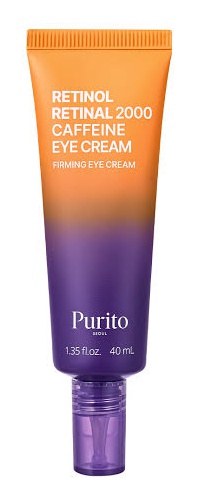
Retinol Retinal 2000 Caffeine Eye Cream
Ingredients overview
Highlights
Key Ingredients
Other Ingredients
Skim through
Purito SEOUL Retinol Retinal 2000 Caffeine Eye CreamIngredients explained
Good old water, aka H2O. The most common skincare ingredient of all. You can usually find it right in the very first spot of the ingredient list, meaning it’s the biggest thing out of all the stuff that makes up the product.
It’s mainly a solvent for ingredients that do not like to dissolve in oils but rather in water.
Once inside the skin, it hydrates, but not from the outside - putting pure water on the skin (hello long baths!) is drying.
One more thing: the water used in cosmetics is purified and deionized (it means that almost all of the mineral ions inside it is removed). Like this, the products can stay more stable over time.
- A multi-functional skincare superstar with several proven benefits for the skin
- Great anti-aging, wrinkle smoothing ingredient used at 4-5% concentration
- Fades brown spots alone or in combination with amino sugar, acetyl glucosamine
- Increases ceramide synthesis that results in a stronger, healthier skin barrier and better skin hydration
- Can help to improve several skin conditions including acne, rosacea, and atopic dermatitis
Butylene glycol, or let’s just call it BG, is a multi-tasking colorless, syrupy liquid. It’s a great pick for creating a nice feeling product.
BG’s main job is usually to be a solvent for the other ingredients. Other tasks include helping the product to absorb faster and deeper into the skin (penetration enhancer), making the product spread nicely over the skin (slip agent), and attracting water (humectant) into the skin.
It’s an ingredient whose safety hasn’t been questioned so far by anyone (at least not that we know about). BG is approved by Ecocert and is also used enthusiastically in natural products. BTW, it’s also a food additive.
A clear, slightly yellow, odorless oil that's a very common, medium-spreading emollient. It makes the skin feel nice and smooth and works in a wide range of formulas.
A hydrocarbon-based emollient that can come in different viscosities from silky-light through satiny-smooth to luxurious, rich. It forms a non-occlusive film on the surface of the skin and brings gloss without greasiness to the formula. It's a very pure and hypoallergenic emollient that's also ideal for baby care products.
An ester coming from sorbitol and the fatty acids of olive oil. It is part of the popular emulsifier trade named Olivem 1000 that is well-known for generating biomimetic liquid crystal structures. We have more info on Olivem 1000 at Cetearyl Olivate >>
An easy-to-formulate, commonly used, nice to have ingredient that’s also called pro-vitamin B5. As you might guess from the “pro” part, it’s a precursor to vitamin B5 (whose fancy name is pantothenic acid).
Its main job in skincare products is to moisturise the skin. It’s a humectant meaning that it can help the skin to attract water and then hold onto it. There is also research showing that panthenol can help our skin to produce more lovely lipids that are important for a strong and healthy skin barrier.
Another great thing about panthenol is that it has anti-inflammatory and skin protecting abilities. A study shows that it can reduce the irritation caused by less-nice other ingredients (e.g. fragrance, preservatives or chemical sunscreens) in the product.
Research also shows that it might be useful for wound healing as it promotes fibroblast (nice type of cells in our skin that produce skin-firming collagen) proliferation.
If that wasn’t enough panthenol is also useful in nail and hair care products. A study shows that a nail treatment liquide with 2% panthenol could effectively get into the nail and significantly increase the hydration of it.
As for the hair the hydration effect is also true there. Panthenol might make your hair softer, more elastic and helps to comb your hair more easily.
An extremely common multitasker ingredient that gives your skin a nice soft feel (emollient) and gives body to creams and lotions. It also helps to stabilize oil-water mixes (emulsions), though it does not function as an emulsifier in itself. Its typical use level in most cream type formulas is 2-3%.
It’s a so-called fatty alcohol, a mix of cetyl and stearyl alcohol, other two emollient fatty alcohols. Though chemically speaking, it is alcohol (as in, it has an -OH group in its molecule), its properties are totally different from the properties of low molecular weight or drying alcohols such as denat. alcohol. Fatty alcohols have a long oil-soluble (and thus emollient) tail part that makes them absolutely non-drying and non-irritating and are totally ok for the skin.
A super common emollient that makes your skin feel nice and smooth. It comes from coconut oil and glycerin, it’s light-textured, clear, odorless and non-greasy. It’s a nice ingredient that just feels good on the skin, is super well tolerated by every skin type and easy to formulate with. No wonder it’s popular.
Hello, our favorite molecule that helps us wake up in the morning and then keeps us going through the day. As a super well-known stimulant from coffee, tea and plenty of other soft drinks, Caffeine needs no introduction. So we will skip right to the part where we talk about what the hell it does in so-so many cosmetic products.
Looking at the research, we were surprised to find how versatile Caffeine is. It is a small, water-loving molecule with pretty good skin penetration abilties. Once in the skin, it has nice antioxidant properties, meaning that it reduces the formation of evil free radicals and it might even be useful in preventing UV-induced skin cancers.
A well-known thing about Caffeine is that it improves the microcirculation of the blood vessels. Though conventional wisdom and anecdotal evidence says that this property is helpful for dark under-eye circles and puffy eyes, we have to mention that the double-blind research we have found about a 3% caffeine gel concluded that "the overall efficacy of the selected caffeine gel in reducing puffy eyes was not significantly different from that of its gel base." But you know, the proof is in the pudding.
Another thing Caffeine is used for in body care products is its anti-cellulite effects. In theory, it can speed up the lipolysis process (the "fat burning" by our cells) and stimulate the draining lymph system that might lead to the improvement of cellulite. But here again, the evidence that it actually makes a measurable, let alone visible, improvement on actual human beings is limited (we could find only some animal skin studies or caffeine being combined with other actives).
Last, but not least, we have to write about caffeine and hair growth. The theory is that it can inhibit the activity of the 5-α-reductase enzyme that plays an important role in hair loss and allows a renewed growth phase of the hair. We have found some recent and promising research to back this up. A 2017 study compared a 0.2% caffeine liquid with a 5% Minoxidil (an FDA approved active to treat baldness) solution and found that "a caffeine-based topical liquid should be considered as not inferior to minoxidil 5% solution in men with androgenetic alopecia", or English translation means that the caffeine liquid was pretty much as good as the FDA-approved Minoxidil stuff. Not bad!
Overall, we think that caffeine is a very versatile and biologically active ingredient. Even though some of its effects are more hyped up than backed up, it is still a nice to have on many ingredient lists.
 We don't have description for this ingredient yet.
A clear, colorless, almost odorless oil that spreads nicely and easily and gives a velvet dry skin feel. It is good friends with sunscreen agents and helps to solubilize them. Also, it makes sunscreens feel lighter and spread easier.
A so-called fatty (the good, non-drying kind of) alcohol that does all kinds of things in a skincare product: it makes your skin feel smooth and nice (emollient), helps to thicken up products and also helps water and oil to blend (emulsifier). Can be derived from coconut or palm kernel oil.
We don't have description for this ingredient yet.
A vegetable-based emulsifier that helps the oily and watery parts of the formula to mix nicely together. It is compatible with a bunch of cosmetic oils as well as active ingredients and its specialty is creating emulsions with super high heat and freeze stability (from -25 °C and +50 °C).
- A natural moisturizer that’s also in our skin
- A super common, safe, effective and cheap molecule used for more than 50 years
- Not only a simple moisturizer but knows much more: keeps the skin lipids between our skin cells in a healthy (liquid crystal) state, protects against irritation, helps to restore barrier
- Effective from as low as 3% with even more benefits for dry skin at higher concentrations up to 20-40%
- High-glycerin moisturizers are awesome for treating severely dry skin
A helper ingredient that functions as a film-forming polymer (big molecule from repeated subunits).
It usually comes to the formula as part of a thickener-emulsifier trio paired with Polyisobutene and Polysorbate 20. The three togeather have excellent thickening properties with remarkable emulsifying-stabilising abilities. They also have a nice silicone feel with glide-on spreading.
A really multi-functional helper ingredient that can do several things in a skincare product: it can bring a soft and pleasant feel to the formula, it can act as a humectant and emollient, it can be a solvent for some other ingredients (for example it can help to stabilize perfumes in watery products) and it can also help to disperse pigments more evenly in makeup products. And that is still not all: it can also boost the antimicrobial activity of preservatives.
A glycerin-derived gentle cleansing agent that is described as being skin and eye-friendly, and not leaving the skin dry or tight. It's also used as a co-emulsifier or solubilizer that helps to blend small amounts of oily things into water-based products.
A super common, waxy, white, solid stuff that helps water and oil to mix together, gives body to creams and leaves the skin feeling soft and smooth.
Chemically speaking, it is the attachment of a glycerin molecule to the fatty acid called stearic acid. It can be produced from most vegetable oils (in oils three fatty acid molecules are attached to glycerin instead of just one like here) in a pretty simple, "green" process that is similar to soap making. It's readily biodegradable.
It also occurs naturally in our body and is used as a food additive. As cosmetic chemist Colins writes it, "its safety really is beyond any doubt".
A fatty alcohol (the non-drying type with a long oil loving chain of 22 carbon atoms) that is used to increase the viscosity of the formula and it also helps the oily and the watery parts to stay nicely mixed together (called emulsion stabilizing).
An amino acid-based emulsifier that helps water and oil to mix and stay that way. It is considered as natural, environmentally friendly, and hypoallergenic.
A handy multifunctional ingredient that works as a preservative booster, as well as an antioxidant and soothing agent.
A synthetic liquid oil that can replace mineral oil or silicone oils in the cosmetic formulas. There are different grades depending on the molecular weight ranging from very light, volatile, non-residue leaving ones to more substantial, slight residue leaving ones.
Apart from leaving the skin soft and smooth (emollient), it's also used as a waterproofing agent in sunscreens or makeup products and as a shine enhancer in lip gloss formulas.
It's the chemically chopped up version of normal lecithin. Most often it's used to create liposomes and to coat and stabilize other ingredients.
We don't have description for this ingredient yet.
- Retinol (pure Vitamin A) is probably the most proven anti-aging ingredient available OTC
- It has to be converted in the skin to retinoic acid to work its magic
- Once converted, it has the same effect as all-trans-retinoic acid, aka tretinoin
- A generally accepted ballpark number is that retinol is 10-to-20 times less potent than retinoic acid
- It makes skin less wrinkled, smoother, firmer and tighter
- It might also be helpful for acne prone skin as it normalizes keratinization and makes the pores produce less sebum
- Possible side effects and irritation are also much less than with retinoic acid
- Do not use whilst pregnant
If you are reading here, we are pretty sure the words retinoids and retinol ring a bell, but if not, you are seriously missing out, please click here immediately to catch up. The TL;DR version is that retinoids are the royal family of skincare with tretinoin being the king, the only FDA-approved ingredient to treat the signs of photoaging. Retinol is like a grandkid, it has to be converted (through two steps) in the skin to become retinoic acid. The conversion means retinol is both less effective and less harsh on the skin.
So where does our current molecule, Retinal, aka Retinaldehyde fit into the family (btw, here is a nice visual family tree about who is who)? Remember that retinol needed two conversion steps to become retinoic acid? Yes, you are right, Retinal is the intermediate step between retinoic acid and retinol, meaning it needs only one conversion step to become active in the skin. If we go with our royal family analogy, Retinal is Prince William, directly next in line to the throne.
Once retinal is converted, it becomes retinoic acid and does the same things we detailed in our tretinoin description. In a nutshell, it is everything you expect from an anti-aging superstar such as decreased wrinkles, smoother, firmer and more elastic skin.
This sounds good, but how does Retinal compare to retinoic acid? Good question! We found a study (a pretty good one with 125 patients) that compared 0.05% retinal with 0.05% retinoic acid (and vehicle). They concluded that "at week 18, a significant reduction of the wrinkle and roughness features was observed with both retinaldehyde and retinoic acid." and the difference between the two was not statistically significant. (Interestingly, in both groups, the results were less significant at week 44, so it might be a good idea to have a retinoid break from time to time?) Also, our guy, Retinal was much better tolerated than retinoic acid known for its harshness.
The good tolerability of retinal was also confirmed by another study that compared retinol (ROL), retinal (RAL) and retinoic acid (RA). They found that "the natural retinoids ROL and RAL do have a good tolerance profile, in contrast with the irritating potential of RA", meaning retinal is an awesome alternative if you have irritation and flaking issues with prescription products, such as Retin-A.
Last, but not least, we want to mention a pretty big (but subjectively evaluated), Avene (the French pharmacy brand famous for its Retinal products) sponsored study that examined the tolerability and efficacy of a 0.1 Retinal + 6% glycolic acid product in the treatment of acne. The product was added next to the standard anti-acne regimen of 1,709 patients for 90 days and the study concluded that the formula was both very well tolerated as well as effective next to other standard anti-acne medications such as benzoyl peroxide and antibiotics.
Overall, if you are into retinoids, Retinal is a really awesome and well-proven member of the family that is absolutely worth trying.
An oily kind of ingredient that can magically blend with water all by itself. This is called self-emulsifying and SE in its name stands for that.
The difference between "normal" Glyceryl Stearate and this guy is that the SE grade contains a small amount of water-loving soap molecules, such as sodium stearate. This increases Glyceryl Stearate's affinity for water and gives it stronger emulsifying abilities.
Other than that, it’s a nice emollient that gives a smooth and soft appearance to the skin.
You can read some more at Glyceryl Stearate >>
Pentaerythrityl Tetra-Di-T-Butyl Hydroxyhydrocinnamate is an antioxidant molecule used in small amounts (less than 0.8%) to help products stay nice longer. More specifically, it is great at preventing discoloration or other types of oxidative degradation. It is a trendy alternative to often bad-mouthed synthetic antioxidant and stabilizer, BHT.
Benzotriazolyl Dodecyl P-Cresol is a broadband UV absorber used to stabilize products in transparent packaging. It protects sensitive ingredients such as colors, fragrances, or natural extracts from photooxidative degradation. The recommended usage rate is 0.01% - 0.1%.
If you have spotted ethylhexylglycerin on the ingredient list, most probably you will see there also the current IT-preservative, phenoxyethanol. They are good friends because ethylhexylglycerin can boost the effectiveness of phenoxyethanol (and other preservatives) and as an added bonus it feels nice on the skin too.
Also, it's an effective deodorant and a medium spreading emollient.
A super common, medium-spreading emollient ester that gives richness to the formula and a mild feel during rubout. It can be a replacement for mineral oil and is often combined with other emollients to achieve different sensorial properties.
A handy spherical powder that's often combined with fellow spherical powder, Polymethylsilsesquioxane to form a high-performing texturizing duo. The duo is claimed to provide excellent slip, fluidity and overall skin feel and gives soft focus and wrinkle correction to the formula. It also has strong de-tackifying and anti-caking properties.
It's one of the most commonly used thickeners and emulsion stabilizers. If the product is too runny, a little xanthan gum will make it more gel-like. Used alone, it can make the formula sticky and it is a good team player so it is usually combined with other thickeners and so-called rheology modifiers (helper ingredients that adjust the flow and thus the feel of the formula). The typical use level of Xantha Gum is below 1%, it is usually in the 0.1-0.5% range.
Btw, Xanthan gum is all natural, a chain of sugar molecules (polysaccharide) produced from individual sugar molecules (glucose and sucrose) via fermentation. It’s approved by Ecocert and also used in the food industry (E415).
It's one of the important lipids that can be found naturally in the outer layer of the skin. About 25% of the goopy stuff between our skin cells consists of cholesterol. Together with ceramides and fatty acids, they play a vital role in having a healthy skin barrier and keeping the skin hydrated.
Apart from being an important skin-identical ingredient, it's also an emollient and stabilizer.
A handy helper ingredient that helps water and oil to mix nicely together, aka emulsifier. It is especially recommended for protective, baby care and general purpose emollient creams.
It also helps to disperse insoluble particles (think color pigments or zinc/titanium dioxide sunscreen) nice and even in cosmetic formulas.
It’s one of those little helper ingredients that makes sure the product stays the same over time. No color change or anything like that. It does so by neutralizing the metal ions in the formula (that usually get into there from water) that would otherwise cause some not so nice changes.
We don't have description for this ingredient yet.
It's a type of glycol that - according to the manufacturer - is an extremely good replacement for other glycols like propylene or butylene glycol. Its main job is to be a solvent, but it has also very good antimicrobial properties and acts as a true preservative booster. Also helps with skin hydration without stickiness or tacky feel.
Centella Asiatica - or sometimes also called Gotu Kola or Cica - has been used in folk medicine for hundreds of years. It’s traditionally used to improve small wounds, burns and scratches and it’s also a well known anti-inflammatory agent for eczema.
Recently science has taken an interest in Gotu Kola as well and it turns out it really has many active compounds with several benefits. Just for hard-core geeks, the main biologically active compounds are pentacyclic triterpenoid saponins called asiaticoside, madecassoside, asiatic and madecassic acid (also called centellosides).
One of the biological activities of the centellosides is to be able to stimulate GAGs (glycosaminoglycans - polysaccharides that are part of the liquidy stuff between our skin cells), and especially hyaluronic acid synthesis in our skin. This is probably one of the reasons why Centella Asiatica Extract has nice skin moisturizing properties that was confirmed by a 25 people, four weeks study along with Centella's anti-inflammatory effects.
Madecassoside can also help in burn wound healing through increasing antioxidant activity and enhancing collagen synthesis. Asiaticoside was shown to increase antioxidant levels on rats skin when applied at 0.2%.
Centella Asiatica also often shows up in products that try to treat cellulite or striae. Of course, it cannot make a miracle but it might have some effect via regulating microcirculation and normalizing the metabolism in the cells of connective tissues.
Bottom line: Gotu Kola is a great plant ingredient with proven wound healing, anti-inflammatory, and antioxidant properties. Nice to spot on any ingredient list.
We don't have description for this ingredient yet.
One of the many types of ceramides that can be found naturally in the upper layer of the skin. Ceramides make up about 50% of the goopy stuff that's between our skin cells and play a super important role in having a healthy skin barrier and keeping the skin hydrated. It works even better when combined with its pal, Ceramide 1.
We wrote way more about ceramides at ceramide 1, so click here to know more.
- Primary fat-soluble antioxidant in our skin
- Significant photoprotection against UVB rays
- Vit C + Vit E work in synergy and provide great photoprotection
- Has emollient properties
- Easy to formulate, stable and relatively inexpensive
It’s a handy multi-tasking ingredient that gives the skin a nice, soft feel. At the same time, it also boosts the effectiveness of other preservatives, such as the nowadays super commonly used phenoxyethanol.
The blend of these two (caprylyl glycol + phenoxyethanol) is called Optiphen, which not only helps to keep your cosmetics free from nasty things for a long time but also gives a good feel to the finished product. It's a popular duo.
A naturally occurring floral component with a delicate scent that can mask the odor of other raw materials but is not noticeable in the final product. It also has remarkable antimicrobial and preservative boosting abilities and can help to create "preservative-free" formulas.
We don't have description for this ingredient yet.
We don't have description for this ingredient yet.
We don't have description for this ingredient yet.
Citric acid comes from citrus fruits and is an AHA. If these magic three letters don’t tell you anything, click here and read our detailed description on glycolic acid, the most famous AHA.
So citric acid is an exfoliant, that can - just like other AHAs - gently lift off the dead skin cells of your skin and make it more smooth and fresh.
There is also some research showing that citric acid with regular use (think three months and 20% concentration) can help sun-damaged skin, increase skin thickness and some nice hydrating things called glycosaminoglycans in the skin.
But according to a comparative study done in 1995, citric acid has less skin improving magic properties than glycolic or lactic acid. Probably that’s why citric acid is usually not used as an exfoliant but more as a helper ingredient in small amounts to adjust the pH of a formulation.
You may also want to take a look at...
| what‑it‑does | solvent |
| what‑it‑does | cell-communicating ingredient | skin brightening | anti-acne | moisturizer/humectant |
| what‑it‑does | moisturizer/humectant | solvent |
| irritancy, com. | 0, 1 |
| what‑it‑does | emollient | perfuming |
| what‑it‑does | emollient | perfuming | solvent |
| what‑it‑does | emulsifying |
| what‑it‑does | soothing | moisturizer/humectant |
| irritancy, com. | 0, 0 |
| what‑it‑does | emollient | viscosity controlling | emulsifying | surfactant/cleansing |
| irritancy, com. | 1, 2 |
| what‑it‑does | emollient |
| what‑it‑does | antioxidant | perfuming |
| what‑it‑does | emollient |
| what‑it‑does | emollient | viscosity controlling |
| irritancy, com. | 2, 2 |
| what‑it‑does | emulsifying |
| what‑it‑does | skin-identical ingredient | moisturizer/humectant |
| irritancy, com. | 0, 0 |
| what‑it‑does | solvent |
| what‑it‑does | surfactant/cleansing | emulsifying |
| what‑it‑does | emollient | emulsifying |
| irritancy, com. | 0, 1 |
| what‑it‑does | emollient | viscosity controlling |
| what‑it‑does | emulsifying | surfactant/cleansing |
| what‑it‑does | antioxidant | preservative |
| what‑it‑does | emollient | viscosity controlling |
| irritancy, com. | 2, 1 |
| what‑it‑does | emollient | emulsifying |
| what‑it‑does | cell-communicating ingredient |
| what‑it‑does | cell-communicating ingredient |
| what‑it‑does | emulsifying |
| irritancy, com. | 2, 3 |
| what‑it‑does | antioxidant | preservative |
| what‑it‑does | preservative |
| what‑it‑does | emollient |
| irritancy, com. | 0, 2-4 |
| what‑it‑does | viscosity controlling |
| what‑it‑does | skin-identical ingredient | emollient |
| irritancy, com. | 0, 0 |
| what‑it‑does | emulsifying |
| irritancy, com. | 0, 1-2 |
| what‑it‑does | chelating |
| what‑it‑does | viscosity controlling |
| what‑it‑does | solvent |
| what‑it‑does | soothing | antioxidant | moisturizer/humectant |
| what‑it‑does | moisturizer/humectant |
| what‑it‑does | skin-identical ingredient |
| what‑it‑does | antioxidant |
| irritancy, com. | 0-3, 0-3 |
| what‑it‑does | moisturizer/humectant | emollient |
| what‑it‑does | perfuming | solvent |
| what‑it‑does | viscosity controlling |
| what‑it‑does | buffering |