




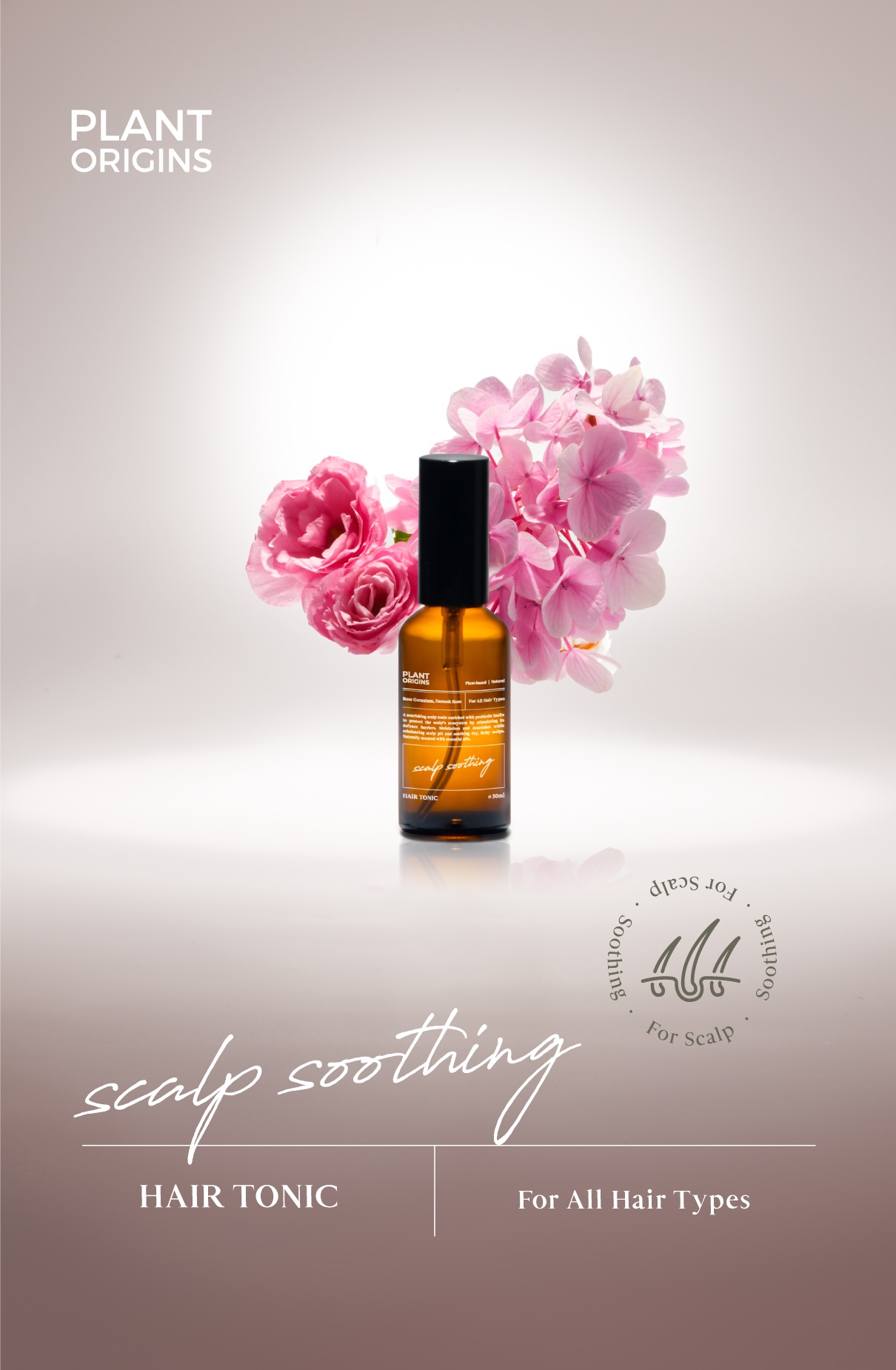
Scalp Soothing Hair Tonic
Ingredients overview
Highlights
Key Ingredients
Other Ingredients
Skim through
Plant Origins Scalp Soothing Hair TonicIngredients explained
Good old water, aka H2O. The most common skincare ingredient of all. You can usually find it right in the very first spot of the ingredient list, meaning it’s the biggest thing out of all the stuff that makes up the product.
It’s mainly a solvent for ingredients that do not like to dissolve in oils but rather in water.
Once inside the skin, it hydrates, but not from the outside - putting pure water on the skin (hello long baths!) is drying.
One more thing: the water used in cosmetics is purified and deionized (it means that almost all of the mineral ions inside it is removed). Like this, the products can stay more stable over time.
- It's a super common and super debated skincare ingredient
- It has several benefits: great solvent, penetration enhancer, creates cosmetically elegant, light formulas, great astringent and antimicrobial
- It can be very drying if it's in the first few ingredients on an ingredient list
- Some experts even think that regular exposure to alcohol damages skin barrier and causes inflammation though it's a debated opinion (read more in geeky details tab)
- A natural moisturizer that’s also in our skin
- A super common, safe, effective and cheap molecule used for more than 50 years
- Not only a simple moisturizer but knows much more: keeps the skin lipids between our skin cells in a healthy (liquid crystal) state, protects against irritation, helps to restore barrier
- Effective from as low as 3% with even more benefits for dry skin at higher concentrations up to 20-40%
- High-glycerin moisturizers are awesome for treating severely dry skin
Propanediol is a natural alternative for the often used and often bad-mouthed propylene glycol. It's produced sustainably from corn sugar and it's Ecocert approved.
It's quite a multi-tasker: can be used to improve skin moisturization, as a solvent, to boost preservative efficacy or to influence the sensory properties of the end formula.
The distillate created from the leaves of the hazelnut-bush-like-magic-tree commonly called Witch Hazel. The distillate from the leaves is probably the gentlest, most diluted version of any kind of With Hazel ingredient.
The leaves contain much, much less active components than the bark (4.77% vs 0.04% tannins) and distillates are more diluted than extracts. So this one is probably just a "fancy-water" that resembles the properties of Witch Hazel Extract (astringent, soothing, antioxidant, antibacterial) in a very mild and gentle way.
We have gone into much more details about Witch Hazel here.
Cucumber is a nice, non-irritating plant extract that’s known for it’s soothing and emollient properties. It’s not something new to put it on our face: even Cleopatra used it to “preserve her skin”.
It’s commonly believed that cucumber is the answer to puffy eyes, but there is no research confirming this. What research does confirm is that it contains amino acids and organic acids that’s helpful for the skin’s acid mantle. There is also an enzyme (called shikimate dehydrigenase) in the pulp that’s shown to have anti-inflammatory properties.
The salt form of one of the main anti-inflammatory ingredients in the licorice plant, monoammonium glycyrrhizinate. It’s a yellowish powder with a nice sweet smell.
It’s used mainly for its soothing and anti-inflammatory properties, but according to manufacturer info, it’s also sebum regulating so it's a perfect ingredient for problem skin products.
Read more about licorice and why it's a skincare superstar here.
A naturally occurring fructose polysaccharide found in the roots and rhizomes of several plants, for example, chicory. It is used in skincare for its prebiotic activity, meaning that it reduces the growth of bad bacteria in favor of friendly microorganisms naturally present on the skin.
A skin protecting ingredient obtained by enzymatic synthesis from natural sugars (sucrose and maltose). It's claimed to be a bio-selective substrate that protects and stimulates the beneficial microbial skin flora without doing the same with pathogens and undesirable flora. It also stimulates the antimicrobial peptide release by keratinocytes (skin cells).
Aloe Vera is one of today’s magic plants. It does have some very nice properties indeed, though famous dermatologist Leslie Baumann warns us in her book that most of the evidence is anecdotal and the plant might be a bit overhyped.
What research does confirm about Aloe is that it’s a great moisturizer and has several anti-inflammatory (among others contains salicylates, polysaccharides, magnesium lactate and C-glucosyl chromone) as well as some antibacterial components. It also helps wound healing and skin regeneration in general. All in all definitely a goodie.
A mildly viscous, amber-colored liquid with fatty odor, made from Castor Oil and polyethylene glycol (PEG).
If it were a person, we’d say, it’s agile, diligent & multifunctional. It’s mostly used as an emulsifier and surfactant but most often it is used to solubilize fragrances into water-based formulas.
The fragrant essential oil coming from the flowers of Rose Geranium. Like most essential oils, it contains antioxidant and antimicrobial components, but the main ones are fragrant constituents (like citronellol and geraniol). Be careful with it, if your skin is sensitive.
We are big fans of all kinds of roses as ornamental plants but when it comes to skincare, it is a mixed bag. Before we list out the good and the not so good, here is an interesting thing.
The oil content in rose is very, very low so distilling rose essential oil requires huge amounts of rose flowers. It has such a wonderful scent that there are no comparable synthetic alternatives. You can probably guess that this means rose essential oil is expensive.... very very expensive.
So the good things: thanks to its wonderful scent the high-end perfume industry loves rose oil. Also, we (humans :)) love rose oil. We love its scent so much that it can heal headaches, depression, stress, and even grief.
Rose oil contains more than 95 compounds, among them flavonoids, anthocyanins, vitamin C, and quercetin that are all known for their medicinal properties and great antioxidant effects. Similar to many other essential oils, it has antimicrobial properties too.
Now, the not-so-good thing? Out of the 95 compounds, the major ones are citronellol and geraniol, fragrant components that might irritate sensitive skin.
 We don't have description for this ingredient yet.
Menthol needs no introduction: it's the thing that causes the cooling sensation so well-known both from cosmetic products as well as a bunch of other things like chocolate, chewing gum, toothpaste or cigarette. It's a natural compound that comes from the essential oil of Mentha species (peppermint oil contains 40-50% menthol) and it gives them their typical minty smell and flavor.
As for skincare, menthol seems to be a mixed bag. Apart from the cool cooling sensation (that might last up to 70 mins!), it also has painkilling, itch reducing, antibacterial, antifungal and even penetration enhancing properties. On the other hand, it also seems to act as a skin irritant that increases trans-epidermal water loss (the water that evaporates from the outer layer of the skin) and thus contributes to drying out the skin.
A handy helper ingredient that helps products to remain nice and stable for a longer time. It does so by neutralizing the metal ions in the formula (that usually get into there from water) that would otherwise cause some not so nice changes.
Citric acid comes from citrus fruits and is an AHA. If these magic three letters don’t tell you anything, click here and read our detailed description on glycolic acid, the most famous AHA.
So citric acid is an exfoliant, that can - just like other AHAs - gently lift off the dead skin cells of your skin and make it more smooth and fresh.
There is also some research showing that citric acid with regular use (think three months and 20% concentration) can help sun-damaged skin, increase skin thickness and some nice hydrating things called glycosaminoglycans in the skin.
But according to a comparative study done in 1995, citric acid has less skin improving magic properties than glycolic or lactic acid. Probably that’s why citric acid is usually not used as an exfoliant but more as a helper ingredient in small amounts to adjust the pH of a formulation.
It’s pretty much the current IT-preservative. It’s safe and gentle, but even more importantly, it’s not a feared-by-everyone-mostly-without-scientific-reason paraben.
It’s not something new: it was introduced around 1950 and today it can be used up to 1% worldwide. It can be found in nature - in green tea - but the version used in cosmetics is synthetic.
Other than having a good safety profile and being quite gentle to the skin it has some other advantages too. It can be used in many types of formulations as it has great thermal stability (can be heated up to 85°C) and works on a wide range of pH levels (ph 3-10).
It’s often used together with ethylhexylglycerin as it nicely improves the preservative activity of phenoxyethanol.
If you have spotted ethylhexylglycerin on the ingredient list, most probably you will see there also the current IT-preservative, phenoxyethanol. They are good friends because ethylhexylglycerin can boost the effectiveness of phenoxyethanol (and other preservatives) and as an added bonus it feels nice on the skin too.
Also, it's an effective deodorant and a medium spreading emollient.
You may also want to take a look at...
| what‑it‑does | solvent |
| what‑it‑does | antimicrobial/antibacterial | solvent | viscosity controlling |
| what‑it‑does | skin-identical ingredient | moisturizer/humectant |
| irritancy, com. | 0, 0 |
| what‑it‑does | solvent | moisturizer/humectant |
| what‑it‑does | soothing | antimicrobial/antibacterial |
| what‑it‑does | soothing | emollient |
| what‑it‑does | soothing | moisturizer/humectant |
| what‑it‑does | soothing | moisturizer/humectant |
| what‑it‑does | emulsifying | surfactant/cleansing |
| what‑it‑does | perfuming |
| what‑it‑does | antioxidant | perfuming | antimicrobial/antibacterial |
| what‑it‑does | perfuming |
| what‑it‑does | soothing |
| what‑it‑does | chelating |
| what‑it‑does | buffering |
| what‑it‑does | preservative |
| what‑it‑does | preservative |