




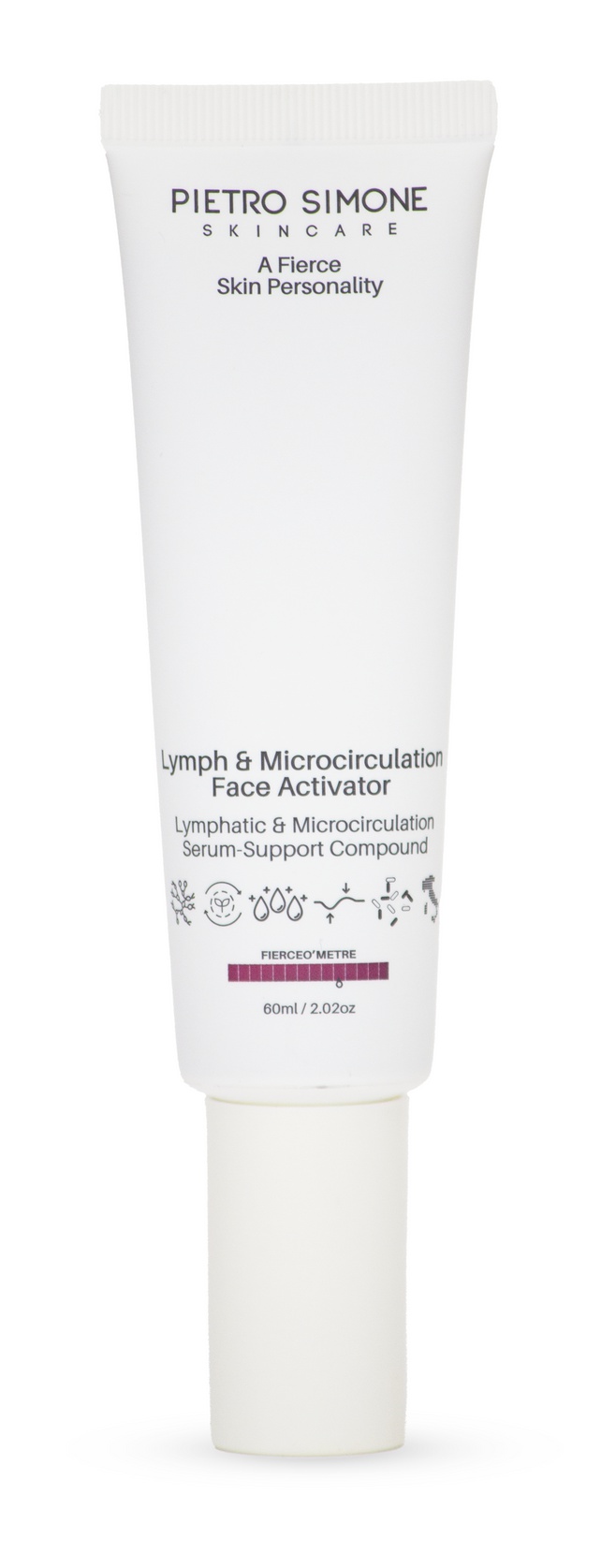
Lymph And micro circulation Face Activator
Ingredients overview
Highlights
Key Ingredients
Other Ingredients
Skim through
Pietro Simone Skincare Lymph And micro circulation Face ActivatorIngredients explained
The distillate created from the leaves of the hazelnut-bush-like-magic-tree commonly called Witch Hazel. The distillate from the leaves is probably the gentlest, most diluted version of any kind of With Hazel ingredient.
The leaves contain much, much less active components than the bark (4.77% vs 0.04% tannins) and distillates are more diluted than extracts. So this one is probably just a "fancy-water" that resembles the properties of Witch Hazel Extract (astringent, soothing, antioxidant, antibacterial) in a very mild and gentle way.
We have gone into much more details about Witch Hazel here.
Good old water, aka H2O. The most common skincare ingredient of all. You can usually find it right in the very first spot of the ingredient list, meaning it’s the biggest thing out of all the stuff that makes up the product.
It’s mainly a solvent for ingredients that do not like to dissolve in oils but rather in water.
Once inside the skin, it hydrates, but not from the outside - putting pure water on the skin (hello long baths!) is drying.
One more thing: the water used in cosmetics is purified and deionized (it means that almost all of the mineral ions inside it is removed). Like this, the products can stay more stable over time.
- A natural moisturizer that’s also in our skin
- A super common, safe, effective and cheap molecule used for more than 50 years
- Not only a simple moisturizer but knows much more: keeps the skin lipids between our skin cells in a healthy (liquid crystal) state, protects against irritation, helps to restore barrier
- Effective from as low as 3% with even more benefits for dry skin at higher concentrations up to 20-40%
- High-glycerin moisturizers are awesome for treating severely dry skin
 We don't have description for this ingredient yet.
Citric acid comes from citrus fruits and is an AHA. If these magic three letters don’t tell you anything, click here and read our detailed description on glycolic acid, the most famous AHA.
So citric acid is an exfoliant, that can - just like other AHAs - gently lift off the dead skin cells of your skin and make it more smooth and fresh.
There is also some research showing that citric acid with regular use (think three months and 20% concentration) can help sun-damaged skin, increase skin thickness and some nice hydrating things called glycosaminoglycans in the skin.
But according to a comparative study done in 1995, citric acid has less skin improving magic properties than glycolic or lactic acid. Probably that’s why citric acid is usually not used as an exfoliant but more as a helper ingredient in small amounts to adjust the pH of a formulation.
When it comes to grape and skincare, the seed extract and the seed oil steals most of the show. The reason for that is that the seed contains the majority of the skin goodies, the antioxidant superstar polyphenols.
The fruit also contains some, but it's less potent. However - according to manufacturer info - the fruit extract is not only an antioxidant, but it's also a soothing, moisturizing and nourishing agent.
Apple needs no introduction as one of the most common fruits on planet Earth. It's not only a healthy fruit snack, it's also a goodie if you put in all over your face.
It's loaded with proteins, starch, sugars, acids, vitamins and salts. The sugars (mainly fructose, glucose, sucrose) give apple fruit extract nice moisturizing and smoothing properties, while the acids (mainly malic and gallic acid) give it mild exfoliant, skin brightening and antibacterial properties.
A plant stem cell extract derived from the famous mountain flower, Edelweiss. It goes by the trade name Majestem and the manufacturer claims that it has a visible lifting action on the neck and face.
In their in-vivo (made on real people) tests, the sagging skin on the neck was tightened by -10.6% up to -56% in three weeks. After six weeks, the cheeks were also lifted and the crow’s feet wrinkles were smoothed out (surface -11% up to -75%).
Apart from manufacturer claims, edelweiss is traditionally known for and used for its soothing properties. We found a 2012 study confirming that edelweiss cell culture extract contains the active called leontopodic acid that seems to be responsible for the plant's anti-inflammatory properties.
A menthol-derived cooling agent that is claimed to give a long-lasting cooling effect (similar to menthol itself) while also being moisturizing and less irritating than menthol thanks to the lactic acid part. It's recommended to be used at 0.5-1%.
If life gives the cosmetic industry lemon, it makes lemon fruit extract. As to why, we can write here extremely similar things to our shiny description of orange fruit extract. Being both of them citruses, they contain very similar active compounds with very similar (potential) effects on the skin.
Just like orange fruit, lemon fruit also contains citric acid so it is commonly used as a natural, mild exfoliating agent. If this is the case, it is usually combined with other AHA containing fruit extracts such as bilberry, sugar cane, orange, and sugar maple in a super popular ingredient mix trade named ACB Fruit Mix.
But, citrus fruits are chemically complex mixtures with a bunch of other active components such as vitamin C, flavonoids, phenolics, carbohydrates and essential oil (this latter one coming from the rind of the fruit, but still present in some amount in the fruit extract). These have the potential to give lemon extract antioxidant, antibacterial, anti-dandruff, venotonic and moisturizing properties, but the essential oil also brings some questionable compounds such as fragrance allergen limonene or phototoxic compound bergaptene. If your skin is sensitive, be careful with citrus extracts.
We don't have description for this ingredient yet.
Burdock root is a goodie plant extract that has anti-inflammatory and antioxidant properties. Also, it has some anti-fungal and seborrhea regulation magic powers that make the ingredient especially useful for greasy and flaky skin and scalp.
We don't have description for this ingredient yet.
We don't have description for this ingredient yet.
The extract coming from ginger, the lovely spice that we all know from the kitchen. It is also a medicinal plant used both in Chinese and Ayurvedic medicine for pretty much everything you can imagine (muscular pain, sore throat, nausea, fever or cramps, just to give a few examples).
As for ginger and skincare, the root extract contains the biologically active component called gingerol that has potent antioxidant and anti-inflammatory properties. Combined with Bisabolol, the duo works synergistically to sooth the skin and take down redness.
Other than that, ginger also contains moisturizing polysaccharides, amino acids, and sugars, and it is also quite well known to increase blood circulation and have a toning effect.
Last but not least, Ginger also has some volatile, essential oil compounds (1-3%). Those are mostly present in ginger oil, but small amounts might be in the extract as well (around 0.5% based on manufacturer info).
We don't have description for this ingredient yet.
We don't have description for this ingredient yet.
The extract of red seaweed that has nice film-forming, skin smoothing and moisturizing properties.
The manufacturer claims that thanks to biomimetic properties between skin proteins and carrageenans it has a very long-lasting action and can form a "second skin". It also gives a "slow-release" effect to oil-loving active ingredients and measurably reduces trans-epidermal water loss (that's pretty much a synonym of saying that it moisturizes the skin).
We don't have description for this ingredient yet.
We don't have description for this ingredient yet.
We don't have description for this ingredient yet.
We don't have description for this ingredient yet.
We don't have description for this ingredient yet.
A little helper ingredient that works as a preservative. It works against bacteria and some species of fungi and yeast. It's often combined with IT-preservative, phenoxyethanol.
We don't have description for this ingredient yet.
A helper ingredient that helps to make the products stay nice longer, aka preservative. It works mainly against fungi.
It’s pH dependent and works best at acidic pH levels (3-5). It’s not strong enough to be used in itself so it’s always combined with something else, often with potassium sorbate.
It's one of those things that help your cosmetics not to go wrong too soon, aka a preservative. It’s not a strong one and doesn’t really work against bacteria, but more against mold and yeast. To do that it has to break down to its active form, sorbic acid. For that to happen, there has to be water in the product and the right pH value (pH 3-4).
But even if everything is right, it’s not enough on its own. If you see potassium sorbate you should see some other preservative next to it too.
BTW, it’s also a food preservative and even has an E number, E202.
It's one of the most commonly used thickeners and emulsion stabilizers. If the product is too runny, a little xanthan gum will make it more gel-like. Used alone, it can make the formula sticky and it is a good team player so it is usually combined with other thickeners and so-called rheology modifiers (helper ingredients that adjust the flow and thus the feel of the formula). The typical use level of Xantha Gum is below 1%, it is usually in the 0.1-0.5% range.
Btw, Xanthan gum is all natural, a chain of sugar molecules (polysaccharide) produced from individual sugar molecules (glucose and sucrose) via fermentation. It’s approved by Ecocert and also used in the food industry (E415).
You may also want to take a look at...
| what‑it‑does | soothing | antimicrobial/antibacterial |
| what‑it‑does | solvent |
| what‑it‑does | skin-identical ingredient | moisturizer/humectant |
| irritancy, com. | 0, 0 |
| what‑it‑does | buffering |
| what‑it‑does | soothing | antioxidant | moisturizer/humectant |
| what‑it‑does | moisturizer/humectant |
| what‑it‑does | buffering | exfoliant |
| what‑it‑does | antioxidant | soothing | moisturizer/humectant |
| what‑it‑does | antioxidant | soothing |
| what‑it‑does | antioxidant | soothing |
| what‑it‑does | antioxidant | emollient | moisturizer/humectant |
| what‑it‑does | moisturizer/humectant | viscosity controlling |
| what‑it‑does | antimicrobial/antibacterial |
| what‑it‑does | surfactant/cleansing |
| what‑it‑does | emollient |
| what‑it‑does | surfactant/cleansing | viscosity controlling |
| what‑it‑does | preservative | antimicrobial/antibacterial |
| what‑it‑does | viscosity controlling |
| what‑it‑does | preservative |
| what‑it‑does | preservative |
| what‑it‑does | viscosity controlling |