




Highlights
Key Ingredients
Skim through
| Ingredient name | what-it-does | irr., com. | ID-Rating |
|---|---|---|---|
| Aqua | solvent | ||
| Hyaluronic Acid | skin-identical ingredient, moisturizer/humectant | goodie | |
| Niacinamide | cell-communicating ingredient, skin brightening, anti-acne, moisturizer/humectant | superstar | |
| Avena Sativa(Oat) Kernel Extract | antioxidant, soothing, emollient, abrasive/scrub | goodie | |
| Aloe Barbadensis Leaf Extract | soothing, emollient, moisturizer/humectant | goodie | |
| Sodium PCA | skin-identical ingredient, moisturizer/humectant | 0, 0 | goodie |
| Vit C | antioxidant, skin brightening, buffering | superstar | |
| Xylitylglucoside | moisturizer/humectant | goodie | |
| Anhydroxylitol | moisturizer/humectant | goodie | |
| Xylitol | moisturizer/humectant | goodie | |
| Polyacrylate -13 | |||
| Polyisobutene | viscosity controlling | ||
| Polysorbate 20 | emulsifying, surfactant/cleansing | 0, 0 | |
| Sodium Hydroxide | buffering | ||
| Sodium Carbomer | viscosity controlling | ||
| Sodium Gluconate | chelating, moisturizer/humectant | ||
| Ethylhexylglycerin | preservative |
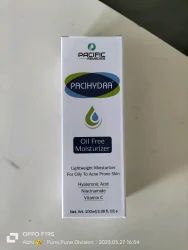
Pacific Remedies PacihydraIngredients explained
Good old water, aka H2O. The most common skincare ingredient of all. You can usually find it right in the very first spot of the ingredient list, meaning it’s the biggest thing out of all the stuff that makes up the product.
It’s mainly a solvent for ingredients that do not like to dissolve in oils but rather in water.
Once inside the skin, it hydrates, but not from the outside - putting pure water on the skin (hello long baths!) is drying.
One more thing: the water used in cosmetics is purified and deionized (it means that almost all of the mineral ions inside it is removed). Like this, the products can stay more stable over time.
- It’s naturally in our skin and behaves there like a sponge
- It can bind up to 1000 times its own weight in water
- It is a big molecule from repeated subunits (polymer) so different molecular weight versions exist (unfortunately there is no way to determine MW from INCI list only)
- High-molecular-weight-HA (>500 kDa) is an excellent surface hydrator, skin protectant and can act as an osmotic pump helping water-soluble actives to penetrate deeper into the skin
- Low-molecular-weight-HA (< 500 kDa) can hydrate the skin somewhat deeper though it is still a big molecule and works mainly in the epidermis (outer layer of the skin)
- Low-molecular-weight-HA might also help the skin to repair itself by increasing its self-defense (~ 200kDa used in the study)
- Ultra-low-molecular-weight-HA (<50kDa) is a controversial ingredient and might work as a pro-inflammatory signal molecule
- A multi-functional skincare superstar with several proven benefits for the skin
- Great anti-aging, wrinkle smoothing ingredient used at 4-5% concentration
- Fades brown spots alone or in combination with amino sugar, acetyl glucosamine
- Increases ceramide synthesis that results in a stronger, healthier skin barrier and better skin hydration
- Can help to improve several skin conditions including acne, rosacea, and atopic dermatitis
When you hear oatmeal, you probably think of breakfast, but the finely ground version of whole oat kernels, aka colloidal oatmeal, can do good things for your skin, especially if it's dry, itchy or prone to skin-rashes or eczema.
Oat is loaded with compounds good for the body, inside or outside, such as soothing agent beta-glucan (5%), lipids (3-11%) including barrier repairing omega-3 and 6 fatty acids or phenolic antioxidant and anti-inflammatory agents (avenanthramides).
The soothing, antioxidant and skin-protecting abilities of oat are so well-established that it is an active natural ingredient covered by the FDA OTC Skin Protectant monograph in the US, meaning that colloidal oatmeal can be claimed as an active ingredient on the INCI list and Aveeno is a mass-market brand built around oat-containing products.
If your skin is dry, irritated, inflamed or eczema-prone, colloidal oatmeal is something to try.
The extract coming from the juice containing leaves of the Aloe vera plant. It's usually a hydroglycolic extract (though oil extract for the lipid parts also exists) that has similar moisturizing, emollient and anti-inflammatory properties as the juice itself. We have written some more about aloe here.
PCA stands for Pyrrolidone Carboxylic Acid and though it might not sound like it, it is a thing that can be found naturally in our skin. The sodium salt form of PCA is an important skin-identical ingredient and great natural moisturizer that helps the skin to hold onto water and stay nicely hydrated.
- Works best between a concentration of 5-20%
- Boosts the skin’s own collagen production
- Fades pigmentation and brown spots
- If used under sunscreen it boosts its UV protection
- Extremely unstable and oxidizes very easily in presence of light or air
- Stable in solutions with water only if pH is less than 3.5 or in waterless formulations
- Vit E + C work in synergy and provide superb photoprotection
- Ferulic acid doubles the photoprotection effect of Vit C+E and helps to stabilize Vit C
- Potent Vit. C serums might cause a slight tingling on sensitive skin
The main part of a moisturizing complex called Aquaxyl. Comes from two water-binding plant sugars, glucose and xylitol. According to the manufacturer, Aquaxyl is close to a magic moisturizer that not only simply moisturizes, but can "harmonize the skin's hydrous flow".
This means that on the one side it can optimize water reserves by increasing important NMFs (natural moisturizing factors - things that are naturally in the skin and help to keep it hydrated) - like hyaluronic acid and chondroitin sulfate - in the skin. On the other side, it also limits water loss by improving the skin barrier with increased lipid (ceramides and cholesterol) and protein synthesis.
In vivo (made on real people) tests show that 3% Aquaxyl not only increases the water content of the outer layer instantly and in the long run but it also visibly improves cracked, dry skin and smoothes the skin surface after a month of treatment.
The hydrating effect of Aquaxyl was also examined in a comparative study in the Journal of Cosmetic Dermatology. Four humectants were examined in combination with 5% glycerin in a hydrogel formula and one with 4% Aquaxyl performed as well as the well-known moisturizer, urea and somewhat better than the formula containing NMF components or hydrating plant extract called Imperata Cylindrica.
All in all, Aquaxyl is a goodie and if you have dehydrated, dry skin it's something to look at.
A sugar derived moisturizer that's part of a moisturizing trio called Aquaxyl. You can read more about its magic properties at xylitylglucoside.
A type of sugar that's part of a moisturizing trio called Aquaxyl. You can read more about its magic properties at xylitylglucoside.
A helper ingredient that functions as a film-forming polymer (big molecule from repeated subunits).
It usually comes to the formula as part of a thickener-emulsifier trio paired with Polyisobutene and Polysorbate 20. The three togeather have excellent thickening properties with remarkable emulsifying-stabilising abilities. They also have a nice silicone feel with glide-on spreading.
A polymer (big molecule from repeated subunits) that's used as a gloss improver for lipsticks and lipglosses. Its stickiness also helps lip products to stay on longer.
Combined with polyacrylate-13 and polysorbate 20, it forms a very effective tickener-emulsifier trio.
It's a common little helper ingredient that helps water and oil to mix together. Also, it can help to increase the solubility of some other ingredients in the formula.
The unfancy name for it is lye. It’s a solid white stuff that’s very alkaline and used in small amounts to adjust the pH of the product and make it just right.
For example, in case of AHA or BHA exfoliants, the right pH is super-duper important, and pH adjusters like sodium hydroxide are needed.
BTW, lye is not something new. It was already used by ancient Egyptians to help oil and fat magically turn into something else. Can you guess what? Yes, it’s soap. It still often shows up in the ingredient list of soaps and other cleansers.
Sodium hydroxide in itself is a potent skin irritant, but once it's reacted (as it is usually in skin care products, like exfoliants) it is totally harmless.
A pre-neutralised form of super common thickener, Carbomer. This means that it forms viscous gels immediately upon addition to water (while Carbomer has to be neutralized with a base), but it can also be harder to disperse evenly in the formula.
The neutralized form of gluconic acid. It's a great ingredient to neutralize metal (especially iron and copper) ions in a cosmetic product. This helps to prevent discoloration of the formula over time or rancidity of cosmetic oils. It can also be a pH regulator and a humectant (helps skin to cling onto water).
It's also used in oral care products where it reduces the bitterness of other ingredients. And it's natural, both Ecocert and Cosmos approved. (source: manufacturer info)
If you have spotted ethylhexylglycerin on the ingredient list, most probably you will see there also the current IT-preservative, phenoxyethanol. They are good friends because ethylhexylglycerin can boost the effectiveness of phenoxyethanol (and other preservatives) and as an added bonus it feels nice on the skin too.
Also, it's an effective deodorant and a medium spreading emollient.
You may also want to take a look at...
| what‑it‑does | solvent |
| what‑it‑does | skin-identical ingredient | moisturizer/humectant |
| what‑it‑does | cell-communicating ingredient | skin brightening | anti-acne | moisturizer/humectant |
| what‑it‑does | antioxidant | soothing | emollient | abrasive/scrub |
| what‑it‑does | soothing | emollient | moisturizer/humectant |
| what‑it‑does | skin-identical ingredient | moisturizer/humectant |
| irritancy, com. | 0, 0 |
| what‑it‑does | antioxidant | skin brightening | buffering |
| what‑it‑does | moisturizer/humectant |
| what‑it‑does | moisturizer/humectant |
| what‑it‑does | moisturizer/humectant |
| what‑it‑does | viscosity controlling |
| what‑it‑does | emulsifying | surfactant/cleansing |
| irritancy, com. | 0, 0 |
| what‑it‑does | buffering |
| what‑it‑does | viscosity controlling |
| what‑it‑does | chelating | moisturizer/humectant |
| what‑it‑does | preservative |