




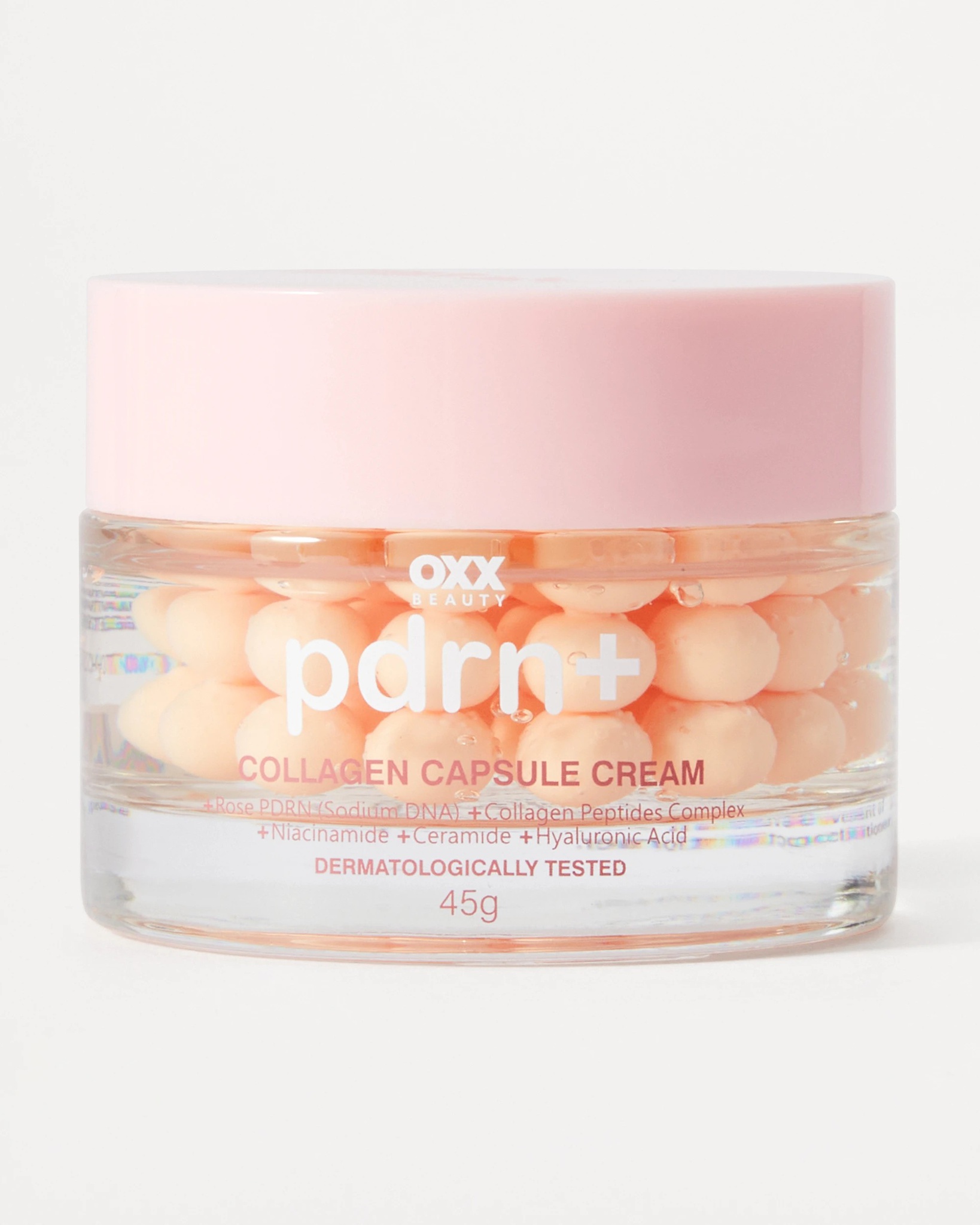
Pdrn+ Collagen Capsule Cream
Ingredients overview
Highlights
Key Ingredients
Other Ingredients
Skim through
OXX SKINCARE Kmart Pdrn+ Collagen Capsule CreamIngredients explained
Good old water, aka H2O. The most common skincare ingredient of all. You can usually find it right in the very first spot of the ingredient list, meaning it’s the biggest thing out of all the stuff that makes up the product.
It’s mainly a solvent for ingredients that do not like to dissolve in oils but rather in water.
Once inside the skin, it hydrates, but not from the outside - putting pure water on the skin (hello long baths!) is drying.
One more thing: the water used in cosmetics is purified and deionized (it means that almost all of the mineral ions inside it is removed). Like this, the products can stay more stable over time.
- A natural moisturizer that’s also in our skin
- A super common, safe, effective and cheap molecule used for more than 50 years
- Not only a simple moisturizer but knows much more: keeps the skin lipids between our skin cells in a healthy (liquid crystal) state, protects against irritation, helps to restore barrier
- Effective from as low as 3% with even more benefits for dry skin at higher concentrations up to 20-40%
- High-glycerin moisturizers are awesome for treating severely dry skin
A really multi-functional helper ingredient that can do several things in a skincare product: it can bring a soft and pleasant feel to the formula, it can act as a humectant and emollient, it can be a solvent for some other ingredients (for example it can help to stabilize perfumes in watery products) and it can also help to disperse pigments more evenly in makeup products. And that is still not all: it can also boost the antimicrobial activity of preservatives.
- It's a helper ingredient that improves the freeze-thaw stability of products
- It's also a solvent, humectant and to some extent a penetration enhancer
- It has a bad reputation among natural cosmetics advocates but cosmetic scientists and toxicology experts do not agree (read more in the geeky details section)
- A multi-functional skincare superstar with several proven benefits for the skin
- Great anti-aging, wrinkle smoothing ingredient used at 4-5% concentration
- Fades brown spots alone or in combination with amino sugar, acetyl glucosamine
- Increases ceramide synthesis that results in a stronger, healthier skin barrier and better skin hydration
- Can help to improve several skin conditions including acne, rosacea, and atopic dermatitis
A clear, colorless liquid that works as a solvent and viscosity decreasing ingredient. It also has great skin-moisturizing abilities.
A super common emollient that makes your skin feel nice and smooth. It comes from coconut oil and glycerin, it’s light-textured, clear, odorless and non-greasy. It’s a nice ingredient that just feels good on the skin, is super well tolerated by every skin type and easy to formulate with. No wonder it’s popular.
It's a nice glycerin-based humectant and emollient that gives skin a smooth and luxurious feel.
Butylene glycol, or let’s just call it BG, is a multi-tasking colorless, syrupy liquid. It’s a great pick for creating a nice feeling product.
BG’s main job is usually to be a solvent for the other ingredients. Other tasks include helping the product to absorb faster and deeper into the skin (penetration enhancer), making the product spread nicely over the skin (slip agent), and attracting water (humectant) into the skin.
It’s an ingredient whose safety hasn’t been questioned so far by anyone (at least not that we know about). BG is approved by Ecocert and is also used enthusiastically in natural products. BTW, it’s also a food additive.
A semi-essential (infants cannot synthesize it, but adults can) amino acid that is one of the primary building blocks of hair keratin and skin collagen. It's a natural moisturizing factor, a skin hydrator and might also help to speed up wound healing.
Arginine usually has a positive charge (cationic) that makes it substantive to skin and hair (those are more negatively charged surfaces) and an excellent film former. Thanks to the positive charge, it also creates a complex with AHAs (AHAs like to lose a hydrogen ion and be negatively charged, so the positive and the negative ions attract each other) that causes a "time-release AHA effect" and reduces the irritation associated with AHAs.
A super common, medium-spreading emollient ester that gives richness to the formula and a mild feel during rubout. It can be a replacement for mineral oil and is often combined with other emollients to achieve different sensorial properties.
An extremely common multitasker ingredient that gives your skin a nice soft feel (emollient) and gives body to creams and lotions. It also helps to stabilize oil-water mixes (emulsions), though it does not function as an emulsifier in itself. Its typical use level in most cream type formulas is 2-3%.
It’s a so-called fatty alcohol, a mix of cetyl and stearyl alcohol, other two emollient fatty alcohols. Though chemically speaking, it is alcohol (as in, it has an -OH group in its molecule), its properties are totally different from the properties of low molecular weight or drying alcohols such as denat. alcohol. Fatty alcohols have a long oil-soluble (and thus emollient) tail part that makes them absolutely non-drying and non-irritating and are totally ok for the skin.
- It’s naturally in our skin and behaves there like a sponge
- It can bind up to 1000 times its own weight in water
- It is a big molecule from repeated subunits (polymer) so different molecular weight versions exist (unfortunately there is no way to determine MW from INCI list only)
- High-molecular-weight-HA (>500 kDa) is an excellent surface hydrator, skin protectant and can act as an osmotic pump helping water-soluble actives to penetrate deeper into the skin
- Low-molecular-weight-HA (< 500 kDa) can hydrate the skin somewhat deeper though it is still a big molecule and works mainly in the epidermis (outer layer of the skin)
- Low-molecular-weight-HA might also help the skin to repair itself by increasing its self-defense (~ 200kDa used in the study)
- Ultra-low-molecular-weight-HA (<50kDa) is a controversial ingredient and might work as a pro-inflammatory signal molecule
The big and important protein molecule that usually comes from animal skin such as fish or bovine. The gist of the "collagen in topical skincare" subject is to know that collagen in a jar has nothing to do with wrinkles but everything to do with skin hydration. We have a shiny explanation about this at soluble collagen, so click here to read more >>
One of the many types of ceramides that can be found naturally in the upper layer of the skin. Ceramides make up about 50% of the goopy stuff that's between our skin cells and play a super important role in having a healthy skin barrier and keeping the skin hydrated. It works even better when combined with its pal, Ceramide 1.
We wrote way more about ceramides at ceramide 1, so click here to know more.
A big molecule created from repeated subunits (a polymer of acrylic acid) that magically converts a liquid into a nice gel formula. It usually has to be neutralized with a base (such as sodium hydroxide) for the thickening to occur and it creates viscous, clear gels that also feel nice and non-tacky on the skin. No wonder, it is a very popular and common ingredient. Typically used at 1% or less in most formulations.
An ester that comes from Cetearyl alcohol and the fatty acids of olive oil. It often comes to the formula coupled with Sorbitan Olivate as the two together form the well-known, natural emulsifier trade named Olivem 1000.
Other than helping oil and water to blend, the main thing of Olivem 1000 is generating liquid crystal structures that are similar to the lipid structures of the stratum corneum (the outermost layer of the skin). Thanks to this, Olivem 1000 doubles as an active ingredient with significant moisturizing, barrier-repairing and soothing properties.
It also helps to deliver water-soluble actives such as caffeine more effectively, and can even boost SPF in sunscreen formulas. Its typical use level is 1-5% and has wide compatibility with other actives and oils.
Overall, a real multi-tasker with nice sensorial properties. No wonder it is so popular.
If you have spotted ethylhexylglycerin on the ingredient list, most probably you will see there also the current IT-preservative, phenoxyethanol. They are good friends because ethylhexylglycerin can boost the effectiveness of phenoxyethanol (and other preservatives) and as an added bonus it feels nice on the skin too.
Also, it's an effective deodorant and a medium spreading emollient.
Adenosine is an important little compound in our body that has a vital cell-signalling role. Research on smearing it on our face is also promising and shows so far a couple of things:
- It can help with wound healing
- It’s a good anti-inflammatory agent
- It might even help with skin’s own collagen production and improve skin firmness and elasticity
- It helps with barrier repair and protection
- It might be even useful for the hair helping with hair thickness and hair growth
It’s pretty much the current IT-preservative. It’s safe and gentle, but even more importantly, it’s not a feared-by-everyone-mostly-without-scientific-reason paraben.
It’s not something new: it was introduced around 1950 and today it can be used up to 1% worldwide. It can be found in nature - in green tea - but the version used in cosmetics is synthetic.
Other than having a good safety profile and being quite gentle to the skin it has some other advantages too. It can be used in many types of formulations as it has great thermal stability (can be heated up to 85°C) and works on a wide range of pH levels (ph 3-10).
It’s often used together with ethylhexylglycerin as it nicely improves the preservative activity of phenoxyethanol.
A helper ingredient that functions as a film-forming polymer (big molecule from repeated subunits).
It usually comes to the formula as part of a thickener-emulsifier trio paired with Polyisobutene and Polysorbate 20. The three togeather have excellent thickening properties with remarkable emulsifying-stabilising abilities. They also have a nice silicone feel with glide-on spreading.
It's a film-forming and thickening polymer (a large molecule composed of many repeated subunits) that comes to the formula usually as part of an emulsifier, thickener trio (with C13-14 Isoparaffin and Laureth-7, trade named Sepigel 305). This trio is an easy-to-use liquid that helps to create nice, non-tacky gel formulas.
A not-very-interesting helper ingredient that is used as an emulsifier and/or surfactant. Comes from a coconut oil derived fatty alcohol, lauryl alcohol.
Sodium chloride is the fancy name of salt. Normal, everyday table salt.
If (similar to us) you are in the weird habit of reading the label on your shower gel while taking a shower, you might have noticed that sodium chloride is almost always on the ingredient list. The reason for this is that salt acts as a fantastic thickener in cleansing formulas created with ionic cleansing agents (aka surfactants) such as Sodium Laureth Sulfate. A couple of percents (typically 1-3%) turns a runny surfactant solution into a nice gel texture.
If you are into chemistry (if not, we understand, just skip this paragraph), the reason is that electrolytes (you know, the Na+ and Cl- ions) screen the electrostatic repulsion between the head groups of ionic surfactants and thus support the formation of long shaped micelles (instead of spherical ones) that entangle like spaghetti, and viola, a gel is formed. However, too much of it causes the phenomenon called "salting out", and the surfactant solution goes runny again.
Other than that, salt also works as an emulsion stabilizer in water-in-oil emulsions, that is when water droplets are dispersed in the outer oil (or silicone) phase. And last but not least, when salt is right at the first spot of the ingredient list (and is not dissolved), the product is usually a body scrub where salt is the physical exfoliating agent.
Super common little helper ingredient that helps products to remain nice and stable for a longer time. It does so by neutralizing the metal ions in the formula (that usually get into there from water) that would otherwise cause some not so nice changes.
It is typically used in tiny amounts, around 0.1% or less.
 We don't have description for this ingredient yet.
A super common, waxy, white, solid stuff that helps water and oil to mix together, gives body to creams and leaves the skin feeling soft and smooth.
Chemically speaking, it is the attachment of a glycerin molecule to the fatty acid called stearic acid. It can be produced from most vegetable oils (in oils three fatty acid molecules are attached to glycerin instead of just one like here) in a pretty simple, "green" process that is similar to soap making. It's readily biodegradable.
It also occurs naturally in our body and is used as a food additive. As cosmetic chemist Colins writes it, "its safety really is beyond any doubt".
A polymer (big molecule from repeated subunits) that's used as a gloss improver for lipsticks and lipglosses. Its stickiness also helps lip products to stay on longer.
Combined with polyacrylate-13 and polysorbate 20, it forms a very effective tickener-emulsifier trio.
It's a common little helper ingredient that helps water and oil to mix together. Also, it can help to increase the solubility of some other ingredients in the formula.
A handy helper ingredient that helps water and oil to mix nicely together, aka emulsifier. It is especially recommended for protective, baby care and general purpose emollient creams.
It also helps to disperse insoluble particles (think color pigments or zinc/titanium dioxide sunscreen) nice and even in cosmetic formulas.
It’s the - sodium form - cousin of the famous NMF, hyaluronic acid (HA). If HA does not tell you anything we have a super detailed, geeky explanation about it here. The TL; DR version of HA is that it's a huge polymer (big molecule from repeated subunits) found in the skin that acts as a sponge helping the skin to hold onto water, being plump and elastic. HA is famous for its crazy water holding capacity as it can bind up to 1000 times its own weight in water.
As far as skincare goes, sodium hyaluronate and hyaluronic acid are pretty much the same and the two names are used interchangeably. As cosmetic chemist kindofstephen writes on reddit "sodium hyaluronate disassociates into hyaluronic acid molecule and a sodium atom in solution".
In spite of this, if you search for "hyaluronic acid vs sodium hyaluronate" you will find on multiple places that sodium hyaluronate is smaller and can penetrate the skin better. Chemically, this is definitely not true, as the two forms are almost the same, both are polymers and the subunits can be repeated in both forms as much as you like. (We also checked Prospector for sodium hyaluronate versions actually used in cosmetic products and found that the most common molecular weight was 1.5-1.8 million Da that absolutely counts as high molecular weight).
What seems to be a true difference, though, is that the salt form is more stable, easier to formulate and cheaper so it pops up more often on the ingredient lists.
If you wanna become a real HA-and-the-skin expert you can read way more about the topic at hyaluronic acid (including penetration-questions, differences between high and low molecular weight versions and a bunch of references to scientific literature).
We don't have description for this ingredient yet.
A clear, slightly yellow, odorless oil that's a very common, medium-spreading emollient. It makes the skin feel nice and smooth and works in a wide range of formulas.
Hydrolyzed Hyaluronic Acid is a low molecular weight, chemically chopped up version of the naturally big molecule and current IT-moisturizer, Hyaluronic Acid (HA). The TL; DR version of HA is that it's a huge polymer (big molecule from repeated subunits) found in the skin that acts as a sponge helping the skin to retain water, making it plump and elastic. As HA is a polymer, the subunits can be repeated many times (as a high-molecular-weight version), or just a few times (as a low-molecular-weight version).
We wrote in detail at HA about how different molecular weight versions do different things both as a component of the skin and as a skincare ingredient, so click here and read about all the details. Hydrolyzed Hyaluronic Acid can also come in different molecular-weight versions with different properties:
- 100-300 kDa version: apart from moisturizing, this size might also help the skin to repair itself by increasing its self-defense. It is also claimed to boost the wound healing process and is especially helpful for sensitive skin types (acne, rosacea, inflammation-related skin diseases).
- 50k Da version: this is the size that is claimed to be able to absorb into the skin and plump up wrinkles, so it is used mainly as an "anti-aging ingredient"
- below 50k, around 10k Da version: there is a Japanese version trade named Hyalo-Oligo that has only a 10k molecular weight and is claimed to penetrate the skin very well, have a unique touch and give deep and long-lasting moisturization. Based on the Evonik-research and the natural role of LMW-HA in the body working as a pro-inflammatory signal molecule, this ultra-low molecular weight version is a controversial ingredient.
If you wanna become a real HA-and-the-skin expert, you can read much more about the topic at hyaluronic acid (including penetration-questions, differences between high and low molecular weight versions and a bunch of references to scientific literature).
If you see a cosmetic product that claims that it has "Botox-like effect" then two things are almost certain: one, the product overpromises and two, it contains Argireline.
So this one is the famous peptide that's marketed by its manufacturer as the "Botox in a jar". The basis for this claim is that it targets the same wrinkle forming mechanism (wrinkles caused by facial muscle movement) as Botox, but the way it works is very different. In addition, the extent to which it can prevent muscles from contracting (and to smooth wrinkles) is very different (otherwise why would anyone use still Botox?).
The manufacturer did several studies to prove that Argireline really works and it does (just not as well as Botox). In-vivo (made on real people) tests showed that using 10% Argireline solution around the eyes for 15 days decreased wrinkles depth by 17%, while a 5% Argireline formula applied for 28 days did almost the same with a decrease in wrinkle depth by 16.26%. A Spanish University also did some research and found that Argireline increased the level of skin moisturization and decreased both the depth and width of wrinkles "significantly".
This means, Acetyl Hexapeptide-8 does have some ability to smooth wrinkles (but not as well as Botox - sorry, if we sound like a broken record). Also, we have to agree with TruthInAging, that it's not a collagen builder and not a preventer of structural aging (think vitamin C, AHAs or retinol); it's just a quick fix. If you are looking for one, this could be your thing. If you are more of a "let's treat this aging thing properly" type, then it's probably not your thing.
- GHK-Cu is a copper-peptide complex found naturally in yucky bodily fluids (plasma, saliva, and urine)
- It has unique wound healing properties by stimulating the breakdown of unhealthy, too large collagen in scar tissue and stimulating nice and healthy collagen production afterwards
- It stimulates the production of several important skin-identical ingredients (e.g. collagen, elastin, and glycosaminoglycans)
- It has significant anti-inflammatory and antioxidant effect
- There are a few promising studies showing GHK-Cu can improve skin elasticity, clarity, firmness and reduce lines and wrinkles
- It can improve hair growth by enlarging hair follicles (and bigger follicles produce longer, thicker hair)
- There are some urban legends about possible overdosing or facial hair problems (read more in geeky details)
It’s a handy multi-tasking ingredient that gives the skin a nice, soft feel. At the same time, it also boosts the effectiveness of other preservatives, such as the nowadays super commonly used phenoxyethanol.
The blend of these two (caprylyl glycol + phenoxyethanol) is called Optiphen, which not only helps to keep your cosmetics free from nasty things for a long time but also gives a good feel to the finished product. It's a popular duo.
A pretty famous and better-researched peptide consisting of five amino acids (the building blocks of all proteins). It was created in a joint effort by the French ingredient supplier, Sederma and the cosmetics industry big shot, Procter&Gamble.
The amino acid sequence of the peptide is lysine–threonine–threonine–lysine–serine (KTTKS). Sometimes, it's also called collagen pentapeptide, as it's a subfragment of skin-structure-giving type I collagen. The KTTKS amino sequence is then attached for better oil solubility and skin penetration to palmitic acid and BOOM; we get Palmitoyl Pentapeptide-4.
Though most research is manufacturer sponsored, the clinical studies about Palmitoyl Pentapeptide-4 are promising. In short, it can reduce fine lines, wrinkles and improve skin texture significantly (and at crazy low concentrations, the studies were done with just 3 ppm that is 0.0003%).
There are also studies comparing Palmitoyl Pentapeptide-4 with anti-aging gold standard, retinol. One of them compared 3ppm Pal-KTTKS with 700 ppm (0.07%) retinol and found that they showed similar wrinkle improving ability with the peptide showing better skin tolerability.
Bottom line, if you are into peptides, this is a good one to try.
We don't have description for this ingredient yet.
A handy multifunctional ingredient that works as a preservative booster, as well as an antioxidant and soothing agent.
An amino acid-based emulsifier that helps water and oil to mix and stay that way. It is considered as natural, environmentally friendly, and hypoallergenic.
You may also want to take a look at...
| what‑it‑does | solvent |
| what‑it‑does | skin-identical ingredient | moisturizer/humectant |
| irritancy, com. | 0, 0 |
| what‑it‑does | solvent |
| what‑it‑does | moisturizer/humectant | solvent |
| irritancy, com. | 0, 0 |
| what‑it‑does | cell-communicating ingredient | skin brightening | anti-acne | moisturizer/humectant |
| what‑it‑does | solvent |
| what‑it‑does | emollient |
| what‑it‑does | moisturizer/humectant | emollient | viscosity controlling |
| irritancy, com. | 0, 0 |
| what‑it‑does | moisturizer/humectant | solvent |
| irritancy, com. | 0, 1 |
| what‑it‑does | skin-identical ingredient |
| what‑it‑does | emollient |
| irritancy, com. | 0, 2-4 |
| what‑it‑does | emollient | viscosity controlling | emulsifying | surfactant/cleansing |
| irritancy, com. | 1, 2 |
| what‑it‑does | skin-identical ingredient | moisturizer/humectant |
| what‑it‑does | moisturizer/humectant |
| what‑it‑does | skin-identical ingredient |
| what‑it‑does | viscosity controlling |
| irritancy, com. | 0, 1 |
| what‑it‑does | emulsifying |
| what‑it‑does | preservative |
| what‑it‑does | cell-communicating ingredient |
| what‑it‑does | preservative |
| what‑it‑does | viscosity controlling |
| what‑it‑does | solvent |
| what‑it‑does | emulsifying | surfactant/cleansing |
| what‑it‑does | viscosity controlling |
| what‑it‑does | buffering |
| what‑it‑does | buffering |
| what‑it‑does | chelating |
| what‑it‑does | moisturizer/humectant |
| what‑it‑does | emollient | emulsifying |
| irritancy, com. | 0, 1 |
| what‑it‑does | viscosity controlling |
| what‑it‑does | emulsifying | surfactant/cleansing |
| irritancy, com. | 0, 0 |
| what‑it‑does | emulsifying |
| irritancy, com. | 0, 1-2 |
| what‑it‑does | skin-identical ingredient | moisturizer/humectant |
| irritancy, com. | 0, 0 |
| what‑it‑does | emollient | perfuming |
| what‑it‑does | moisturizer/humectant |
| what‑it‑does | cell-communicating ingredient | moisturizer/humectant |
| what‑it‑does | cell-communicating ingredient | soothing | antioxidant |
| what‑it‑does | moisturizer/humectant | emollient |
| what‑it‑does | cell-communicating ingredient |
| what‑it‑does | emulsifying |
| what‑it‑does | antioxidant | preservative |
| what‑it‑does | emulsifying | surfactant/cleansing |
| what‑it‑does | colorant |