




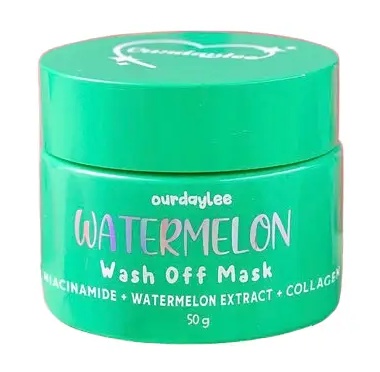
Watermelon Wash Off Mask
Ingredients overview
 INCI photo pending approval
Highlights
Key Ingredients
Other Ingredients
Skim through
Ourdaylee Watermelon Wash Off MaskIngredients explained
Good old water, aka H2O. The most common skincare ingredient of all. You can usually find it right in the very first spot of the ingredient list, meaning it’s the biggest thing out of all the stuff that makes up the product.
It’s mainly a solvent for ingredients that do not like to dissolve in oils but rather in water.
Once inside the skin, it hydrates, but not from the outside - putting pure water on the skin (hello long baths!) is drying.
One more thing: the water used in cosmetics is purified and deionized (it means that almost all of the mineral ions inside it is removed). Like this, the products can stay more stable over time.
- A multi-functional skincare superstar with several proven benefits for the skin
- Great anti-aging, wrinkle smoothing ingredient used at 4-5% concentration
- Fades brown spots alone or in combination with amino sugar, acetyl glucosamine
- Increases ceramide synthesis that results in a stronger, healthier skin barrier and better skin hydration
- Can help to improve several skin conditions including acne, rosacea, and atopic dermatitis
- It's a helper ingredient that improves the freeze-thaw stability of products
- It's also a solvent, humectant and to some extent a penetration enhancer
- It has a bad reputation among natural cosmetics advocates but cosmetic scientists and toxicology experts do not agree (read more in the geeky details section)
A handy helper ingredient (a polymer, i.e. big molecule from repeated subunits) that is used to stabilize emulsions as well as to thicken up products. It can also stabilize foam in cleansing products.
PCA stands for Pyrrolidone Carboxylic Acid and though it might not sound like it, it is a thing that can be found naturally in our skin. The sodium salt form of PCA is an important skin-identical ingredient and great natural moisturizer that helps the skin to hold onto water and stay nicely hydrated.
We love a cold slice of watermelon on a hot summer day and we love watermelon as a skincare ingredient. It's really full of good-for-the-skin stuff: it contains a bunch of vitamins (A, B, C and E), mineral salts (K, Mg, Ca and Fe), amino acids citrulline and arginine and antioxidant carotenoids and phenolics.
It's especially rich in potent antioxidant, lycopene (a type of carotenoid), the cool pigment that's responsible for the red color of the watermelon. According to manufacturer info, in-vitro (made in the lab not on real people) studies show that watermelon extract gives significant DNA protection against UV damage. The in-vivo (made on real people) study also confirmed this and the watermelon formula showed 25% increase in skin protection compared to placebo.
All in all, a cool fruit extract with potent antioxidant magic abilities.
The extract coming from the juice containing leaves of the Aloe vera plant. It's usually a hydroglycolic extract (though oil extract for the lipid parts also exists) that has similar moisturizing, emollient and anti-inflammatory properties as the juice itself. We have written some more about aloe here.
The big and important protein molecule that usually comes from animal skin such as fish or bovine. The gist of the "collagen in topical skincare" subject is to know that collagen in a jar has nothing to do with wrinkles but everything to do with skin hydration. We have a shiny explanation about this at soluble collagen, so click here to read more >>
A controversial preservative that has formaldehyde-releasing properties. It works great against bacteria and also has mild fungicide abilities.
Cosmetic chemist, Colin wrote a great article about formaldehyde and DMDM Hydantoin. He writes that formaldehyde is the perfect example of "the dose makes the poison" principle. It's a natural stuff that can also be found in fresh fruits and vegetables, and eating it in tiny amounts is totally ok. However, in larger amounts (according to Wikipedia 30 mL of a solution containing 37% formaldehyde) it's deadly.
The amount of formaldehyde used in cosmetics either neat or through formaldehyde-releasing preservatives is tiny. Probably that is why the Cosmetic Ingredient Review Broad concluded both in 1988 and in 2008 that DMDM Hydantoin is "safe as used in cosmetics".
However, Colins argues that in the case of formaldehyde-releasing preservatives, formaldehyde is released slowly and the skin has probably not evolved to deal with that. The lingering formaldehyde might be toxic to the Langerhans Cells that are important for the skin's defense system. Another potential issue is that formaldehyde-releasers might also release other things while reacting with amino acids in the skin that is probably the explanation why some people are not allergic to formaldehyde but are allergic to formaldehyde-releasing preservatives. These are all theories, far from proven facts, but we feel that there are some justified reasons why formaldehyde-releasing preservatives and Dmdm Hydantoin count as controversial.
All in all, it's up to you to decide if you wanna avoid this preservative group or not. If so, there are other, less risky and more skin-friendly options out there.
It’s the - sodium form - cousin of the famous NMF, hyaluronic acid (HA). If HA does not tell you anything we have a super detailed, geeky explanation about it here. The TL; DR version of HA is that it's a huge polymer (big molecule from repeated subunits) found in the skin that acts as a sponge helping the skin to hold onto water, being plump and elastic. HA is famous for its crazy water holding capacity as it can bind up to 1000 times its own weight in water.
As far as skincare goes, sodium hyaluronate and hyaluronic acid are pretty much the same and the two names are used interchangeably. As cosmetic chemist kindofstephen writes on reddit "sodium hyaluronate disassociates into hyaluronic acid molecule and a sodium atom in solution".
In spite of this, if you search for "hyaluronic acid vs sodium hyaluronate" you will find on multiple places that sodium hyaluronate is smaller and can penetrate the skin better. Chemically, this is definitely not true, as the two forms are almost the same, both are polymers and the subunits can be repeated in both forms as much as you like. (We also checked Prospector for sodium hyaluronate versions actually used in cosmetic products and found that the most common molecular weight was 1.5-1.8 million Da that absolutely counts as high molecular weight).
What seems to be a true difference, though, is that the salt form is more stable, easier to formulate and cheaper so it pops up more often on the ingredient lists.
If you wanna become a real HA-and-the-skin expert you can read way more about the topic at hyaluronic acid (including penetration-questions, differences between high and low molecular weight versions and a bunch of references to scientific literature).
Super common soothing ingredient. It can be found naturally in the roots & leaves of the comfrey plant, but more often than not what's in the cosmetic products is produced synthetically.
It's not only soothing but it' also skin-softening and protecting and can promote wound healing.
 We don't have description for this ingredient yet.
It’s pretty much the current IT-preservative. It’s safe and gentle, but even more importantly, it’s not a feared-by-everyone-mostly-without-scientific-reason paraben.
It’s not something new: it was introduced around 1950 and today it can be used up to 1% worldwide. It can be found in nature - in green tea - but the version used in cosmetics is synthetic.
Other than having a good safety profile and being quite gentle to the skin it has some other advantages too. It can be used in many types of formulations as it has great thermal stability (can be heated up to 85°C) and works on a wide range of pH levels (ph 3-10).
It’s often used together with ethylhexylglycerin as it nicely improves the preservative activity of phenoxyethanol.
This ingredient name is not according to the INCI-standard. :( What, why?!
This ingredient name is not according to the INCI-standard. :( What, why?!
- It's a helper ingredient that improves the freeze-thaw stability of products
- It's also a solvent, humectant and to some extent a penetration enhancer
- It has a bad reputation among natural cosmetics advocates but cosmetic scientists and toxicology experts do not agree (read more in the geeky details section)
A molecule that gives a long-lasting cooling and chilling effect to the formula. It is not derived from menthol and, according to the manufacturer, is not allergenic.
You may also want to take a look at...
| what‑it‑does | solvent |
| what‑it‑does | cell-communicating ingredient | skin brightening | anti-acne | moisturizer/humectant |
| what‑it‑does | moisturizer/humectant | solvent |
| irritancy, com. | 0, 0 |
| what‑it‑does | surfactant/cleansing | viscosity controlling |
| irritancy, com. | 0, 1 |
| what‑it‑does | skin-identical ingredient | moisturizer/humectant |
| irritancy, com. | 0, 0 |
| what‑it‑does | antioxidant |
| what‑it‑does | soothing | emollient | moisturizer/humectant |
| what‑it‑does | moisturizer/humectant |
| what‑it‑does | preservative |
| what‑it‑does | skin-identical ingredient | moisturizer/humectant |
| irritancy, com. | 0, 0 |
| what‑it‑does | soothing |
| irritancy, com. | 0, 0 |
| what‑it‑does | viscosity controlling |
| what‑it‑does | preservative |
| what‑it‑does | moisturizer/humectant | solvent |
| irritancy, com. | 0, 0 |
| what‑it‑does | colorant |
| what‑it‑does | colorant |