




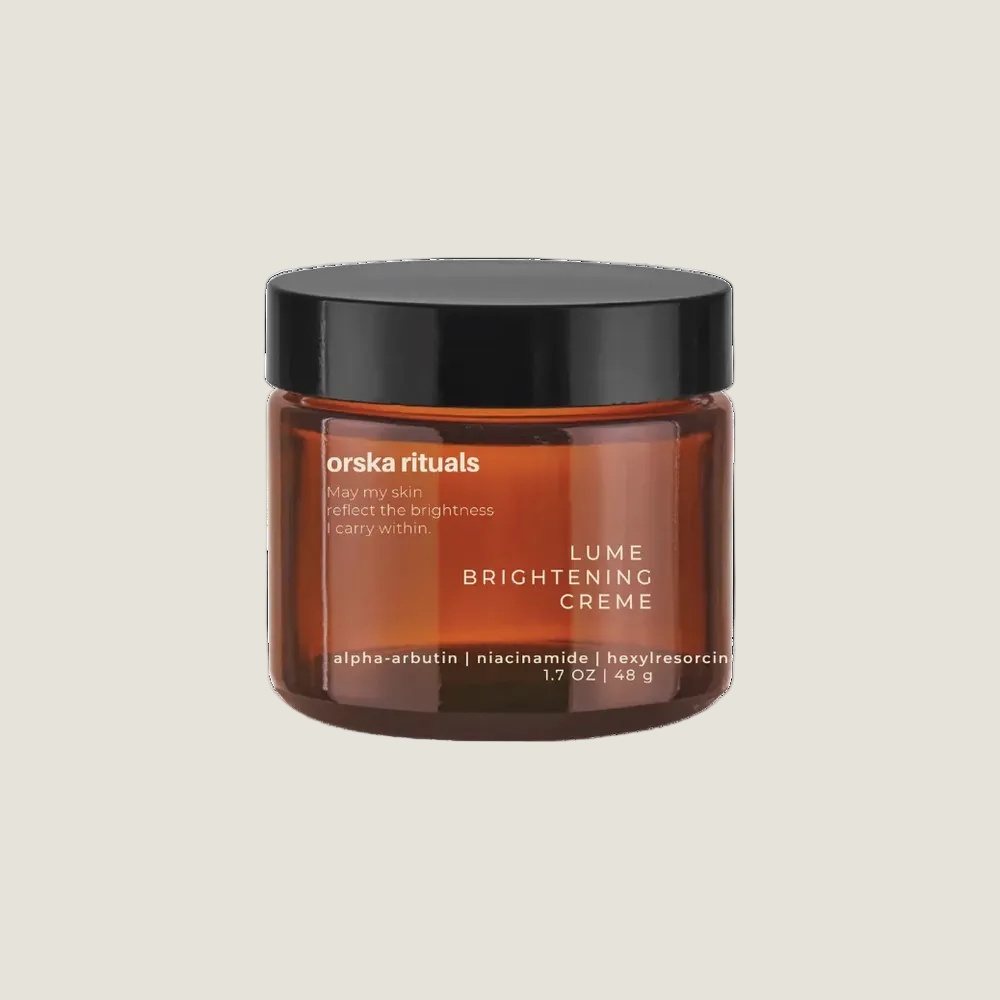
Lume Brightening Creme
Ingredients overview
 INCI photo pending approval
Highlights
Key Ingredients
Other Ingredients
Skim through
Orska Rituals Lume Brightening CremeIngredients explained
This ingredient name is not according to the INCI-standard. :( What, why?!
Good old water, aka H2O. The most common skincare ingredient of all. You can usually find it right in the very first spot of the ingredient list, meaning it’s the biggest thing out of all the stuff that makes up the product.
It’s mainly a solvent for ingredients that do not like to dissolve in oils but rather in water.
Once inside the skin, it hydrates, but not from the outside - putting pure water on the skin (hello long baths!) is drying.
One more thing: the water used in cosmetics is purified and deionized (it means that almost all of the mineral ions inside it is removed). Like this, the products can stay more stable over time.
- A natural moisturizer that’s also in our skin
- A super common, safe, effective and cheap molecule used for more than 50 years
- Not only a simple moisturizer but knows much more: keeps the skin lipids between our skin cells in a healthy (liquid crystal) state, protects against irritation, helps to restore barrier
- Effective from as low as 3% with even more benefits for dry skin at higher concentrations up to 20-40%
- High-glycerin moisturizers are awesome for treating severely dry skin
A little helper ingredient that can boost the performance and enhance the delivery of active ingredients in a formula. It can penetrate deep layers of the skin helping actives to do the same.
It's especially useful to help active ingredients for self-tanning (DHA), anti-acne or skin-whitening to penetrate deeper and work better.
- A multi-functional skincare superstar with several proven benefits for the skin
- Great anti-aging, wrinkle smoothing ingredient used at 4-5% concentration
- Fades brown spots alone or in combination with amino sugar, acetyl glucosamine
- Increases ceramide synthesis that results in a stronger, healthier skin barrier and better skin hydration
- Can help to improve several skin conditions including acne, rosacea, and atopic dermatitis
A goodie plant oil coming from the polyphenol-rich seeds of the grape. It's a light emollient oil that makes your skin feel smooth and nice and also contains a bunch of good-for-the-skin stuff. It's a great source of antioxidant polyphenols, barrier repair fatty acid linoleic acid (about 55-77%, while oleic acid is about 12-27%) and antioxidant, skin-protectant vitamin E.
An extremely common multitasker ingredient that gives your skin a nice soft feel (emollient) and gives body to creams and lotions. It also helps to stabilize oil-water mixes (emulsions), though it does not function as an emulsifier in itself. Its typical use level in most cream type formulas is 2-3%.
It’s a so-called fatty alcohol, a mix of cetyl and stearyl alcohol, other two emollient fatty alcohols. Though chemically speaking, it is alcohol (as in, it has an -OH group in its molecule), its properties are totally different from the properties of low molecular weight or drying alcohols such as denat. alcohol. Fatty alcohols have a long oil-soluble (and thus emollient) tail part that makes them absolutely non-drying and non-irritating and are totally ok for the skin.
Butylene glycol, or let’s just call it BG, is a multi-tasking colorless, syrupy liquid. It’s a great pick for creating a nice feeling product.
BG’s main job is usually to be a solvent for the other ingredients. Other tasks include helping the product to absorb faster and deeper into the skin (penetration enhancer), making the product spread nicely over the skin (slip agent), and attracting water (humectant) into the skin.
It’s an ingredient whose safety hasn’t been questioned so far by anyone (at least not that we know about). BG is approved by Ecocert and is also used enthusiastically in natural products. BTW, it’s also a food additive.
A soft, white powder that can be used as a talc replacement in body powders or in pressed powders. It also has some oil absorbing properties and gives increased cushion and richness to emulsion-type formulas.
A common functional ingredient that helps to keep the oil-loving and water-loving ingredients together (emulsifier), stabilizes and thickens the products.
Chemically speaking, it is ethoxylated Cetearyl alcohol, meaning that some ethylene oxide is added to the fatty alcohol to increase the water-soluble part in the molecule. The result is that the mainly oil soluble, emollient fatty alcohol is converted to an emulsifier molecule that keeps oil and water mixed in creams. The number in the name of Ceteareth emulsifiers refers to the average number of ethylene oxide molecules added and 20 makes a good emulsifier.
Probably the most common silicone of all. It is a polymer (created from repeating subunits) molecule and has different molecular weight and thus different viscosity versions from water-light to thick liquid.
As for skincare, it makes the skin silky smooth, creates a subtle gloss and forms a protective barrier (aka occlusive). Also, works well to fill in fine lines and wrinkles and give skin a plump look (of course that is only temporary, but still, it's nice). There are also scar treatment gels out there using dimethicone as their base ingredient. It helps to soften scars and increase their elasticity.
As for hair care, it is a non-volatile silicone meaning that it stays on the hair rather than evaporates from it and smoothes the hair like no other thing. Depending on your hair type, it can be a bit difficult to wash out and might cause some build-up (btw, this is not true to all silicones, only the non-volatile types).
A molecule that is naturally present in the bran of rye and other cereals. It has been used for a long time in the food industry as an "anti-browning agent" for fresh-cut fruits or shrimps.
It turns out that Hexylresorcinol works as an "anti-browning agent" also in cosmetic products. It is a pretty well-researched molecule with significant tyrosinase (the famous enzyme needed to produce melanin) inhibiting abilities. The clinical study of the manufacturer showed that 0.5% Hexylresorcinol has a comparable skin-lightening effect to gold-standard, 2% Hydroquinone.
Even better, a 12-weeks, double-blind, placebo-controlled study with 65 volunteers confirmed the effectiveness of our skin-lightening molecule and it measured an average of 88% skin-lightening improvement. The study also included before and after photos (always a good sign!) and the skin-lightening was indeed visible and significant (though the pigmentation spots did not completely disappear, just so you have realistic expectations).
Our molecule is also a good team player and seems to work in synergy with skincare-do-it-all Niacinamide. A 2022 study compared 3% Niacinamide on its own and a combination of 0.4% Hexylresorcinol + 3% Niacinamide and found that the combo delivered superior skin tone and anti-ageing benefits significantly better than Niacinamide alone.
An optical isomer of naturally occurring arbutin (or beta-arbutin). Just like its sibling, alpha-arbutin is also a skin-brightening, depigmenting agent.
Researching the difference between the two kinds of arbutin, you can read in multiple places on the internet that alpha-arbutin is stronger in effect. Unfortunately, it's never backed up with a credible source. :( Our own research resulted in conflicting results: a study from 1995 found that alpha-arbutin is 10x as effective on mouse melanoma as beta-arbutin. On the other hand, a more recent study from 2015 found that beta-arbutin is more effective both on mouse melanoma cells and on human melanoma cells (btw, kojic acid was the most effective on human melanoma cells).
None of the studies we could find is in-vivo (made on real people) anyways, so who knows. We think you cannot go wrong with trying both beta- and alpha-arbutin and see if one works better for you than the other.
 We don't have description for this ingredient yet.
You might know licorice as a sweet treat from your childhood, but it's actually a legume that grows around the Mediterranean Sea, the Middle East, central and southern Russia. It's sweet and yellow and not only used for licorice all sorts but it's also a skincare superstar thanks to two magic properties:
Nr. 1 magic property is that it has skin-lightening or to say it another way depigmenting properties. The most active part is called glabridin. The topical application (meaning when you put it on your face) of 0.5% glabridin was shown to inhibit UVB caused pigmentation of guinea pigs. Another study even suggested that licorice is more effective than the gold standard skin-lightening agent hydroquinone. All in all, licorice is considered to be one of the safest skin lightening agents with the fewest side effects.
There is just one catch regarding glabridin and licorice: the amount of glabridin in commercial licorice extracts can vary a lot. We have seen extracts with only 4% glabridin as well as 40% glabridin. The latter one is a very-very expensive ingredient, so if you are after the depigmenting properties try to choose a product that boasts its high-quality licorice extract.
Nr. 2 magic property is that licorice is a potent anti-inflammatory. Glabridin has also some soothing properties but the main active anti-inflammatory component is glycyrrhizin. It’s used to treat several skin diseases that are connected to inflammation including atopic dermatitis, rosacea or eczema.
Oh, and one more thing: glabridin seems to be also an antioxidant, which is just one more reason to be happy about licorice root extract on an ingredient list.
Bottom line: Licorice is a great skincare ingredient with significant depigmenting, anti-inflammatory and even some antioxidant properties. Be happy if it's on the ingredient list. :)
We don't have description for this ingredient yet.
We have to start by writing how fascinated we are by the amazing lavender fields of Provance and we do love pretty much everything about lavender: its look, its color, its scent.... but, when it comes to skincare, lavender is a questionable ingredient that you probably do not want in your skincare products.
First, let us start with the pros: it has a lovely scent, so no wonder that it is popular as a fragrance ingredient in natural products wanting to be free from synthetic fragrances but still wanting to smell nice. The scent of lavender is famous for having calming and relaxing properties and some smallish scientific studies do support that. Inhaled volatile compounds seem to have a soothing effect on the central nervous system and studies have shown that lavender aromatherapy can improve patient's anxiety and experience in hospitals.
Another pro is that lavender oil has some nice antimicrobial and antibacterial properties. It also has some local pain relieving and muscle relaxing magical powers. Lavender oil is also often claimed to have anti-inflammatory properties. We have found a study confirming this but it was the essential oil of the leaves and not the much more commonly used flowers and the two differ in their main chemical compounds very much. (The main components of the flower essential oil are linalyl acetate and linalool [around 80% the two together] while it is 1,8-Cineole [around 65%] in the essential oil of the leaves.)
Now, let us look at the cons: similar to a bunch of other essential oils, the main components of lavender oil are potentially irritating fragrant components. The two main components are linalyl acetate (about 50%) and linalool (about 35%) and both autoxidise on exposure to the air forming strong contact allergens. To make things even worse, lavender oil seems to be cytotoxic from concentrations as low as 0.25% (concentration up to 0.125% were ok).
There is also an often cited Japanese study that made patch tests with lavender oil for 9 years and found a huge increase in lavender oil sensitivity in 1997 (from 1.1% in 1990 to 8.7% in 1997 and 13.9% in 1998). This was the year when using dried lavender flowers in pillows, wardrobes, and elsewhere became fashionable in Japan, so it seems that increased exposure to lavender results in increased risk of sensitivity.
Overall, it makes us sad to write bad things about such a lovely plant, but when it comes to skincare, you will be better off without lavender.
A very common ingredient that can be found in all cell membranes. In cosmetics it's quite the multi-tasker: it's an emollient and water-binding ingredient but it's also an emulsifier and can be used for stabilization purposes. It's also often used to create liposomes.
A so-called fatty (the good, non-drying kind of) alcohol that does all kinds of things in a skincare product: it makes your skin feel smooth and nice (emollient), helps to thicken up products and also helps water and oil to blend (emulsifier). Can be derived from coconut or palm kernel oil.
A big molecule from repeated subunits that is used to form gel-like textures and create a film on the skin.
It’s pretty much the current IT-preservative. It’s safe and gentle, but even more importantly, it’s not a feared-by-everyone-mostly-without-scientific-reason paraben.
It’s not something new: it was introduced around 1950 and today it can be used up to 1% worldwide. It can be found in nature - in green tea - but the version used in cosmetics is synthetic.
Other than having a good safety profile and being quite gentle to the skin it has some other advantages too. It can be used in many types of formulations as it has great thermal stability (can be heated up to 85°C) and works on a wide range of pH levels (ph 3-10).
It’s often used together with ethylhexylglycerin as it nicely improves the preservative activity of phenoxyethanol.
It’s a handy multi-tasking ingredient that gives the skin a nice, soft feel. At the same time, it also boosts the effectiveness of other preservatives, such as the nowadays super commonly used phenoxyethanol.
The blend of these two (caprylyl glycol + phenoxyethanol) is called Optiphen, which not only helps to keep your cosmetics free from nasty things for a long time but also gives a good feel to the finished product. It's a popular duo.
You may also want to take a look at...
| what‑it‑does | solvent |
| what‑it‑does | skin-identical ingredient | moisturizer/humectant |
| irritancy, com. | 0, 0 |
| what‑it‑does | solvent | viscosity controlling |
| what‑it‑does | cell-communicating ingredient | skin brightening | anti-acne | moisturizer/humectant |
| what‑it‑does | antioxidant | emollient |
| what‑it‑does | emollient | viscosity controlling | emulsifying | surfactant/cleansing |
| irritancy, com. | 1, 2 |
| what‑it‑does | moisturizer/humectant | solvent |
| irritancy, com. | 0, 1 |
| what‑it‑does | viscosity controlling |
| what‑it‑does | emulsifying | surfactant/cleansing |
| irritancy, com. | 3, 2 |
| what‑it‑does | emollient |
| irritancy, com. | 0, 1 |
| what‑it‑does | skin brightening | antimicrobial/antibacterial |
| what‑it‑does | antioxidant | skin brightening |
| what‑it‑does | soothing | skin brightening |
| what‑it‑does | antimicrobial/antibacterial | perfuming |
| what‑it‑does | emollient | emulsifying |
| what‑it‑does | emollient | viscosity controlling |
| irritancy, com. | 2, 2 |
| what‑it‑does | viscosity controlling |
| what‑it‑does | preservative |
| what‑it‑does | moisturizer/humectant | emollient |