




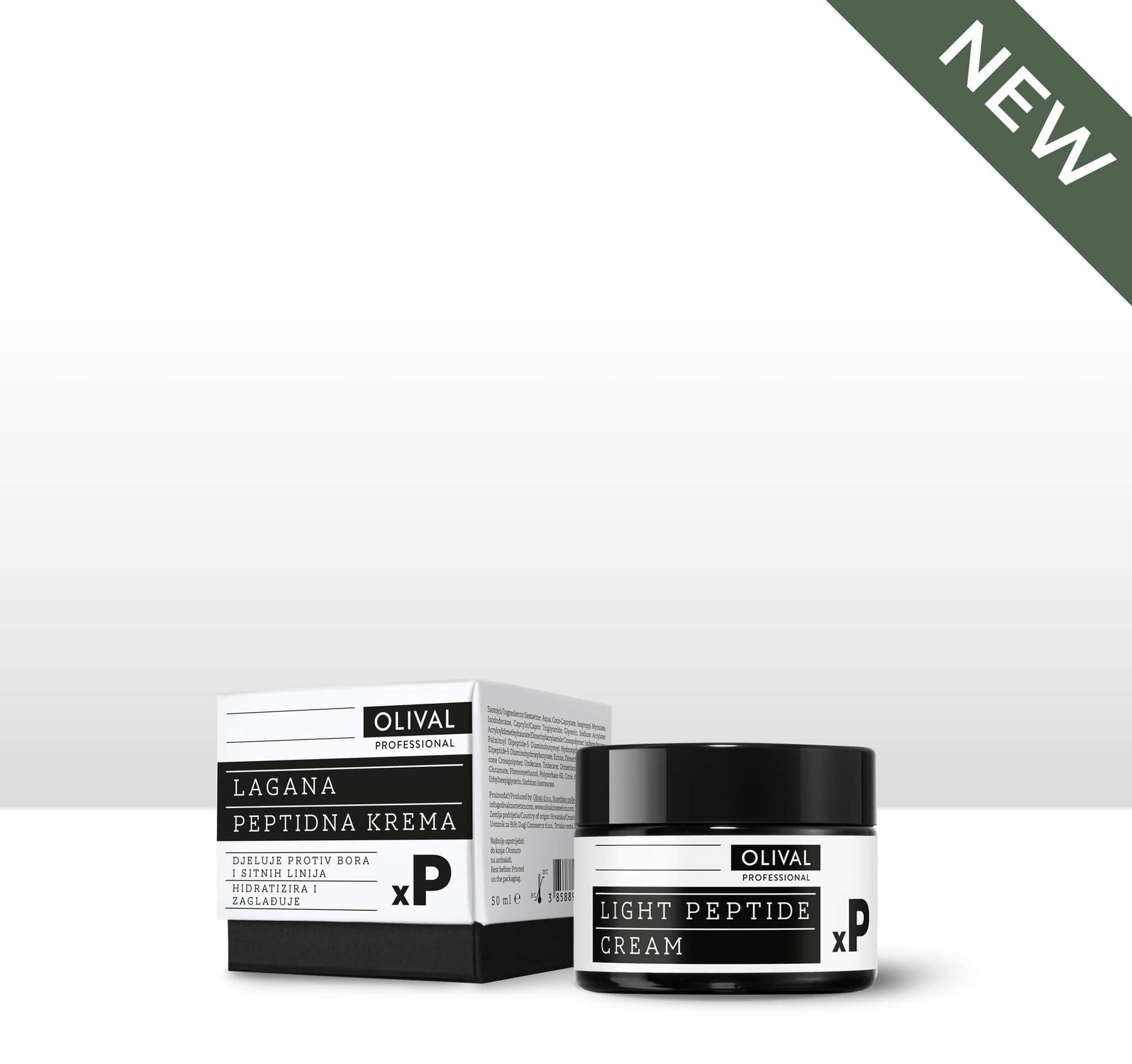
Light Peptide Cream Xp
Ingredients overview
Highlights
Key Ingredients
Other Ingredients
Skim through
Olival Professional Light Peptide Cream XpIngredients explained
Good old water, aka H2O. The most common skincare ingredient of all. You can usually find it right in the very first spot of the ingredient list, meaning it’s the biggest thing out of all the stuff that makes up the product.
It’s mainly a solvent for ingredients that do not like to dissolve in oils but rather in water.
Once inside the skin, it hydrates, but not from the outside - putting pure water on the skin (hello long baths!) is drying.
One more thing: the water used in cosmetics is purified and deionized (it means that almost all of the mineral ions inside it is removed). Like this, the products can stay more stable over time.
A clear, colorless to slightly yellowish oil that makes the skin nice and smooth (emollient), spreads easily on the skin and is marketed as a good alternative to volatile (does not absorb into the skin but rather evaporates from it) silicones like Cyclomethicone.
A clear, colorless oil-like liquid that makes the skin feel smooth and nice (aka emollient) and it does so without it being greasy.
What's more, it can even reduce the heavy, greasy feel in products with high oil content. It's also fast-spreading meaning that it gives the formula a good, nice slip. It absorbs quickly into the skin and helps other ingredients to penetrate quicker and deeper.
Thanks to all this, it's one of the most commonly used emollients out there. There is just one little drawback: it has a high comedogenic index (5 out of 5...), so it might clog pores if you're prone to it.
A clear, colorless and odorless, highly volatile (meaning it does not absorb into the skin but evaporates from it) liquid that's used as an emollient. It gives a nice non-oily light skin feel and it can improve the slip of the formula without leaving a tacky residue behind.
It's also popular in make-up products as its volatility makes mascaras and foundations last longer. If that would not be enough, it's also an excellent solvent, and it's a regular not only on the ingredients lists of make-ups but also on makeup removers.
A super common emollient that makes your skin feel nice and smooth. It comes from coconut oil and glycerin, it’s light-textured, clear, odorless and non-greasy. It’s a nice ingredient that just feels good on the skin, is super well tolerated by every skin type and easy to formulate with. No wonder it’s popular.
- A natural moisturizer that’s also in our skin
- A super common, safe, effective and cheap molecule used for more than 50 years
- Not only a simple moisturizer but knows much more: keeps the skin lipids between our skin cells in a healthy (liquid crystal) state, protects against irritation, helps to restore barrier
- Effective from as low as 3% with even more benefits for dry skin at higher concentrations up to 20-40%
- High-glycerin moisturizers are awesome for treating severely dry skin
 We don't have description for this ingredient yet.
A light, velvety, unique skin feel liquid that is a good solvent and also makes the skin feel nice and smooth (aka emollient). It's often used in makeup products mixed with silicones to give shine and slip to the product. It's also great for cleansing dirt and oil from the skin as well as for taking off make-up.
We don't have description for this ingredient yet.
We don't have description for this ingredient yet.
Ectoin is a surprisingly well-researched, multi-functional active that can do from pollution & light protection to skin hydration, soothing, and barrier repair, several things to your skin.
It is an extremolyte, a small stress-protection molecule that protects microorganisms living under extreme conditions such as salt lakes, hot springs, arctic ice, the deep sea, or deserts. It was discovered in 1985 in a microorganism living in a salt lake in the Egyptian desert.
The key skill of Ectoin is protection that applies also to the skin. Its main mode of action is binding water molecules (aka kosmotropic) and creating hydro complexes. These complexes then surround important biomolecules (e.g. cells, proteins, enzymes) and form a stabilizing hydration shell around them.
This protection mechanism means good things when it comes to our skin: Ectoin has antioxidant, anti-inflammatory, pollution& light protecting, skin hydrating, barrier repairing as well as anti-aging properties.
A placebo-controlled 10-person study examined a four-week treatment with 0.5% Ectoin in the crow's feet area and found a significant anti-wrinkle effect (-19% mean wrinkle depth) in 100% of the participants. Another double-blind, placebo-controlled clinical study with 24 participants used a 2% Ectoin cream twice a day for 4 weeks and found an improvement in all of the measured parameters, such as wrinkle volume, skin scaling, roughness, and elasticity.
Another remarkable property of Ectoin is protecting the epidermal immune cells called Langerhans cells from UV damage. 0.3% and 0.5% Ectoin cream was used twice a day for 14 days on the forearm and then irradiated with 1.5 MED UV (one and a half times the UV dose that causes detectable redness). While the untreated, UV-stressed area showed a 40% decrease in viable Langerhans cells, 0.5% Ectoin showed 100% protection (and 0.3% showed ~95% protection).
The soothing efficacy is also backed up by multiple in-vivo studies. A 20-person study compared 1% Ectoin cream to 0.25% hydrocortisone treatment on surfactant irritated skin and found similar effectiveness in reducing skin redness. Another study with 23 females with sensitive skin found that a 1% Ectoin cream helped to tolerate a 0.5% or 1% retinol treatment much better.
A tiny, 5-person study examined the long-term (7 days) skin hydration effect of 1% Ectoin. During the study, hydration levels increased up to 200% compared to placebo, and even 7 days after stopping the treatment hydration status was largely preserved. Higher concentration (5-7%) Ectoin treatments are also used as OTC medical products for the treatment of eczema or atopic skin.
The anti-pollution magic properties are also well-established and Ectoin is currently the only anti-pollution active ingredient approved for use in medical products (e.g. inhalation solutions) in Europe. Clinical studies showed a reduction of inflammations in human lungs of patients with COPD (a pulmonary disease) and pollution-induced asthma. But coming back to the skin, Ectoin protects both from PMs (Particulate Matters, including ultrafine) as well as PAHs (Polycyclic Aromatic Hydrocarbons) and heavy metals.
If that weren't enough, Ectoin is also shown to protect the skin from blue and visible light, and pigmentation resulting from environmental stress (think UV, pollution, oxidative stress).
All in all, we think Ectoin is one of those under-the-radar actives that deserves more hype than it is currently getting. As an amazing all-around skin protectant, it is a useful addition to any skincare routine.
A white, elastomeric silicone powder that gives a nice silky and powdery feel to the products. It also has some oil and sebum absorption capabilities.
A thick, high molecular weight silicone that is usually diluted in another, lighter silicone fluid (like dimethicone or cyclopentasiloxane). The dimethiconol containing silicone blends leave a silky smooth, non-greasy film on the skin.
An amino acid-based emulsifier that helps water and oil to mix and stay that way. It is considered as natural, environmentally friendly, and hypoallergenic.
It’s pretty much the current IT-preservative. It’s safe and gentle, but even more importantly, it’s not a feared-by-everyone-mostly-without-scientific-reason paraben.
It’s not something new: it was introduced around 1950 and today it can be used up to 1% worldwide. It can be found in nature - in green tea - but the version used in cosmetics is synthetic.
Other than having a good safety profile and being quite gentle to the skin it has some other advantages too. It can be used in many types of formulations as it has great thermal stability (can be heated up to 85°C) and works on a wide range of pH levels (ph 3-10).
It’s often used together with ethylhexylglycerin as it nicely improves the preservative activity of phenoxyethanol.
A common little helper ingredient that helps water and oil to mix together, aka emulsifier.
Citric acid comes from citrus fruits and is an AHA. If these magic three letters don’t tell you anything, click here and read our detailed description on glycolic acid, the most famous AHA.
So citric acid is an exfoliant, that can - just like other AHAs - gently lift off the dead skin cells of your skin and make it more smooth and fresh.
There is also some research showing that citric acid with regular use (think three months and 20% concentration) can help sun-damaged skin, increase skin thickness and some nice hydrating things called glycosaminoglycans in the skin.
But according to a comparative study done in 1995, citric acid has less skin improving magic properties than glycolic or lactic acid. Probably that’s why citric acid is usually not used as an exfoliant but more as a helper ingredient in small amounts to adjust the pH of a formulation.
Super common little helper ingredient that helps products to remain nice and stable for a longer time. It does so by neutralizing the metal ions in the formula (that usually get into there from water) that would otherwise cause some not so nice changes.
It is typically used in tiny amounts, around 0.1% or less.
If you have spotted ethylhexylglycerin on the ingredient list, most probably you will see there also the current IT-preservative, phenoxyethanol. They are good friends because ethylhexylglycerin can boost the effectiveness of phenoxyethanol (and other preservatives) and as an added bonus it feels nice on the skin too.
Also, it's an effective deodorant and a medium spreading emollient.
A handy helper ingredient that helps water and oil to mix nicely together, aka emulsifier. It is especially recommended for protective, baby care and general purpose emollient creams.
It also helps to disperse insoluble particles (think color pigments or zinc/titanium dioxide sunscreen) nice and even in cosmetic formulas.
You may also want to take a look at...
| what‑it‑does | solvent |
| what‑it‑does | emollient |
| what‑it‑does | emollient | perfuming |
| irritancy, com. | 3, 3-5 |
| what‑it‑does | emollient | solvent |
| what‑it‑does | emollient |
| what‑it‑does | skin-identical ingredient | moisturizer/humectant |
| irritancy, com. | 0, 0 |
| what‑it‑does | viscosity controlling |
| what‑it‑does | emollient | solvent |
| what‑it‑does | cell-communicating ingredient |
| what‑it‑does | antioxidant | soothing | moisturizer/humectant |
| what‑it‑does | viscosity controlling |
| what‑it‑does | emollient |
| what‑it‑does | perfuming |
| what‑it‑does | emollient | moisturizer/humectant |
| what‑it‑does | emulsifying | surfactant/cleansing |
| what‑it‑does | preservative |
| what‑it‑does | emulsifying | surfactant/cleansing |
| what‑it‑does | buffering |
| what‑it‑does | chelating |
| what‑it‑does | preservative |
| what‑it‑does | emulsifying |
| irritancy, com. | 0, 1-2 |