




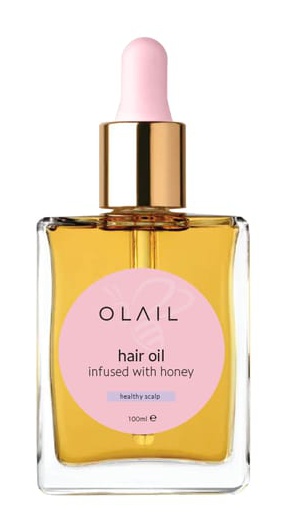
Infused With Honey Hair Oil
Ingredients overview
Highlights
Key Ingredients
Other Ingredients
Skim through
| Ingredient name | what-it-does | irr., com. | ID-Rating |
|---|---|---|---|
| Glycine Soja (Soybean) Oil | emollient, perfuming | 0, 3 | goodie |
| Ricinus Communis (Castor) Seed Oil | emollient, perfuming | 0, 0-1 | |
| Olea Europaea (Olive) Fruit Oil | antioxidant, emollient | 0, 0-2 | goodie |
| Parfum | perfuming | icky | |
| Cocos Nucifera (Coconut) Oil | emollient, perfuming | 0, 4 | goodie |
| Honey | soothing, moisturizer/humectant, antimicrobial/antibacterial | goodie | |
| Melaleuca Alternifolia (Tea Tree) Leaf Oil | soothing, anti-acne, antioxidant, antimicrobial/antibacterial, perfuming | goodie | |
| Prunus Amygdalus Dulcis (Sweet Almond 0Oil, Tocopheryl Acetate (Itamin E), Lavandula Angustifolia Lavender) Oil | emollient | 0, 1-3 | goodie |
| Ci 47000 | colorant | ||
| Hexyl Cinnamal | perfuming | icky | |
| Coumarin | perfuming | icky | |
| Linalool | perfuming | icky | |
| Limonene | perfuming, solvent | icky |
Olail Infused With Honey Hair OilIngredients explained
The emollient plant oil coming from the soybean. It is considered to be a nice, cost-effective base oil with moisturizing properties. As for its fatty acid profile, it contains 48-59% barrier-repairing linoleic acid, 17-30% nourishing oleic acid and also some (4.5-11%) potentially anti-inflammatory linolenic acid.
Castor oil is sourced from the castor bean plant native to tropical areas in Eastern Africa and the Mediterranean Basin. It is an age-old ingredient (it’s over 4,000 years old!) with many uses including as a shoe polish, food additive and motor lubricant. You would be reasonable to think that putting shoe polish on your face wouldn’t be the best idea, but it turns out castor oil has some unique properties that make it a stalwart in thick and gloss-giving formulas (think lipsticks and highlighters).
So what is so special about it? The answer is its main fatty acid, called ricinoleic acid (85-95%). Unlike other fatty acids, ricinoleic acid has an extra water-loving part (aka -OH group) on its fatty chain that gives Castor Oil several unique properties. First, it is thicker than other oils, then its solubility is different (e.g. dissolves in alcohol but not in mineral oil), and it allows all kinds of chemical modifications other oils do not, hence the lots of Castor oil-derived ingredients. It is also more glossy than other oils, in fact, it creates the highest gloss of all natural oils when applied to the skin. Other than that, it is a very effective emollient and occlusive that reduces skin moisture loss so it is quite common in smaller amounts in moisturizers.
While it is very unlikely (and this is true for pretty much every ingredient), cases of reactions to castor oil have been reported, so if your skin is sensitive, it never hurts to patch test.
You probably know olive oil from the kitchen as a great and healthy option for salad dressing but it's also a great and healthy option to moisturize and nourish the skin, especially if it's on the dry side.
Similar to other emollient plant oils, it's loaded with nourishing fatty acids: oleic is the main component (55-83%), and also contains linoleic (3.5-20%) and palmitic acids (7-20%). It also contains antioxidant polyphenols, tocopherols (types of vitamin E) and carotenoids and it's one of the best plant sources of skin-identical emollient, Squalene.
Overall, a great option for dry skin but less so for acne-prone or damaged skin.
Exactly what it sounds: nice smelling stuff put into cosmetic products so that the end product also smells nice. Fragrance in the US and parfum in the EU is a generic term on the ingredient list that is made up of 30 to 50 chemicals on average (but it can have as much as 200 components!).
If you are someone who likes to know what you put on your face then fragrance is not your best friend - there's no way to know what’s really in it.
Also, if your skin is sensitive, fragrance is again not your best friend. It’s the number one cause of contact allergy to cosmetics. It’s definitely a smart thing to avoid with sensitive skin (and fragrance of any type - natural is just as allergic as synthetic, if not worse!).
There is definitely some craze going on for coconut oil both in the healthy eating space (often claimed to be the healthiest oil to cook with but this is a topic for another site) and in the skin and hair care space.
We will talk here about the latter two and see why we might want to smear it all over ourselves. Chemically speaking, coconut oil has a unique fatty acid profile. Unlike many plant oils that mostly contain unsaturated fatty acids (fatty acids with double bonds and kinky structure such as linoleic or oleic), coconut oil is mostly saturated (fatty acids with single bonds only) and its most important fatty acid is Lauric Acid (about 50%). Saturated fatty acids have a linear structure that can stack nice and tight and hence they are normally solid at room temperature. Coconut oil melts around 25 °C so it is solid in the tub but melts on contact with the skin.
The saturated nature of coconut oil also means that it is a heavy-duty-oil ideal for dry skin types. A double-blind research confirmed that extra virgin coconut oil is as effective in treating xerosis (aka very dry skin) as mineral oil. Another study found that coconut oil is more effective than mineral oil in treating mild to moderate atopic dermatitis (aka eczema) in children.
So when it comes to dry skin, coconut oil is a goodie, no question there. The question is if it is good or bad for acne-prone skin. Its main fatty acid, Lauric Acid has some research showing that it is a promising ingredient against evil acne-causing bacteria, P. acnes but at the same time, both Lauric Acid and coconut oil have a very high comedogenic rating (4 out of 5). Though comedogenic ratings are not very reliable, anecdotal evidence (i.e. people commenting in forums) shows that people have mixed experiences. While some claim that it worked wonders on their acne others say that it gave them serious blackheads and zits. Try it at your own risk.
As for hair care, coconut oil has pretty solid research showing that it can penetrate into the hair very well (better than mineral oil and sunflower oil) and it can prevent hair protein loss as well as combing damage. If you have problems with damaged hair, split ends, coconut oil is worth trying as a pre- or/and post-wash treatment. Labmuffin has an awesome blogpost explaining in more detail why coconut oil is good for your hair.
A couple of other things worth mentioning: coconut oil might help with wound healing (promising animal study), it has some antifungal activity (against dermatophytes that cause the thing known as ringworm) and it also works as an insect repellent against black flies.
Overall, coconut oil is definitely a goodie for the hair and dry skin. If that warrants for the magic oil status it enjoys, we don't know.
We all know honey as the sweet, gooey stuff that is lovely to sweeten a good cup of tea and we have good news about putting honey all over our skin. It is just as lovely on the skin as it is in the tea.
The great review article about honey in the Journal of Cosmetic Dermatology writes that it is arguably the oldest skincare ingredient and evidence from around 4500 BC mentions honey in some eye cream recipes. Chemically speaking, it is a bee-derived, supersaturated sugar solution. About 95% of honey dry weight is sugar and the other 5% consists of a great number of other minor components including proteins, amino acids, vitamins, enzymes, and minerals.
This unique and complex chemical composition gives honey a bunch of nice skin care properties: it is very moisturizing, has soothing and antioxidant abilities as well as significant antibacterial and antifungal magic powers. There is also a lot of empirical evidence with emerging scientific backup that honey dressing promotes the healing of wounds and burns.
One tricky thing about honey though, is that it can have lots of different floral sources and different types of honey have a somewhat different composition and thus somewhat different properties. For example, the darker the honey the richer it is in antioxidant phenolic compounds. Two special types of honey are acacia and manuka. The former is unique and popular because of its higher than usual fructose content that makes it more water-soluble and easier to stabilize in cosmetic formulas. The latter comes from the Leptospermum Scoparium tree native to New Zeland and its special thing is its extra strong antibacterial power due to a unique component called methylglyoxal.
Overall, honey is a real skin-goodie in pretty much every shape and form, and it is a nice one to spot on the ingredient list.
The famous tea tree oil. One of the best known essential oils which comes from Australia where it has been used for almost 100 years for its antiseptic and anti-inflammatory actions. Legend has it that the medicinal benefits of the oil were considered so important that Australian soldiers were supplied with some tea tree oil in their World War II military kit.
Similar to other essential oils, tea tree oil is a very complex chemical mixture consisting of about 100 components, the major ones being terpinen-4-ol (40%), γ-Terpinene (23%) and α-Terpinene (10%). Terpinen-4-ol is considered to be the main active component but as a great article in Clinical Microbiology Reviews states "while some TTO components may be considered less active, none can be considered inactive" and most components contribute to TTO's strong antibacterial, antiviral and antifungal effects.
Regarding skincare and tea tree oil, its most well-known effect is probably being a well established anti-acne ingredient. Multiple studies confirm that TTO is effective against the evil acne-causing bacteria called P. acnes and the effectiveness of 5% TTO gel is comparable to the gold standard anti-acne treatment, 5% Benzoyl Peroxide lotion. You need to be a bit more patient with TTO, though, as its effects come slower but also with fewer side effects.
Regarding TTO and sensitive skin, we say that you should be careful. Even if your skin is not sensitive you should never put undiluted TTO on your skin. Luckily, it contains only very small amounts of the common allergens (such as limonene), but irritant and allergic reactions still happen, especially by oxidation products that occur in older or not properly stored oil. So if you have some pure TTO at home, know that storage matters, keep it in a cool, dry, dark place and use it up in a reasonable amount of time.
Overall, we do not often give a goodie status to essential oils, but we feel that TTO's unique antibacterial and anti-acne properties with its minimal allergen content warrant an exception. If your skin is acne-prone, TTO is something to experiment with.
The emollient plant oil that comes from almonds. Similar to other plant oils, it is loaded with skin-nourishing fatty acids (oleic acid - 55-86% and linoleic acid 7-35%) and contains several other skin goodies such as antioxidant vitamin E and vitamin B versions.
It's a nice, basic oil that is often used due to its great smoothing, softening and moisturizing properties. It's also particularly good at treating dry brittle nails (source).
 We don't have description for this ingredient yet.
A common fragrance ingredient that smells like jasmine. It is one of the “EU 26 fragrances” that has to be labelled separately because of allergen potential. Best to avoid if your skin is sensitive.
A common fragrance ingredient that has a sweet, vanilla, nutty scent. When diluted it smells like freshly-mown hay.
It’s one of the “EU 26 fragrances” that has to be labelled separately (and cannot be simply included in the term “fragrance/perfume” on the label) because of allergen potential. Best to avoid if your skin is sensitive.
Linalool is a super common fragrance ingredient. It’s kind of everywhere - both in plants and in cosmetic products. It’s part of 200 natural oils including lavender, ylang-ylang, bergamot, jasmine, geranium and it can be found in 90-95% of prestige perfumes on the market.
The problem with linalool is, that just like limonene it oxidises on air exposure and becomes allergenic. That’s why a product containing linalool that has been opened for several months is more likely to be allergenic than a fresh one.
A study made in the UK with 483 people tested the allergic reaction to 3% oxidised linalool and 2.3% had positive test results.
A super common and cheap fragrance ingredient. It's in many plants, e.g. rosemary, eucalyptus, lavender, lemongrass, peppermint and it's the main component (about 50-90%) of the peel oil of citrus fruits.
It does smell nice but the problem is that it oxidizes on air exposure and the resulting stuff is not good for the skin. Oxidized limonene can cause allergic contact dermatitis and counts as a frequent skin sensitizer.
Limonene's nr1 function is definitely being a fragrance component, but there are several studies showing that it's also a penetration enhancer, mainly for oil-loving components.
All in all, limonene has some pros and cons, but - especially if your skin is sensitive - the cons probably outweigh the pros.
You may also want to take a look at...
| what‑it‑does | emollient | perfuming |
| irritancy, com. | 0, 3 |
| what‑it‑does | emollient | perfuming |
| irritancy, com. | 0, 0-1 |
| what‑it‑does | antioxidant | emollient |
| irritancy, com. | 0, 0-2 |
| what‑it‑does | perfuming |
| what‑it‑does | emollient | perfuming |
| irritancy, com. | 0, 4 |
| what‑it‑does | soothing | moisturizer/humectant | antimicrobial/antibacterial |
| what‑it‑does | soothing | anti-acne | antioxidant | antimicrobial/antibacterial | perfuming |
| what‑it‑does | emollient |
| irritancy, com. | 0, 1-3 |
| what‑it‑does | colorant |
| what‑it‑does | perfuming |
| what‑it‑does | perfuming |
| what‑it‑does | perfuming |
| what‑it‑does | perfuming | solvent |