




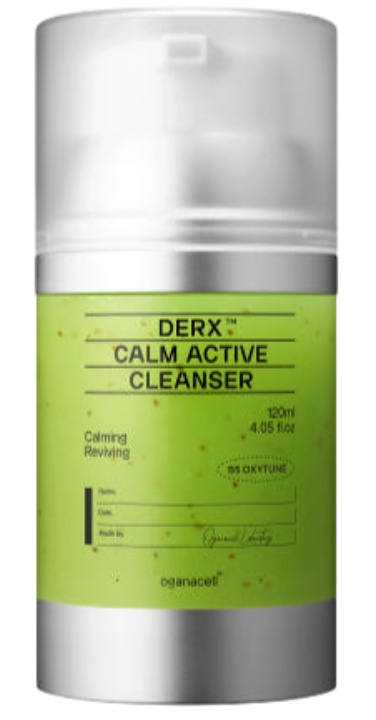
Derx Calm Active Cleanser
Ingredients overview
 INCI photo pending approval
Highlights
Key Ingredients
Other Ingredients
Skim through
oganacell Derx Calm Active CleanserIngredients explained
Good old water, aka H2O. The most common skincare ingredient of all. You can usually find it right in the very first spot of the ingredient list, meaning it’s the biggest thing out of all the stuff that makes up the product.
It’s mainly a solvent for ingredients that do not like to dissolve in oils but rather in water.
Once inside the skin, it hydrates, but not from the outside - putting pure water on the skin (hello long baths!) is drying.
One more thing: the water used in cosmetics is purified and deionized (it means that almost all of the mineral ions inside it is removed). Like this, the products can stay more stable over time.
Super common ingredient in all kinds of cleansing products: face and body washes, shampoos and foam baths.
Number one reason for its popularity has to do with bubbles. Everyone loves bubbles. And cocamidopropyl betaine is great at stabilizing them.
The other reason is that it’s mild and works very well combined with other cleansing agents and surfactants. The art of cleansing is usually to balance between properly cleansing but not over-cleansing and cocamidopropyl betaine is helpful in pulling off this balance right.
Oh, and one more nice thing: even though it’s synthetic it’s highly biodegradable.
More info on CAPB on Collins Beaty Pages.
A soft, mild cleansing agent with amphoteric structure meaning that its head contains both a positively and a negatively charged part (surfactants are most commonly anionic meaning their head has a negative charge). It also has great foaming abilities and is recommended for baby products and other non-irritating cleansers.
A big polymer molecule that has a bunch of different versions and thus different uses. It can act as a film former, as a thickening agent, or it can increase the water-resistance in sunscreens. It is also used to entrap pigments/inorganic sunscreens within a micron size matrix for even coverage and easy application.
 We don't have description for this ingredient yet.
Sodium chloride is the fancy name of salt. Normal, everyday table salt.
If (similar to us) you are in the weird habit of reading the label on your shower gel while taking a shower, you might have noticed that sodium chloride is almost always on the ingredient list. The reason for this is that salt acts as a fantastic thickener in cleansing formulas created with ionic cleansing agents (aka surfactants) such as Sodium Laureth Sulfate. A couple of percents (typically 1-3%) turns a runny surfactant solution into a nice gel texture.
If you are into chemistry (if not, we understand, just skip this paragraph), the reason is that electrolytes (you know, the Na+ and Cl- ions) screen the electrostatic repulsion between the head groups of ionic surfactants and thus support the formation of long shaped micelles (instead of spherical ones) that entangle like spaghetti, and viola, a gel is formed. However, too much of it causes the phenomenon called "salting out", and the surfactant solution goes runny again.
Other than that, salt also works as an emulsion stabilizer in water-in-oil emulsions, that is when water droplets are dispersed in the outer oil (or silicone) phase. And last but not least, when salt is right at the first spot of the ingredient list (and is not dissolved), the product is usually a body scrub where salt is the physical exfoliating agent.
We don't have description for this ingredient yet.
We don't have description for this ingredient yet.
We don't have description for this ingredient yet.
A copper salt (copper cation + gluconate anion) probably best known for promoting cellular regeneration and wound healing. It works mainly in the final healing phase that complements nicely with the wound healing abilities of its mineral salt sister, zinc gluconate.
Other than that, copper is also involved in several enzyme systems: it is a cofactor for the antioxidant enzyme, superoxide dismutase and also a cofactor for the melanin stimulating enzyme, tyrosinase. This means that copper has some tan activating properties, though we think you should not be into tanning at all, as UV is so bad for the skin.
The gluconate part is there to promote the bioavailability of copper and it also plays a role in cellular regeneration (involved in the synthesis of ribose sugars, structural components of DNA and RNA).
A clear, colorless liquid that works as a solvent and viscosity decreasing ingredient. It also has great skin-moisturizing abilities.
An easy-to-formulate, commonly used, nice to have ingredient that’s also called pro-vitamin B5. As you might guess from the “pro” part, it’s a precursor to vitamin B5 (whose fancy name is pantothenic acid).
Its main job in skincare products is to moisturise the skin. It’s a humectant meaning that it can help the skin to attract water and then hold onto it. There is also research showing that panthenol can help our skin to produce more lovely lipids that are important for a strong and healthy skin barrier.
Another great thing about panthenol is that it has anti-inflammatory and skin protecting abilities. A study shows that it can reduce the irritation caused by less-nice other ingredients (e.g. fragrance, preservatives or chemical sunscreens) in the product.
Research also shows that it might be useful for wound healing as it promotes fibroblast (nice type of cells in our skin that produce skin-firming collagen) proliferation.
If that wasn’t enough panthenol is also useful in nail and hair care products. A study shows that a nail treatment liquide with 2% panthenol could effectively get into the nail and significantly increase the hydration of it.
As for the hair the hydration effect is also true there. Panthenol might make your hair softer, more elastic and helps to comb your hair more easily.
One of the main biologically active components of the famous medicinal plant, Centella Asiatica, aka Gotu Kola. It has well established wound healing, skin-soothing and antioxidant activities.
There is also a study by La Roche Posay (belongs to L'Oreal) that examined the anti-aging effects of 5% Vitamin C combined with 0.1% Madecassoside. They mention that " Madecassoside is known to induce collagen expression and ⁄ or to modulate inflammatory mediators thus might prevent and correct some signs of aging." The surprisingly long, 6-month study observed "significant improvement of the clinical score for deep and superficial wrinkles, suppleness, firmness, roughness, and skin hydration", but Vitamin C in itself is already an anti-aging superstar, so it is hard to know how much Madecassoside did.
Another promising property of Madecassoside is that it seems to inhibit UV-induced melanin synthesis (test formula with 0.05% MA, used twice a day on 23 volunteers for 8 weeks), making it a great active for hyperpigmentation-prone skin.
If that would not be enough, the French manufacturer (Seppic) also has encouraging in-vivo studies on the molecule. Used at 0.2%, Madecassoside reduces redness and peeling in skin with light atopic dermatitis as well as itching in psoriasis-prone skin.
One of the biologically active components of Gotu Kola that is thought to contribute to the plant extract's well-documented skin regenerating, wound healing, and moisturizing properties.
If you are into Gotu Kola we have some more info at Centella Asiatica Extract and its other biologically active components Madecassoside, Asiaticoside and Asiatic Acid.
One of the main biologically active components of the famous medicinal plant, Centella Asiatica, aka Gotu Kola. It has well established wound healing and antioxidant activities.
In-vitro (made in the lab) studies also show that Asiaticoside stimulates GAGs (glycosaminoglycans - polysaccharides that are part of the liquidy stuff between our skin cells) production as well as collagen I synthesis. Read more at Gotu Kola >>
One of the biologically active components of Gotu Kola. It's a bit less prominent than its sister component, Asiaticoside, but in-vitro (made in the lab) studies show that Asiatic Acid also stimulates GAGs (glycosaminoglycans - polysaccharides that are part of the liquidy stuff between our skin cells) production as well as collagen I synthesis.
English translation equals that it probably contributes to the well-established moisturizing and wound healing abilities of Gotu Kola.
We don't have description for this ingredient yet.
When it comes to Tea Tree, the essential oil is the one that steals the show with its well-documented antimicrobial and anti-acne effects. The extract is not very well defined, and it probably contains the active components of the oil in much-reduced concentrations. Manufacturers still mention soothing, antimicrobial, purifying and antiseptic properties for the tea tree extract.
A handy multifunctional ingredient that works as a preservative booster, as well as an antioxidant and soothing agent.
Similar to other glycols, it's a helper ingredient used as a solvent, or to thin out thick formulas and make them more nicely spreadable.
Hexylene Glycol is also part a preservative blend named Lexgard® HPO, where it helps the effectiveness of current IT-preservative, phenoxyethanol.
A 100% natural and plant-derived moisturizer that mimics the natural carbohydrate fraction found in the upper layer of the skin. Its special magic power is to bind to the skin stronger and longer than other moisturizer ingredients do so it can keep the skin hydrated longer than usual.
It’s a handy multi-tasking ingredient that gives the skin a nice, soft feel. At the same time, it also boosts the effectiveness of other preservatives, such as the nowadays super commonly used phenoxyethanol.
The blend of these two (caprylyl glycol + phenoxyethanol) is called Optiphen, which not only helps to keep your cosmetics free from nasty things for a long time but also gives a good feel to the finished product. It's a popular duo.
We don't have description for this ingredient yet.
Citric acid comes from citrus fruits and is an AHA. If these magic three letters don’t tell you anything, click here and read our detailed description on glycolic acid, the most famous AHA.
So citric acid is an exfoliant, that can - just like other AHAs - gently lift off the dead skin cells of your skin and make it more smooth and fresh.
There is also some research showing that citric acid with regular use (think three months and 20% concentration) can help sun-damaged skin, increase skin thickness and some nice hydrating things called glycosaminoglycans in the skin.
But according to a comparative study done in 1995, citric acid has less skin improving magic properties than glycolic or lactic acid. Probably that’s why citric acid is usually not used as an exfoliant but more as a helper ingredient in small amounts to adjust the pH of a formulation.
Butylene glycol, or let’s just call it BG, is a multi-tasking colorless, syrupy liquid. It’s a great pick for creating a nice feeling product.
BG’s main job is usually to be a solvent for the other ingredients. Other tasks include helping the product to absorb faster and deeper into the skin (penetration enhancer), making the product spread nicely over the skin (slip agent), and attracting water (humectant) into the skin.
It’s an ingredient whose safety hasn’t been questioned so far by anyone (at least not that we know about). BG is approved by Ecocert and is also used enthusiastically in natural products. BTW, it’s also a food additive.
A really multi-functional helper ingredient that can do several things in a skincare product: it can bring a soft and pleasant feel to the formula, it can act as a humectant and emollient, it can be a solvent for some other ingredients (for example it can help to stabilize perfumes in watery products) and it can also help to disperse pigments more evenly in makeup products. And that is still not all: it can also boost the antimicrobial activity of preservatives.
Centella Asiatica - or sometimes also called Gotu Kola or Cica - has been used in folk medicine for hundreds of years. It’s traditionally used to improve small wounds, burns and scratches and it’s also a well known anti-inflammatory agent for eczema.
Recently science has taken an interest in Gotu Kola as well and it turns out it really has many active compounds with several benefits. Just for hard-core geeks, the main biologically active compounds are pentacyclic triterpenoid saponins called asiaticoside, madecassoside, asiatic and madecassic acid (also called centellosides).
One of the biological activities of the centellosides is to be able to stimulate GAGs (glycosaminoglycans - polysaccharides that are part of the liquidy stuff between our skin cells), and especially hyaluronic acid synthesis in our skin. This is probably one of the reasons why Centella Asiatica Extract has nice skin moisturizing properties that was confirmed by a 25 people, four weeks study along with Centella's anti-inflammatory effects.
Madecassoside can also help in burn wound healing through increasing antioxidant activity and enhancing collagen synthesis. Asiaticoside was shown to increase antioxidant levels on rats skin when applied at 0.2%.
Centella Asiatica also often shows up in products that try to treat cellulite or striae. Of course, it cannot make a miracle but it might have some effect via regulating microcirculation and normalizing the metabolism in the cells of connective tissues.
Bottom line: Gotu Kola is a great plant ingredient with proven wound healing, anti-inflammatory, and antioxidant properties. Nice to spot on any ingredient list.
A little helper ingredient that is used to adjust the pH of the product. It also helps to keep products stay nice longer by neutralizing the metal ions in the formula (they usually come from water).
We don't have description for this ingredient yet.
The salt form of one of the main anti-inflammatory ingredients in the licorice plant, monoammonium glycyrrhizinate. It’s a yellowish powder with a nice sweet smell.
It’s used mainly for its soothing and anti-inflammatory properties, but according to manufacturer info, it’s also sebum regulating so it's a perfect ingredient for problem skin products.
Read more about licorice and why it's a skincare superstar here.
It’s the most commonly used version of pure vitamin E in cosmetics. You can read all about the pure form here. This one is the so-called esterified version.
According to famous dermatologist, Leslie Baumann while tocopheryl acetate is more stable and has a longer shelf life, it’s also more poorly absorbed by the skin and may not have the same awesome photoprotective effects as pure Vit E.
- A natural moisturizer that’s also in our skin
- A super common, safe, effective and cheap molecule used for more than 50 years
- Not only a simple moisturizer but knows much more: keeps the skin lipids between our skin cells in a healthy (liquid crystal) state, protects against irritation, helps to restore barrier
- Effective from as low as 3% with even more benefits for dry skin at higher concentrations up to 20-40%
- High-glycerin moisturizers are awesome for treating severely dry skin
When it comes to grape and skincare, the seed extract and the seed oil steals most of the show. The reason for that is that the seed contains the majority of the skin goodies, the antioxidant superstar polyphenols.
The fruit also contains some, but it's less potent. However - according to manufacturer info - the fruit extract is not only an antioxidant, but it's also a soothing, moisturizing and nourishing agent.
We don't have description for this ingredient yet.
- Green tea is one of the most researched natural ingredients
- The active parts are called polyphenols, or more precisely catechins (EGCG being the most abundant and most active catechin)
- There can be huge quality differences between green tea extracts. The good ones contain 50-90% catechins (and often make the product brown and give it a distinctive smell)
- Green tea is proven to be a great antioxidant, UV protectant, anti-inflammatory, anticarcinogenic and antimicrobial
- Because of these awesome properties green tea is a great choice for anti-aging and also for skin diseases including rosacea, acne and atopic dermatitis
We don't have description for this ingredient yet.
We don't have description for this ingredient yet.
We don't have description for this ingredient yet.
We don't have description for this ingredient yet.
If you are into Japanese cuisine, you might know this guy as Japanese pepper or Sanshō pepper that is known for its unique fresh aroma and appetite increasing spicy sensation.
As for the skin benefits of Zanthoxylum Piperitum, it might have antioxidant effects (with active components called hyperoside and quercitrin), but more importantly, it is an antibacterial and natural preservative agent. It is pretty common in K-Beauty products, as it's one of the three natural extracts that make up the popular Korean preservative called EURO-NApre.
Combined with Usnea Barbata and Pulsatilla Koreana, these three extracts are claimed to form a natural preservative system that also has anti-inflammatory effects and might help with skin conditions such as blemishes, atopic dermatitis, and dandruff.
On the flip side, Zanthoxylum Piperitum contains fragrant components (Limonene and Citrone), that might irritate sensitive skin.
Super common soothing ingredient. It can be found naturally in the roots & leaves of the comfrey plant, but more often than not what's in the cosmetic products is produced synthetically.
It's not only soothing but it' also skin-softening and protecting and can promote wound healing.
Super common little helper ingredient that helps products to remain nice and stable for a longer time. It does so by neutralizing the metal ions in the formula (that usually get into there from water) that would otherwise cause some not so nice changes.
It is typically used in tiny amounts, around 0.1% or less.
If you have spotted ethylhexylglycerin on the ingredient list, most probably you will see there also the current IT-preservative, phenoxyethanol. They are good friends because ethylhexylglycerin can boost the effectiveness of phenoxyethanol (and other preservatives) and as an added bonus it feels nice on the skin too.
Also, it's an effective deodorant and a medium spreading emollient.
CI 42090 or Blue 1 is a super common synthetic colorant in beauty & food. Used alone, it adds a brilliant smurf-like blue color, combined with Tartrazine, it gives the fifty shades of green.
Ci 19140 or Tartrazine is a super common colorant in skincare, makeup, medicine & food. It’s a synthetic lemon yellow that's used alone or mixed with other colors for special shades.
FDA says it's possible, but rare, to have an allergic-type reaction to a color additive. As an example, it mentions that Ci 19140 may cause itching and hives in some people but the colorant is always labeled so that you can avoid it if you are sensitive.
Exactly what it sounds: nice smelling stuff put into cosmetic products so that the end product also smells nice. Fragrance in the US and parfum in the EU is a generic term on the ingredient list that is made up of 30 to 50 chemicals on average (but it can have as much as 200 components!).
If you are someone who likes to know what you put on your face then fragrance is not your best friend - there's no way to know what’s really in it.
Also, if your skin is sensitive, fragrance is again not your best friend. It’s the number one cause of contact allergy to cosmetics. It’s definitely a smart thing to avoid with sensitive skin (and fragrance of any type - natural is just as allergic as synthetic, if not worse!).
You may also want to take a look at...
| what‑it‑does | solvent |
| what‑it‑does | surfactant/cleansing |
| what‑it‑does | surfactant/cleansing |
| what‑it‑does | viscosity controlling |
| what‑it‑does | surfactant/cleansing | viscosity controlling |
| what‑it‑does | viscosity controlling |
| what‑it‑does | solvent | viscosity controlling |
| what‑it‑does | solvent | viscosity controlling |
| what‑it‑does | soothing |
| what‑it‑does | solvent |
| what‑it‑does | soothing | moisturizer/humectant |
| irritancy, com. | 0, 0 |
| what‑it‑does | antioxidant | soothing |
| what‑it‑does | antioxidant | perfuming |
| what‑it‑does | viscosity controlling |
| what‑it‑does | antimicrobial/antibacterial | perfuming |
| what‑it‑does | antioxidant | preservative |
| what‑it‑does | solvent | emulsifying | perfuming | surfactant/cleansing |
| irritancy, com. | 0-1, 0-2 |
| what‑it‑does | moisturizer/humectant |
| what‑it‑does | moisturizer/humectant | emollient |
| what‑it‑does | surfactant/cleansing |
| what‑it‑does | buffering |
| what‑it‑does | moisturizer/humectant | solvent |
| irritancy, com. | 0, 1 |
| what‑it‑does | solvent |
| what‑it‑does | soothing | antioxidant | moisturizer/humectant |
| what‑it‑does | chelating | buffering |
| what‑it‑does | chelating |
| what‑it‑does | soothing | moisturizer/humectant |
| what‑it‑does | antioxidant |
| irritancy, com. | 0, 0 |
| what‑it‑does | skin-identical ingredient | moisturizer/humectant |
| irritancy, com. | 0, 0 |
| what‑it‑does | soothing | antioxidant | moisturizer/humectant |
| what‑it‑does | antioxidant | soothing |
| what‑it‑does | antioxidant |
| what‑it‑does | antioxidant | antimicrobial/antibacterial | preservative |
| what‑it‑does | soothing |
| irritancy, com. | 0, 0 |
| what‑it‑does | chelating |
| what‑it‑does | preservative |
| what‑it‑does | colorant |
| what‑it‑does | colorant |
| what‑it‑does | perfuming |