




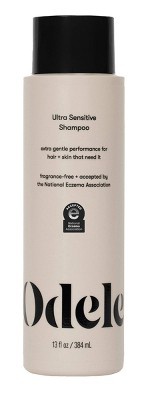
Ultra Sensitive Shampoo
Ingredients overview
Highlights
Key Ingredients
Skim through
Odele Ultra Sensitive ShampooIngredients explained
Good old water, aka H2O. The most common skincare ingredient of all. You can usually find it right in the very first spot of the ingredient list, meaning it’s the biggest thing out of all the stuff that makes up the product.
It’s mainly a solvent for ingredients that do not like to dissolve in oils but rather in water.
Once inside the skin, it hydrates, but not from the outside - putting pure water on the skin (hello long baths!) is drying.
One more thing: the water used in cosmetics is purified and deionized (it means that almost all of the mineral ions inside it is removed). Like this, the products can stay more stable over time.
A versatile and biodegradable cleansing agent with high cleaning power and strong foaming properties. Unfortunately, these two properties for a surfactant usually mean that it is harsh on the skin, which is the case here as well.
A thickening and foam-boasting co-surfactant with amphoteric structure meaning that its head contains both a positively and a negatively charged part (surfactants are most commonly anionic meaning their head has a negative charge). It's very mild and gentle, comes from coconut oil and is readily biodegradable.
 We don't have description for this ingredient yet.
A finely powdered form of Oat Extract that has the same skin soothing, skin protecting and antioxidant benefits we have written about at Avena Sativa Kernel Extract. It is loaded with skin-goodies such as anti-inflammatory agent beta-glucan, skin nourishing lipids, and moisturizing carbohydrates. A real goodie for dry, irritated, inflamed or eczema-prone skin.
We don't have description for this ingredient yet.
It's the seed extract of a plant called amaranth or love-lies-bleeding. It's a really ancient plant grown by Aztecs, Incas and Mayas as their main food and they called it “the golden grain”. They believed it had supernatural powers. Nowadays it's a popular health food because the seeds have great nutritional benefits and are high in protein.
As for skincare there are two types of the seed extract:
1, The aqueous extract contains a high concentration of peptides and polysaccharides and helps to improve the combability and manageability of damaged hair.
2. The oily extract is more common and acts as other similar emollient plant oils. It's rich in non-saturated fatty acids (linoleic acid/omega-6 and oleic acid/omega-9) and squalene and is a great moisturizer and emollient for both skin and hair.
We don't have description for this ingredient yet.
- A natural moisturizer that’s also in our skin
- A super common, safe, effective and cheap molecule used for more than 50 years
- Not only a simple moisturizer but knows much more: keeps the skin lipids between our skin cells in a healthy (liquid crystal) state, protects against irritation, helps to restore barrier
- Effective from as low as 3% with even more benefits for dry skin at higher concentrations up to 20-40%
- High-glycerin moisturizers are awesome for treating severely dry skin
Propanediol is a natural alternative for the often used and often bad-mouthed propylene glycol. It's produced sustainably from corn sugar and it's Ecocert approved.
It's quite a multi-tasker: can be used to improve skin moisturization, as a solvent, to boost preservative efficacy or to influence the sensory properties of the end formula.
A cellulose derived polymer (a big molecule that consists of many parts) that can help to thicken up products, form a nice film on the skin or hair and is considered to be an excellent hair conditioner.
We don't have description for this ingredient yet.
A so-called diester created from two stearic acid molecules and an ethylene glycol molecule. Its main thing is being an opacifier and pearling agent in cleansing products making them white and glossy. It can also give body to creams and emulsions.
We don't have description for this ingredient yet.
A vegetable origin (coconut/palm kernel oil, glucose) cleansing agent that gives moderate to high stable foam. It's also biodegradable and mild to the skin.
We don't have description for this ingredient yet.
We don't have description for this ingredient yet.
A helper ingredient that helps to make the products stay nice longer, aka preservative. It works mainly against fungi.
It’s pH dependent and works best at acidic pH levels (3-5). It’s not strong enough to be used in itself so it’s always combined with something else, often with potassium sorbate.
It's one of those things that help your cosmetics not to go wrong too soon, aka a preservative. It’s not a strong one and doesn’t really work against bacteria, but more against mold and yeast. To do that it has to break down to its active form, sorbic acid. For that to happen, there has to be water in the product and the right pH value (pH 3-4).
But even if everything is right, it’s not enough on its own. If you see potassium sorbate you should see some other preservative next to it too.
BTW, it’s also a food preservative and even has an E number, E202.
Citric acid comes from citrus fruits and is an AHA. If these magic three letters don’t tell you anything, click here and read our detailed description on glycolic acid, the most famous AHA.
So citric acid is an exfoliant, that can - just like other AHAs - gently lift off the dead skin cells of your skin and make it more smooth and fresh.
There is also some research showing that citric acid with regular use (think three months and 20% concentration) can help sun-damaged skin, increase skin thickness and some nice hydrating things called glycosaminoglycans in the skin.
But according to a comparative study done in 1995, citric acid has less skin improving magic properties than glycolic or lactic acid. Probably that’s why citric acid is usually not used as an exfoliant but more as a helper ingredient in small amounts to adjust the pH of a formulation.
You may also want to take a look at...
| what‑it‑does | solvent |
| what‑it‑does | surfactant/cleansing |
| what‑it‑does | surfactant/cleansing | viscosity controlling |
| what‑it‑does | emulsifying | solvent | surfactant/cleansing | viscosity controlling |
| what‑it‑does | soothing | antioxidant | emollient |
| what‑it‑does | emollient |
| what‑it‑does | skin-identical ingredient | moisturizer/humectant |
| irritancy, com. | 0, 0 |
| what‑it‑does | solvent | moisturizer/humectant |
| what‑it‑does | viscosity controlling |
| what‑it‑does | antimicrobial/antibacterial | emulsifying | preservative | surfactant/cleansing |
| what‑it‑does | emollient | emulsifying | viscosity controlling |
| what‑it‑does | surfactant/cleansing |
| what‑it‑does | surfactant/cleansing |
| what‑it‑does | surfactant/cleansing |
| what‑it‑does | preservative |
| what‑it‑does | preservative |
| what‑it‑does | buffering |