




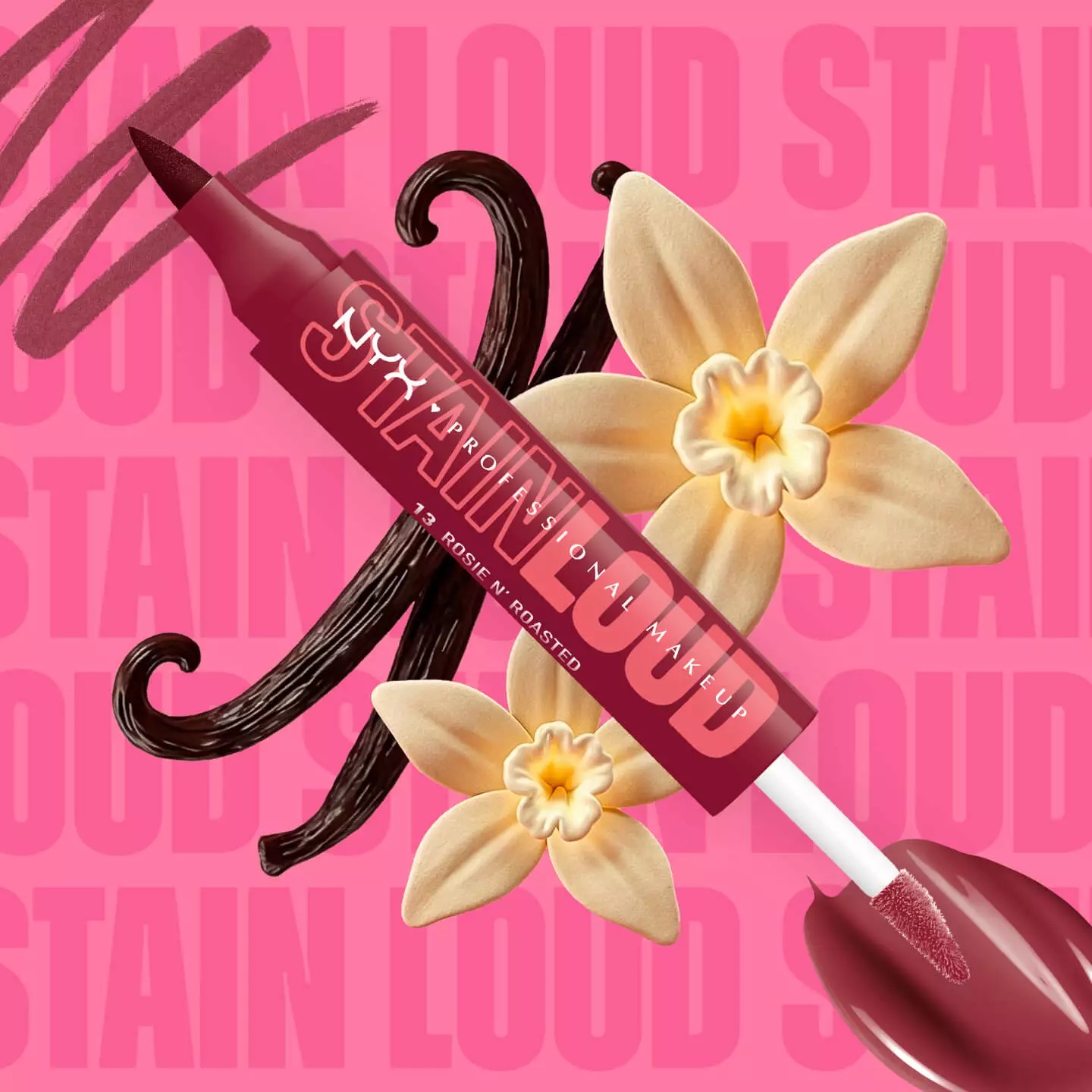
Stain Loud Lip Stain & Gloss
Ingredients overview
Highlights
Key Ingredients
Other Ingredients
Skim through
NYX Professional Makeup Stain Loud Lip Stain & GlossIngredients explained
Good old water, aka H2O. The most common skincare ingredient of all. You can usually find it right in the very first spot of the ingredient list, meaning it’s the biggest thing out of all the stuff that makes up the product.
It’s mainly a solvent for ingredients that do not like to dissolve in oils but rather in water.
Once inside the skin, it hydrates, but not from the outside - putting pure water on the skin (hello long baths!) is drying.
One more thing: the water used in cosmetics is purified and deionized (it means that almost all of the mineral ions inside it is removed). Like this, the products can stay more stable over time.
- A natural moisturizer that’s also in our skin
- A super common, safe, effective and cheap molecule used for more than 50 years
- Not only a simple moisturizer but knows much more: keeps the skin lipids between our skin cells in a healthy (liquid crystal) state, protects against irritation, helps to restore barrier
- Effective from as low as 3% with even more benefits for dry skin at higher concentrations up to 20-40%
- High-glycerin moisturizers are awesome for treating severely dry skin
Butylene glycol, or let’s just call it BG, is a multi-tasking colorless, syrupy liquid. It’s a great pick for creating a nice feeling product.
BG’s main job is usually to be a solvent for the other ingredients. Other tasks include helping the product to absorb faster and deeper into the skin (penetration enhancer), making the product spread nicely over the skin (slip agent), and attracting water (humectant) into the skin.
It’s an ingredient whose safety hasn’t been questioned so far by anyone (at least not that we know about). BG is approved by Ecocert and is also used enthusiastically in natural products. BTW, it’s also a food additive.
Simply alcohol refers to ethanol and it's a pretty controversial ingredient. It has many instant benefits: it's a great solvent, penetration enhancer, creates cosmetically elegant, light formulas, great astringent and antimicrobial. No wonder it's popular in toners and oily skin formulas.
The downside is that it can be very drying if it's in the first few ingredients on an ingredient list.
Some experts even think that regular exposure to alcohol damages skin barrier and causes inflammation though it's a debated opinion. If you wanna know more, we wrote a more detailed explanation about what's the deal with alcohol in skincare products at alcohol denat. (it's also alcohol, but with some additives to make sure no one drinks it).
A multi-functional, silky feeling helper ingredient that can do quite many things. It's used as an emulsion stabilizer, solvent and a broad spectrum antimicrobial. According to manufacturer info, it's also a moisturizer and helps to make the product feel great on the skin. It works synergistically with preservatives and helps to improve water-resistance of sunscreens.
It seems to us that squalane is in fashion and there is a reason for it. Chemically speaking, it is a saturated (no double bonds) hydrocarbon (a molecule consisting only of carbon and hydrogen), meaning that it's a nice and stable oily liquid with a long shelf life.
It occurs naturally in certain fish and plant oils (e.g. olive), and in the sebum (the oily stuff our skin produces) of the human skin. As f.c. puts it in his awesome blog post, squalane's main things are "emolliency, surface occlusion, and TEWL prevention all with extreme cosmetic elegance". In other words, it's a superb moisturizer that makes your skin nice and smooth, without being heavy or greasy.
Another advantage of squalane is that it is pretty much compatible with all skin types and skin conditions. It is excellent for acne-prone skin and safe to use even if you have fungi-related skin issues, like seborrhea or fungal acne.
The unsaturated (with double bonds) and hence less stable version of Squalane is Squalene, you can read about it here >>
A handy helper ingredient that helps water and oil to mix nicely together, aka emulsifier. It is especially recommended for protective, baby care and general purpose emollient creams.
It also helps to disperse insoluble particles (think color pigments or zinc/titanium dioxide sunscreen) nice and even in cosmetic formulas.
A helper ingredient that usually comes to the formula coupled with PEG-40 Hydrogenated Castor Oil. The two together work as surfactants and oil solubilizers. It's a non-sticky duo that works at low concentration and is often used to solubilize fragrance components into water-based formulas.
A mildly viscous, amber-colored liquid with fatty odor, made from Castor Oil and polyethylene glycol (PEG).
If it were a person, we’d say, it’s agile, diligent & multifunctional. It’s mostly used as an emulsifier and surfactant but most often it is used to solubilize fragrances into water-based formulas.
It’s the - sodium form - cousin of the famous NMF, hyaluronic acid (HA). If HA does not tell you anything we have a super detailed, geeky explanation about it here. The TL; DR version of HA is that it's a huge polymer (big molecule from repeated subunits) found in the skin that acts as a sponge helping the skin to hold onto water, being plump and elastic. HA is famous for its crazy water holding capacity as it can bind up to 1000 times its own weight in water.
As far as skincare goes, sodium hyaluronate and hyaluronic acid are pretty much the same and the two names are used interchangeably. As cosmetic chemist kindofstephen writes on reddit "sodium hyaluronate disassociates into hyaluronic acid molecule and a sodium atom in solution".
In spite of this, if you search for "hyaluronic acid vs sodium hyaluronate" you will find on multiple places that sodium hyaluronate is smaller and can penetrate the skin better. Chemically, this is definitely not true, as the two forms are almost the same, both are polymers and the subunits can be repeated in both forms as much as you like. (We also checked Prospector for sodium hyaluronate versions actually used in cosmetic products and found that the most common molecular weight was 1.5-1.8 million Da that absolutely counts as high molecular weight).
What seems to be a true difference, though, is that the salt form is more stable, easier to formulate and cheaper so it pops up more often on the ingredient lists.
If you wanna become a real HA-and-the-skin expert you can read way more about the topic at hyaluronic acid (including penetration-questions, differences between high and low molecular weight versions and a bunch of references to scientific literature).
A handy multifunctional ingredient that works as a preservative booster, as well as an antioxidant and soothing agent.
This long-named, polymer molecule (big molecule from repeated subunits) is a helper ingredient that's good at emulsifying and stabilizing oils into water-based formulas. It also acts as a thickening and gelling agent that creates nice, non-sticky and supple textures. It works over a very wide pH range (3-12) and can be used to thicken up low-ph formulas, such as exfoliants. Its recommended used range is 0.3-3%.
If you have spotted ethylhexylglycerin on the ingredient list, most probably you will see there also the current IT-preservative, phenoxyethanol. They are good friends because ethylhexylglycerin can boost the effectiveness of phenoxyethanol (and other preservatives) and as an added bonus it feels nice on the skin too.
Also, it's an effective deodorant and a medium spreading emollient.
A common little helper ingredient that helps water and oil to mix together, aka emulsifier.
A really multi-functional helper ingredient that can do several things in a skincare product: it can bring a soft and pleasant feel to the formula, it can act as a humectant and emollient, it can be a solvent for some other ingredients (for example it can help to stabilize perfumes in watery products) and it can also help to disperse pigments more evenly in makeup products. And that is still not all: it can also boost the antimicrobial activity of preservatives.
- Primary fat-soluble antioxidant in our skin
- Significant photoprotection against UVB rays
- Vit C + Vit E work in synergy and provide great photoprotection
- Has emollient properties
- Easy to formulate, stable and relatively inexpensive
It’s pretty much the current IT-preservative. It’s safe and gentle, but even more importantly, it’s not a feared-by-everyone-mostly-without-scientific-reason paraben.
It’s not something new: it was introduced around 1950 and today it can be used up to 1% worldwide. It can be found in nature - in green tea - but the version used in cosmetics is synthetic.
Other than having a good safety profile and being quite gentle to the skin it has some other advantages too. It can be used in many types of formulations as it has great thermal stability (can be heated up to 85°C) and works on a wide range of pH levels (ph 3-10).
It’s often used together with ethylhexylglycerin as it nicely improves the preservative activity of phenoxyethanol.
 We don't have description for this ingredient yet.
A super common synthetic colorant that adds a purple-red color - similar to red beet - to a product.
A polymer (big molecule from repeated subunits) that's used as a gloss improver for lipsticks and lipglosses. Its stickiness also helps lip products to stay on longer.
Combined with polyacrylate-13 and polysorbate 20, it forms a very effective tickener-emulsifier trio.
A nice-feeling, light emollient that makes the skin soft and smooth. It gives a fresh and gliding sensation with a powdery or soft after-feel depending on the exact grade used. It is a popular alternative to replace silicones.
Chemically speaking, it is an alkane (stable, non-reacting hydrocarbon) that used to be produced from petrochemicals, but today's versions are typically vegetable based. It is readily biodegradable.
An emollient ester (oily liquid from Isostearyl Alcohol + Isostearic Acid) that gives excellent slip, lubricity and luxurious softness on skin. It's also popular in makeup products to disperse pigments nicely and evenly.
We don't have description for this ingredient yet.
An emollient ester with a rich and creamy but non-greasy skin feel. It makes skin supple and protects dry skin.
We don't have description for this ingredient yet.
We don't have description for this ingredient yet.
A synthetic liquid oil that can replace mineral oil or silicone oils in the cosmetic formulas. There are different grades depending on the molecular weight ranging from very light, volatile, non-residue leaving ones to more substantial, slight residue leaving ones.
Apart from leaving the skin soft and smooth (emollient), it's also used as a waterproofing agent in sunscreens or makeup products and as a shine enhancer in lip gloss formulas.
This ingredient name is not according to the INCI-standard. :( What, why?!
A thick, paste-like emollient ester that is touted as a vegetable-derived lanolin alternative. It has a smooth spreadability and touch, and it gives a substantive film to protect and moisturize the skin.
The emollient plant oil coming from the seeds of the white flowering plant called meadowfoam. Meadowfoam Oil has a unique fatty acid composition with 95% of it being long chain fatty acids (eicosenoic acid C20:1 - 61%, docosenoic acid C22:1 - 16% and docosadienoic acid C22:2 - 18%) that make the oil extraordinarily stable. It also contains antioxidant components such as vitamin E as well as phytosterols.
Apart from Meadowfoam Oil's crazy stability, the oil is described as non-greasy, rapidly absorbed and having a similar skin feel to more often used jojoba oil. The oil is ideal for products where a soft, smooth, silky feel is required whether it be on skin or hair.
Good old water, aka H2O. The most common skincare ingredient of all. You can usually find it right in the very first spot of the ingredient list, meaning it’s the biggest thing out of all the stuff that makes up the product.
It’s mainly a solvent for ingredients that do not like to dissolve in oils but rather in water.
Once inside the skin, it hydrates, but not from the outside - putting pure water on the skin (hello long baths!) is drying.
One more thing: the water used in cosmetics is purified and deionized (it means that almost all of the mineral ions inside it is removed). Like this, the products can stay more stable over time.
A 100% plant derived, natural (Ecocert approved) multi-functional ingredient that has emollient and moisturizing properties, can work as a co-emulsifier (meaning that next to other emulsifiers it can help water and oil to mix) and even more importantly has a strong antimicrobial activity.
Thanks to this last thing, it allows a lower percentage of traditional preservative or it might even be able to completely replace them.
A clear, colorless and odorless, highly volatile (meaning it does not absorb into the skin but evaporates from it) liquid that's used as an emollient. It gives a nice non-oily light skin feel and it can improve the slip of the formula without leaving a tacky residue behind.
It's also popular in make-up products as its volatility makes mascaras and foundations last longer. If that would not be enough, it's also an excellent solvent, and it's a regular not only on the ingredients lists of make-ups but also on makeup removers.
It's a water-hating, fumed silica that works as a thickener for oils and it can also suspend particles in oils.
Also, increases the gloss of castor oil that can be useful for makeup products.
It's a water-hating, fumed silica that works as a thickener for oils and it can also suspend particles in oils.
Also, increases the gloss of castor oil that can be useful for makeup products.
Officially, CosIng (the official EU ingredient database) lists Aluminum Hydroxide 's functions as opacifying (making the product white and non-transparent), as well as emollient and skin protectant.
However, with a little bit of digging, it turns out Aluminum Hyroxide often moonlights as a protective coating for UV filter superstar Titanium Dioxide. Specifically, it protects our skin from the harmful effects of nasty Reactive Oxygen Species (free radicals derived from oxygen such as Superoxide and Hydrogen Peroxide) generated when Titanium Dioxide is exposed to UV light. Btw, chlorine in swimming pool water depletes this protective coating, so one more reason to reapply your sunscreen after a dip in the pool on holiday.
Other than that, Aluminum Hydroxide also often shows up in composite pigment technologies where it is used the other way around (as the base material and not as the coating material) and helps to achieve higher color coverage with less pigment.
We don't have description for this ingredient yet.
An organic derivative of hectorite clay, Disteardimonium Hectorite is used as a viscosity controller - it thickens up formulations to make them less runny.
It’s most popular use in cosmetics is in sunscreens, under the trademarked name Bentone 38 from Elementis. According to the manufacturer info, it is a real multi-tasker, including the ability to prevent pigments settling during storage, stabilizing a formula for longer, creating a light and smooth skin feel and enhancing the water-resistance of sunscreen formulas.
If you have spotted ethylhexylglycerin on the ingredient list, most probably you will see there also the current IT-preservative, phenoxyethanol. They are good friends because ethylhexylglycerin can boost the effectiveness of phenoxyethanol (and other preservatives) and as an added bonus it feels nice on the skin too.
Also, it's an effective deodorant and a medium spreading emollient.
We don't have description for this ingredient yet.
A big polymer molecule that has a bunch of different versions and thus different uses. It can act as a film former, as a thickening agent, or it can increase the water-resistance in sunscreens. It is also used to entrap pigments/inorganic sunscreens within a micron size matrix for even coverage and easy application.
A silicone emulsifier that helps water and silicone oils to mix nicely together.
- Primary fat-soluble antioxidant in our skin
- Significant photoprotection against UVB rays
- Vit C + Vit E work in synergy and provide great photoprotection
- Has emollient properties
- Easy to formulate, stable and relatively inexpensive
It’s the most commonly used version of pure vitamin E in cosmetics. You can read all about the pure form here. This one is the so-called esterified version.
According to famous dermatologist, Leslie Baumann while tocopheryl acetate is more stable and has a longer shelf life, it’s also more poorly absorbed by the skin and may not have the same awesome photoprotective effects as pure Vit E.
Pentaerythrityl Tetra-Di-T-Butyl Hydroxyhydrocinnamate is an antioxidant molecule used in small amounts (less than 0.8%) to help products stay nice longer. More specifically, it is great at preventing discoloration or other types of oxidative degradation. It is a trendy alternative to often bad-mouthed synthetic antioxidant and stabilizer, BHT.
It’s pretty much the current IT-preservative. It’s safe and gentle, but even more importantly, it’s not a feared-by-everyone-mostly-without-scientific-reason paraben.
It’s not something new: it was introduced around 1950 and today it can be used up to 1% worldwide. It can be found in nature - in green tea - but the version used in cosmetics is synthetic.
Other than having a good safety profile and being quite gentle to the skin it has some other advantages too. It can be used in many types of formulations as it has great thermal stability (can be heated up to 85°C) and works on a wide range of pH levels (ph 3-10).
It’s often used together with ethylhexylglycerin as it nicely improves the preservative activity of phenoxyethanol.
We don't have description for this ingredient yet.
Red Iron Oxide is the super common pigment that gives the familiar, "rust" red color. It is also the one that gives the pink tones in your foundation. Chemically speaking, it is iron III oxide (Fe2O3).
Yellow Iron Oxide is the super common inorganic (as in no carbon atom in the molecule) pigment that gives the yellow tones in your foundation. Blended with red and black iron oxides, it is essential in all "flesh-toned" makeup products.
Chemically speaking, it is hydrated iron III oxide and depending on the conditions of manufacture, it can range from a light lemon to an orange-yellow shade.
Black Iron Oxide is the super common inorganic (as in no carbon atom in the molecule) pigment that controls the darkness of your foundation or gives the blackness to your mascara. Blended with red and black iron oxides, it is essential in all "flesh-toned" makeup products.
Chemically speaking, it is a mixture of iron II and iron III oxide. Btw, this guy, unlike the yellow and red pigments, is magnetic.
Ci 77891 is the color code of titanium dioxide. It's a white pigment with great color consistency and dispersibility.
Exactly what it sounds: nice smelling stuff put into cosmetic products so that the end product also smells nice. Fragrance in the US and parfum in the EU is a generic term on the ingredient list that is made up of 30 to 50 chemicals on average (but it can have as much as 200 components!).
If you are someone who likes to know what you put on your face then fragrance is not your best friend - there's no way to know what’s really in it.
Also, if your skin is sensitive, fragrance is again not your best friend. It’s the number one cause of contact allergy to cosmetics. It’s definitely a smart thing to avoid with sensitive skin (and fragrance of any type - natural is just as allergic as synthetic, if not worse!).
You may also want to take a look at...
| what‑it‑does | solvent |
| what‑it‑does | skin-identical ingredient | moisturizer/humectant |
| irritancy, com. | 0, 0 |
| what‑it‑does | moisturizer/humectant | solvent |
| irritancy, com. | 0, 1 |
| what‑it‑does | antimicrobial/antibacterial | solvent | viscosity controlling |
| what‑it‑does | solvent | moisturizer/humectant |
| what‑it‑does | skin-identical ingredient | emollient |
| irritancy, com. | 0, 1 |
| what‑it‑does | emulsifying |
| irritancy, com. | 0, 1-2 |
| what‑it‑does | emulsifying | surfactant/cleansing |
| what‑it‑does | skin-identical ingredient | moisturizer/humectant |
| irritancy, com. | 0, 0 |
| what‑it‑does | antioxidant | preservative |
| what‑it‑does | viscosity controlling |
| what‑it‑does | preservative |
| what‑it‑does | emulsifying | surfactant/cleansing |
| what‑it‑does | solvent |
| what‑it‑does | antioxidant |
| irritancy, com. | 0-3, 0-3 |
| what‑it‑does | preservative |
| what‑it‑does | colorant |
| what‑it‑does | colorant |
| irritancy, com. | 2, 1 |
| what‑it‑does | viscosity controlling |
| what‑it‑does | emollient |
| what‑it‑does | emollient |
| irritancy, com. | 1, 4 |
| what‑it‑does | emollient | surfactant/cleansing |
| what‑it‑does | emollient |
| what‑it‑does | viscosity controlling |
| what‑it‑does | emollient | viscosity controlling |
| irritancy, com. | 2, 1 |
| what‑it‑does | emollient |
| what‑it‑does | emollient |
| what‑it‑does | solvent |
| what‑it‑does | preservative |
| what‑it‑does | emollient | solvent |
| what‑it‑does | perfuming |
| what‑it‑does | emollient | viscosity controlling |
| what‑it‑does | emollient | viscosity controlling |
| what‑it‑does | emollient | moisturizer/humectant | viscosity controlling |
| what‑it‑does | emollient | viscosity controlling |
| what‑it‑does | viscosity controlling |
| what‑it‑does | preservative |
| what‑it‑does | emulsifying |
| what‑it‑does | viscosity controlling |
| what‑it‑does | emulsifying | surfactant/cleansing |
| what‑it‑does | antioxidant |
| irritancy, com. | 0-3, 0-3 |
| what‑it‑does | antioxidant |
| irritancy, com. | 0, 0 |
| what‑it‑does | antioxidant | preservative |
| what‑it‑does | preservative |
| what‑it‑does | colorant |
| irritancy, com. | 0, 1 |
| what‑it‑does | colorant |
| irritancy, com. | 0, 0 |
| what‑it‑does | colorant |
| irritancy, com. | 0, 0 |
| what‑it‑does | colorant |
| irritancy, com. | 0, 0 |
| what‑it‑does | colorant |
| irritancy, com. | 0, 0 |
| what‑it‑does | perfuming |