




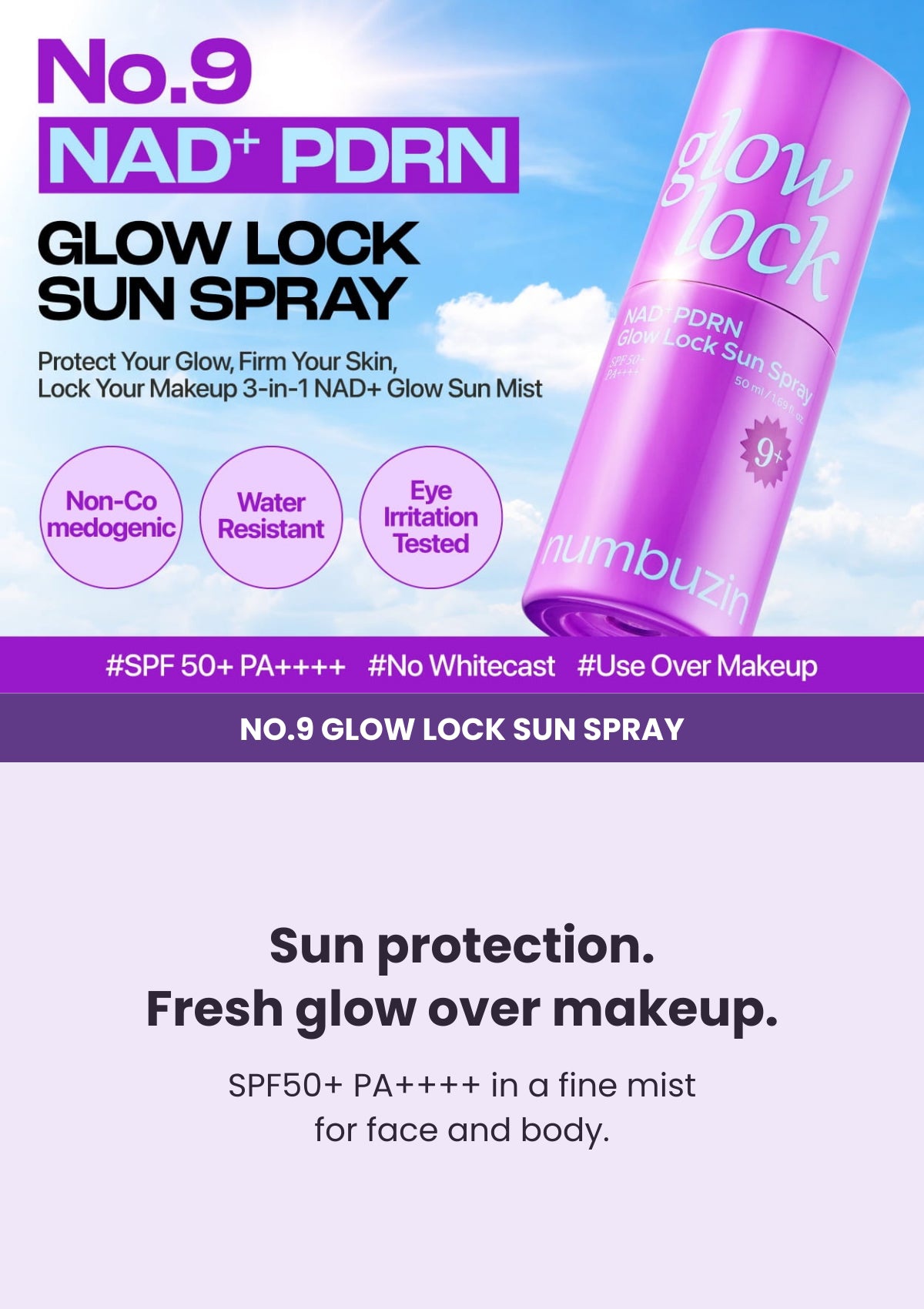
No.9 Nad+pdrn Glow Lock Sun Spray
Ingredients overview
Highlights
Key Ingredients
Skim through
numbuzin No.9 Nad+pdrn Glow Lock Sun SprayIngredients explained
 We don't have description for this ingredient yet.
Good old water, aka H2O. The most common skincare ingredient of all. You can usually find it right in the very first spot of the ingredient list, meaning it’s the biggest thing out of all the stuff that makes up the product.
It’s mainly a solvent for ingredients that do not like to dissolve in oils but rather in water.
Once inside the skin, it hydrates, but not from the outside - putting pure water on the skin (hello long baths!) is drying.
One more thing: the water used in cosmetics is purified and deionized (it means that almost all of the mineral ions inside it is removed). Like this, the products can stay more stable over time.
A clear, colorless, odorless oily liquid that makes the formula easily spreadable and also makes the skin nice and smooth (emollient). It's especially helpful in sunscreens as it can help to solubilize UV filters.
A nice, multi-functional helper ingredient that's especially useful in sunscreens. It can solubilize some commonly used UV-filters like Oxybenzone or Avobenzone and it can also help to increase the SPF rating of sunscreens. It's also cosmetically elegant, has excellent spreadability and a pleasant, moisturizing skin feel. Oh, and according to Wikipedia, it even helps to stabilize famously unstable UVA-filter, Avobenzone.
A L'Oréal-group exclusive sunscreen agent commonly called Mexoryl SX. As opposed to most sunscreen agents, it is water soluble and protects in the UVA range with a peak absorbance at 345 nm.
Its INCI name is a bit of a mouthful, but Bis-Ethylhexyloxyphenol Methoxyphenyl Triazine is worth recognizing it as it is one of the best sunscreen agents known today. Unfortunately, it's not FDA-approved so you will not find it in sunscreens coming from the US (not because it's not good, but because US regulations make it impossible for newer sunscreen agents to get approved), but it is widely available in other parts of the world like Europe, Australia or Asia.
It is a broad-spectrum (covers the whole UVB and UVA range, 280-400 nm) chemical sunscreen agent with peak protections at about 310 and 345 nm and unlike older UV filters, it's very photostable. It hardly deteriorates in the presence of UV light and it's also useful in stabilizing other less stable sunscreen agents, like the famous UVA protector, avobenzone.
It's a new generation sunscreen agent that was specifically designed for high SPF and good UVA protection and based on a 2007 study that compared 18 sunscreen agents available in the EU it really had the best SPF protection (they used the highest concentration allowed by EU regulations from each 18 sunscreens and Trinosorb S gave an SPF 20 all by itself).
It is an oil-soluble, slightly yellowish powder that is not absorbed into the skin too much. This is good news for a sunscreen agent as it needs to be on the surface of the skin to do its job properly. Regarding Bis-Ethylhexyloxyphenol Methoxyphenyl Triazine side effects, we have good news here as well: it has a great safety profile and unlike a couple of other chemical sunscreens, Trinosorb S (and M) does not show estrogenic activity.
Overall, we think Trinosorb S is one of the best sunscreen options available today.
Are you into sunscreen agents? We have shiny explanations (along with product lists) about others as well:
- Methylene Bis-Benzotriazolyl Tetramethylbutylphenol, aka Tinosorb M, the good buddy of our current molecule Tinosorb S
- Tris-Biphenyl Triazine, aka Tinosorb A2B, the newest addition to the Tinosorb family that protects strongly in an in-between wavelength that most other filters miss
- Ethylhexyl Triazone, aka Uvinul T 150, another new generation sunscreen agent with super-high UVB protection
- Diethylamino Hydroxybenzoyl Hexyl Benzoate, aka Uvinul A Plus, a new generation sunscreen for UVA protection
An often used emollient with a light and silky feel. It's very mild to both skin and eyes and spreads nicely and easily. It's often used in sunscreens as it's also an excellent solvent for sunscreen agents.
A very thin and very volatile (evaporates from the skin rather than absorbs into it) silicone fluid that gives silky softness and great spreadability to the formulas.
A L'Oréal-group exclusive sunscreen agent that was invented in 1999 and is commonly called Mexoryl XL. It is an oil-soluble, photostable chemical sunscreen with both UVB and UVA protection with peak absorbance at 303 nm (UVB) and at 344 nm (UVA).
A chemical sunscreen agent that gives strong protection in the UVB (280-320nm) range with its peak protection at 306 nm. Its special property is that unlike most sunscreen agents, it is not oil but water soluble, so it is ideal to create light, oily skin compatible formulas. It is also fairly photostable and can be used to protect other less stable UV filters (like famous UVA blocker, avobenzone) in the formula. It is approved worldwide and can be used up to 4% in the US and up to 8% in the EU.
It's a little helper ingredient that helps to set the pH of the products to be right. It has an alkaline pH and can neutralize acidic ingredients.
Diethylamino Hydroxybenzoyl Hexyl Benzoate is a new generation, chemical sunscreen agent (not available in the US due to impossible FDA regulations) that's designed for high UVA protection and high photostability. It gives sun protection in the whole UVA range (320-400 nm) with peak protection at 354nm. It can be used up to 10% worldwide except for the US and Canada.
Ethylhexyl Triazone is a new generation, chemical sunscreen (not available in the US due to impossible FDA regulations) that gives the highest photo-stable absorption of all available UVB filters today. It protects in the UVB range (280-320nm) with a peak protection of 314nm. It is an oil soluble, odorless, colorless powder that works well in fragrance-free formulas. It can be used up to 5% worldwide except for the US and Canada.
- A multi-functional skincare superstar with several proven benefits for the skin
- Great anti-aging, wrinkle smoothing ingredient used at 4-5% concentration
- Fades brown spots alone or in combination with amino sugar, acetyl glucosamine
- Increases ceramide synthesis that results in a stronger, healthier skin barrier and better skin hydration
- Can help to improve several skin conditions including acne, rosacea, and atopic dermatitis
A clear, colorless, low viscosity, volatile (does not absorb into the skin but rather evaporates from it) silicone fluid that has excellent spreadability and leaves a light, silky and smooth feel on the skin.
According to manufacturer info, its big advantage is that it's compatible both with other silicones and with natural plant oils, so it's a great ingredient to formulate products with good-sounding, consumer-pleasing vegetable oils but still maintain a cosmetically elegant, non-greasy and non-tacky feel.
A really multi-functional helper ingredient that can do several things in a skincare product: it can bring a soft and pleasant feel to the formula, it can act as a humectant and emollient, it can be a solvent for some other ingredients (for example it can help to stabilize perfumes in watery products) and it can also help to disperse pigments more evenly in makeup products. And that is still not all: it can also boost the antimicrobial activity of preservatives.
It’s a handy multi-tasking ingredient that gives the skin a nice, soft feel. At the same time, it also boosts the effectiveness of other preservatives, such as the nowadays super commonly used phenoxyethanol.
The blend of these two (caprylyl glycol + phenoxyethanol) is called Optiphen, which not only helps to keep your cosmetics free from nasty things for a long time but also gives a good feel to the finished product. It's a popular duo.
A spherical texturizing powder that's used as a texture enhancer and soft focus agent. It's claimed to give silicone type softness to the formula and also works as a (temporary) wrinkle filler.
If you have spotted ethylhexylglycerin on the ingredient list, most probably you will see there also the current IT-preservative, phenoxyethanol. They are good friends because ethylhexylglycerin can boost the effectiveness of phenoxyethanol (and other preservatives) and as an added bonus it feels nice on the skin too.
Also, it's an effective deodorant and a medium spreading emollient.
A white, elastomeric silicone powder that gives a nice silky and powdery feel to the products. It also has some oil and sebum absorption capabilities.
A white to beige powder that is described as the golden standard emulsifier for emulsions (oil+water mixtures) that are difficult to stabilize. It is especially popular in sunscreens as it can boost SPF protection and increase the water-resistance of the formula.
We don't have description for this ingredient yet.
We don't have description for this ingredient yet.
Adenosine is an important little compound in our body that has a vital cell-signalling role. Research on smearing it on our face is also promising and shows so far a couple of things:
- It can help with wound healing
- It’s a good anti-inflammatory agent
- It might even help with skin’s own collagen production and improve skin firmness and elasticity
- It helps with barrier repair and protection
- It might be even useful for the hair helping with hair thickness and hair growth
Butylene glycol, or let’s just call it BG, is a multi-tasking colorless, syrupy liquid. It’s a great pick for creating a nice feeling product.
BG’s main job is usually to be a solvent for the other ingredients. Other tasks include helping the product to absorb faster and deeper into the skin (penetration enhancer), making the product spread nicely over the skin (slip agent), and attracting water (humectant) into the skin.
It’s an ingredient whose safety hasn’t been questioned so far by anyone (at least not that we know about). BG is approved by Ecocert and is also used enthusiastically in natural products. BTW, it’s also a food additive.
We don't have description for this ingredient yet.
A type of bucket or donut-shaped molecule with a water-loving outer side and an oil-loving inner side that is used mostly to encapsulate other actives in cosmetics.
We don't have description for this ingredient yet.
A semi-essential (infants cannot synthesize it, but adults can) amino acid that is one of the primary building blocks of hair keratin and skin collagen. It's a natural moisturizing factor, a skin hydrator and might also help to speed up wound healing.
Arginine usually has a positive charge (cationic) that makes it substantive to skin and hair (those are more negatively charged surfaces) and an excellent film former. Thanks to the positive charge, it also creates a complex with AHAs (AHAs like to lose a hydrogen ion and be negatively charged, so the positive and the negative ions attract each other) that causes a "time-release AHA effect" and reduces the irritation associated with AHAs.
A big molecule created from repeated subunits (a polymer of acrylic acid) that magically converts a liquid into a nice gel formula. It usually has to be neutralized with a base (such as sodium hydroxide) for the thickening to occur and it creates viscous, clear gels that also feel nice and non-tacky on the skin. No wonder, it is a very popular and common ingredient. Typically used at 1% or less in most formulations.
It's the chemically chopped up version of normal lecithin. Most often it's used to create liposomes and to coat and stabilize other ingredients.
If you are looking for a reason why red wine is good for you, good news, you have found it! Resveratrol, aka the "red grape antioxidant" is the thing that's suspected to keep the French from coronary heart disease despite their not so healthy eating habits (such as high saturated fat intake).
So resveratrol, found in the seed and skin of the red grape (and berries), is a pretty well-known and well-studied molecule that has potent antioxidant, anti-inflammatory, and anticarcinogenic abilities. Most of the studies were done examining resveratrol's promising anti-cancer properties, but as for skin care, it shows a potent protective effect against UV-caused oxidative stress as well as promising effects against multiple types of skin cancer including the most severe one, melanoma (as an adjuvant therapy).
When it comes to skincare and antioxidants, "the more the merrier", so resveratrol is definitely a nice addition to any skincare routine.
Sh-Oligopeptide-1 is the famous molecule, which is also called Epidermal Growth Factor or EGF. Chemically speaking, Growth Factors are largish peptides or smallish proteins, or to put it in another way, medium-length amino acid sequences (EGF consists of 53 amino acids). Biologically speaking, Growth Factors are cellular signal molecules that can stimulate cell growth, proliferation, healing and/or differentiation.
There are lots of Growth Factors and EGF is just one of them. The topic of "Growth Factors and skincare" is a big, confusing and controversial one and we will try our best to summarize the story for you, including the pros and the cons.
EGF is a special snowflake when it comes to skincare as it was the first Growth Factor that made its way into cosmetic products and it is also the most common one. The American biochemist, Stanley Cohen discovered EGF and was awarded a Noble prize in 1986 for it. As the Noble prize may signify, the molecule is significant and powerful and directly stimulates the proliferation of epidermal cells.
When it comes to Sh-Oligopeptide-1 in a cosmetic product, it has pretty well-established wound healing and skin renewal properties. It might even do more than that. According to a 2012 study on a serum containing barley bioengineered epidermal growth factor, "clinical evaluations showed statistically significant improvement in the appearance of fine lines and rhytids, skin texture, pore size, and various dyschromatic conditions apparent within the first month of use, and continuing improvement trends for the duration of the study" (which was 3 months).
This all sounds amazing, "give me some EGF Serum", we can hear you say! But as we wrote in the intro, the topic is complex and controversial so here are some of the questions that keep coming up around slathering EGF all over our face.
The first and biggest concern is that if EGF is so good at stimulating cell proliferation, how does it relate to cancer? Is the definition of cancer not "cells proliferating out of control"? Most experts agree on this answer: EGF is mitogenic (= stimulates cell proliferation) but not mutagenic (= does not alter the cell to make it cancerous). If you do not have cancer, you will not get cancer from EGF. However, if you have cancerous cells, EGF will help them to spread, just like it helps healthy cells. So if you have a lot of moles, excessive UV exposure in the past, or if you have any of the skin cancer risk factors, we suggest you should think twice about using EGF products. The same is true if you have psoriasis, a skin disease related to the abnormal growth of epidermal skin cells. You do not want to add fuel to the fire with EGF.
Other (less serious) concerns are if EGF can properly penetrate the skin (as it is a medium-sized, polar molecule, so a special delivery system is probably needed), if it can affect collagen synthesis (or just works on the surface plumping up only the upmost layers of the skin) and if it has beneficial effects at all when used in isolation versus when used in a "conditioned media" that contains lots of growth factors resembling the synergistic balance found in the skin.
Overall, our impression is that EGF is definitely a potent molecule. Some EGF products have a cult-like following adding anecdotal evidence to the clinical studies showing EGF has a beneficial effect on the skin. If you like experimenting, by all means, go ahead (unless you have psoriasis or high skin cancer risk factors), but if you are a better safe than sorry type, stick to daily SPF + a good retinoid product. This duo is still the golden standard of anti-aging.
Are you interested in Growth Factors and skincare? We have some more here:
- Human Fibroblast Conditioned Media - a growth factor cocktail used in some cosmetic products
- Insulin-like growth factor 1, aka sh-Oligopeptide -2 - a pal of EGF composed of 70 amino acids
- Vascular Endothelial Growth Factor, aka Sh-Polypeptide-9 - part of a GF cocktail trade named BIO-Placenta
A soothing dipeptide (tyrosine + arginine) based molecule that functions as a "messenger of tranquility and muscle relaxation". It works via stimulating the skin nerve cells to release met-enkephalin, which is an opioid (i.e. relaxing, pain-relieving) messenger molecule.
This means that Acetyl Dipeptide-1 Cetyl Ester can "signal" our skin cells to "relax" and it can instantly decrease skin irritations coming from heat, chemical stinging or mechanical stresses. It is also claimed to be able to prevent the onset of wrinkles and expression lines thanks to its muscle relaxation properties.
Regarding the research, we could find one study that compared the calming effects of our guy with the soothing molecule called 4-T-Butylcyclohexanol. They irritated the skin with Capsaicin (the active in chili peppers) and examined how the test products relieved the burning/stinging sensation. They found that both molecules worked, but 4-t-Butylcyclohexanol worked somewhat better.
Acetyl Hexapeptide-1 is a bit of a special snowflake among peptides as it's not a wrinkle-smoothing, anti-aging active like most of the other ones but it can stimulate pigmentation and melanin production (by interacting with a skin cell receptor called MC1R).
As melanin not only gives the skin its nice tanned color but also works as a natural protection factor, Acetyl Hexapeptide-1, aka Melitane does the same. It not only boosts a natural or an artificial tan but gives extra protection against UV-induced DNA and free radical damage and protects the skin against UV-caused redness.
If you see a cosmetic product that claims that it has "Botox-like effect" then two things are almost certain: one, the product overpromises and two, it contains Argireline.
So this one is the famous peptide that's marketed by its manufacturer as the "Botox in a jar". The basis for this claim is that it targets the same wrinkle forming mechanism (wrinkles caused by facial muscle movement) as Botox, but the way it works is very different. In addition, the extent to which it can prevent muscles from contracting (and to smooth wrinkles) is very different (otherwise why would anyone use still Botox?).
The manufacturer did several studies to prove that Argireline really works and it does (just not as well as Botox). In-vivo (made on real people) tests showed that using 10% Argireline solution around the eyes for 15 days decreased wrinkles depth by 17%, while a 5% Argireline formula applied for 28 days did almost the same with a decrease in wrinkle depth by 16.26%. A Spanish University also did some research and found that Argireline increased the level of skin moisturization and decreased both the depth and width of wrinkles "significantly".
This means, Acetyl Hexapeptide-8 does have some ability to smooth wrinkles (but not as well as Botox - sorry, if we sound like a broken record). Also, we have to agree with TruthInAging, that it's not a collagen builder and not a preventer of structural aging (think vitamin C, AHAs or retinol); it's just a quick fix. If you are looking for one, this could be your thing. If you are more of a "let's treat this aging thing properly" type, then it's probably not your thing.
A newer and, molecule-wise, somewhat bigger version of the famous "Botox-like" peptide called Acetyl Hexapeptide-8 or Argireline. Just like Argireline, Acetyl Octapeptide-3 is also claimed to influence the muscle contraction process that results in a more relaxed and line-free face, especially around the forehead and the eyes.
While Argireline counts as a pretty well-proven peptide, with multiple studies confirming its anti-wrinkle efficacy, we cannot say the same for Acetyl Octapeptide-3. What we have is the manufacturer's claim that comparing 10% Argireline with 10% SNAP-8 solution (that means 0.005% pure peptide powder) the SNAP-8 peptide did a bit better as it reduced wrinkles by 34.98% vs 27.05% reduction for Argireline (twice a day use for 28 days on 17 women).
Other than that, we can write here pretty much the same as at Argireline. Obviously, no peptide works as effectively as real Botox, and the Botox-inspired peptides are quick fixes rather than being collagen builders or real preventers of structural aging. They are nice additions to an anti-aging skincare routine but not the real superstars (think vitamin C, AHAs or retinol).
We don't have description for this ingredient yet.
A four amino acid peptide that is claimed to mimic the youth hormone called thymopoietin. It works by compensating the loss of thymic factors that come with age and is thought to stimulate the skin immune defenses and to help the skin regenerate.
A relatively new, four amino acid peptide that promises to help combat hair loss alongside red clover extract as part of the trademarked technology Capixyl.
The main thing of Acetyl Tetrapeptide-3 is to stimulate the synthesis of key Extra Cellular Matrix (aka ECM, the gooey stuff between cells that make up the framework of our skin) components in the scalp. According to the manufacturer’s lab studies, the expression of type III collagen increased by 65% and the expression of laminins (anchoring proteins found in the ECM) was up a massive 285%, resulting in a stronger ECM bed for hair anchoring.
Together with red clover extract, the duo has a synergistic action and works to combat hair loss thanks to a neat multi-faceted approach: it not only stimulates important ECM components but also inhibits the DHT-causing 5-a-reductase enzyme (DHT is the annoying hormone largely responsible for male pattern baldness) and reduces micro-inflammation around hair follicles. The manufacturer’s study over 4 months showed the total impact of Capixyl was an increased anagen (growth phase)/telogen (resting phase) ratio of +46%, resulting in significantly denser hair.
All in all, Acetyl Tetrapeptide-3 is a promising ingredient in the fight against hair loss, but as the only results we could find were from the manufacturer, take these claims with a pinch of salt until more research is done.
A four amino acid peptide that is claimed to improve puffy eye bags via its anti-oedema and anti-glycation effects.
To back this claim up, the manufacturer created an in-vivo study with 20 volunteers using 10% of EYESERYL (that comes down to 0.01% (!) of the pure peptide) and found that by day 15, 70% of the volunteers improved, while 95% of the volunteers improved by the end of the study (60 days). About third of them improved only slightly, third of them showed an ok improvement and third showed a good improvement. They also have pretty convincing before and after photos, so we can tell you that for the lucky ones, the improvement can be real and visible.
But, the thing is that puffiness around the eyes can have multiple reasons and one of the major ones is fat accumulation that might happen as we age. No miracle cream or ingredient can do much about that, however, another common reason is water accumulation. If the reason behind your eye bags is this latter one, trying an eye cream with Acetyl Tetrapeptide-5 can be a good idea and might bring nice improvements.
We don't have description for this ingredient yet.
We don't have description for this ingredient yet.
A three amino acid peptide where the famous collagen fragment, Tripeptide-1, aka GHK is combined with Biotin, the well-known supplement for stronger nails and hairs. The result of the combination is Biotinoyl Tripeptide-1, a peptide claimed to be helpful for reducing hair loss and for making the eyelashes appear longer, fuller, and stronger.
As for proof, the manufacturer did some in-vitro (made in test tubes) studies that show that our molecule can promote hair bulb keratinocyte proliferation and also helps optimal hair anchorage by stimulating the synthesis and organization of the adhesion molecules laminin 5 and collagen IV. This means that our peptide might help the hair to be stronger and to stay longer in its place, though these are only in vitro results that might or might not translate to real-world use.
As for a clinical, made on real people study, the manufacturer did one for eyelash growth with 30 volunteers. Using a mascara with 2% of SpecPed LashLD (trade name for the diluted, buyable version of Biotinoyl Tripeptide-1), the lashes got longer by 17% and thicker by 19% after 30 days.
- GHK-Cu is a copper-peptide complex found naturally in yucky bodily fluids (plasma, saliva, and urine)
- It has unique wound healing properties by stimulating the breakdown of unhealthy, too large collagen in scar tissue and stimulating nice and healthy collagen production afterwards
- It stimulates the production of several important skin-identical ingredients (e.g. collagen, elastin, and glycosaminoglycans)
- It has significant anti-inflammatory and antioxidant effect
- There are a few promising studies showing GHK-Cu can improve skin elasticity, clarity, firmness and reduce lines and wrinkles
- It can improve hair growth by enlarging hair follicles (and bigger follicles produce longer, thicker hair)
- There are some urban legends about possible overdosing or facial hair problems (read more in geeky details)
We don't have description for this ingredient yet.
This awfully long named ingredient is, in fact, a pretty small molecule. It's a tripeptide (a three amino acid peptide) with molecular weight less than 500 Da, meaning that it's small enough to penetrate nicely and easily into the skin.
It belongs to the "Botox in a jar" type of peptides (similar to Argireline or Leuphasyl) targeting wrinkles caused by facial movements, like laughter lines or crow’s feet. According to the manufacturer's in-vivo (made on real people) studies, 4% Syn-Ake used for 28 days resulted in 21% smoother and 15-20% less wrinkled skin with max values up to 52%. The smoothing effect was measurable on 80% of the volunteers, while the wrinkle reduction effect was evident on 73%.
A tiny peptide with only two amino acids (amino acids are the building block of proteins, and peptides are a few amino acids attached together), Valine and Tryptophan. It's part of a 3 actives complex called Eyeliss (with HMC and Palmitoyl Tetrapeptide-7) that's supposed to fight under-eye bags.
The manufacturer claims that this dipeptide in Eyeliss can increase lymphatic circulation and the three actives together represent a "global approach to treating puffy eyes". The clinical study of the manufacturer with 20 people and 3% Eyeliss showed improvement after 56 days for 70% of the participants.
We don't have description for this ingredient yet.
We don't have description for this ingredient yet.
We don't have description for this ingredient yet.
An anti-aging peptide that can visibly reduce the length and depth of wrinkles, at least according to its manufacturer. In vitro (meaning it was done in the lab, not on real people) studies show that it enhances epidermal regeneration, collagen type I and III synthesis as well as the synthesis of other important skin proteins.
A five amino acid peptide (Lys-Leu-Ala-Lys-Lys) attached to the oil-soluble fatty acid, myristic acid for better bioavailability. It is known to significantly stimulate keratin genes, i. e. it can convince the cells to produce more keratin, the super important structural protein in hair, nails and the outermost layer of the skin.
Most often you will meet Myristoyl Pentapeptide-17 combined with Myristoyl Hexapeptide-16 in eyelash growth products, as the two together can visibly increase eyelash length after two weeks.
We don't have description for this ingredient yet.
We don't have description for this ingredient yet.
We don't have description for this ingredient yet.
We don't have description for this ingredient yet.
A six amino acid peptide that is claimed to improve firmness and skin tone. Its amino acid sequence is Val-Gly-Val-Ala-Pro-Gly that is also called the "spring fragment" and is repeated six times in the important skin protein, elastin molecule.
The manufacturer made a double-blind, one-month long clinical study on 10 women and found that twice a day application of 4% Biopeptide El improved skin firmness by 33% and skin tone by 20%.
A Botox-mimicking peptide (kind of like the famous Argireline) that is supposed to relax the mimic facial wrinkles such as crow's feet or thinker's wrinkles. It is obviously not as effective as real Botox, but according to the manufacturer's data, 5% of the BoNT-L peptide liquid (the diluted, sold version of the peptide) can reduce mimic wrinkles by 38% in 28 days (tested on 15 volunteers).
A pretty famous and better-researched peptide consisting of five amino acids (the building blocks of all proteins). It was created in a joint effort by the French ingredient supplier, Sederma and the cosmetics industry big shot, Procter&Gamble.
The amino acid sequence of the peptide is lysine–threonine–threonine–lysine–serine (KTTKS). Sometimes, it's also called collagen pentapeptide, as it's a subfragment of skin-structure-giving type I collagen. The KTTKS amino sequence is then attached for better oil solubility and skin penetration to palmitic acid and BOOM; we get Palmitoyl Pentapeptide-4.
Though most research is manufacturer sponsored, the clinical studies about Palmitoyl Pentapeptide-4 are promising. In short, it can reduce fine lines, wrinkles and improve skin texture significantly (and at crazy low concentrations, the studies were done with just 3 ppm that is 0.0003%).
There are also studies comparing Palmitoyl Pentapeptide-4 with anti-aging gold standard, retinol. One of them compared 3ppm Pal-KTTKS with 700 ppm (0.07%) retinol and found that they showed similar wrinkle improving ability with the peptide showing better skin tolerability.
Bottom line, if you are into peptides, this is a good one to try.
We don't have description for this ingredient yet.
We don't have description for this ingredient yet.
A four amino acid peptide with the amino sequence of glycine-glutamine-proline-arginine. It is attached to palmitic acid (a fatty acid) to increase oil solubility and skin penetration.
It works by reducing the production of the signal molecule, interleukin-6 (IL-6) which promotes inflammation in the skin and less inflammation means slower degradation of important things (like collagen) that results in younger looking skin for a longer time.
It works in synergy with its pal, Palmitoyl Tripeptide-1 in the famous Matrixyl 3000 complex. You can read some more about the famous duo here.
A really famous peptide that is part of Matrixyl 3000, the most sold peptide complex in the word. Before we go and find out what the big deal with Matrixyl 3000 is, let's just focus on Palmitoyl Tripeptide-1 itself for a bit.
It's a small three amino acid (they are the building blocks of all proteins) peptide with the amino sequence of glycine-histidine-lysine, or GHK. GHK is attached to palmitic acid (a fatty acid) to increase oil solubility and skin penetration.
The GHK part is the important one as it's a type I collagen fragment. When collagen naturally breaks down in the skin, the resulting peptide fragments signal to the skin that it should get to work and create some nice, new collagen. Adding in collagen fragment peptides, like GHK, might trick the skin into thinking that collagen has broken down and it's time to create some more.
Therefore, Palmitoyl Tripeptide-1 is believed to be able to stimulate collagen production in the skin, and more collagen means fewer wrinkles and younger looking skin.
In Matrixyl 3000, Palmitoyl Tripeptide-1 is coupled with Palmitoyl Tetrapeptide-7 and the duo works in synergy to reduce wrinkles and give younger looking skin. According to the manufacturer's in-vivo (made on real people) test, applying 3% Matrixyl 3000 twice a day for 2 months resulted in all of the following things:
- 39.4% reduction in surface occupied by deep wrinkles
- 32.9% reduction in main wrinkle density
- 19.9% reduction in main wrinkle average depth
- 16% improvement in roughness
- 16.2% in lifting effect
- 5.5% improvement in elasticity
- 15.5% improvement in skin tone
Manufacturer results, of course, always have to be taken with a pinch of salt, but if you like peptides, the Matryxil 3000 duo is one of the best-proven and most well-known ones and it's something that is worth trying.
We don't have description for this ingredient yet.
It's a pretty new peptide trade-named MATRIXYL™ synthe’6. The manufacturer claims that it can boost the production of 6 major components of the skin matrix (collagen I, III, IV, fibronectin, hyaluronic acid and laminin 5) that result in more even skin and fewer wrinkles particularly on the forehead and crow's feet. Using 2% of the active for two months daily, women reported a decrease in wrinkles by 31% up to 100%.
A tripeptide (three amino acids attached to each other: Lys-Val-Lys) that's claimed to protect and boost collagen and improve skin texture.
The manufacturer did an in-vivo (made on real people) study with 45 volunteers and found that used twice daily for 84 days 1% and 2.5% Syn-Coll reduces the appearance of wrinkles by 7 and 12% respectively. In another study (also by the manufacturer) with 33 female Chinese volunteers, 77% of the participants felt that Syn-Coll visibly improved the firmness and elasticity of the skin after 4 weeks. What's more, 60% of the participants also noticed a reduction in the look of the pore size also after 4 weeks of treatment.
We don't have description for this ingredient yet.
A five amino-acid peptide that is claimed to target expression wrinkles that appear due to facial movements. Its effect is similar to the older and more famous Argireline peptide. They achieve similar results but in a different way.
The two together work in a synergistic way (the solution is trade named Argirelox) hindering the muscle contraction process in two different stages. The in-vivo (made on real people) test by the manufacturer showed that after 28 days 5% Leuphasyl alone reduced wrinkles by 11% and 5% Leuphasyl + 5% Argireline reduced wrinkles on average by 25% with max values up to 47%.
We don't have description for this ingredient yet.
A high-tech, South-Korean peptide that's made synthetically to be identical to the protein called Met-Enkephalin. It's a 10 amino acid neuropeptide that helps the body to regulate how it responds to harmful things (like heat, cold, cutting or irritation).
In general, neuropeptides are believed to be important in wound-healing and the manufacturer claims that Sh-Decapeptide-7 is effective for anti-aging and would-healing skincare.
A high-tech, South-Korean peptide that's made synthetically to be identical to the protein called Leu-Enkephalin. It's an 8 amino acid neuropeptide that helps the body to regulate how it responds to harmful things (like heat, cold, cutting or irritation).
In general, neuropeptides are believed to be important in wound-healing and the manufacturer claims that Sh-Octapeptide-4 has strong anti-aging and anti-wrinkle effect as well as rejuvenating effect on aged hair tissue and follicles.
Sh-Polypeptide-1 is a cell signaling protein also called Basic Fibroblast Growth Factor and is twin sister to Acidic Fibroblast Growth Factor. We can write here pretty much the same things as we did on aFGF: it is a mitogenic (= stimulates cell proliferation) ingredient that stimulates fibroblast cell growth and proliferation. According to manufacturer info, it also stimulates the synthesis of collagen and other extracellular-matrix (the gooey stuff between cells) components.
Growth Factors and skincare is a big, complicated and controversial topic, so if you wanna know more, we have a more detailed explanation on Epidermal Growth Factor, the most common one used in skincare.
Sh-Polypeptide-11 is a medium sized cell signaling molecule also called Acidic Fibroblast Growth Factor. It belongs to the same group of ingredients (Growth Factors) as its better-known sister, Epidermal Growth Factor or Sh-Oligopeptide-1. As its name suggests, FGF can stimulate the growth and proliferation of fibroblast cells (VIP cells that produce among other things collagen). According to manufacturer info, it also stimulates skin regeneration, wound healing and collagen and elastin synthesis.
As for research, we could find an in-vitro study that proved that "Recombinant FGF-1 strongly stimulated fibroblast and keratinocyte proliferation. However, the transition of this protein through the SC required an appropriate carrier system - lipid spheres."
It's also good to know that slathering mitogenic (= stimulates cell proliferation) ingredients on yourself is somewhat controversial. If you are new to the "Growth Factors and skincare" topic, we have a more detailed explanation of Epidermal Growth Factor, so click here and read all about it.
We don't have description for this ingredient yet.
We don't have description for this ingredient yet.
Sh-Polypeptide-9 is a cell signaling protein also called Vascular Endothelial Growth Factor. As its name suggests, its main function is to stimulate the formation of blood vessels. As to what it does in cosmetic products, we found manufacturers info claiming that it plays a role in supplying fibroblast cells (VIP skin cells that make collagen) with nutrients, in the growth and migration of cells and in wound healing.
It usually comes to the formula as part of a Growth Factor mix trade named BIO-Placenta, that combines EGF, IGF-1, FGF1, FGF2 and this guy to form a synergistic growth factor cocktail. BIO Placenta is claimed to do pretty much everything you would want from an anti-aging active including anti-wrinkle, skin rejuvenation, elasticity enhancement, moisturizing and cell vitalization properties.
This all sounds great and Growth Factors are for sure potent cell signaling molecules, but the use of them in cosmetic products is somewhat controversial, so if you are new to the topic, read our explanation at EGF to get a (hopefully) balanced view.
A four amino acid peptide (Proline – Lysine – Glutamic Acid – Lysine; PKEK) whose main magic power is to fade hyperpigmentation (aka age spots) and even out the skin tone.
According to its German manufacturer, Tetrapeptide-30 has a nice anti-inflammatory function that leads to a dual action in hindering the pigmentation process. It acts as a tyrosinase inhibitor (the famous enzyme needed to create melanin), and it also blocks the transfer of the melanin up into the top layers of the skin.
The manufacturer has done several clinical studies to back up its claims and examined what Tetrapeptide-30 is doing on Caucasian, Asian as well as on ethnic skin. The results confirmed skin-brightening, reduction of age spots, reduction of skin redness and even some reduction of acne lesions. In the reduction of age spots, the peptide showed some synergistic effects with the nice vitamin-C derivative, called SAP.
A small, three amino acid (glycine-histidine-lysine or GHK) peptide that is famous for being a type I collagen fragment. The theory behind collagen-fragment peptides is that when collagen naturally breaks down in the skin, the resulting peptide fragments signal to the skin that it should get to work and create some nice, new collagen.
Adding in collagen fragment peptides, like GHK, might trick the skin into thinking that collagen has broken down and it's time to create some more. So Tripeptide-1 is believed to be able to stimulate collagen production in the skin, and more collagen means fewer wrinkles and younger looking skin. FYI; Tripeptide-1 is the same peptide that can be found in the famous Matrixyl 3000, but in Matrixyl a palmitic acid is attached to it to increase its oil solubility and thus skin penetration.
Another reason why Tripeptide-1 is especially famous is that it is not only a signal peptide but also a so-called carrier peptide that helps to stabilize and deliver copper in the skin. It has a high affinity for copper ions and likes to form a complex with them called Copper-Tripeptide-1 or GHK-Cu. GHK-Cu is a famous and well-researched peptide that does a bunch of things in the skin and we have a shiny explanation about it here.
As for Tripeptide-1 in and of itself, without a palmitic acid or copper attached to it, it goes by the trade name Kollaren and according to the manufacturer, it not only stimulates collagen but also other essential skin proteins such as fibronectin, elastin, and laminin. Kollaren is also claimed to be beneficial for acne-prone skin as it can boost tissue repair and thus help acne scars to heal faster.
We don't have description for this ingredient yet.
A small, three-amino acid peptide (Glycine-Proline-Hydroxyproline) found naturally in our collagen structure.
The theory behind Tripeptide-29 is the following: Collagen is a long sequence of amino acids and breaking it down produces short amino acid sequences, aka peptides. These peptides "signal" to the skin that collagen was lost and that new collagen should be produced. So putting collagen-fragment-identical peptides on the skin might trick it into thinking that new collagen is needed.
The unique thing about Tripeptide-29 is that it is not produced by traditional methods such as chemically chopping up collagen as it gives lots of random peptides, but it is produced via modern peptide synthesis (from non-animal and non-GMO sources) that gives it exceptional purity. So Tripeptide-29 is available as a pure powder, unlike most peptides that are available as diluted solutions, which makes it possible to use it in much higher concentrations.
This sounds great but there is a catch: the efficacy data from the manufacturer contains only two tests, both in-vitro, aka done in test tubes, not on real people. Based on the lab test, 3% Tripeptide-29 can increase collagen type I synthesis by 400% after 48 hours. However, if anything happens when Tripeptide-29 is applied on real human skin is a good question with no answer (at least we could not find one).
Overall, the theory is nice, but the proof is missing. If you are into peptides and experimenting, this sure sounds interesting but if you like the tried and true this one is not for you.
You may also want to take a look at...
| what‑it‑does | solvent |
| what‑it‑does | solvent |
| what‑it‑does | emollient | solvent |
| what‑it‑does | solvent |
| what‑it‑does | sunscreen |
| what‑it‑does | sunscreen |
| what‑it‑does | emollient | antimicrobial/antibacterial |
| what‑it‑does | sunscreen |
| what‑it‑does | sunscreen |
| what‑it‑does | buffering |
| what‑it‑does | sunscreen |
| what‑it‑does | sunscreen |
| what‑it‑does | cell-communicating ingredient | skin brightening | anti-acne | moisturizer/humectant |
| what‑it‑does | emollient |
| what‑it‑does | solvent |
| what‑it‑does | moisturizer/humectant | emollient |
| what‑it‑does | preservative |
| what‑it‑does | viscosity controlling |
| what‑it‑does | emulsifying | surfactant/cleansing |
| what‑it‑does | cell-communicating ingredient |
| what‑it‑does | moisturizer/humectant | solvent |
| irritancy, com. | 0, 1 |
| what‑it‑does | skin-identical ingredient |
| what‑it‑does | viscosity controlling |
| irritancy, com. | 0, 1 |
| what‑it‑does | emollient | emulsifying |
| what‑it‑does | antioxidant |
| what‑it‑does | buffering |
| what‑it‑does | cell-communicating ingredient |
| what‑it‑does | cell-communicating ingredient | soothing |
| what‑it‑does | cell-communicating ingredient | moisturizer/humectant |
| what‑it‑does | cell-communicating ingredient | moisturizer/humectant |
| what‑it‑does | cell-communicating ingredient |
| what‑it‑does | cell-communicating ingredient |
| what‑it‑does | cell-communicating ingredient | moisturizer/humectant |
| what‑it‑does | cell-communicating ingredient |
| what‑it‑does | cell-communicating ingredient | soothing | antioxidant |
| what‑it‑does | cell-communicating ingredient |
| what‑it‑does | cell-communicating ingredient |
| what‑it‑does | cell-communicating ingredient |
| what‑it‑does | cell-communicating ingredient |
| what‑it‑does | antioxidant | chelating |
| what‑it‑does | antioxidant |
| what‑it‑does | cell-communicating ingredient |
| what‑it‑does | cell-communicating ingredient |
| what‑it‑does | cell-communicating ingredient |
| what‑it‑does | cell-communicating ingredient |
| what‑it‑does | cell-communicating ingredient |
| what‑it‑does | cell-communicating ingredient |
| what‑it‑does | cell-communicating ingredient |
| what‑it‑does | cell-communicating ingredient |
| what‑it‑does | soothing |
| what‑it‑does | cell-communicating ingredient |
| what‑it‑does | cell-communicating ingredient | antioxidant | buffering | chelating |
| what‑it‑does | cell-communicating ingredient | antioxidant | chelating |
| what‑it‑does | cell-communicating ingredient |
| what‑it‑does | cell-communicating ingredient |
| what‑it‑does | antioxidant |
| what‑it‑does | cell-communicating ingredient |
| what‑it‑does | skin brightening |
| what‑it‑does | cell-communicating ingredient |
| what‑it‑does | cell-communicating ingredient |