




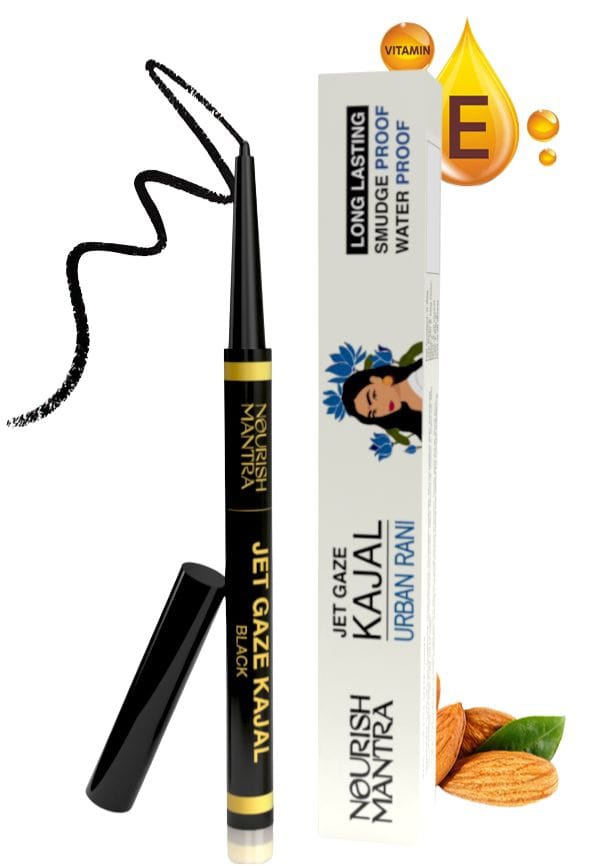
Jet Gaze Kajal Urban Rani-black With Rich Waterproof Pigment
Highlights
Key Ingredients
Other Ingredients
Skim through
| Ingredient name | what-it-does | irr., com. | ID-Rating |
|---|---|---|---|
| Cyclomethicone | emollient | 0, 0 | |
| Dimethicone | emollient | 0, 1 | |
| Octyldodecanol | emollient, perfuming | ||
| Trimethylsiloxysilicate | emollient | ||
| Microcrystalline Wax | viscosity controlling | ||
| Carnauba Wax | emollient | 0, 1 | |
| Candelilla Wax | emollient | 0, 1 | |
| Pentaerythrityl Tetra-Di-T-Butyl Hydroxyhydrocinnamate | antioxidant, preservative | ||
| Silica | viscosity controlling | ||
| Almond Oil | emollient | 0, 1-3 | goodie |
| Vitamin E | antioxidant | 0-3, 0-3 | goodie |
| Argan Oil | antioxidant, emollient | goodie |
Nourish Mantra Jet Gaze Kajal Urban Rani-black With Rich Waterproof PigmentIngredients explained
Cyclomethicone is not one type of silicone, but a whole mixture of them: it's a mix of specific chain length (4 to 7) cyclic structured silicone molecules. (There seems to be a confusion on the internet whether Cyclomethicone and Cyclopentasiloxane are the same. They are not the same, but Cyclopentasiloxane is part of the mixture that makes up Cyclomethicone).
All the silicones in the Cyclomethicone mixture are volatile, meaning they evaporate from the skin or hair rather than stay on it. This means that Cyclomethicone has a light skin feel with none-to-minimal after-feel. It also makes the formulas easy to spread and has nice emollient properties.
Probably the most common silicone of all. It is a polymer (created from repeating subunits) molecule and has different molecular weight and thus different viscosity versions from water-light to thick liquid.
As for skincare, it makes the skin silky smooth, creates a subtle gloss and forms a protective barrier (aka occlusive). Also, works well to fill in fine lines and wrinkles and give skin a plump look (of course that is only temporary, but still, it's nice). There are also scar treatment gels out there using dimethicone as their base ingredient. It helps to soften scars and increase their elasticity.
As for hair care, it is a non-volatile silicone meaning that it stays on the hair rather than evaporates from it and smoothes the hair like no other thing. Depending on your hair type, it can be a bit difficult to wash out and might cause some build-up (btw, this is not true to all silicones, only the non-volatile types).
A clear, slightly yellow, odorless oil that's a very common, medium-spreading emollient. It makes the skin feel nice and smooth and works in a wide range of formulas.
A solid silicone resin that creates a permeable film over the skin. It makes makeup formulas more long-lasting and can enhance the water resistance of sunscreens. It leaves a non-tacky film when dried.
 We don't have description for this ingredient yet.
A vegetable wax coming from the leaves of the Brazilian tropical palm tree, Copernicia cerifera. Similar to other waxes, it is used to stabilize and give body to products, or to keep stick type formulas solid. It is the hardest natural wax with a high melting point (around 85C) and high gloss making it a great wax choice for lip products.
A vegetable wax coming from the leaves of the North Mexican candelilla shrubs (Euphorbia cerifera and Euphorbia antisyphilitica). Similar to other waxes, it is used to stabilize products and give body to them, or to keep stick type formulas solid. It has a melting point around 70C and has high gloss making it a good choice for lip products.
Pentaerythrityl Tetra-Di-T-Butyl Hydroxyhydrocinnamate is an antioxidant molecule used in small amounts (less than 0.8%) to help products stay nice longer. More specifically, it is great at preventing discoloration or other types of oxidative degradation. It is a trendy alternative to often bad-mouthed synthetic antioxidant and stabilizer, BHT.
A white powdery thing that's the major component of glass and sand. In cosmetics, it’s often in products that are supposed to keep your skin matte as it has great oil-absorbing abilities. It’s also used as a helper ingredient to thicken up products or suspend insoluble particles.
The emollient plant oil that comes from almonds. Similar to other plant oils, it is loaded with skin-nourishing fatty acids (oleic acid - 55-86% and linoleic acid 7-35%) and contains several other skin goodies such as antioxidant vitamin E and vitamin B versions.
It's a nice, basic oil that is often used due to its great smoothing, softening and moisturizing properties. It's also particularly good at treating dry brittle nails (source).
- Primary fat-soluble antioxidant in our skin
- Significant photoprotection against UVB rays
- Vit C + Vit E work in synergy and provide great photoprotection
- Has emollient properties
- Easy to formulate, stable and relatively inexpensive
When it comes to cosmetic oils and hype, argan oil is for sure leading the way. Dubbed as the "liquid gold of Morocco", we have to admit we have some trouble determining why this oil enjoys such a special miracle status. Not that it's not good, it is good, even great but reading the research about argan and a bunch of other plant oils we just do not see the big, unique differentiating factor (though that might be our fault not reading enough, obvs.)
So, argan oil comes from the kernel of the argan fruit that comes from the argan tree that grows only in Morocco. The tree is slow growing and getting the oil is a hard job. The traditional process is that the ripe argan fruits fall from the tree, then goats eat them up and poop out the seeds. The seeds are collected and smashed with a stone to get the kernels inside. This part is the hard one as the seeds have extremely hard shells. Once the kernels are obtained, the oil is pressed out from them (the kernels contain about 50% oil).
As for skincare, argan oil is loaded with lots of skin goodies (but so are many other plant oils): it contains 80% nourishing and moisturizing unsaturated fatty acids, mainly oleic (38-50%), linoleic (28-38%) and palmitic (10-18%). It also contains a relatively large amount of antioxidant vitamin E (600-900 mg/kg, about twice as much as olive), small amounts of antioxidant phenols (including caffeic acid, ferulic acid, and epicatechin), as well as some rare sterols with soothing and anti-inflammatory properties.
Thanks to all the above goodness in argan oil, it can greatly nourish and moisturize the skin and hair. It's also claimed to be able to neutralize collagen-damaging free radicals, help reduce scars, and revitalize and improve skin elasticity. You can even read that argan might help acne-prone skin, but being a high oleic oil, we would be careful with that.
All in all, argan oil is a real goodie but we do not fully understand the special miracle status it enjoys.
You may also want to take a look at...
| what‑it‑does | emollient |
| irritancy, com. | 0, 0 |
| what‑it‑does | emollient |
| irritancy, com. | 0, 1 |
| what‑it‑does | emollient | perfuming |
| what‑it‑does | emollient |
| what‑it‑does | viscosity controlling |
| what‑it‑does | emollient |
| irritancy, com. | 0, 1 |
| what‑it‑does | emollient |
| irritancy, com. | 0, 1 |
| what‑it‑does | antioxidant | preservative |
| what‑it‑does | viscosity controlling |
| what‑it‑does | emollient |
| irritancy, com. | 0, 1-3 |
| what‑it‑does | antioxidant |
| irritancy, com. | 0-3, 0-3 |
| what‑it‑does | antioxidant | emollient |