




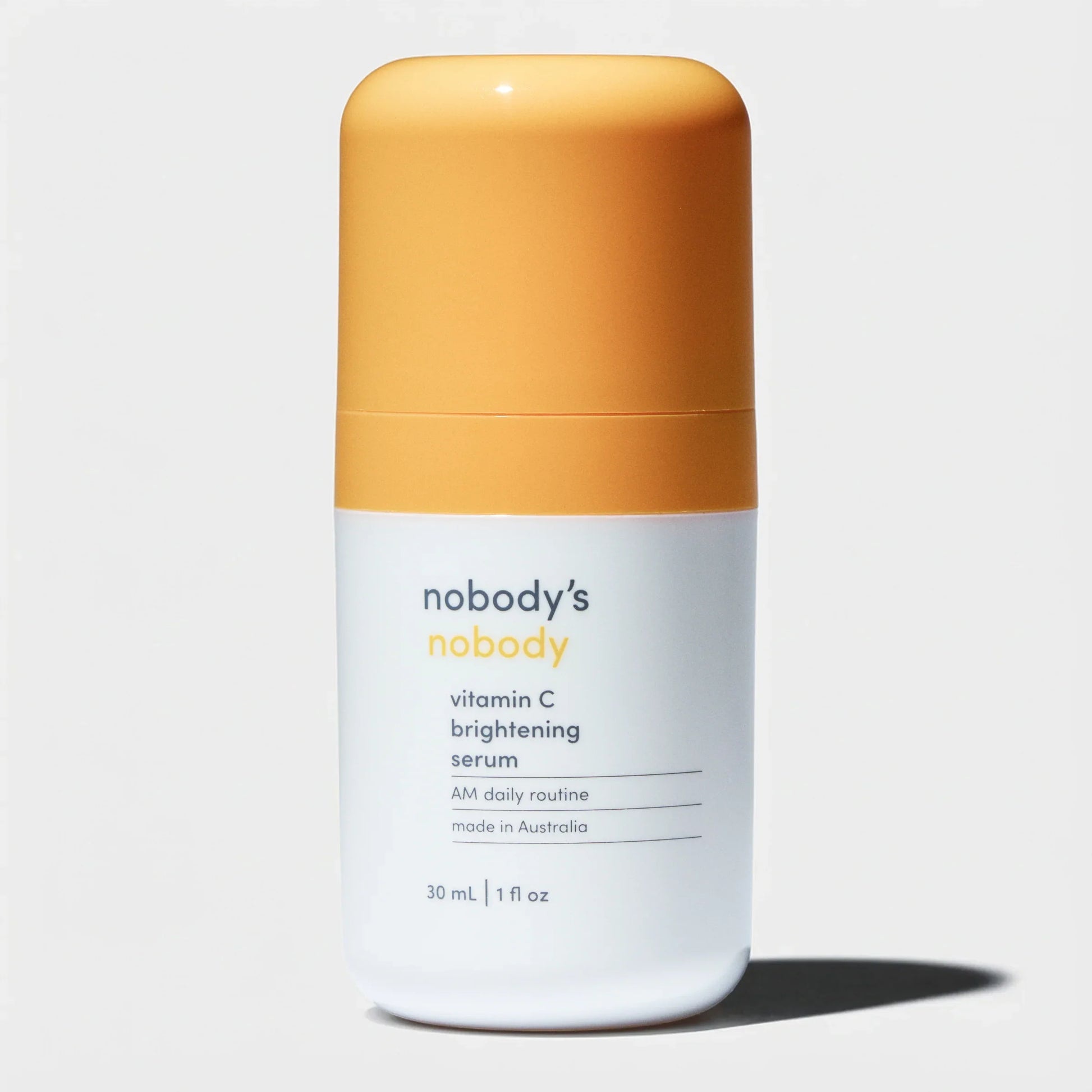
Vitamin C Brightening Serum
Highlights
Key Ingredients
Skim through
| Ingredient name | what-it-does | irr., com. | ID-Rating |
|---|---|---|---|
| Water | solvent | ||
| 3-O-Ethyl Ascorbic Acid | antioxidant, skin brightening | goodie | |
| Glycerin | skin-identical ingredient, moisturizer/humectant | 0, 0 | superstar |
| Xanthan Gum | viscosity controlling | ||
| Caprylyl Glycol | moisturizer/humectant, emollient | ||
| Sodium Hyaluronate | skin-identical ingredient, moisturizer/humectant | 0, 0 | goodie |
| Phenoxyethanol | preservative | ||
| Allantoin | soothing | 0, 0 | goodie |
| Sclerotium Gum | viscosity controlling | ||
| Lecithin | emollient, emulsifying | goodie | |
| Pullulan | |||
| Terminalia Ferdinandiana Fruit Extract | antioxidant, skin brightening | ||
| Panthenol | soothing, moisturizer/humectant | 0, 0 | goodie |
| Silica | viscosity controlling | ||
| Sodium Benzoate | preservative |
nobody's nobody Vitamin C Brightening SerumIngredients explained
Good old water, aka H2O. The most common skincare ingredient of all. You can usually find it right in the very first spot of the ingredient list, meaning it’s the biggest thing out of all the stuff that makes up the product.
It’s mainly a solvent for ingredients that do not like to dissolve in oils but rather in water.
Once inside the skin, it hydrates, but not from the outside - putting pure water on the skin (hello long baths!) is drying.
One more thing: the water used in cosmetics is purified and deionized (it means that almost all of the mineral ions inside it is removed). Like this, the products can stay more stable over time.
A very stable and promising form of the skincare superstar, Vitamin C. If you do not know why Vitamin C is such a big deal in skin care, you can catch up here. In short, Vitamin C has three proven magic abilities: antioxidant, collagen booster, and skin brightener. The problem, though, is that it's very unstable, turns brown and becomes ineffective in no time (after a few month) and the cosmetics industry is trying to come up with smart derivatives that are stable and have the magic properties of pure Vitamin C.
Ethyl Ascorbic Acid or EAC for short is an "etherified derivative of ascorbic acid" that consists of vitamin C and an ethyl group bound to the third carbon position. This makes Vitamin C very stable and soluble in both water and oil.
However, for a Vitamin C derivative to work it's not enough just to be stable, they also have to be absorbed into the skin and be converted there to pure Vitamin C. We have good news regarding the absorption: on top of manufacturer claims, there is some data (animal study) demonstrating in can get into the skin, and it seems to be better at it than Ascorbyl Glucoside, another vitamin C derivative.
Regarding conversion, we can cite only a manufacturers claim saying that EAC is metabolized in the skin into pure ascorbic acid (and the ascorbic acid content of EAC is very high - 86,4% - compared to the usual 50-60% Vitamin C content of other derivatives).
As for the three magic abilities of Vitamin C, we again mostly have only the manufacturer's claims, but at least those are very promising. EAC seems to have both an antioxidant and anti-inflammatory effect, and it's claimed to be able to boost the skin's collagen production. The strong point of EAC though is skin brightening. On top of manufacturer claims, there is also clinical in-vivo (tested on real people) data showing that 2% EAC can improve skin tone and whiten the skin.
Overall, Ethyl Ascorbic Acid is a very promising but not a fully proven Vitamin C derivative. It's worth a try, especially if you are after Vitamin C's skin-brightening effects.
- A natural moisturizer that’s also in our skin
- A super common, safe, effective and cheap molecule used for more than 50 years
- Not only a simple moisturizer but knows much more: keeps the skin lipids between our skin cells in a healthy (liquid crystal) state, protects against irritation, helps to restore barrier
- Effective from as low as 3% with even more benefits for dry skin at higher concentrations up to 20-40%
- High-glycerin moisturizers are awesome for treating severely dry skin
It's one of the most commonly used thickeners and emulsion stabilizers. If the product is too runny, a little xanthan gum will make it more gel-like. Used alone, it can make the formula sticky and it is a good team player so it is usually combined with other thickeners and so-called rheology modifiers (helper ingredients that adjust the flow and thus the feel of the formula). The typical use level of Xantha Gum is below 1%, it is usually in the 0.1-0.5% range.
Btw, Xanthan gum is all natural, a chain of sugar molecules (polysaccharide) produced from individual sugar molecules (glucose and sucrose) via fermentation. It’s approved by Ecocert and also used in the food industry (E415).
It’s a handy multi-tasking ingredient that gives the skin a nice, soft feel. At the same time, it also boosts the effectiveness of other preservatives, such as the nowadays super commonly used phenoxyethanol.
The blend of these two (caprylyl glycol + phenoxyethanol) is called Optiphen, which not only helps to keep your cosmetics free from nasty things for a long time but also gives a good feel to the finished product. It's a popular duo.
It’s the - sodium form - cousin of the famous NMF, hyaluronic acid (HA). If HA does not tell you anything we have a super detailed, geeky explanation about it here. The TL; DR version of HA is that it's a huge polymer (big molecule from repeated subunits) found in the skin that acts as a sponge helping the skin to hold onto water, being plump and elastic. HA is famous for its crazy water holding capacity as it can bind up to 1000 times its own weight in water.
As far as skincare goes, sodium hyaluronate and hyaluronic acid are pretty much the same and the two names are used interchangeably. As cosmetic chemist kindofstephen writes on reddit "sodium hyaluronate disassociates into hyaluronic acid molecule and a sodium atom in solution".
In spite of this, if you search for "hyaluronic acid vs sodium hyaluronate" you will find on multiple places that sodium hyaluronate is smaller and can penetrate the skin better. Chemically, this is definitely not true, as the two forms are almost the same, both are polymers and the subunits can be repeated in both forms as much as you like. (We also checked Prospector for sodium hyaluronate versions actually used in cosmetic products and found that the most common molecular weight was 1.5-1.8 million Da that absolutely counts as high molecular weight).
What seems to be a true difference, though, is that the salt form is more stable, easier to formulate and cheaper so it pops up more often on the ingredient lists.
If you wanna become a real HA-and-the-skin expert you can read way more about the topic at hyaluronic acid (including penetration-questions, differences between high and low molecular weight versions and a bunch of references to scientific literature).
It’s pretty much the current IT-preservative. It’s safe and gentle, but even more importantly, it’s not a feared-by-everyone-mostly-without-scientific-reason paraben.
It’s not something new: it was introduced around 1950 and today it can be used up to 1% worldwide. It can be found in nature - in green tea - but the version used in cosmetics is synthetic.
Other than having a good safety profile and being quite gentle to the skin it has some other advantages too. It can be used in many types of formulations as it has great thermal stability (can be heated up to 85°C) and works on a wide range of pH levels (ph 3-10).
It’s often used together with ethylhexylglycerin as it nicely improves the preservative activity of phenoxyethanol.
Super common soothing ingredient. It can be found naturally in the roots & leaves of the comfrey plant, but more often than not what's in the cosmetic products is produced synthetically.
It's not only soothing but it' also skin-softening and protecting and can promote wound healing.
A big sugar molecule (polysaccharide) that is used as a natural thickening and gelling agent. It is similar to more commonly used Xanthan Gum, and the two are also often combined to create gel formulas or to stabilize emulsions.
A very common ingredient that can be found in all cell membranes. In cosmetics it's quite the multi-tasker: it's an emollient and water-binding ingredient but it's also an emulsifier and can be used for stabilization purposes. It's also often used to create liposomes.
If you ever wondered what those little Listerine breath strips were made of, you found your answer! Pullulan is a polysaccharide polymer, which basically means that it’s a big molecule made up of smaller sugar molecule units.
It dissolves in water and can make a thin, elastic, and moisture-absorbing film when spread on the skin that can cause an instant tightening effect. It can also be used as a thickener to get a silicone-like feel and can be used in peel-off masks. Btw, it's made from fungus via fermentation.
 We don't have description for this ingredient yet.
An easy-to-formulate, commonly used, nice to have ingredient that’s also called pro-vitamin B5. As you might guess from the “pro” part, it’s a precursor to vitamin B5 (whose fancy name is pantothenic acid).
Its main job in skincare products is to moisturise the skin. It’s a humectant meaning that it can help the skin to attract water and then hold onto it. There is also research showing that panthenol can help our skin to produce more lovely lipids that are important for a strong and healthy skin barrier.
Another great thing about panthenol is that it has anti-inflammatory and skin protecting abilities. A study shows that it can reduce the irritation caused by less-nice other ingredients (e.g. fragrance, preservatives or chemical sunscreens) in the product.
Research also shows that it might be useful for wound healing as it promotes fibroblast (nice type of cells in our skin that produce skin-firming collagen) proliferation.
If that wasn’t enough panthenol is also useful in nail and hair care products. A study shows that a nail treatment liquide with 2% panthenol could effectively get into the nail and significantly increase the hydration of it.
As for the hair the hydration effect is also true there. Panthenol might make your hair softer, more elastic and helps to comb your hair more easily.
A white powdery thing that's the major component of glass and sand. In cosmetics, it’s often in products that are supposed to keep your skin matte as it has great oil-absorbing abilities. It’s also used as a helper ingredient to thicken up products or suspend insoluble particles.
A helper ingredient that helps to make the products stay nice longer, aka preservative. It works mainly against fungi.
It’s pH dependent and works best at acidic pH levels (3-5). It’s not strong enough to be used in itself so it’s always combined with something else, often with potassium sorbate.
You may also want to take a look at...
| what‑it‑does | solvent |
| what‑it‑does | antioxidant | skin brightening |
| what‑it‑does | skin-identical ingredient | moisturizer/humectant |
| irritancy, com. | 0, 0 |
| what‑it‑does | viscosity controlling |
| what‑it‑does | moisturizer/humectant | emollient |
| what‑it‑does | skin-identical ingredient | moisturizer/humectant |
| irritancy, com. | 0, 0 |
| what‑it‑does | preservative |
| what‑it‑does | soothing |
| irritancy, com. | 0, 0 |
| what‑it‑does | viscosity controlling |
| what‑it‑does | emollient | emulsifying |
| what‑it‑does | antioxidant | skin brightening |
| what‑it‑does | soothing | moisturizer/humectant |
| irritancy, com. | 0, 0 |
| what‑it‑does | viscosity controlling |
| what‑it‑does | preservative |