




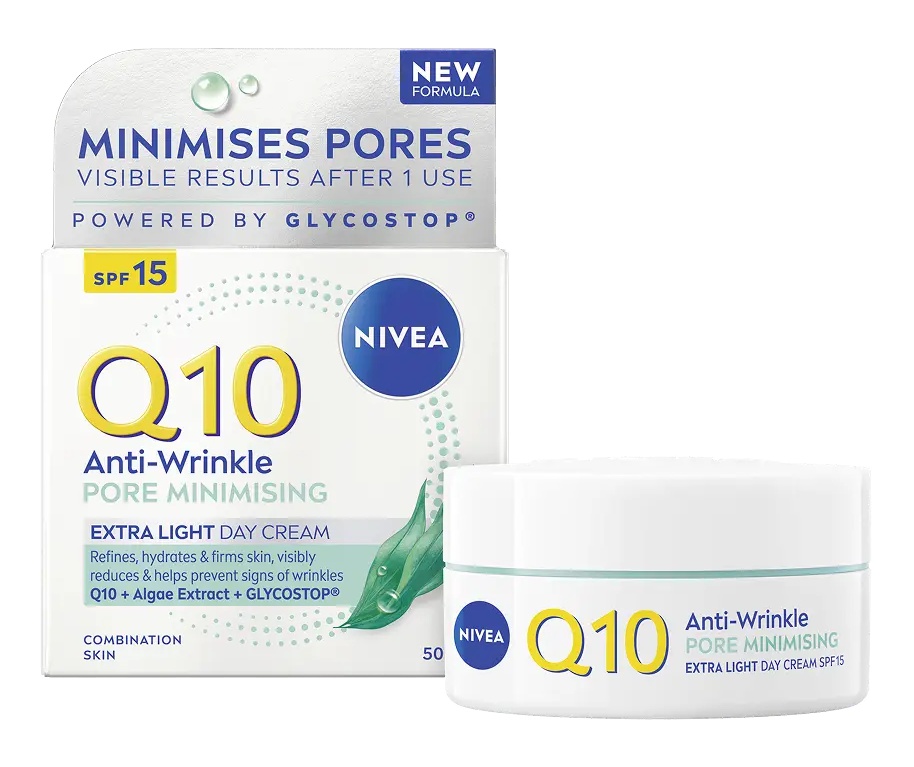
Q10 Anti-Wrinkle Pore Minimizing Day Cream SPF 15
Ingredients overview
Highlights
Key Ingredients
Other Ingredients
Skim through
Nivea Q10 Anti-Wrinkle Pore Minimizing Day Cream SPF 15Ingredients explained
Good old water, aka H2O. The most common skincare ingredient of all. You can usually find it right in the very first spot of the ingredient list, meaning it’s the biggest thing out of all the stuff that makes up the product.
It’s mainly a solvent for ingredients that do not like to dissolve in oils but rather in water.
Once inside the skin, it hydrates, but not from the outside - putting pure water on the skin (hello long baths!) is drying.
One more thing: the water used in cosmetics is purified and deionized (it means that almost all of the mineral ions inside it is removed). Like this, the products can stay more stable over time.
- A natural moisturizer that’s also in our skin
- A super common, safe, effective and cheap molecule used for more than 50 years
- Not only a simple moisturizer but knows much more: keeps the skin lipids between our skin cells in a healthy (liquid crystal) state, protects against irritation, helps to restore barrier
- Effective from as low as 3% with even more benefits for dry skin at higher concentrations up to 20-40%
- High-glycerin moisturizers are awesome for treating severely dry skin
- It's a super common and super debated skincare ingredient
- It has several benefits: great solvent, penetration enhancer, creates cosmetically elegant, light formulas, great astringent and antimicrobial
- It can be very drying if it's in the first few ingredients on an ingredient list
- Some experts even think that regular exposure to alcohol damages skin barrier and causes inflammation though it's a debated opinion (read more in geeky details tab)
An often used emollient with a light and silky feel. It's very mild to both skin and eyes and spreads nicely and easily. It's often used in sunscreens as it's also an excellent solvent for sunscreen agents.
An extremely common multitasker ingredient that gives your skin a nice soft feel (emollient) and gives body to creams and lotions. It also helps to stabilize oil-water mixes (emulsions), though it does not function as an emulsifier in itself. Its typical use level in most cream type formulas is 2-3%.
It’s a so-called fatty alcohol, a mix of cetyl and stearyl alcohol, other two emollient fatty alcohols. Though chemically speaking, it is alcohol (as in, it has an -OH group in its molecule), its properties are totally different from the properties of low molecular weight or drying alcohols such as denat. alcohol. Fatty alcohols have a long oil-soluble (and thus emollient) tail part that makes them absolutely non-drying and non-irritating and are totally ok for the skin.
A super common, waxy, white, solid stuff that helps water and oil to mix together, gives body to creams and leaves the skin feeling soft and smooth.
Chemically speaking, it is the attachment of a glycerin molecule to the fatty acid called stearic acid. It can be produced from most vegetable oils (in oils three fatty acid molecules are attached to glycerin instead of just one like here) in a pretty simple, "green" process that is similar to soap making. It's readily biodegradable.
It also occurs naturally in our body and is used as a food additive. As cosmetic chemist Colins writes it, "its safety really is beyond any doubt".
A chemical sunscreen agent that gives strong protection in the UVB (280-320nm) range with its peak protection at 306 nm. Its special property is that unlike most sunscreen agents, it is not oil but water soluble, so it is ideal to create light, oily skin compatible formulas. It is also fairly photostable and can be used to protect other less stable UV filters (like famous UVA blocker, avobenzone) in the formula. It is approved worldwide and can be used up to 4% in the US and up to 8% in the EU.
A clear, colorless emollient ester (oily liquid from isopropyl alcohol + palmitic acid) that makes the skin nice and smooth. It has very good spreading properties and gives a silky touch to the products.
The famous Avobenzone. It is a special snowflake as it is the only globally available chemical sunscreen agent that provides proper UVA protection (in the US, new generation sunscreen agents are not approved because of impossible FDA regulations). It is the global gold standard of UVA protection and is the most used UVA sunscreen in the world.
It gives very good protection across the whole UVA range (310-400 nm that is both UVA1 and UVA2) with a peak protection at 360 nm. The problem with it, though, is that it is not photostable and degrades in the sunlight. Wikipedia says that avobenzone loses 36% of its UV-absorption capacity after just one hour of sunlight (yep, this is one of the reasons why sunscreens have to be reapplied after a few hours).
The cosmetic's industry is trying to solve the problem by combining avobenzone with other UV filters that enhance its stability (like octocrylene, Tinosorb S or Ensulizole) or by encapsulating it and while both solutions help, neither is perfect. Interestingly, the combination of avobenzone with mineral sunscreens (that is titanium dioxide and zinc oxide) is not a good idea. In the US, it is flat out prohibited as avobenzone becomes unstable when combined with mineral sunscreens.
As for safety, avobenzone has a pretty good safety profile. It counts as non-irritating, and unlike some other chemical sunscreens, it shows no estrogenic effect. The maximum concentration of avobenzone permitted is 5% in the EU and 3% in the US.
A colorless to light yellowish oily liquid that works as a UVB (280-320nm) sunscreen filter with a peak absorbance at 306 nm. It's not a strong filter in itself, it's always used in combination with other sunscreen agents to further enhance the SPF and to solubilize other solid UV filters.
It has a good safety profile and is allowed to be used at a max concentration of 5% both in the US and in Europe (10% is allowed in Japan).
Its INCI name is a bit of a mouthful, but Bis-Ethylhexyloxyphenol Methoxyphenyl Triazine is worth recognizing it as it is one of the best sunscreen agents known today. Unfortunately, it's not FDA-approved so you will not find it in sunscreens coming from the US (not because it's not good, but because US regulations make it impossible for newer sunscreen agents to get approved), but it is widely available in other parts of the world like Europe, Australia or Asia.
It is a broad-spectrum (covers the whole UVB and UVA range, 280-400 nm) chemical sunscreen agent with peak protections at about 310 and 345 nm and unlike older UV filters, it's very photostable. It hardly deteriorates in the presence of UV light and it's also useful in stabilizing other less stable sunscreen agents, like the famous UVA protector, avobenzone.
It's a new generation sunscreen agent that was specifically designed for high SPF and good UVA protection and based on a 2007 study that compared 18 sunscreen agents available in the EU it really had the best SPF protection (they used the highest concentration allowed by EU regulations from each 18 sunscreens and Trinosorb S gave an SPF 20 all by itself).
It is an oil-soluble, slightly yellowish powder that is not absorbed into the skin too much. This is good news for a sunscreen agent as it needs to be on the surface of the skin to do its job properly. Regarding Bis-Ethylhexyloxyphenol Methoxyphenyl Triazine side effects, we have good news here as well: it has a great safety profile and unlike a couple of other chemical sunscreens, Trinosorb S (and M) does not show estrogenic activity.
Overall, we think Trinosorb S is one of the best sunscreen options available today.
Are you into sunscreen agents? We have shiny explanations (along with product lists) about others as well:
- Methylene Bis-Benzotriazolyl Tetramethylbutylphenol, aka Tinosorb M, the good buddy of our current molecule Tinosorb S
- Tris-Biphenyl Triazine, aka Tinosorb A2B, the newest addition to the Tinosorb family that protects strongly in an in-between wavelength that most other filters miss
- Ethylhexyl Triazone, aka Uvinul T 150, another new generation sunscreen agent with super-high UVB protection
- Diethylamino Hydroxybenzoyl Hexyl Benzoate, aka Uvinul A Plus, a new generation sunscreen for UVA protection
 We don't have description for this ingredient yet.
Thanks to Nivea, Q10 is a pretty well-known ingredient and the fame and Beiersdorf's (the parent company of Nivea) obsession with it are not for no reason. It's an antioxidant found naturally in human cells where it plays a big role in energy production.
In fact, it's so important for energy production that if taken as an oral supplement it has a caffeine-like effect and if taken at night you will probably not sleep very well (so you should take it in the morning). Q10 supplementation is not a bad idea: it not only gives you energy but research also shows that oral Q10 increases the Q10 level of the skin (of course, it decreases with age like pretty much every good thing in the skin) and may help to reduce wrinkles. If you are not for supplements, dietary sources include fish, spinach, and nuts.
As for skincare, Q10 comes in the form of a yellow, oil-soluble powder that's shown to absorb into the upper layer of the skin and act there like an awesome antioxidant. It not only has preventative effects but might also be able to reduce the depth of wrinkles, though 0.3% Q10 was used in the study that counts as really high (products containing that much should be very yellow!).
We don't have description for this ingredient yet.
We don't have description for this ingredient yet.
We don't have description for this ingredient yet.
A spray-dried or freeze-dried version of Aloe Leaf Juice. The point of both drying methods is to make water evaporate from the juice and leave just the "useful" components behind.
So the aloe powder has similar soothing, emollient and moisturizing properties as the juice. You can read a bit more about the juice here.
We don't have description for this ingredient yet.
- Green tea is one of the most researched natural ingredients
- The active parts are called polyphenols, or more precisely catechins (EGCG being the most abundant and most active catechin)
- There can be huge quality differences between green tea extracts. The good ones contain 50-90% catechins (and often make the product brown and give it a distinctive smell)
- Green tea is proven to be a great antioxidant, UV protectant, anti-inflammatory, anticarcinogenic and antimicrobial
- Because of these awesome properties green tea is a great choice for anti-aging and also for skin diseases including rosacea, acne and atopic dermatitis
We don't have description for this ingredient yet.
A white to beige powder that is described as the golden standard emulsifier for emulsions (oil+water mixtures) that are difficult to stabilize. It is especially popular in sunscreens as it can boost SPF protection and increase the water-resistance of the formula.
We don't have description for this ingredient yet.
A fatty acid that can be found naturally in the skin. In fact, it's the most common saturated fatty acid found in animals and plants.
As for skincare, it can make the skin feel nice and smooth in moisturizers (emollient) or it can act as a foam building cleansing agent in cleansers. It's also a very popular ingredient in shaving foams.
A common multi-tasker fatty acid. It makes your skin feel nice and smooth (emollient), gives body to cream type products and helps to stabilize water and oil mixes (aka emulsions).
A 14 carbon length fatty acid that can be naturally found in nutmeg, palm kernel oil, coconut oil and butter fat. It's used as a foam building cleansing agent. Paula Begoun writes that it can be a bit drying to the skin.
We don't have description for this ingredient yet.
A common fatty acid that can be found in lots of plant oils. Its name, "oleic", means derived from olive oil, a plant oil rich in oleic acid, but avocado, macadamia and marula oils, just to name a few, are also oleic rich.
Its chemical structure is monounsaturated, meaning it has one double bond (cis-9) that makes it less kinky than polyunsaturated fatty acids with multiple double bonds. Less kinkiness means that oleic acid and OA-rich oils are a bit thicker and heavier than their LA-rich siblings.
Maybe this thickness is the reason that Oleic acid is considered comedogenic, and if you have acne-prone skin avoid OA-rich plant oils, and choose linoleic acid-rich versions instead.
The thickness of OA also means that OA-rich oils are considered more nourishing and moisturizing than their LA-rich counterparts, and are generally considered to be more suitable for dry, mature skin types.
As for oleic acid in its free form (and by free we mean that it is not bound up in a triglyceride structure like it is in oils), it mostly serves as an emulsifier or emulsion stabilizer in small amounts in regular cosmetic products. It is also quite well researched and is used in the pharmaceutical industry as a penetration enhancer.
A 12 carbon length fatty acid that can be found naturally in coconut milk, coconut oil, laurel oil, and palm kernel oil. It's also in breast milk. As a skincare ingredient, it can be used as an emulsifier or as a cleansing agent.
What's more, there is emerging research about lauric acid being a good anti-acne ingredient. A 2009 study found that the lowest concentration to prevent evil acne-causing P. acnes growth of lauric acid is over 15 times lower than that of gold standard anti-acne ingredient benzoyl peroxide.
Though the studies are only in-vitro (made in the lab, not on real people), and it also has a high comedogenicity index, it might be worth a try if you are prone to inflamed acne (the type that's caused by P. acnes bacteria).
A super common emollient that makes your skin feel nice and smooth. It comes from coconut oil and glycerin, it’s light-textured, clear, odorless and non-greasy. It’s a nice ingredient that just feels good on the skin, is super well tolerated by every skin type and easy to formulate with. No wonder it’s popular.
A handy multifunctional ingredient that works as a preservative booster, as well as an antioxidant and soothing agent.
It's one of the most commonly used thickeners and emulsion stabilizers. If the product is too runny, a little xanthan gum will make it more gel-like. Used alone, it can make the formula sticky and it is a good team player so it is usually combined with other thickeners and so-called rheology modifiers (helper ingredients that adjust the flow and thus the feel of the formula). The typical use level of Xantha Gum is below 1%, it is usually in the 0.1-0.5% range.
Btw, Xanthan gum is all natural, a chain of sugar molecules (polysaccharide) produced from individual sugar molecules (glucose and sucrose) via fermentation. It’s approved by Ecocert and also used in the food industry (E415).
A soft, white powder that can be used as a talc replacement in body powders or in pressed powders. It also has some oil absorbing properties and gives increased cushion and richness to emulsion-type formulas.
A common helper ingredient that works as a so-called chelating agent. It helps products to remain nice and stable for a longer time by neutralizing the metal ions in the formula (that usually get into there from water) that would otherwise cause some not so nice changes.
Citric acid comes from citrus fruits and is an AHA. If these magic three letters don’t tell you anything, click here and read our detailed description on glycolic acid, the most famous AHA.
So citric acid is an exfoliant, that can - just like other AHAs - gently lift off the dead skin cells of your skin and make it more smooth and fresh.
There is also some research showing that citric acid with regular use (think three months and 20% concentration) can help sun-damaged skin, increase skin thickness and some nice hydrating things called glycosaminoglycans in the skin.
But according to a comparative study done in 1995, citric acid has less skin improving magic properties than glycolic or lactic acid. Probably that’s why citric acid is usually not used as an exfoliant but more as a helper ingredient in small amounts to adjust the pH of a formulation.
The unfancy name for it is lye. It’s a solid white stuff that’s very alkaline and used in small amounts to adjust the pH of the product and make it just right.
For example, in case of AHA or BHA exfoliants, the right pH is super-duper important, and pH adjusters like sodium hydroxide are needed.
BTW, lye is not something new. It was already used by ancient Egyptians to help oil and fat magically turn into something else. Can you guess what? Yes, it’s soap. It still often shows up in the ingredient list of soaps and other cleansers.
Sodium hydroxide in itself is a potent skin irritant, but once it's reacted (as it is usually in skin care products, like exfoliants) it is totally harmless.
Sodium chloride is the fancy name of salt. Normal, everyday table salt.
If (similar to us) you are in the weird habit of reading the label on your shower gel while taking a shower, you might have noticed that sodium chloride is almost always on the ingredient list. The reason for this is that salt acts as a fantastic thickener in cleansing formulas created with ionic cleansing agents (aka surfactants) such as Sodium Laureth Sulfate. A couple of percents (typically 1-3%) turns a runny surfactant solution into a nice gel texture.
If you are into chemistry (if not, we understand, just skip this paragraph), the reason is that electrolytes (you know, the Na+ and Cl- ions) screen the electrostatic repulsion between the head groups of ionic surfactants and thus support the formation of long shaped micelles (instead of spherical ones) that entangle like spaghetti, and viola, a gel is formed. However, too much of it causes the phenomenon called "salting out", and the surfactant solution goes runny again.
Other than that, salt also works as an emulsion stabilizer in water-in-oil emulsions, that is when water droplets are dispersed in the outer oil (or silicone) phase. And last but not least, when salt is right at the first spot of the ingredient list (and is not dissolved), the product is usually a body scrub where salt is the physical exfoliating agent.
We don't have description for this ingredient yet.
A helper ingredient that helps to make the products stay nice longer, aka preservative. It works mainly against fungi.
It’s pH dependent and works best at acidic pH levels (3-5). It’s not strong enough to be used in itself so it’s always combined with something else, often with potassium sorbate.
It’s pretty much the current IT-preservative. It’s safe and gentle, but even more importantly, it’s not a feared-by-everyone-mostly-without-scientific-reason paraben.
It’s not something new: it was introduced around 1950 and today it can be used up to 1% worldwide. It can be found in nature - in green tea - but the version used in cosmetics is synthetic.
Other than having a good safety profile and being quite gentle to the skin it has some other advantages too. It can be used in many types of formulations as it has great thermal stability (can be heated up to 85°C) and works on a wide range of pH levels (ph 3-10).
It’s often used together with ethylhexylglycerin as it nicely improves the preservative activity of phenoxyethanol.
Exactly what it sounds: nice smelling stuff put into cosmetic products so that the end product also smells nice. Fragrance in the US and parfum in the EU is a generic term on the ingredient list that is made up of 30 to 50 chemicals on average (but it can have as much as 200 components!).
If you are someone who likes to know what you put on your face then fragrance is not your best friend - there's no way to know what’s really in it.
Also, if your skin is sensitive, fragrance is again not your best friend. It’s the number one cause of contact allergy to cosmetics. It’s definitely a smart thing to avoid with sensitive skin (and fragrance of any type - natural is just as allergic as synthetic, if not worse!).
CI 42090 or Blue 1 is a super common synthetic colorant in beauty & food. Used alone, it adds a brilliant smurf-like blue color, combined with Tartrazine, it gives the fifty shades of green.
You may also want to take a look at...
| what‑it‑does | solvent |
| what‑it‑does | skin-identical ingredient | moisturizer/humectant |
| irritancy, com. | 0, 0 |
| what‑it‑does | antimicrobial/antibacterial | solvent | viscosity controlling |
| what‑it‑does | emollient | antimicrobial/antibacterial |
| what‑it‑does | emollient | viscosity controlling | emulsifying | surfactant/cleansing |
| irritancy, com. | 1, 2 |
| what‑it‑does | emollient | emulsifying |
| irritancy, com. | 0, 1 |
| what‑it‑does | sunscreen |
| what‑it‑does | emollient |
| irritancy, com. | 1, 3-4 |
| what‑it‑does | sunscreen |
| what‑it‑does | sunscreen |
| irritancy, com. | 0, 0 |
| what‑it‑does | sunscreen |
| what‑it‑does | antioxidant |
| what‑it‑does | emollient | moisturizer/humectant |
| what‑it‑does | soothing | moisturizer/humectant |
| what‑it‑does | emollient | soothing |
| what‑it‑does | antioxidant | soothing |
| what‑it‑does | emollient | emulsifying | viscosity controlling |
| what‑it‑does | emulsifying | surfactant/cleansing |
| what‑it‑does | surfactant/cleansing |
| what‑it‑does | skin-identical ingredient | emollient | emulsifying |
| irritancy, com. | 0, 2 |
| what‑it‑does | emollient | viscosity controlling |
| irritancy, com. | 0, 2-3 |
| what‑it‑does | surfactant/cleansing | emulsifying | perfuming |
| irritancy, com. | 0, 3 |
| what‑it‑does | surfactant/cleansing | emulsifying |
| what‑it‑does | emollient | emulsifying |
| what‑it‑does | anti-acne | surfactant/cleansing | emulsifying |
| irritancy, com. | 1, 4 |
| what‑it‑does | emollient |
| what‑it‑does | antioxidant | preservative |
| what‑it‑does | viscosity controlling |
| what‑it‑does | viscosity controlling |
| what‑it‑does | chelating |
| what‑it‑does | buffering |
| what‑it‑does | buffering |
| what‑it‑does | viscosity controlling |
| what‑it‑does | viscosity controlling |
| what‑it‑does | preservative |
| what‑it‑does | preservative |
| what‑it‑does | perfuming |
| what‑it‑does | colorant |