




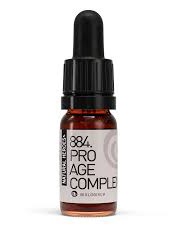
Pro-age Complex
Highlights
Key Ingredients
Skim through
| Ingredient name | what-it-does | irr., com. | ID-Rating |
|---|---|---|---|
| Carthamus Tinctorius Seed Oil | antioxidant, emollient | 0, 0-2 | goodie |
| Spilanthes Acmella Flower/Leaf/Stem Extract | antimicrobial/antibacterial | ||
| Astragalus Membranaceus Root Extract | antioxidant, emollient | goodie | |
| Ubiquinone | antioxidant | goodie | |
| Tocopherol | antioxidant | 0-3, 0-3 | goodie |
Natural Heroes Pro-age ComplexIngredients explained
The oil coming from the seeds of the yellow flowered safflower plant. Similar to other plant oils, it's loaded with nourishing and moisturizing fatty acids: it's a high linoleic acid oil (70%) and has only smaller amounts of oleic acid (11%) (this might be great for acne-prone skin). It also contains antioxidant vitamin E (44mg/100g alpha-tocopherol).
 We don't have description for this ingredient yet.
Astragalus Membranaceus, or Huangqi as the Chinese call it, is one of their most important medicinal herbs that is traditionally used to strengthen "qi", the body’s life force. It has a bunch of magic abilities including tonic, liver-protecting, immunomodulating, antihyperglycemic, anti-inflammatory, antioxidant, and antiviral properties.
Modern research does prove that Huangqi is a valuable medicinal herb and contains plenty of bioactive compounds such as saponins, flavonoids, and polysaccharides. As for skincare and Huangqi, it is well known and used for its general tonic and skin reinforcing properties, as well as for its anti-inflammatory and antioxidant action.
On top of that, we also found a manufacturer claiming that Astragalus Membranaceus Root Extract combines anti-aging and anti-blemish properties so it is especially useful for aging, acne-prone skin. In their in-vivo (made on real people) studies, 2% of liposomal Huangqi increased skin hydration, firmness, and smoothness by 20% after 14 days and decreased "blemish-prone skin signs" by 10-15% after 42 days.
Thanks to Nivea, Q10 is a pretty well-known ingredient and the fame and Beiersdorf's (the parent company of Nivea) obsession with it are not for no reason. It's an antioxidant found naturally in human cells where it plays a big role in energy production.
In fact, it's so important for energy production that if taken as an oral supplement it has a caffeine-like effect and if taken at night you will probably not sleep very well (so you should take it in the morning). Q10 supplementation is not a bad idea: it not only gives you energy but research also shows that oral Q10 increases the Q10 level of the skin (of course, it decreases with age like pretty much every good thing in the skin) and may help to reduce wrinkles. If you are not for supplements, dietary sources include fish, spinach, and nuts.
As for skincare, Q10 comes in the form of a yellow, oil-soluble powder that's shown to absorb into the upper layer of the skin and act there like an awesome antioxidant. It not only has preventative effects but might also be able to reduce the depth of wrinkles, though 0.3% Q10 was used in the study that counts as really high (products containing that much should be very yellow!).
- Primary fat-soluble antioxidant in our skin
- Significant photoprotection against UVB rays
- Vit C + Vit E work in synergy and provide great photoprotection
- Has emollient properties
- Easy to formulate, stable and relatively inexpensive
You may also want to take a look at...
| what‑it‑does | antioxidant | emollient |
| irritancy, com. | 0, 0-2 |
| what‑it‑does | antimicrobial/antibacterial |
| what‑it‑does | antioxidant | emollient |
| what‑it‑does | antioxidant |
| what‑it‑does | antioxidant |
| irritancy, com. | 0-3, 0-3 |