




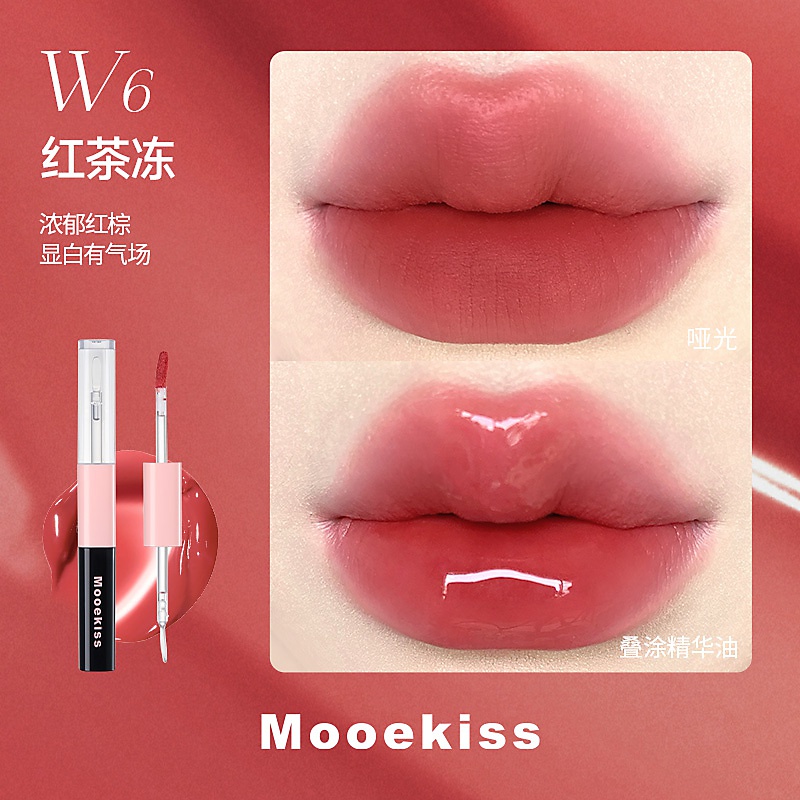
Dual Effect Essence Lip Gloss-w6
Ingredients overview
Highlights
Key Ingredients
Other Ingredients
Skim through
Mooekiss Dual Effect Essence Lip Gloss-w6Ingredients explained
Probably the most common silicone of all. It is a polymer (created from repeating subunits) molecule and has different molecular weight and thus different viscosity versions from water-light to thick liquid.
As for skincare, it makes the skin silky smooth, creates a subtle gloss and forms a protective barrier (aka occlusive). Also, works well to fill in fine lines and wrinkles and give skin a plump look (of course that is only temporary, but still, it's nice). There are also scar treatment gels out there using dimethicone as their base ingredient. It helps to soften scars and increase their elasticity.
As for hair care, it is a non-volatile silicone meaning that it stays on the hair rather than evaporates from it and smoothes the hair like no other thing. Depending on your hair type, it can be a bit difficult to wash out and might cause some build-up (btw, this is not true to all silicones, only the non-volatile types).
Methyl Trimethicone is a very light, volatile silicone (it evaporates from the skin rather than absorbs into it) that's similar to super commonly used Cyclopentasiloxane but it dries even faster when applied to the skin.
 We don't have description for this ingredient yet.
A high-molecular-weight silicone elastomer (rubber-like elastic material) that is usually blended with a base silicone fluid (such as dimethicone or cyclopentasiloxane) to give the formula a silky smooth feel and to act as a thickening agent.
Exactly what it sounds: nice smelling stuff put into cosmetic products so that the end product also smells nice. Fragrance in the US and parfum in the EU is a generic term on the ingredient list that is made up of 30 to 50 chemicals on average (but it can have as much as 200 components!).
If you are someone who likes to know what you put on your face then fragrance is not your best friend - there's no way to know what’s really in it.
Also, if your skin is sensitive, fragrance is again not your best friend. It’s the number one cause of contact allergy to cosmetics. It’s definitely a smart thing to avoid with sensitive skin (and fragrance of any type - natural is just as allergic as synthetic, if not worse!).
An emollient ester (basically an oil like liquid) with a light, elegant and silky feel. It gives a matte finish to the products.
It often comes together with two other esters (called Tridecyl Stearate and Tridecyl Trimellitate) as the three of them can be blended so that they mimic very closely the aesthetic and textural properties of controversial, but nice feeling mineral oil.
We don't have description for this ingredient yet.
You probably know olive oil from the kitchen as a great and healthy option for salad dressing but it's also a great and healthy option to moisturize and nourish the skin, especially if it's on the dry side.
Similar to other emollient plant oils, it's loaded with nourishing fatty acids: oleic is the main component (55-83%), and also contains linoleic (3.5-20%) and palmitic acids (7-20%). It also contains antioxidant polyphenols, tocopherols (types of vitamin E) and carotenoids and it's one of the best plant sources of skin-identical emollient, Squalene.
Overall, a great option for dry skin but less so for acne-prone or damaged skin.
The oil coming from the seeds of the nice, little, yellow-flowered plant called Evening Primrose. Similar to other plant oils, it's loaded with nourishing and moisturizing fatty acids. It's a very rich source of linoleic acid (66-76%), and also contains the soothing and healing superstar fatty acid, gamma-linolenic acid (aka GLA, 7-12%) (Btw, the richest known source of GLA is the borage oil, but evening primrose still counts as a very good source of it). It also contains oleic acid, but not too much around 6-15%.
Since the 1980's, EPO is a well-known food supplement and there are quite a lot of studies examining what happens if you take it orally. It seems to be helpful with a bunch of things: atopic dermatitis, dry eyes, brittle nails, sunburn and even acne.
As for the skin, it's a great hydrating plant oil, that can also reduce inflammation and irritation. It's a superb healing agent that can truly help dry skin, not just on the surface by covering it (and not letting water to evaporate) but by initiating structural changes within the skin. If that's not enough, it also helps skin cell regeneration.
All in all, a real goodie especially for dry, easily irritated skin.
A super common emollient that makes your skin feel nice and smooth. It comes from coconut oil and glycerin, it’s light-textured, clear, odorless and non-greasy. It’s a nice ingredient that just feels good on the skin, is super well tolerated by every skin type and easy to formulate with. No wonder it’s popular.
The emollient plant oil that comes from almonds. Similar to other plant oils, it is loaded with skin-nourishing fatty acids (oleic acid - 55-86% and linoleic acid 7-35%) and contains several other skin goodies such as antioxidant vitamin E and vitamin B versions.
It's a nice, basic oil that is often used due to its great smoothing, softening and moisturizing properties. It's also particularly good at treating dry brittle nails (source).
Unless you live under a rock you must have heard about shea butter. It's probably the most hyped up natural butter in skincare today. It comes from the seeds of African Shea or Karite Trees and used as a magic moisturizer and emollient.
But it's not only a simple emollient, it regenerates and soothes the skin, protects it from external factors (such as UV rays or wind) and is also rich in antioxidants (among others vitamin A, E, F, quercetin and epigallocatechin gallate). If you are looking for rich emollient benefits + more, shea is hard to beat.
The emollient plant oil coming from the kernel (the seed of the seed) of the delicious apricot fruit. Like other plant oils, it contains antioxidant vitamin E and nourishing fatty acids (mostly oleic acid 54-74%, linoleic acid 12-35%).
It's a nice general purpose emollient, has nourishing and moisturizing properties (as a high oleic oil it's ideal for dry skin types) and is quite easily absorbed into the skin.
When it comes to cosmetic oils and hype, argan oil is for sure leading the way. Dubbed as the "liquid gold of Morocco", we have to admit we have some trouble determining why this oil enjoys such a special miracle status. Not that it's not good, it is good, even great but reading the research about argan and a bunch of other plant oils we just do not see the big, unique differentiating factor (though that might be our fault not reading enough, obvs.)
So, argan oil comes from the kernel of the argan fruit that comes from the argan tree that grows only in Morocco. The tree is slow growing and getting the oil is a hard job. The traditional process is that the ripe argan fruits fall from the tree, then goats eat them up and poop out the seeds. The seeds are collected and smashed with a stone to get the kernels inside. This part is the hard one as the seeds have extremely hard shells. Once the kernels are obtained, the oil is pressed out from them (the kernels contain about 50% oil).
As for skincare, argan oil is loaded with lots of skin goodies (but so are many other plant oils): it contains 80% nourishing and moisturizing unsaturated fatty acids, mainly oleic (38-50%), linoleic (28-38%) and palmitic (10-18%). It also contains a relatively large amount of antioxidant vitamin E (600-900 mg/kg, about twice as much as olive), small amounts of antioxidant phenols (including caffeic acid, ferulic acid, and epicatechin), as well as some rare sterols with soothing and anti-inflammatory properties.
Thanks to all the above goodness in argan oil, it can greatly nourish and moisturize the skin and hair. It's also claimed to be able to neutralize collagen-damaging free radicals, help reduce scars, and revitalize and improve skin elasticity. You can even read that argan might help acne-prone skin, but being a high oleic oil, we would be careful with that.
All in all, argan oil is a real goodie but we do not fully understand the special miracle status it enjoys.
Jojoba is a drought resistant evergreen shrub native to South-western North America. It's known and grown for jojoba oil, the golden yellow liquid coming from the seeds (about 50% of the weight of the seeds will be oil).
At first glance, it seems like your average emollient plant oil: it looks like an oil and it's nourishing and moisturizing to the skin but if we dig a bit deeper, it turns out that jojoba oil is really special and unique: technically - or rather chemically - it's not an oil but a wax ester (and calling it an oil is kind of sloppy).
So what the heck is a wax ester and why is that important anyway? Well, to understand what a wax ester is, you first have to know that oils are chemically triglycerides: one glycerin + three fatty acids attached to it. The fatty acids attached to the glycerin vary and thus we have many kinds of oils, but they are all triglycerides. Mother Nature created triglycerides to be easily hydrolyzed (be broken down to a glycerin + 3 fatty acid molecules) and oxidized (the fatty acid is broken down into small parts) - this happens basically when we eat fats or oils and our body generates energy from it.
Mother Nature also created wax esters but for a totally different purpose. Chemically, a wax ester is a fatty acid + a fatty alcohol, one long molecule. Wax esters are on the outer surface of several plant leaves to give them environmental protection. 25-30% of human sebum is also wax esters to give us people environmental protection.
So being a wax ester results in a couple of unique properties: First, jojoba oil is extremely stable. Like crazy stable. Even if you heat it to 370 C (698 F) for 96 hours, it does not budge. (Many plant oils tend to go off pretty quickly). If you have some pure jojoba oil at home, you should be fine using it for years.
Second, jojoba oil is the most similar to human sebum (both being wax esters), and the two are completely miscible. Acne.org has this not fully proven theory that thanks to this, jojoba might be able to "trick" the skin into thinking it has already produced enough sebum, so it might have "skin balancing" properties for oily skin.
Third, jojoba oil moisturizes the skin through a unique dual action: on the one hand, it mixes with sebum and forms a thin, non-greasy, semi-occlusive layer; on the other hand, it absorbs into the skin through pores and hair follicles then diffuses into the intercellular spaces of the outer layer of the skin to make it soft and supple.
On balance, the point is this: in contrast to real plant oils, wax esters were designed by Mother Nature to stay on the surface and form a protective, moisturizing barrier and jojoba oil being a wax ester is uniquely excellent at doing that.
Though it says fruit oil in its name, the rosehip fruit contains the seeds that contain the oil. So this one is the same as Rosa Canina Seed Oil, or Rosehip Oil, known for its high omega fatty acid content (linoleic acid - 51%, linolenic acid - 19% and oleic acid - 20%) and skin-regenerative properties.
There is a common misconception that rosehip oil contains vitamin C as the fruit itself does, but vitamin C is a water-soluble vitamin hence it is not contained in the oil. The antioxidant and regenerative properties of the oil probably come from the oil-soluble tocopherols (vitamin E) and carotenoids (pro-vitamin A). Read more here.
We don't have description for this ingredient yet.
We don't have description for this ingredient yet.
A multi-functional, silky feeling helper ingredient that can do quite many things. It's used as an emulsion stabilizer, solvent and a broad spectrum antimicrobial. According to manufacturer info, it's also a moisturizer and helps to make the product feel great on the skin. It works synergistically with preservatives and helps to improve water-resistance of sunscreens.
A really multi-functional helper ingredient that can do several things in a skincare product: it can bring a soft and pleasant feel to the formula, it can act as a humectant and emollient, it can be a solvent for some other ingredients (for example it can help to stabilize perfumes in watery products) and it can also help to disperse pigments more evenly in makeup products. And that is still not all: it can also boost the antimicrobial activity of preservatives.
If you have spotted ethylhexylglycerin on the ingredient list, most probably you will see there also the current IT-preservative, phenoxyethanol. They are good friends because ethylhexylglycerin can boost the effectiveness of phenoxyethanol (and other preservatives) and as an added bonus it feels nice on the skin too.
Also, it's an effective deodorant and a medium spreading emollient.
- It’s the second most researched AHA after glycolic acid
- It gently lifts off dead skin cells to reveal newer, fresher, smoother skin
- It also has amazing skin hydrating properties
- In higher concentration (10% and up) it improves skin firmness, thickness and wrinkles
- Choose a product where you know the concentration and pH value because these two greatly influence effectiveness
- Don’t forget to use your sunscreen (in any case but especially so next to an AHA product)
A four amino acid peptide with the amino sequence of glycine-glutamine-proline-arginine. It is attached to palmitic acid (a fatty acid) to increase oil solubility and skin penetration.
It works by reducing the production of the signal molecule, interleukin-6 (IL-6) which promotes inflammation in the skin and less inflammation means slower degradation of important things (like collagen) that results in younger looking skin for a longer time.
It works in synergy with its pal, Palmitoyl Tripeptide-1 in the famous Matrixyl 3000 complex. You can read some more about the famous duo here.
A really famous peptide that is part of Matrixyl 3000, the most sold peptide complex in the word. Before we go and find out what the big deal with Matrixyl 3000 is, let's just focus on Palmitoyl Tripeptide-1 itself for a bit.
It's a small three amino acid (they are the building blocks of all proteins) peptide with the amino sequence of glycine-histidine-lysine, or GHK. GHK is attached to palmitic acid (a fatty acid) to increase oil solubility and skin penetration.
The GHK part is the important one as it's a type I collagen fragment. When collagen naturally breaks down in the skin, the resulting peptide fragments signal to the skin that it should get to work and create some nice, new collagen. Adding in collagen fragment peptides, like GHK, might trick the skin into thinking that collagen has broken down and it's time to create some more.
Therefore, Palmitoyl Tripeptide-1 is believed to be able to stimulate collagen production in the skin, and more collagen means fewer wrinkles and younger looking skin.
In Matrixyl 3000, Palmitoyl Tripeptide-1 is coupled with Palmitoyl Tetrapeptide-7 and the duo works in synergy to reduce wrinkles and give younger looking skin. According to the manufacturer's in-vivo (made on real people) test, applying 3% Matrixyl 3000 twice a day for 2 months resulted in all of the following things:
- 39.4% reduction in surface occupied by deep wrinkles
- 32.9% reduction in main wrinkle density
- 19.9% reduction in main wrinkle average depth
- 16% improvement in roughness
- 16.2% in lifting effect
- 5.5% improvement in elasticity
- 15.5% improvement in skin tone
Manufacturer results, of course, always have to be taken with a pinch of salt, but if you like peptides, the Matryxil 3000 duo is one of the best-proven and most well-known ones and it's something that is worth trying.
You may also want to take a look at...
| what‑it‑does | emollient |
| irritancy, com. | 0, 1 |
| what‑it‑does | solvent |
| what‑it‑does | viscosity controlling |
| what‑it‑does | perfuming |
| what‑it‑does | emollient |
| what‑it‑does | antioxidant | emollient |
| irritancy, com. | 0, 0-2 |
| what‑it‑does | soothing | emollient |
| irritancy, com. | 2, 3 |
| what‑it‑does | emollient |
| what‑it‑does | emollient |
| irritancy, com. | 0, 1-3 |
| what‑it‑does | emollient |
| what‑it‑does | emollient |
| irritancy, com. | 0, 1-2 |
| what‑it‑does | antioxidant | emollient |
| what‑it‑does | emollient |
| irritancy, com. | 0, 0-2 |
| what‑it‑does | emollient |
| what‑it‑does | emulsifying |
| what‑it‑does | solvent | moisturizer/humectant |
| what‑it‑does | solvent |
| what‑it‑does | preservative |
| what‑it‑does | exfoliant | moisturizer/humectant | buffering |
| what‑it‑does | cell-communicating ingredient |
| what‑it‑does | cell-communicating ingredient |