




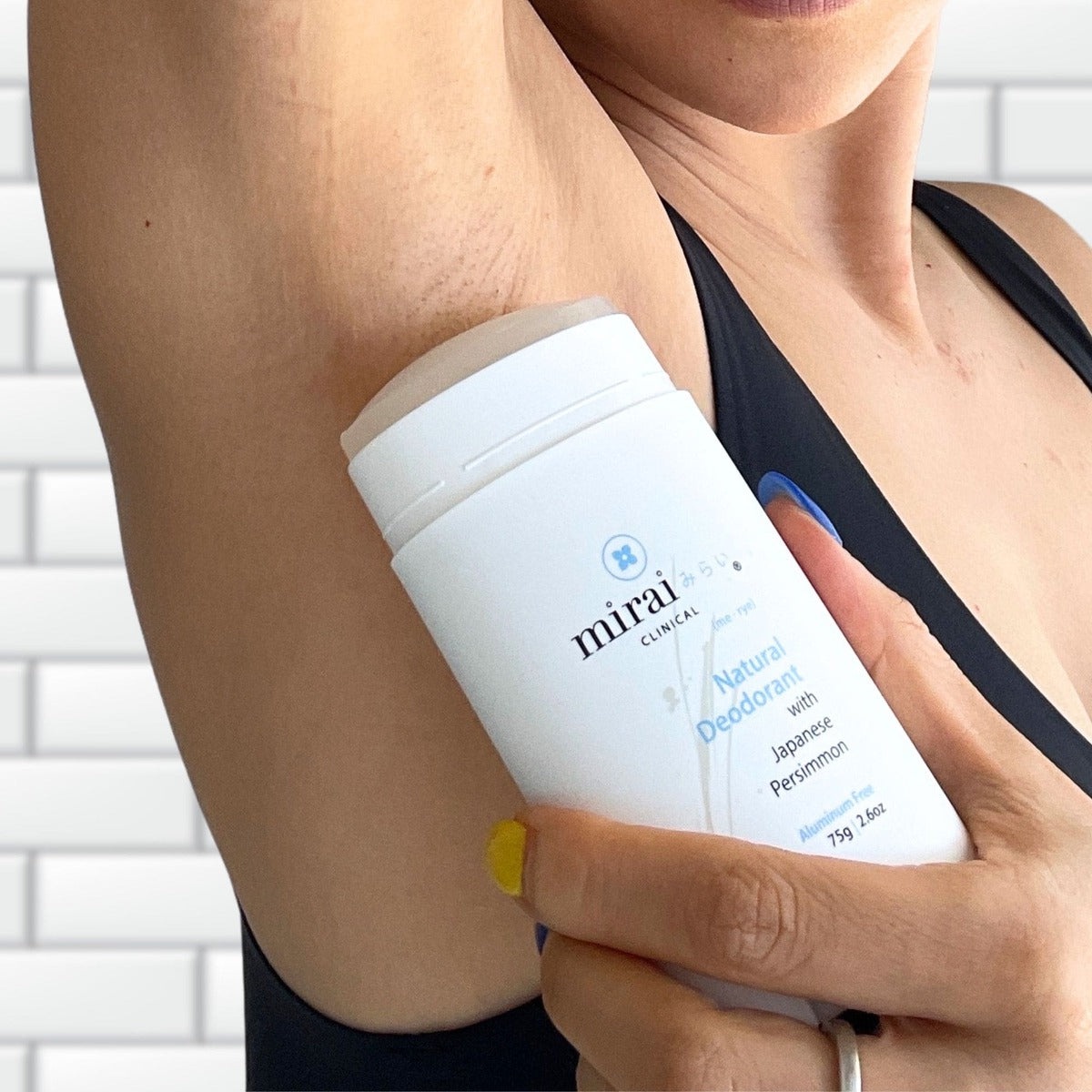
Ingredients overview
Highlights
Key Ingredients
Other Ingredients
Skim through
Mirai Aluminum Free Natural Deodorant With PersimmonIngredients explained
- It's a helper ingredient that improves the freeze-thaw stability of products
- It's also a solvent, humectant and to some extent a penetration enhancer
- It has a bad reputation among natural cosmetics advocates but cosmetic scientists and toxicology experts do not agree (read more in the geeky details section)
Good old water, aka H2O. The most common skincare ingredient of all. You can usually find it right in the very first spot of the ingredient list, meaning it’s the biggest thing out of all the stuff that makes up the product.
It’s mainly a solvent for ingredients that do not like to dissolve in oils but rather in water.
Once inside the skin, it hydrates, but not from the outside - putting pure water on the skin (hello long baths!) is drying.
One more thing: the water used in cosmetics is purified and deionized (it means that almost all of the mineral ions inside it is removed). Like this, the products can stay more stable over time.
A very classic, old-school cleansing agent, a soap (the sodium salt of Stearic Acid). It is known for its rich, creamy foam and being quite harsh on the skin.
If it's not in a soap bar, it can also function as an emulsifier or consistency agent.
 We don't have description for this ingredient yet.
A soft, white powder that can be used as a talc replacement in body powders or in pressed powders. It also has some oil absorbing properties and gives increased cushion and richness to emulsion-type formulas.
We don't have description for this ingredient yet.
Aloe Vera is one of today’s magic plants. It does have some very nice properties indeed, though famous dermatologist Leslie Baumann warns us in her book that most of the evidence is anecdotal and the plant might be a bit overhyped.
What research does confirm about Aloe is that it’s a great moisturizer and has several anti-inflammatory (among others contains salicylates, polysaccharides, magnesium lactate and C-glucosyl chromone) as well as some antibacterial components. It also helps wound healing and skin regeneration in general. All in all definitely a goodie.
We don't have description for this ingredient yet.
We don't have description for this ingredient yet.
It's a little helper ingredient coming from corn, rice or potato starch that can help to keep skin mat (absorbent), to stabilise emulsions, and to keep the product together (binding).
A sugar derived moisturizer that's part of a moisturizing trio called Aquaxyl. You can read more about its magic properties at xylitylglucoside.
We don't have description for this ingredient yet.
If you have spotted ethylhexylglycerin on the ingredient list, most probably you will see there also the current IT-preservative, phenoxyethanol. They are good friends because ethylhexylglycerin can boost the effectiveness of phenoxyethanol (and other preservatives) and as an added bonus it feels nice on the skin too.
Also, it's an effective deodorant and a medium spreading emollient.
The essential oil coming from the peel of the pink grapefruit. In general, the main component of citrus peel oils is limonene (around 90% for grapefruit peel), a super common fragrant ingredient that makes everything smell nice (but counts as a frequent skin sensitizer). Similar to other essential oils, grapefruit peel has also antibacterial and antifungal acitivity.
Other than that, citrus peels contain the problematic compounds called furanocoumarins that make them (mildly) phototoxic. So be careful with grapefruit peel oil, especially if it's in a product for daytime use.
We don't have description for this ingredient yet.
You may also want to take a look at...
| what‑it‑does | moisturizer/humectant | solvent |
| irritancy, com. | 0, 0 |
| what‑it‑does | solvent |
| what‑it‑does | surfactant/cleansing | emulsifying | viscosity controlling |
| what‑it‑does | surfactant/cleansing | emulsifying |
| what‑it‑does | viscosity controlling |
| what‑it‑does | soothing | moisturizer/humectant |
| what‑it‑does | viscosity controlling |
| what‑it‑does | antimicrobial/antibacterial |
| what‑it‑does | moisturizer/humectant |
| what‑it‑does | antimicrobial/antibacterial | emulsifying | moisturizer/humectant | surfactant/cleansing |
| what‑it‑does | preservative |
| what‑it‑does | perfuming |
| what‑it‑does | buffering |
| what‑it‑does | abrasive/scrub | buffering |