




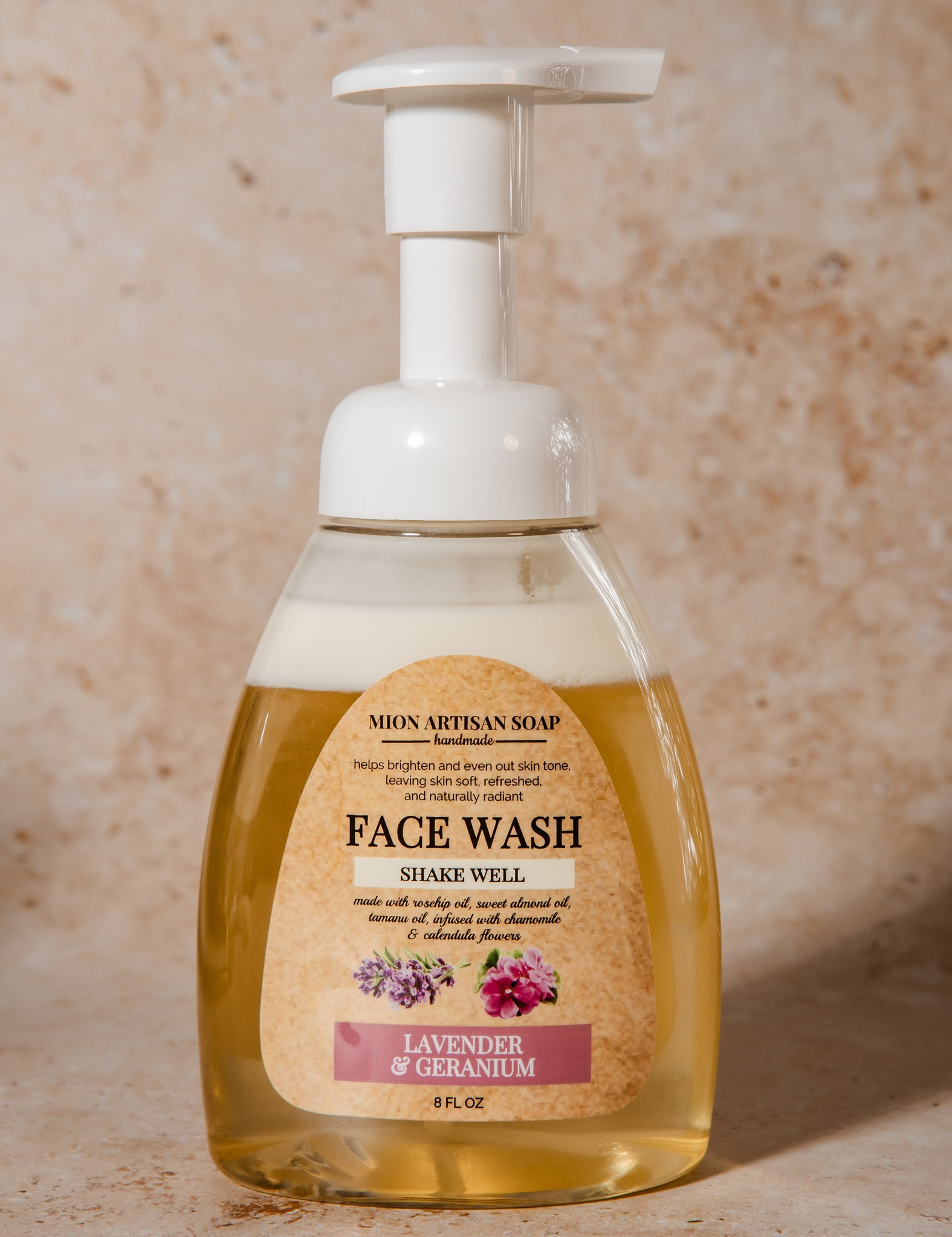
Face Wash | With Rose Hip And Tamanu Oils
Ingredients overview
Highlights
Other Ingredients
Skim through
| Ingredient name | what-it-does | irr., com. | ID-Rating |
|---|---|---|---|
| Organic Extra Virgin Coconut Oil | emollient, perfuming | 0, 4 | goodie |
| Avocado Oil | antioxidant, emollient | 0, 0-3 | goodie |
| Mango Butter | emollient | goodie | |
| Organic Castor Oil | emollient, perfuming | 0, 0-1 | |
| Distilled Water | solvent | ||
| Potassium Hydroxide | buffering | ||
| Organic Extra Virgin Rosehip Oil | emollient | ||
| Organic Tamanu Oil | soothing, emollient | goodie | |
| Sweet Almond Oil (Infused With Organic Chamomile And Organic Calendula Flowers) | emollient | 0, 1-3 | goodie |
| Lavender Essential Oil | antimicrobial/antibacterial, perfuming | icky | |
| Geranium Essential Oil | perfuming | icky |
Mion Artisan Soap Face Wash | With Rose Hip And Tamanu OilsIngredients explained
There is definitely some craze going on for coconut oil both in the healthy eating space (often claimed to be the healthiest oil to cook with but this is a topic for another site) and in the skin and hair care space.
We will talk here about the latter two and see why we might want to smear it all over ourselves. Chemically speaking, coconut oil has a unique fatty acid profile. Unlike many plant oils that mostly contain unsaturated fatty acids (fatty acids with double bonds and kinky structure such as linoleic or oleic), coconut oil is mostly saturated (fatty acids with single bonds only) and its most important fatty acid is Lauric Acid (about 50%). Saturated fatty acids have a linear structure that can stack nice and tight and hence they are normally solid at room temperature. Coconut oil melts around 25 °C so it is solid in the tub but melts on contact with the skin.
The saturated nature of coconut oil also means that it is a heavy-duty-oil ideal for dry skin types. A double-blind research confirmed that extra virgin coconut oil is as effective in treating xerosis (aka very dry skin) as mineral oil. Another study found that coconut oil is more effective than mineral oil in treating mild to moderate atopic dermatitis (aka eczema) in children.
So when it comes to dry skin, coconut oil is a goodie, no question there. The question is if it is good or bad for acne-prone skin. Its main fatty acid, Lauric Acid has some research showing that it is a promising ingredient against evil acne-causing bacteria, P. acnes but at the same time, both Lauric Acid and coconut oil have a very high comedogenic rating (4 out of 5). Though comedogenic ratings are not very reliable, anecdotal evidence (i.e. people commenting in forums) shows that people have mixed experiences. While some claim that it worked wonders on their acne others say that it gave them serious blackheads and zits. Try it at your own risk.
As for hair care, coconut oil has pretty solid research showing that it can penetrate into the hair very well (better than mineral oil and sunflower oil) and it can prevent hair protein loss as well as combing damage. If you have problems with damaged hair, split ends, coconut oil is worth trying as a pre- or/and post-wash treatment. Labmuffin has an awesome blogpost explaining in more detail why coconut oil is good for your hair.
A couple of other things worth mentioning: coconut oil might help with wound healing (promising animal study), it has some antifungal activity (against dermatophytes that cause the thing known as ringworm) and it also works as an insect repellent against black flies.
Overall, coconut oil is definitely a goodie for the hair and dry skin. If that warrants for the magic oil status it enjoys, we don't know.
The oil coming from the pulp of one of the most nutritious fruits in the world, the avocado. It's loaded with the nourishing and moisturizing fatty acid, oleic (70%) and contains some others including palmitic (10%) and linoleic acid (8%). It also contains a bunch of minerals and vitamins A, E and D.
Avocado oil has extraordinary skin penetration abilities and can nourish different skin layers. It's a very rich, highly moisturizing emollient oil that makes the skin smooth and nourished. Thanks to its vitamin E content it also has some antioxidant properties. As a high-oleic plant oil, it is recommended for dry skin.
The soft solid, off-white to ivory butter or oil coming from the kernel (the seed inside of the seed) of the Mango. Similar to many other plant oils, it's a great moisturizing and nourishing emollient oil. It has medium spreadability and gives skin a creamy-dry feel.
It's loaded with a bunch of good-for-the-skin stuff: it contains almost all of the essential amino acids, has several antioxidant phenolic compounds (including famous antioxidant ferulic acid) and is a rich source of nourishing fatty acids (like stearic and oleic acid).
All in all, a skin goodie especially for dry skin types.
Castor oil is sourced from the castor bean plant native to tropical areas in Eastern Africa and the Mediterranean Basin. It is an age-old ingredient (it’s over 4,000 years old!) with many uses including as a shoe polish, food additive and motor lubricant. You would be reasonable to think that putting shoe polish on your face wouldn’t be the best idea, but it turns out castor oil has some unique properties that make it a stalwart in thick and gloss-giving formulas (think lipsticks and highlighters).
So what is so special about it? The answer is its main fatty acid, called ricinoleic acid (85-95%). Unlike other fatty acids, ricinoleic acid has an extra water-loving part (aka -OH group) on its fatty chain that gives Castor Oil several unique properties. First, it is thicker than other oils, then its solubility is different (e.g. dissolves in alcohol but not in mineral oil), and it allows all kinds of chemical modifications other oils do not, hence the lots of Castor oil-derived ingredients. It is also more glossy than other oils, in fact, it creates the highest gloss of all natural oils when applied to the skin. Other than that, it is a very effective emollient and occlusive that reduces skin moisture loss so it is quite common in smaller amounts in moisturizers.
While it is very unlikely (and this is true for pretty much every ingredient), cases of reactions to castor oil have been reported, so if your skin is sensitive, it never hurts to patch test.
Good old water, aka H2O. The most common skincare ingredient of all. You can usually find it right in the very first spot of the ingredient list, meaning it’s the biggest thing out of all the stuff that makes up the product.
It’s mainly a solvent for ingredients that do not like to dissolve in oils but rather in water.
Once inside the skin, it hydrates, but not from the outside - putting pure water on the skin (hello long baths!) is drying.
One more thing: the water used in cosmetics is purified and deionized (it means that almost all of the mineral ions inside it is removed). Like this, the products can stay more stable over time.
It's a very alkaline stuff that helps to set the pH of the cosmetic formula to be just right. It's similar to the more often used sodium hydroxide and pretty much the same of what we wrote there applies here too.
Though it says fruit oil in its name, the rosehip fruit contains the seeds that contain the oil. So this one is the same as Rosa Canina Seed Oil, or Rosehip Oil, known for its high omega fatty acid content (linoleic acid - 51%, linolenic acid - 19% and oleic acid - 20%) and skin-regenerative properties.
There is a common misconception that rosehip oil contains vitamin C as the fruit itself does, but vitamin C is a water-soluble vitamin hence it is not contained in the oil. The antioxidant and regenerative properties of the oil probably come from the oil-soluble tocopherols (vitamin E) and carotenoids (pro-vitamin A). Read more here.
An oil coming from cool places like Tahiti, Bora Bora, and the island of Polynesia. Similar to other more common plant oils, it's loaded with nourishing and moisturizing fatty acids (oleic acid: 40%, linoleic acid: 35%, palmitic acid: 15% and stearic acid: 11%).
Its unique thing is that it contains calophyllic acid that gives the oil extra healing and regenerating effects. A manufacturer even claims that tamanu oil can protect small capillary vessel and is recommended for redness and rosacea-prone skin.
The emollient plant oil that comes from almonds. Similar to other plant oils, it is loaded with skin-nourishing fatty acids (oleic acid - 55-86% and linoleic acid 7-35%) and contains several other skin goodies such as antioxidant vitamin E and vitamin B versions.
It's a nice, basic oil that is often used due to its great smoothing, softening and moisturizing properties. It's also particularly good at treating dry brittle nails (source).
We have to start by writing how fascinated we are by the amazing lavender fields of Provance and we do love pretty much everything about lavender: its look, its color, its scent.... but, when it comes to skincare, lavender is a questionable ingredient that you probably do not want in your skincare products.
First, let us start with the pros: it has a lovely scent, so no wonder that it is popular as a fragrance ingredient in natural products wanting to be free from synthetic fragrances but still wanting to smell nice. The scent of lavender is famous for having calming and relaxing properties and some smallish scientific studies do support that. Inhaled volatile compounds seem to have a soothing effect on the central nervous system and studies have shown that lavender aromatherapy can improve patient's anxiety and experience in hospitals.
Another pro is that lavender oil has some nice antimicrobial and antibacterial properties. It also has some local pain relieving and muscle relaxing magical powers. Lavender oil is also often claimed to have anti-inflammatory properties. We have found a study confirming this but it was the essential oil of the leaves and not the much more commonly used flowers and the two differ in their main chemical compounds very much. (The main components of the flower essential oil are linalyl acetate and linalool [around 80% the two together] while it is 1,8-Cineole [around 65%] in the essential oil of the leaves.)
Now, let us look at the cons: similar to a bunch of other essential oils, the main components of lavender oil are potentially irritating fragrant components. The two main components are linalyl acetate (about 50%) and linalool (about 35%) and both autoxidise on exposure to the air forming strong contact allergens. To make things even worse, lavender oil seems to be cytotoxic from concentrations as low as 0.25% (concentration up to 0.125% were ok).
There is also an often cited Japanese study that made patch tests with lavender oil for 9 years and found a huge increase in lavender oil sensitivity in 1997 (from 1.1% in 1990 to 8.7% in 1997 and 13.9% in 1998). This was the year when using dried lavender flowers in pillows, wardrobes, and elsewhere became fashionable in Japan, so it seems that increased exposure to lavender results in increased risk of sensitivity.
Overall, it makes us sad to write bad things about such a lovely plant, but when it comes to skincare, you will be better off without lavender.
The fragrant essential oil coming from the whole plant of Rose Geranium. It has a lovely scent with a mix of rose and citrus.
Like most essential oils, it contains antioxidant and antimicrobial components, but the main ones are fragrant constituents (like geraniol and citronellol). Be careful with it, if your skin is sensitive.
You may also want to take a look at...
| what‑it‑does | emollient | perfuming |
| irritancy, com. | 0, 4 |
| what‑it‑does | antioxidant | emollient |
| irritancy, com. | 0, 0-3 |
| what‑it‑does | emollient |
| what‑it‑does | emollient | perfuming |
| irritancy, com. | 0, 0-1 |
| what‑it‑does | solvent |
| what‑it‑does | buffering |
| what‑it‑does | emollient |
| what‑it‑does | soothing | emollient |
| what‑it‑does | emollient |
| irritancy, com. | 0, 1-3 |
| what‑it‑does | antimicrobial/antibacterial | perfuming |
| what‑it‑does | perfuming |