




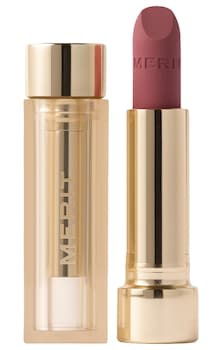
Signature Lip Blush
Ingredients overview
Highlights
Key Ingredients
Other Ingredients
Skim through
MERIT Signature Lip BlushIngredients explained
Probably the most common silicone of all. It is a polymer (created from repeating subunits) molecule and has different molecular weight and thus different viscosity versions from water-light to thick liquid.
As for skincare, it makes the skin silky smooth, creates a subtle gloss and forms a protective barrier (aka occlusive). Also, works well to fill in fine lines and wrinkles and give skin a plump look (of course that is only temporary, but still, it's nice). There are also scar treatment gels out there using dimethicone as their base ingredient. It helps to soften scars and increase their elasticity.
As for hair care, it is a non-volatile silicone meaning that it stays on the hair rather than evaporates from it and smoothes the hair like no other thing. Depending on your hair type, it can be a bit difficult to wash out and might cause some build-up (btw, this is not true to all silicones, only the non-volatile types).
A super common, medium-spreading emollient ester that gives richness to the formula and a mild feel during rubout. It can be a replacement for mineral oil and is often combined with other emollients to achieve different sensorial properties.
 We don't have description for this ingredient yet.
A super common emollient that makes your skin feel nice and smooth. It comes from coconut oil and glycerin, it’s light-textured, clear, odorless and non-greasy. It’s a nice ingredient that just feels good on the skin, is super well tolerated by every skin type and easy to formulate with. No wonder it’s popular.
We don't have description for this ingredient yet.
Kaolin is a type of clay or to be precise, a naturally occurring hydrous aluminum silicate. When you hear clay, you probably think of a muddy greenish-black mess, but that one is bentonite, and this one is a fine, white powder. It is so white that it's also often used, in small amounts, as a helper ingredient to give opacity and whiteness to the cosmetic formulas.
As a clay, it's absorbent and can suck up excess sebum and gunk from your skin, but less so than the more aggressive bentonite. As it's less absorbent, it's also less drying and gentler on the skin, so it's ideal for dry and sensitive skin types.
A natural emulsifier that brings a soft and powdery feel to the formula. It's also very gentle and is recommended for sensitive or baby skin products.
A white, elastomeric silicone powder that gives a nice silky and powdery feel to the products. It also has some oil and sebum absorption capabilities.
We don't have description for this ingredient yet.
You probably know olive oil from the kitchen as a great and healthy option for salad dressing but it's also a great and healthy option to moisturize and nourish the skin, especially if it's on the dry side.
Similar to other emollient plant oils, it's loaded with nourishing fatty acids: oleic is the main component (55-83%), and also contains linoleic (3.5-20%) and palmitic acids (7-20%). It also contains antioxidant polyphenols, tocopherols (types of vitamin E) and carotenoids and it's one of the best plant sources of skin-identical emollient, Squalene.
Overall, a great option for dry skin but less so for acne-prone or damaged skin.
We don't have description for this ingredient yet.
We don't have description for this ingredient yet.
A little helper ingredient that can boost the performance and enhance the delivery of active ingredients in a formula. It can penetrate deep layers of the skin helping actives to do the same.
It's especially useful to help active ingredients for self-tanning (DHA), anti-acne or skin-whitening to penetrate deeper and work better.
We don't have description for this ingredient yet.
We don't have description for this ingredient yet.
We don't have description for this ingredient yet.
- Primary fat-soluble antioxidant in our skin
- Significant photoprotection against UVB rays
- Vit C + Vit E work in synergy and provide great photoprotection
- Has emollient properties
- Easy to formulate, stable and relatively inexpensive
Ci 77891 is the color code of titanium dioxide. It's a white pigment with great color consistency and dispersibility.
Red Iron Oxide is the super common pigment that gives the familiar, "rust" red color. It is also the one that gives the pink tones in your foundation. Chemically speaking, it is iron III oxide (Fe2O3).
Yellow Iron Oxide is the super common inorganic (as in no carbon atom in the molecule) pigment that gives the yellow tones in your foundation. Blended with red and black iron oxides, it is essential in all "flesh-toned" makeup products.
Chemically speaking, it is hydrated iron III oxide and depending on the conditions of manufacture, it can range from a light lemon to an orange-yellow shade.
Black Iron Oxide is the super common inorganic (as in no carbon atom in the molecule) pigment that controls the darkness of your foundation or gives the blackness to your mascara. Blended with red and black iron oxides, it is essential in all "flesh-toned" makeup products.
Chemically speaking, it is a mixture of iron II and iron III oxide. Btw, this guy, unlike the yellow and red pigments, is magnetic.
A cosmetic colorant used as a reddish pigment.
Some version of it is a pH-sensitive dye that enables a colorless lip balm to turn red/pink upon application.
We don't have description for this ingredient yet.
CI 42090 or Blue 1 is a super common synthetic colorant in beauty & food. Used alone, it adds a brilliant smurf-like blue color, combined with Tartrazine, it gives the fifty shades of green.
Ci 19140 or Tartrazine is a super common colorant in skincare, makeup, medicine & food. It’s a synthetic lemon yellow that's used alone or mixed with other colors for special shades.
FDA says it's possible, but rare, to have an allergic-type reaction to a color additive. As an example, it mentions that Ci 19140 may cause itching and hives in some people but the colorant is always labeled so that you can avoid it if you are sensitive.
A super common synthetic colorant that adds a purple-red color - similar to red beet - to a product.
We don't have description for this ingredient yet.
You may also want to take a look at...
| what‑it‑does | emollient |
| irritancy, com. | 0, 1 |
| what‑it‑does | emollient |
| irritancy, com. | 0, 2-4 |
| what‑it‑does | emollient | viscosity controlling |
| what‑it‑does | abrasive/scrub | buffering |
| what‑it‑does | emollient |
| what‑it‑does | viscosity controlling |
| what‑it‑does | colorant | abrasive/scrub |
| irritancy, com. | 0, 0 |
| what‑it‑does | emulsifying |
| irritancy, com. | 0, 4 |
| what‑it‑does | viscosity controlling |
| what‑it‑does | perfuming | viscosity controlling |
| what‑it‑does | antioxidant | emollient |
| irritancy, com. | 0, 0-2 |
| what‑it‑does | viscosity controlling |
| what‑it‑does | solvent | viscosity controlling |
| what‑it‑does | solvent | viscosity controlling |
| what‑it‑does | emollient | emulsifying |
| what‑it‑does | soothing |
| what‑it‑does | antioxidant |
| irritancy, com. | 0-3, 0-3 |
| what‑it‑does | colorant |
| irritancy, com. | 0, 0 |
| what‑it‑does | colorant |
| irritancy, com. | 0, 0 |
| what‑it‑does | colorant |
| irritancy, com. | 0, 0 |
| what‑it‑does | colorant |
| irritancy, com. | 0, 0 |
| what‑it‑does | colorant |
| irritancy, com. | 0, 2 |
| what‑it‑does | colorant |
| irritancy, com. | 0, 1 |
| what‑it‑does | colorant |
| what‑it‑does | colorant |
| what‑it‑does | colorant |
| irritancy, com. | 2, 1 |
| what‑it‑does | colorant |
| irritancy, com. | 0, 3 |